

When a commercial truck breaks down, every minute off the road costs money. Emergency mobile truck repair response time is the critical window between a breakdown call and a qualified technician arriving on-site to get your vehicle moving again.
Key Takeaways
- Response time for mobile diesel repair typically ranges from 45 minutes to 3 hours depending on location, traffic, and provider availability.
- Choosing a provider with geographic coverage across your operating region dramatically cuts wait times.
- Preventative maintenance is the most effective way to reduce the frequency of emergency callouts.
- Fleet operators in Southern California face unique challenges due to freeway congestion and high truck traffic volume.
- Precision Diesel covers Los Angeles County, Orange County, Riverside County, and surrounding areas with 24/7 emergency response.
- DOT and BIT compliance issues are among the leading causes of unexpected roadside stops that trigger emergency repair calls.
Why Response Time Is the Most Expensive Variable in a Breakdown
When a loaded semi-truck sits idle on the shoulder of I-5 or the 91 Freeway, the financial impact compounds fast. According to the American Trucking Associations, truck downtime can cost a fleet anywhere from $448 to over $760 per hour when you factor in driver wages, missed delivery windows, and cargo temperature risk for refrigerated loads.
Response time is not just a convenience metric. It directly determines how long that cost clock runs. A provider that can reach your driver in 60 minutes versus one that takes 3 hours represents a potential difference of over $1,500 in losses per incident.
Several variables affect how quickly a mobile diesel mechanic can reach a stranded vehicle:
- Geographic coverage: Providers with a large service footprint can dispatch the nearest technician faster.
- Fleet size and dispatch systems: Organized providers with multiple service trucks can split coverage zones.
- Time of day: Rush-hour congestion in metro areas like Los Angeles can add 30-60 minutes to any ETA.
- Type of repair needed: A battery swap is faster to prepare for than a fuel system diagnosis.
- Parts inventory on the truck: Technicians who carry OEM and aftermarket parts eliminate wait time for sourcing.
Precision Diesel addresses these variables by operating mobile service trucks stocked with quality OEM and aftermarket parts across Southern California. You can reach their emergency line at (714) 878-2571, also listed as (714) TRUCKS1, available 24/7 for breakdowns, engine failure, and roadside emergencies.
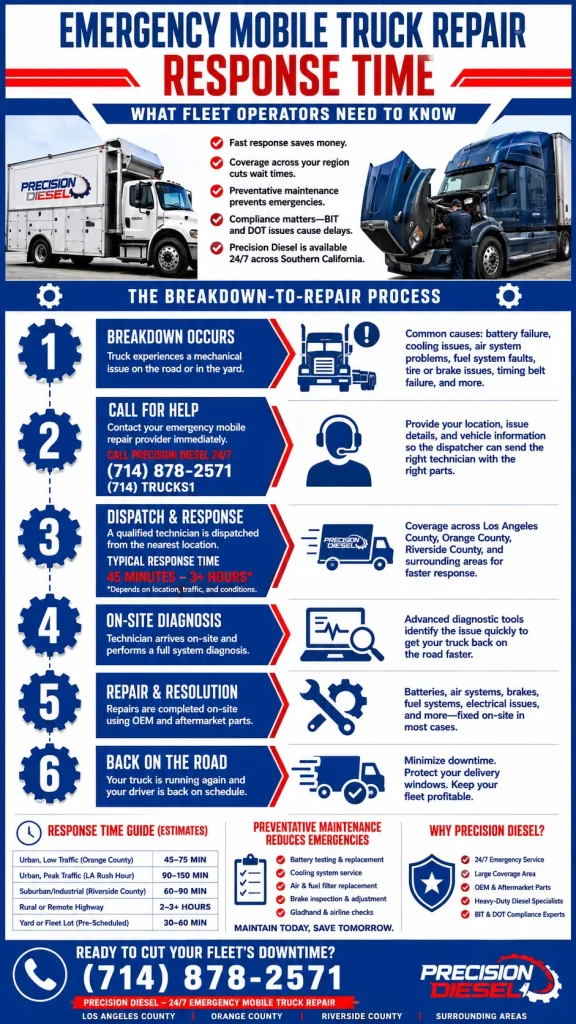
What a Realistic Response Time Looks Like in Southern California
Southern California is one of the most demanding operating environments for commercial fleets in the country. Highways like the I-710, SR-60, and I-15 carry enormous freight volumes daily, and a breakdown in these corridors creates cascading delays for both the driver and nearby traffic.
Here is a breakdown of realistic response time windows based on region and conditions:
| Scenario | Estimated Response Time |
|---|---|
| Urban breakdown, low traffic (e.g., mid-morning in Orange County) | 45-75 minutes |
| Urban breakdown, peak traffic (e.g., LA rush hour on I-405) | 90-150 minutes |
| Suburban/industrial area (e.g., Riverside County logistics park) | 60-90 minutes |
| Rural or remote highway location | 2-3+ hours |
| Yard or fleet lot (pre-scheduled emergency) | 30-60 minutes |
These estimates assume the provider has active coverage in the region. Precision Diesel’s service area spans Los Angeles County, Orange County, Riverside County, and surrounding areas, which puts the majority of Southern California’s commercial freight corridors within their response zone.
The Federal Motor Carrier Safety Administration notes that roadside breakdowns also carry regulatory implications. A vehicle stopped due to mechanical failure during a DOT inspection window can trigger compliance reviews that extend the delay far beyond the repair itself.
The Hidden Causes of Breakdowns That Slow Response
Understanding what causes emergency callouts helps fleet managers reduce their frequency. Many of the most common breakdown causes are preventable, which means the best way to improve your average emergency mobile truck repair response time is to need emergency repairs less often.
The National Highway Traffic Safety Administration (NHTSA) reports that mechanical failures, particularly brake-related and tire-related issues, account for a significant share of commercial vehicle incidents on U.S. highways.
For diesel-powered commercial vehicles, the most frequent emergency triggers include:
- Dead or failing batteries: Group 31 battery failure is one of the most common roadside callouts, particularly in temperature extremes.
- Cooling system failure: Overheating is especially common in Southern California summers where ambient temperatures can push past 105°F.
- Air system and gladhand failures: These affect air brakes and trailer connectivity, causing immediate out-of-service conditions.
- Fuel system problems: Clogged fuel filters, injector issues, and low fuel pressure are frequent culprits.
- Timing belt failure: A failing timing belt on a diesel engine can cause catastrophic engine damage if not caught early. Understanding diesel engine timing belt replacement schedules is a critical part of preventing roadside emergencies.
Reading articles from experienced diesel mechanics can also help fleet managers stay current on emerging failure patterns and maintenance best practices.
How Preventative Maintenance Cuts Emergency Callout Frequency
The most effective strategy for reducing reliance on emergency mobile repair is a structured preventative maintenance program. Fleets that schedule routine service consistently see fewer unexpected breakdowns, lower per-mile repair costs, and better CSA scores with the FMCSA.
For Southern California fleet operators emergency mobile truck repair response time starts long before a breakdown occurs. The relationship between regular maintenance and emergency response time is straightforward: the fewer surprises your trucks encounter, the less often you are racing the clock waiting for a technician.
The guidance on diesel engine maintenance the key to truck owner success in los angeles outlines exactly why consistent upkeep is not optional for high-mileage commercial vehicles operating in urban freight corridors.
Precision Diesel offers scheduled preventative maintenance as a core service, coming directly to your yard or jobsite. This eliminates the shop trip entirely and keeps your fleet visible to technicians who know your vehicles’ history. When those same technicians respond to an emergency, they are not diagnosing blind.
Key preventative maintenance items that directly reduce emergency callouts:
- Regular battery load testing and replacement on schedule
- Coolant flush and radiator inspection every 60,000-100,000 miles
- Air filter and fuel filter replacement per manufacturer guidelines
- Annual brake inspection and adjustment
- Gladhand and airline integrity checks before every DOT inspection cycle
The Mayo Clinic analogy here is apt: just as preventive health care reduces costly emergency room visits, preventive fleet maintenance reduces costly roadside emergencies. The investment in scheduled service pays itself back in avoided downtime costs.
BIT Inspections, DOT Compliance, and Their Connection to Emergency Stops
In California, fleet operators face an additional layer of scrutiny through the Bureau of Investigative Technology (BIT) inspection program administered by the California Highway Patrol. A failed BIT inspection can trigger an out-of-service order, which is effectively an emergency situation requiring immediate repair.
Understanding california bit inspection preparation is essential for any fleet running in Southern California. Many of the violations that cause inspection failures are also the same mechanical issues that cause roadside breakdowns.
Precision Diesel’s technicians are trained to help fleets maintain high CSA scores and can conduct mobile BIT inspections without requiring your trucks to visit a shop. This matters because every shop visit costs time, and time in a shop bay is time your truck is not generating revenue.
The 5 common reasons fleets fail bit inspections in california include issues like brake defects, lighting failures, and tire violations. These are also among the leading causes of emergency roadside callouts. Addressing them proactively through mobile inspection and maintenance keeps your fleet compliant and minimizes the chance of an unplanned emergency repair situation.
Choosing a Provider That Actually Reduces Your Wait Time
Not all mobile diesel repair providers are equal when it comes to response time performance. Here is what to evaluate when selecting a provider for your fleet:
- Service area coverage: Confirm they cover every corridor your trucks operate on, not just a single county.
- Parts availability on the truck: Technicians who carry common parts eliminate the delay of ordering or sourcing.
- 24/7 availability: Freight does not stop at 5 PM. Your emergency provider should not either.
- Specialization in heavy-duty diesel: General mechanics often lack the diagnostic tools and expertise for semi-trucks and commercial trailers.
- FMCSA compliance capability: A provider who understands DOT requirements can help you meet compliance during an emergency stop.
To understand the depth of expertise that matters in diesel repair, it helps to appreciate the history of the technology itself. Reading about when was the first diesel engine made a look back in time gives perspective on how far diesel technology has evolved and why specialized knowledge matters for modern commercial engines.
Precision Diesel checks every box above. Their mobile service trucks cover Southern California’s most active freight regions, they carry OEM and aftermarket parts, and their technicians handle everything from trailer repair and chassis work to computer diagnostics and check engine light troubleshooting.
According to Wikipedia’s overview of diesel engines, modern diesel systems involve sophisticated fuel injection, emissions, and electronic control systems that require purpose-built diagnostic tools, not generic auto shop equipment.
Things to Know
- Response time varies significantly based on traffic conditions. In LA County during peak hours, even a nearby technician may face a 90-minute or longer ETA.
- Mobile repair providers who carry Group 31 batteries, gladhands, and airlines on their service trucks can resolve the most common breakdown types without a parts delay.
- A breakdown near a CHP weigh station may trigger an inspection, turning a simple repair into a compliance situation. Having a provider familiar with FMCSA standards is critical.
- Fleet managers who use a single mobile repair provider for both preventative maintenance and emergency response benefit from technicians who already know their equipment.
- Not all mobile repair providers cover trailer repair. Confirm your provider handles tractor-trailer and semi-trailer repair before signing a service agreement.
- In California, BIT inspection failures can result in out-of-service orders that require immediate repair, making your mobile repair provider’s response time a compliance factor, not just a convenience factor.
Ready to Cut Your Fleet’s Emergency Downtime?
Call Precision Diesel right now at (714) 878-2571 and request emergency mobile service for your vehicle. Whether your truck is stranded on a Southern California freeway or sitting down in your yard with a warning light on, their mobile technicians come to you, fully equipped, and ready to work. Do not wait for downtime to become a financial crisis. Put Precision Diesel’s number in every driver’s phone today.
Frequently Asked Questions
What is a typical emergency mobile truck repair response time in Los Angeles?
In Los Angeles, you can expect a response time of 60 to 150 minutes depending on traffic and the provider’s proximity.
During peak commute hours on freeways like the I-405 or I-10, even a well-positioned technician can face significant delays. Choosing a provider with multiple service trucks in the region improves your odds of a faster response.
Does Precision Diesel offer 24-hour emergency truck repair in Southern California?
Yes, Precision Diesel provides 24/7 roadside emergency repair across Los Angeles County, Orange County, Riverside County, and surrounding areas.
You can reach them at (714) 878-2571 at any hour for engine failure, battery issues, air system failures, and more. Their mobile service trucks are equipped with OEM and aftermarket parts for immediate repairs.
What repairs can a mobile diesel technician actually do on the side of the road?
Mobile diesel technicians can handle battery replacements, fuel system issues, air system repairs, brake adjustments, diagnostic scanning, and minor engine repairs on-site.
For more complex issues like major engine overhauls or frame damage, the truck may need to be towed. However, a well-equipped mobile unit resolves the majority of common breakdown scenarios without needing a shop.
How does preventative maintenance reduce emergency repair callouts?
Scheduled maintenance catches failing components before they cause a roadside breakdown, directly reducing how often you need emergency service.
Routine battery testing, fuel filter changes, brake inspections, and cooling system service address the most common failure points. Fleets on consistent maintenance schedules typically see significantly lower emergency callout frequency.
Will a mobile repair technician help with BIT or DOT compliance during an emergency stop?
Yes, providers like Precision Diesel are trained in FMCSA compliance and can address BIT inspection violations during an emergency callout.
This is critical in California where CHP officers can issue out-of-service orders on the spot. Having a compliance-aware mobile technician on the scene means the repair and the paperwork are handled together.
The Bottom Line on Emergency Mobile Truck Repair Response Time
Emergency mobile truck repair response time is not a fixed number. It is a result of choices you make before the breakdown happens, starting with which provider you have on call, how well your fleet is maintained, and whether your vehicles are in full compliance with DOT and BIT standards. In Southern California’s demanding freight environment, those choices determine whether a breakdown costs you an hour or an entire day.
Precision Diesel has built its operation around minimizing that window for fleet operators across Los Angeles County, Orange County, Riverside County, and beyond. Put their number, (714) 878-2571, in your dispatch system today and schedule a preventative maintenance visit before your next emergency call.
