
Diesel engine timing belt replacement is a critical maintenance task. It directly controls whether your engine’s valves and pistons stay synchronized. Skip it, and you risk catastrophic engine failure. Most diesel engines require timing belt service between 60,000 and 100,000 miles (or 3 to 5 years). However, your specific interval depends on the make, model, and operating conditions.
Key Takeaways
- Timing belt failure in a diesel engine can cause valve-to-piston contact, resulting in engine damage that costs $5,000 to $15,000 or more to repair.
- Replacement intervals typically fall between 60,000 and 100,000 miles (or 3 to 5 years), but heavy-duty commercial use accelerates wear significantly.
- Warning signs include ticking noises, misfires, oil leaks near the belt cover, and visible cracking or fraying on the belt itself.
- Fleet operators in Southern California face additional compliance pressures from CARB regulations, making scheduled maintenance non-negotiable.
- Replacing related components-water pump, tensioner, and idler pulleys, at the same time saves labor costs and reduces future downtime.
- Mobile diesel repair services can perform this work on-site, eliminating the need to pull trucks from service rotation.
Why Diesel Engine Timing Belt Replacement Matters for Your Engine
Inside every diesel engine, the timing belt (or timing chain in some configurations) synchronizes the crankshaft and camshaft rotation. This synchronization ensures that intake and exhaust valves open and close at precisely the right moment. Piston movement must align perfectly with valve operation. When the belt is in good condition, this happens thousands of times per minute without issue.
When the belt fails, the consequences are immediate and severe. In an interference engine, which describes the majority of modern diesel engines, a snapped belt causes the pistons to strike open valves. The result is bent valves, damaged pistons, and often a destroyed cylinder head. Moreover, according to data from the American Trucking Associations, unplanned mechanical breakdowns are one of the top contributors to fleet downtime costs. Timing system failures rank among the most expensive repair categories.
For fleet operators running commercial trucks across Southern California’s dense freeway network, a timing belt failure means more than a repair bill. Additionally, it means a truck sitting on the side of the I-5 or the 710. Your operation faces a missed delivery window and a potential compliance issue if the vehicle is towed to a non-certified facility.
Replacement Intervals: How Often Does Diesel Engine Timing Belt Replacement Actually Need to Happen?
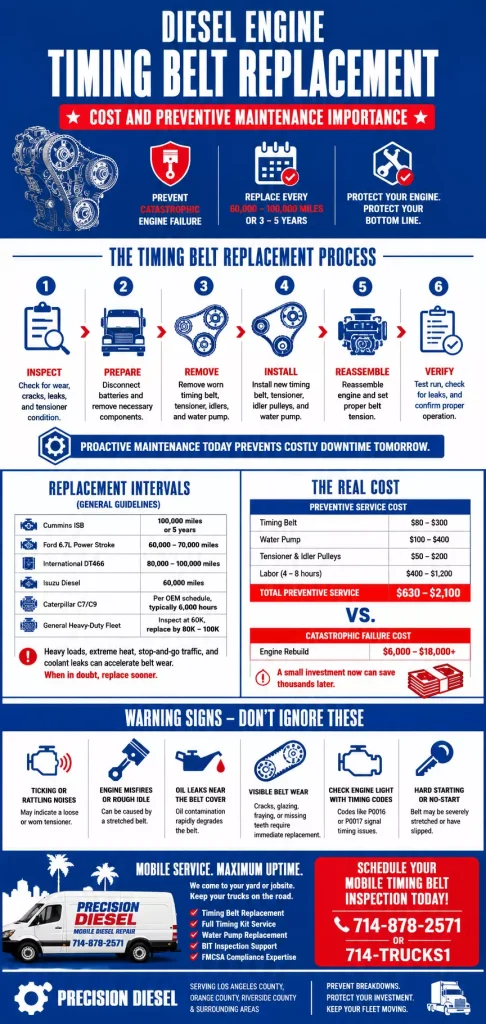
The honest answer is that replacement intervals vary considerably depending on your engine manufacturer, duty cycle, and environmental conditions. Below is a general breakdown across common diesel platforms used in commercial trucking in the United States.
| Engine / Application | Typical Replacement Interval |
|---|---|
| Cummins ISB (mid-range trucks) | 100,000 miles or 5 years |
| Ford 6.7L Power Stroke (medium duty) | 60,000-70,000 miles |
| International DT466 (school/commercial) | 80,000-100,000 miles |
| Isuzu diesel (box trucks, shuttles) | 60,000 miles |
| Caterpillar C7/C9 (heavy equipment) | Per OEM schedule, typically 6,000 hours |
| General heavy-duty fleet use | Inspect at 60K, replace by 80K-100K miles |
Note that these intervals assume normal operating conditions. If your trucks are pulling heavy loads through mountainous terrain, sitting in stop-and-go traffic in Los Angeles County, or operating in extreme heat, all of which are common in Southern California, you should lean toward the shorter end of these ranges.
Coolant contamination accelerates timing belt degradation significantly. Therefore, understanding california bit inspection preparation requirements ensures you’re documenting these considerations properly. If your engine has had any coolant leaks near the front of the motor, get the belt inspected immediately regardless of mileage. Additionally, you can review engine maintenance best practices from the National Institute for Automotive Service Excellence to understand how contamination impacts belt longevity.
The Real Cost of Diesel Engine Timing Belt Replacement
Let’s talk numbers. The cost of a proactive diesel engine timing belt replacement for a commercial truck typically ranges from $500 to $1,500 for parts and labor. This depends on engine type and accessibility. That figure goes up when you add the water pump, tensioner, and idler pulleys. Most experienced mechanics strongly recommend replacing them at the same time since the labor overlap is significant.
Here is a realistic cost breakdown for a typical commercial truck timing belt service:
- Timing belt: $80-$300 (OEM or quality aftermarket)
- Water pump: $100-$400
- Tensioner and idler pulleys: $50-$200
- Labor (4-8 hours at $100-$150/hour): $400-$1,200
- Total preventive service: $630-$2,100
Compare that to the cost of an engine rebuild after catastrophic belt failure. This commonly runs $6,000 to $18,000 depending on the damage. For a fleet owner, that math makes scheduled maintenance an obvious financial decision.
Precision Diesel, a mobile diesel repair provider serving Los Angeles County, Orange County, Riverside County, and surrounding areas in Southern California, performs timing belt replacements on-site. Their work takes place at your yard or jobsite. This approach eliminates the need to pull vehicles from your rotation. You can reach them at (714) 878-2571 or (714) TRUCKS1 for emergency situations.
Warning Signs You Cannot Afford to Ignore
Many fleet operators wait for something to break before scheduling service. With a timing belt, that approach is genuinely dangerous and expensive. Watch for these warning signs:
- Ticking or rattling from the front of the engine: This often indicates a loose or worn tensioner, which puts the belt at immediate risk.
- Engine misfires or rough idle: A stretched belt can cause slight timing variations that disrupt combustion.
- Oil leaks near the timing belt cover: Oil contamination rapidly degrades belt material.
- Visible wear on the belt: Any cracking, glazing, fraying, or missing teeth requires immediate replacement.
- Check engine light with timing-related codes: Codes like P0016 or P0017 point to crankshaft-to-camshaft correlation issues.
- Hard starting or no-start condition: A severely stretched or partially slipped belt will cause the engine to crank without firing.
If your drivers are reporting any of these symptoms, do not defer the inspection. Furthermore, the Mayo Clinic approach to preventive care is a useful analogy here. Catching a small problem before it becomes a systemic one is always the lower-cost, lower-risk path.
For fleet managers who want to stay ahead of these issues, the articles published by Precision Diesel cover a wide range of preventive maintenance topics. These focus specifically on commercial diesel fleets in Southern California.
Fleet Compliance and Diesel Engine Timing Belt Replacement in California
California places heavier regulatory demands on commercial fleets than virtually any other state. The California Highway Patrol’s BIT (Basic Inspection of Terminals) program requires fleet operators to demonstrate documented maintenance practices. This includes scheduled preventive service on all components, not just the obvious ones.
Neglecting timing belt intervals can surface during an inspection as a failure to follow OEM maintenance schedules. This is a red flag for CHP inspectors. If you need help getting your operation inspection-ready, the resource on understanding 5 common reasons fleets fail bit inspections in california from Precision Diesel is an excellent starting point.
It is also worth understanding why fleets get cited in the first place. Incomplete maintenance records, exactly the type of issue that skipped timing belt service creates, are frequently cited violations.
Brake systems are another area of heavy CHP scrutiny. The california truck brake inspection page provides useful context on what inspectors look for. Learn how to stay ahead of violations.
For broader fleet management guidance across the Los Angeles metro area, the los angeles fleet maintenance compliance resource covers the full regulatory landscape. Operators in LA County need this to manage their specific environment.
Choosing the Right Service Provider for Diesel Engine Timing Belt Replacement
Not every diesel repair shop is equipped to handle timing belt work on heavy-duty commercial engines. Additionally, not every provider understands the documentation requirements that California fleet operators face. When evaluating whether your current vendor is meeting your standards, consider the 4 warning signs your fleet deserves a better service provider as a useful checklist.
When evaluating a provider for timing belt service, ask these questions:
- Do they carry OEM or equivalent parts for your specific engine platform?
- Can they document the service in a format compatible with BIT inspection records?
- Do they replace the full timing kit (belt, tensioner, idler, water pump) or just the belt itself?
- Are they mobile, or will your truck need to be towed to a shop?
- What is their response time for emergency service calls?
Precision Diesel operates across Southern California with mobile service trucks that carry quality OEM and aftermarket parts. These range from Group 31 batteries to Glad Hands and airlines. Their FMCSA compliance expertise and BIT inspection support make them a strong fit for fleets. You need both mechanical service and documentation support in one provider. The Federal Motor Carrier Safety Administration’s maintenance regulations outline exactly what carriers must document. Having a service provider who understands those requirements is a real operational advantage.
Things to Know
- Not all diesel engines use a timing belt. Many heavy-duty platforms, including the Detroit DD15, use timing gears or chains. Confirm your engine’s configuration before scheduling service.
- California’s CARB regulations can impact which replacement parts are legal to use on in-state vehicles. Always confirm part compliance with your mechanic before installation. See CARB approved aftermarket parts guidelines for details.
- Timing belt replacement is a labor-intensive job. The front of the engine typically needs significant disassembly, which is why bundling this service with water pump and coolant hose replacement makes financial sense.
- Some fleet operators mistakenly believe that because their truck runs on a timing chain, they have no interval to track. Chains stretch over time and require tensioner inspection at regular intervals.
- Always verify that the technician performing timing belt work has experience with your specific engine model. Incorrect installation or improper tensioning causes premature failure.
- Keep all timing belt service records in your vehicle maintenance file. CHP inspectors can and do request historical maintenance documentation during BIT inspections.
Ready to Schedule Diesel Engine Timing Belt Replacement for Your Fleet?
Contact Precision Diesel directly at (714) 878-2571 and request a mobile timing belt inspection for your fleet. Their team covers Los Angeles County, Orange County, Riverside County, and surrounding areas. They can schedule on-site service at your yard or jobsite so your trucks stay on the road and out of the shop.
Frequently Asked Questions
How do I know if my diesel has a timing belt or a timing chain?
Check your owner’s manual or engine service documentation, or call your dealer with the engine serial number.
Most Cummins, Ford Power Stroke, and International engines in commercial applications use timing gears or chains. Smaller diesel platforms like Isuzu and some European-origin engines use belts. A qualified diesel technician can confirm in minutes.
Can I drive my truck if the timing belt shows signs of wear?
No. A worn timing belt should be treated as an immediate safety and mechanical risk.
Even minor cracking or glazing indicates the belt is approaching the end of its service life. Continued operation risks snapping the belt at highway speed. This causes engine damage that could ground the vehicle for weeks.
Does diesel engine timing belt replacement affect my CSA score?
Not directly, but a breakdown caused by deferred maintenance can lead to out-of-service orders that impact your CSA score.
If a CHP roadside inspection finds a vehicle in poor mechanical condition, violations go directly onto your carrier profile. The cause is neglected scheduled maintenance. Keeping up with timing belt intervals is part of maintaining a strong safety record.
Is it cheaper to replace only the timing belt and skip the water pump?
In the short term, yes, but in most cases it costs more over time.
The labor to access the timing belt typically requires removing the water pump anyway. Skipping the water pump replacement means paying for the same labor again when it fails a year later. Most experienced fleet mechanics recommend replacing the full kit in one service visit.
How long does diesel engine timing belt replacement take on a commercial diesel truck?
Expect 4 to 8 hours of labor depending on the engine and whether additional components are being replaced at the same time.
On engines where the front-end accessory drive is tightly packaged, access to the timing cover takes considerable time. Mobile service providers can perform this work at your facility, but plan for the truck to be out of service for a full shift.
The Bottom Line on Diesel Engine Timing Belt Replacement
Diesel engine timing belt replacement is one of those maintenance tasks where the cost of doing nothing always exceeds the cost of doing it right. A proactive replacement at the recommended interval, paired with a full timing kit service, keeps your trucks running. Your drivers stay safe, and your fleet remains compliant with California’s demanding inspection requirements.
For Southern California fleet operators, Precision Diesel offers the expertise, mobile capability, and compliance knowledge to handle this service. You won’t need to pull your trucks off the road. Call (714) 878-2571 or (714) TRUCKS1 to schedule your inspection today.
