
Trucks operating in Southern California must comply with both federal FMCSA brake standards and California-specific inspection mandates. These requirements are enforced through the BIT (Basic Inspection of Terminals) program. Therefore, understanding Southern California truck brake inspection requirements is critical for fleet safety and legal compliance. Failing to meet these standards puts your drivers at risk. Additionally, violations trigger costly penalties and can pull your vehicles out of service at the worst possible moment.
Key Takeaways
- California’s BIT program requires terminal-level brake inspections on top of federal FMCSA standards, making SoCal compliance stricter than most other states.
- Annual DOT inspections are mandatory, but drivers must perform pre-trip and post-trip brake checks every single operating day.
- Out-of-service violations for brake defects rank among the most common and costly enforcement findings in California.
- Your CSA score takes a direct hit from brake-related violations, affecting your operating authority and insurance rates.
- Mobile diesel mechanics can perform on-site brake inspections, eliminating costly downtime and shop scheduling delays.
- You must retain brake inspection records for at least 14 months under California BIT regulations.
Why Southern California Truck Brake Inspection Requirements Are Strictly Enforced
Southern California is one of the busiest freight corridors in the country. The ports of Los Angeles and Long Beach handle roughly 40% of all containerized imports entering the United States. As a result, tens of thousands of trucks move through the region daily on highways like the I-710, I-15, and SR-60. With that volume comes serious enforcement pressure.
The California Highway Patrol (CHP) enforces brake regulations more aggressively than almost any other state agency. Federal FMCSA rules under 49 CFR Part 393 set the baseline standards. However, California builds on those requirements through its own Commercial Vehicle Safety Alliance (CVSA) inspections and the BIT program administered by the CHP. Brake-related violations consistently rank as one of the top out-of-service categories in roadside inspections across the state.
If your operation runs through Los Angeles County, Orange County, or Riverside County, compliance is not optional. Moreover, understanding these requirements forms the foundation of staying legally operational.
Federal vs. California State Brake Requirements: Understanding the Overlap
Federal FMCSA Rules and What They Require
Federal regulations under 49 CFR Part 393.40 through 393.55 establish specific standards for commercial motor vehicles. Every CMV operating in interstate or intrastate commerce must maintain functioning service brakes, parking brakes, and emergency braking systems. Specific requirements include:
- Brake adjustment: Pushrod travel must stay within defined limits for each brake size. An over-adjusted brake is an automatic out-of-service violation.
- Brake lining thickness: Brake lining or pads must not wear to the point of metal-to-metal contact.
- Air brake systems: Vehicles with air brakes must hold pressure within defined loss rates. They must activate warning devices before pressure drops to dangerous levels.
- Anti-lock Braking Systems (ABS): ABS systems are required on air-braked vehicles manufactured after March 1, 1997.
Drivers must conduct pre-trip and post-trip inspections under 49 CFR 396.13. These inspections include comprehensive brake system checks. Additionally, any defect found must be documented on a Driver Vehicle Inspection Report (DVIR). Repair must occur before the vehicle returns to service.
California’s BIT Program: The Added Layer for Southern California Truck Brake Inspection Requirements
The BIT (Basic Inspection of Terminals) program requires California-based motor carriers to undergo terminal inspections by the CHP. Furthermore, inspections must occur at least once every 25 months. During a BIT inspection, CHP inspectors review maintenance records. They also inspect vehicles in the fleet. Additionally, they verify that brake inspections occur at required intervals and are properly documented.
California requires documented brake adjustments and brake lining inspections. In addition, full brake system checks must happen at scheduled intervals. You must retain records for a minimum of 14 months. Carriers who cannot produce these records during a BIT audit face significant fines and potential suspension of operating authority.
For operators trying to stay ahead of these requirements, reviewing los angeles fleet maintenance compliance protocols provides practical guidance. This resource clarifies what documentation and service intervals CHP inspectors actually look for.
Inspection Intervals: How Often Brake Checks Must Happen
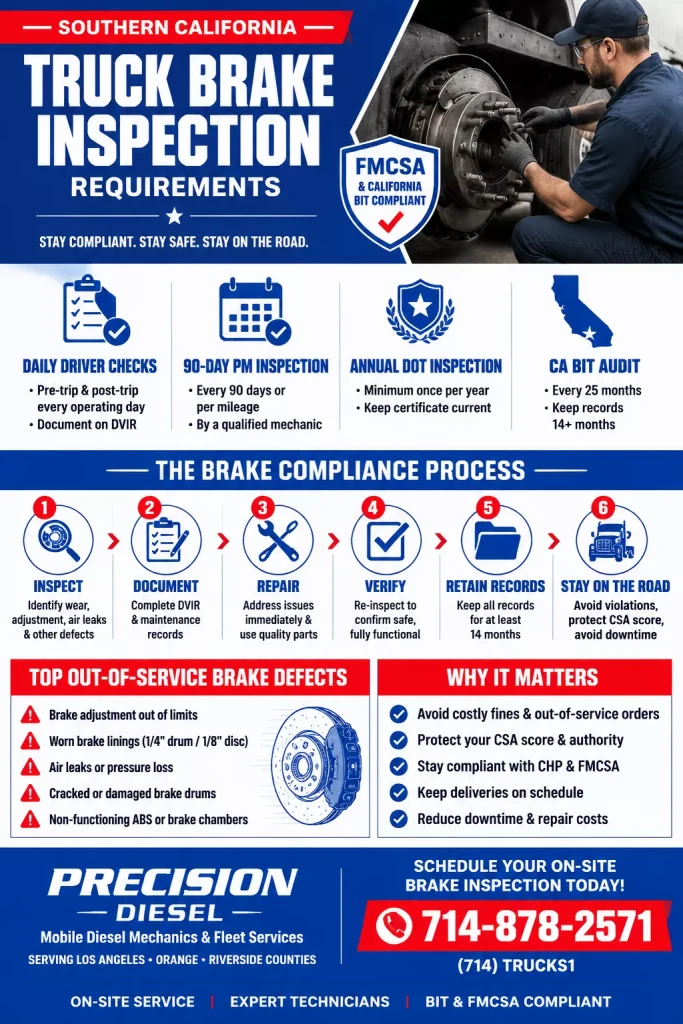
| Inspection Type | Frequency | Who Performs It | Record Required |
|---|---|---|---|
| Pre-trip brake check | Every operating day | Driver | DVIR |
| Post-trip brake check | Every operating day | Driver | DVIR |
| Periodic brake inspection (PMI) | Every 90 days or per mileage | Qualified mechanic | Maintenance record |
| Annual DOT inspection | Once per year minimum | Certified inspector | DOT Form |
| BIT terminal audit | Every 25 months | CHP | All maintenance records |
| CVSA roadside inspection | Random / checkpoint | CHP / enforcement | Inspection report |
The 90-day periodic maintenance inspection is particularly critical in California. During this check, a qualified mechanic must inspect the complete brake system. This includes drums, shoes, linings, slack adjusters, chambers, hoses, and air lines. Automatic slack adjusters do not eliminate the need for this inspection. They simply reduce how often manual re-adjustment becomes necessary.
Common Brake Defects That Trigger Out-of-Service Orders
The Commercial Vehicle Safety Alliance publishes the North American Standard Out-of-Service Criteria that officers use during roadside inspections across California. Brake defects that immediately put a truck out of service include:
- Brake adjustment out of limits on more than 20% of the vehicle’s brakes
- Cracked, loose, broken, or missing brake drums
- Brake lining worn to 1/4 inch or less (for drum brakes) or 1/8 inch (for disc brakes)
- Air leaks detectable by sound or pressure drop tests
- Non-functioning brake chambers
- Missing, damaged, or modified ABS components
Out-of-service orders mean your truck sits until repairs are completed and verified. On a busy SoCal run, this translates directly into missed delivery windows. Furthermore, penalty charges from customers or brokers accumulate quickly.
How Brake Violations Affect Your CSA Score
The FMCSA’s Compliance, Safety, Accountability (CSA) program assigns violation points to carriers based on roadside inspection findings. Brake violations fall under the Vehicle Maintenance BASIC category. In addition, this is one of the most heavily weighted categories in the scoring system.
A single brake adjustment violation adds 8 points to your CSA score. Multiple violations across inspections compound quickly. Moreover, once your percentile rank crosses certain thresholds, you become a priority target for investigations and interventions. In severe cases, the FMCSA can revoke operating authority.
Precision Diesel understands how CSA scores affect a carrier’s bottom line. Their professionals help operators maintain a high CSA score through consistent preventative maintenance and documentation. Therefore, they directly reduce exposure to roadside violations that push percentiles into dangerous territory.
For operators evaluating their current service provider, reviewing 4 warning signs your fleet deserves a better service provider offers a clear checklist. This resource helps you evaluate the quality and reliability of your maintenance partner.
Mobile Brake Inspections: Why On-Site Service Makes Sense for Southern California Truck Brake Inspection Requirements
Getting a truck into a fixed shop in Southern California presents its own logistical challenge. Traffic on the I-710 or I-5 during peak hours can add hours to any route. Additionally, scheduling conflicts at busy shops often mean trucks sit idle rather than generating revenue.
Precision Diesel operates as a mobile diesel mechanic provider across Los Angeles County, Orange County, Riverside County, and surrounding areas. Their technicians come directly to your yard or jobsite. Furthermore, they perform brake inspections, adjustments, and repairs without requiring you to move the vehicle. You can reach them at (714) 878-2571, or by dialing (714) TRUCKS1.
This approach to mobile mechanic fixes proves particularly valuable when a driver’s DVIR flags a brake defect at end of shift. Rather than routing the truck to a shop the following morning and running it in violation, a mobile technician comes to the yard that evening. Additionally, they clear the defect before the next dispatch.
For fleets managing multiple trucks across Southern California, on-site service through commercial fleet maintenance socal keeps vehicles on schedule. Moreover, inspection records remain current without disrupting operations.
Documentation Best Practices for Southern California Truck Brake Inspection Requirements and BIT Compliance
The paperwork side of brake compliance is where many carriers get caught during BIT audits. California CHP inspectors expect organized, complete records. Here is what you need to have in order:
- DVIR logs: Retain all driver vehicle inspection reports for at least 3 months. Additionally, California carriers often retain them longer as part of overall BIT record-keeping.
- Periodic Maintenance Inspection (PMI) records: Each 90-day inspection requires documentation with the date, vehicle ID, mileage, and specific items inspected. Furthermore, records must include findings and the technician’s signature and certification number.
- Repair orders: Any brake repair must connect to either a DVIR defect report or a PMI finding. The repair order should describe the defect, parts replaced, labor performed, and the certifying technician.
- Annual DOT inspection certificates: The inspection sticker must be current and visible on the vehicle. Additionally, underlying documentation must be accessible during a BIT audit.
Precision Diesel provides documentation as part of their service process. Therefore, every brake inspection and repair performed generates the paperwork your BIT audit requires. You can read through their articles for additional guidance on compliance documentation and fleet maintenance best practices.
Brake maintenance connects closely with other preventative maintenance tasks. Issues like low oil pressure or dirty filters often signal broader mechanical neglect. Furthermore, 4 signs your semi trucks oil filter needs immediate attention demonstrates how one ignored maintenance item can cascade into larger compliance problems.
Things to Know
- California’s BIT program applies to intrastate carriers operating within California, not just interstate operators.
- Automatic slack adjusters must still be inspected every 90 days. They do not eliminate the adjustment check requirement.
- A truck can be placed out of service during a roadside inspection even if its annual DOT inspection sticker is current.
- Trailer brakes are subject to the same inspection requirements as tractor brakes. Moreover, many violations come from neglected trailer axles.
- The CHP can conduct unannounced BIT inspections at your terminal, not just at roadside checkpoints.
- Brake inspection records must cover all vehicles in your fleet, including recently acquired units.
Ready to Schedule Your On-Site Brake Inspection?
Contact Precision Diesel directly at (714) 878-2571 and request a mobile brake inspection for your fleet. Their technicians serve Los Angeles County, Orange County, Riverside County, and surrounding areas. Furthermore, they come directly to your yard or job site to perform compliant, documented brake inspections. These inspections satisfy both FMCSA and California BIT requirements. Do not wait for a roadside violation to identify a brake problem that a scheduled inspection would have caught.
Frequently Asked Questions
How often do commercial trucks in California need a full brake inspection?
California requires a periodic brake inspection at least every 90 days as part of the state’s BIT compliance program. Drivers must also conduct brake checks during every pre-trip and post-trip inspection. An annual DOT inspection is required at minimum. However, the 90-day PMI is the standard that CHP auditors look for in maintenance records.
Can a driver be placed out of service for brake violations even if the annual inspection sticker is valid?
Yes. A current annual inspection sticker does not protect a vehicle from an out-of-service order during a roadside inspection if brake defects are found. Roadside inspections evaluate the current condition of the vehicle. They do not rely on its status at the time of its last annual inspection. Wear, adjustment, and damage can develop between annual inspections.
What is the penalty for failing a CHP BIT brake inspection in California?
Carriers can face fines, required corrective action plans, and suspension of operating authority following a failed BIT audit. Individual violations can range from hundreds to thousands of dollars depending on severity. Furthermore, whether the carrier has prior violations on record affects penalties significantly. Repeat violations escalate penalties considerably.
Do trailer brakes get inspected separately from tractor brakes?
Trailer brakes are inspected as part of the same compliance framework and must meet identical standards. Many out-of-service violations in California involve trailer axle brakes specifically. This occurs because trailers are sometimes serviced less frequently than tractors. Proper documentation must cover each trailer individually.
Can a mobile mechanic perform a legally valid brake inspection in California?
Yes, provided the technician holds the appropriate certifications and the inspection is properly documented. Precision Diesel employs qualified technicians who can perform BIT-compliant brake inspections. Additionally, they generate the documentation CHP inspectors require during terminal audits. This occurs all without requiring you to bring the vehicle into a shop.
The Bottom Line on Southern California Truck Brake Inspection Requirements
Meeting Southern California truck brake inspection requirements is an ongoing operational commitment. It is not a one-time box to check. Federal FMCSA rules, California’s BIT program, and aggressive CHP enforcement create a compliance environment where gaps carry real consequences. Therefore, missed inspection intervals carry financial and safety consequences.
Partnering with a mobile service provider like Precision Diesel gives your fleet consistent, documented brake maintenance. Furthermore, services occur at your location, keeping vehicles compliant and CSA scores clean. Call (714) 878-2571 today to schedule your first on-site brake inspection. Additionally, put a proactive maintenance schedule in place before your next BIT audit.