
TL;DR
Implementing a proactive commercial fleet maintenance plan is the single most effective way to eliminate unexpected roadside breakdowns, control high towing costs, and avoid expensive driver downtime in Southern California. Punishing regional driving conditions, ranging from dense port congestion to extreme inland summer heat, place unique stresses on heavy-duty diesel engines, brake systems, and emissions components. Utilizing a dedicated mobile fleet mechanic ensures that minor component wear is caught during scheduled inspections and roadside issues are resolved quickly on-site, keeping regional logistics networks running efficiently and profitably.
Key Takeaways
- Emissions Protection: Continuous low-speed driving and heavy idling require frequent DPF diagnostics and systematic cleaning to avoid sudden engine derate conditions.
- Cooling Integrity: Extreme summer heat along inland shipping corridors demands rigorous cooling system pressure testing to prevent catastrophic engine failure during heavy hill climbs.
- Brake Longevity: Heavy regional traffic wear significantly accelerates friction material degradation, necessitating precise, routine brake adjustments and inspections.
- Mobile Efficiency: Having immediate access to a responsive mobile fleet mechanic eliminates heavy-duty towing expenses and significantly lowers overall vehicle downtime.
- Preventive maintenance costs less than emergency repairs
- DPF issues often show warning signs before complete failure
- Cooling system failures are common during Inland Empire summers
- Brake inspections are critical for mountain grades and heavy loads
- Mobile diesel repair minimizes downtime and towing expenses
- Fleet maintenance planning improves reliability and scheduling
- Regular diagnostics help identify issues before breakdowns occur
- Southern California traffic creates unique wear patterns on commercial vehicles
If there’s one thing every fleet manager, owner-operator, and trucking company in Southern California learns quickly, it’s this: downtime is expensive. A lot of operators end up searching for a diesel mechanic mobile near me when a breakdown hits out of nowhere on routes like the I-5 or SR-91, especially when every minute off the road starts stacking costs fast.
Operating heavy-duty trucks and trailers in Southern California is completely different from running logistics anywhere else in the country. A single delivery route can take an owner-operator or fleet vehicle from the sea-level humidity of the Port of Long Beach straight through the stop-and-go gridlock of the I-710 freeway, before climbing thousands of feet over the Cajon Pass or the Grapevine on the I-5. This intense mix of brutal traffic wear, extreme summer heat in the Inland Empire, and steep elevations creates a punishing environment for diesel engines and trailer components.
A truck sitting on the shoulder of I-5, a trailer stranded near the Port of Long Beach, or a work truck stuck in traffic on SR-91 isn’t making money. Missed deliveries, delayed jobs, frustrated customers, and unexpected repair bills can add up fast. That’s exactly why commercial fleet maintenance Los Angeles matters so much. It’s usually at this point drivers start looking up a diesel mechanic near me because something small has already turned into a road-side problem that can’t wait.
When a heavy-duty truck breaks down on a major Southern California transit node, the consequences multiply instantly. Driver downtime begins accumulating, missed delivery windows trigger costly penalties from distribution centers in Fontana or the City of Industry, and high towing fees eat directly into thin operating margins. Emergency roadside assistance becomes an expensive necessity rather than a planned line item. Staying ahead of these operational disruptions requires a proactive approach centered on structured commercial fleet maintenance.
At Precision Diesel Mobile Heavy-Duty Truck and Trailer Repair, our technicians spend every day helping drivers and fleet operators solve real-world problems before they become major breakdowns. From emergency roadside repairs near the I-405 to scheduled maintenance at distribution centers throughout Orange County and the Inland Empire, we see firsthand how proper Commercial fleet maintenance keeps trucks moving and businesses operating. And in those late-night breakdowns around the Port of Long Beach or deep in the Inland Empire, drivers often need a 24 hour mobile diesel mechanic near me just to avoid waiting hours for a tow.
This guide breaks down the most common fleet issues we encounter across Southern California, what causes them, how to spot warning signs early, and what practical steps can help reduce costly downtime.
The True Cost of Unexpected Fleet Downtime
When a logistics fleet repair issue occurs unexpectedly on a heavily congested route like the SR-91 or I-405, the total expense extends far beyond the invoice for the mechanical fix. The real financial impact is driven by cascading operational delays. A truck stranded near Anaheim during peak morning traffic can easily disrupt an entire regional delivery schedule, leaving trailers sitting idle at warehouse bays and drivers stuck waiting on roadsides instead of moving revenue-generating cargo.
The Cascading Costs of a Breakdown
- Direct Repair Invoice
- Emergency Roadside Assistance Premium
- Heavy-Duty Towing & Recovery Fees
- Driver Downtime Hours (Paid Hourly)
- Missed Delivery Penalties from Distribution Hubs
For companies specializing in construction fleet repair, unexpected downtime can halt progress across an entire jobsite, stalling heavy equipment and leaving labor crews unutilized. Implementing structured preventive measures acts as the primary defense against these unpredictable financial losses, ensuring assets remain operational and project timelines stay on schedule.
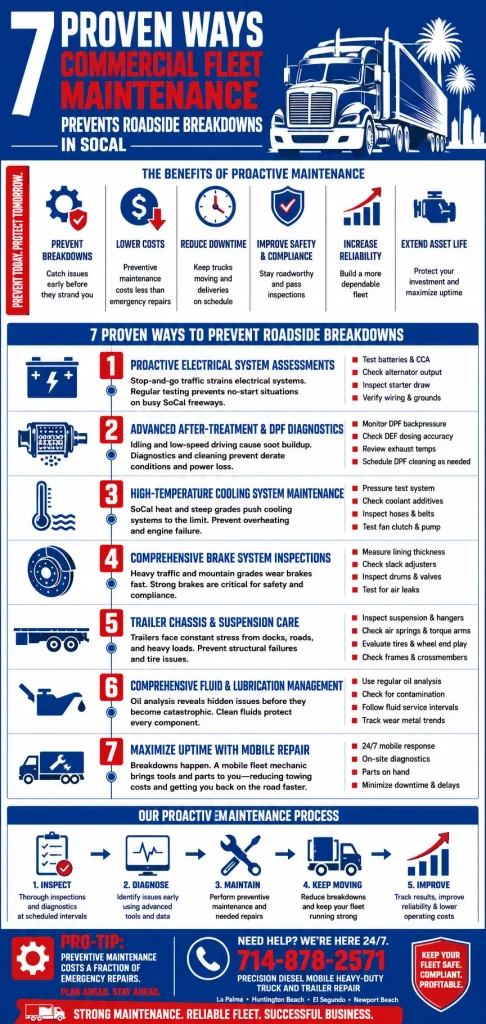
1. Proactive Electrical System Assessments
The relentless stop-and-go traffic conditions found throughout Los Angeles and Orange County place an immense strain on commercial vehicle electrical systems. Alternators rarely have the opportunity to operate at sustained, optimal highway speeds to maintain a steady charge, while electronic logging devices, communication equipment, and cabin climate systems draw continuous power.
Our technicians frequently handle service calls where a truck will not start after spending hours idling near the Port of Los Angeles or waiting in queue at air cargo terminals near LAX. During a standard inspection, our team utilizes specialized diagnostic equipment to evaluate battery health, test alternator output under full load, and check starter draw.
Electrical System Diagnostic Pathway
- Battery Voltage & Cold Cranking Amps (CCA) Test
- Alternator Output & Voltage Regulator Load Evaluation
- Starter Motor Amperage Draw Analysis
- Ground Connection & Wiring Harness Integrity Check
Catching a deteriorating battery or a failing voltage regulator during scheduled shop time prevents the truck from becoming completely immobilized on a chaotic freeway shoulder, protecting the overall efficiency of your trucking fleet repair strategy.
2. Advanced After-Treatment and DPF Diagnostics
Modern diesel emissions systems are highly complex and notoriously sensitive to driving conditions. Extended idling times in industrial micro-zones around Commerce, Norwalk, and Santa Ana prevent diesel particulate filters from reaching the high internal temperatures required to execute a complete passive regeneration cycle. This results in rapid soot accumulation, restricted exhaust flow, and eventually, a sudden engine derate condition that forces the vehicle into a crawl.
DPF Soot Accumulation & Derate Cycle
- Extended Idling / Low-Speed SoCal Traffic
- Exhaust Temperatures Fail to Reach 500°F+
- Unburned Soot Clogs Filter Micro-Channels
- Exhaust Backpressure Rises Exceeding Limits
- ECM Triggers Dash Warning Icons
- Engine Enters Restricted Power “Derate” Mode
To prevent these disruptions, comprehensive maintenance programs must incorporate specialized DPF diagnostics. Our technicians monitor differential pressure sensors, evaluate diesel exhaust fluid dosing accuracy, and track exhaust gas temperatures across the entire system. Identifying restricted soot levels early allows fleet managers to schedule a forced regeneration or arrange for a thorough fleet express dpf cleaning during scheduled downtime, avoiding roadside compliance infractions and keeping vehicles in full operational service.
3. High-Temperature Cooling System Maintenance
Southern California summer temperatures regularly climb past 100 degrees Fahrenheit in inland shipping corridors like Ontario, Fontana, and Pomona. When a fully loaded heavy-duty combination vehicle tackles a grueling hill climb like the Cajon Pass or the Grapevine under these extreme ambient conditions, the cooling system is pushed directly to its engineered limits. Any underlying vulnerability, such as a minor hose weep, a slipping belt, or degraded coolant properties, will rapidly escalate into a catastrophic engine overheat condition.
Regular mechanical oversight ensures that every critical cooling component undergoes thorough testing before seasonal heat waves hit. Our team typically checks coolant additive packages to prevent cylinder liner cavitation, performs system pressure tests to locate hard-to-see leaks, and inspects the structural integrity of radiator cores and fan clutches. Taking these simple steps keeps engines running at safe operating temperatures under heavy cargo loads and high-stress driving conditions.
4. Comprehensive Brake System Inspections
The relentless braking required to safely navigate heavy congestion on local freeways like the I-5 or through the tight surface streets of the South Bay area causes rapid friction material degradation and severe heat generation. This continuous thermal stress can lead to accelerated brake drum cracking, premature shoe wear, and compromised pneumatic valve operation.
When a truck is operating on steep regional descents, fully functioning brakes are the single most critical safety component on the vehicle. Structured commercial vehicle repair routines include precise measurement of brake lining thickness, detailed monitoring of automatic slack adjuster operation, and exhaustive checks for slow pneumatic leaks across the entire tractor and trailer lines. Keeping air brake systems properly calibrated ensures reliable stopping power and helps fleets pass spontaneous roadside commercial vehicle safety inspections without facing costly out-of-service violations.
5. Trailer Chassis and Suspension Care
While the tractor units often command the majority of mechanical attention, trailer reliability is just as vital to maintaining seamless logistics operations. Trailers hauling heavy ocean containers out of the local ports or distribution freight through hubs in Irvine and Ontario experience immense physical stress. Constant backing into tight concrete loading docks, traversing potholed industrial access roads, and carrying maximum payloads can quickly lead to cracked suspension hangers, bent torque arms, and damaged air springs.
Integrating the trailer fleet into regular operational checks prevents minor structural issues from developing into major structural failures on the highway. Technicians systematically inspect slider boxes, evaluate wheel end play, check tire wear patterns for alignment issues, and confirm that all structural crossmembers remain entirely free of stress cracks. Keeping trailers properly maintained ensures they remain completely roadworthy and ready to drop and hook without unexpected mechanical delays.
6. Comprehensive Fluid and Lubrication Management
Oil is the literal lifeblood of a heavy-duty diesel engine, acting as a critical lubricant, a cooling agent, and a vital barrier against internal mechanical friction. In the demanding driving environments of Southern California, engine oil breaks down at an accelerated rate due to prolonged thermal exposure and high engine loads. Regular fluid analysis stands as a cornerstone of advanced fleet maintenance solutions, offering fleet managers a clear window into the internal health of their engines without dismantling a single component.
Fluid Analysis and Diagnostic Insights
| Detected Element | Potential Source |
| Copper / Bronze | Connecting Rod or Main Bearings Wear |
| Chromium / Iron | Cylinder Liner or Piston Ring Friction |
| Glycol / Sodium | Internal Coolant Leak (EGR / Gasket) |
| Fuel Dilution | Leaking Injector / Combustion Issue |
By tracking these microscopic wear metals and identifying early signs of fuel or coolant contamination, our team can pinpoint developing issues before they manifest as catastrophic mechanical failures. Regularly renewing high-quality lubricants across the entire drivetrain protects vital engine components and forms a highly effective roadmap for driving down overall fleet downtime.
7. Maximizing Fleet Uptime Solutions with Mobile Repair
Even with the most rigorous preventative maintenance plan in place, heavy-duty commercial vehicles operate in an unpredictable world. Road hazards, sudden component fatigue, or unexpected sensor failures can still occasionally leave a driver stranded. In these high-pressure situations, having access to rapid, responsive fleet uptime solutions makes the difference between a minor delay and a multi-thousand-dollar logistics disaster.
Utilizing a dedicated mobile fleet mechanic who can respond directly to the breakdown location eliminates the need for expensive heavy-duty towing services and dramatically reduces overall repair turnaround times. A lot of smaller owner-operators start searching for a cheap mobile diesel mechanic near me in that moment, especially when they’re trying to balance repair costs with keeping the load on schedule.
Whether a truck is dealing with a blown air line near Huntington Beach, an electrical failure in El Segundo, or a sudden after-treatment issue in Pasadena, mobile repair units bring advanced diagnostic tools and replacement parts directly to the vehicle. This on-site capability ensures that repairs are performed safely and efficiently right where the truck sits, allowing the driver to get back on the road and complete their delivery with minimal disruption.
Technical Insights: Troubleshooting Common Roadside Symptoms
When a heavy-duty truck begins experiencing mechanical issues on the highway, recognizing the early warning signs allows drivers to take corrective action before a total breakdown occurs. The table below outlines common operational symptoms, their likely underlying causes, and the immediate steps a driver should take to minimize vehicle damage.
| Observed Symptom | Potential Root Cause | Immediate Driver Action |
| Sudden loss of engine power with a flashing DPF icon | Severe exhaust system soot restriction or sensor failure | Safely exit the freeway, find a secure location, and request after-treatment diagnostics |
| Rapidly rising coolant temperature gauge during a steep hill climb | Failing fan clutch, broken serpentine belt, or low coolant level | Safely pull over, let the engine idle to cool down, check for visible leaks, and call for support |
| Loud air exhaust sound when applying the brake pedal | Ruptured brake chamber diaphragm or damaged pneumatic line | Secure the vehicle immediately on a level surface, set the parking brakes, and do not drive |
| Persistent steering wheel vibration or pulling at highway speeds | Uneven front tire wear, loose wheel bearings, or suspension component failure | Reduce travel speed immediately, proceed with high caution to the nearest safe parking area, and inspect the steering axle |
Navigating Local Regulatory and Environmental Demands
Operating commercial diesel vehicles in Southern California involves navigating some of the strictest environmental regulations and challenging driving conditions in North America. Local air quality initiatives place tight restrictions on heavy-duty emissions, making complete compliance a top operational priority for every fleet operator and owner-operator.
- Strict Anti-Idling Regulations: California state law strictly prohibits commercial diesel vehicles from idling for more than five consecutive minutes, especially when parked within residential-adjacent industrial zones or near school boundaries. This rule places an increased emphasis on auxiliary power units (APUs) and electronic control systems, which require routine mechanical checkups to ensure they operate properly without draining main starter batteries.
- Port Access Compliance Protocols: Entering the Port of Los Angeles or Port of Long Beach requires clean truck certification and absolute adherence to strict safety standards. Any visible fluid leaks, frayed air lines, or cracked trailer frames spotted during gate inspections can lead to immediate access denial, causing costly delays for container haulers and logistics operators.
- Corrosive Coastal Environments: Fleet vehicles operating consistently along coastal freight corridors near Newport Beach, Long Beach, and Huntington Beach face constant exposure to salt air. This marine environment accelerates corrosion across exposed electrical wiring harnesses, trailer lighting connectors, and air brake valves, necessitating frequent application of protective dielectric grease and thorough structural cleanings.
Summary of Fleet Support Options
For logistics providers and owner-operators seeking to establish highly reliable operations throughout the region, selecting the right level of mechanical support is critical to long-term profitability. The layout below highlights three core service paths designed to keep commercial vehicles compliant, efficient, and continuously moving forward.
Structured Fleet Maintenance Plan
This comprehensive approach focuses on systematic, mileage-based inspections, customized fluid analysis tracking, and comprehensive bumper-to-bumper preventive maintenance. It is engineered specifically for local businesses looking to maximize total vehicle lifespans, guarantee strict regulatory compliance, and achieve a permanent reduction in unexpected road failures.
On-Demand Commercial Vehicle Repair
A highly responsive mechanical service designed to handle common component wear, after-treatment system issues, and unexpected component failures before they escalate into complete roadside breakdowns. This path provides professional shop-level repairs with flexible scheduling, keeping equipment fully operational without disrupting daily delivery routes.
24/7 Mobile Fleet Mechanic Services
The ultimate emergency response option for active drivers experiencing sudden breakdowns on major Southern California freeways, transit corridors, or distribution hubs. This service dispatches a fully equipped mobile repair unit directly to the vehicle’s location, delivering rapid diagnostic troubleshooting, on-site parts replacement, and immediate assistance to resume travel safely.
Practical Preventative Maintenance Checklist for Drivers
To help drivers and fleet managers stay ahead of unexpected roadside issues, this practical inspection checklist covers the most critical areas that should be evaluated during routine maintenance intervals.
- Emissions and After-Treatment Systems
- Monitor DPF backpressure levels using electronic diagnostic tools to catch early restriction trends.
- Inspect DEF doser nozzles for crystalline buildup that can disrupt proper fluid injection.
- Check exhaust system piping and clamps for any signs of soot leakage or structural cracking.
- Electrical and Starting Systems
- Test individual battery voltage and cleaning terminal connections to prevent high resistance.
- Verify alternator charging output under full electrical load with cabin accessories running.
- Examine starter wiring harnesses for insulation chafing or loose mounting bolts.
- Cooling and Engine Systems
- Pressure test the radiator and cooling lines to uncover hard-to-find pinhole leaks.
- Analyze coolant additive levels to protect cylinder liners from pitting and cavitation.
- Check serpentine belt tensioners and inspect drive belts for dry rot or deep cracking.
- Braking and Suspension Components
- Measure brake lining thickness to ensure friction material remains well within safe limits.
- Verify the operation of automatic slack adjusters and inspect brake drums for heat checking.
- Examine trailer air springs, suspension bushings, and torque arms for physical distortion or damage.
Why Commercial Fleet Maintenance Matters More in Southern California
Southern California presents challenges many fleets elsewhere never experience.
Long hours in stop-and-go Los Angeles traffic. Port drayage work around Long Beach and San Pedro. Distribution center congestion in Fontana and Ontario. Heavy grades through Cajon Pass and the Grapevine. Summer temperatures climbing well above 100 degrees in parts of Riverside County.
All of these conditions accelerate wear on diesel trucks.
A fleet operating between Santa Ana, Anaheim, Long Beach, Irvine, and Los Angeles often accumulates significant engine hours without covering the same mileage seen in other regions. Engines idle longer. Cooling systems work harder. DPF systems regenerate more frequently.
That’s why effective Commercial fleet maintenance isn’t just about changing oil. It’s about preventing failures that disrupt operations.
1. Catch Cooling System Problems Before They Leave You Stranded
One of the most common roadside breakdowns our technicians encounter involves cooling systems.
A truck may seem fine during normal driving. Then it hits heavy traffic near Commerce or Vernon on a hot afternoon and suddenly starts overheating.
Common warning signs include:
- Rising temperature gauge readings
- Coolant leaks under the vehicle
- Low coolant warnings
- Frequent coolant top-offs
- White residue around hoses or fittings
- Heater performance changes
Our technician will typically check:
- Radiator condition
- Coolant levels
- Water pump operation
- Fan clutch performance
- Hose integrity
- Pressure retention
Many overheating events could have been avoided through routine Commercial fleet maintenance inspections.
2. Don’t Ignore DPF Warning Lights
Modern diesel emissions systems are complex.
A small issue today can become a major repair tomorrow.
When drivers report reduced power, frequent regenerations, or dashboard warnings, our team often begins with comprehensive DPF diagnostics and After-treatment diagnostics.
Common signs of DPF trouble include:
Excessive Regeneration Cycles
When a truck starts regenerating more frequently than normal, it’s often an early warning that soot loading is increasing.
Reduced Engine Performance
Restricted exhaust flow can reduce horsepower and fuel efficiency.
Increased Fuel Consumption
Engines working harder due to after-treatment restrictions often burn more fuel.
Fault Codes
Many emissions-related issues trigger fault codes before noticeable drivability problems occur.
For fleets operating around the Port of Los Angeles and Port of Long Beach, extended idle time frequently contributes to DPF-related concerns.
In some cases, fleet express dpf cleaning can help restore performance and prevent larger repairs.
3. Build a Realistic Fleet Maintenance Schedule
One mistake we frequently see is maintenance schedules based solely on mileage.
Mileage matters, but it doesn’t tell the whole story.
A truck operating between Huntington Beach, Carson, and Compton may spend hours in congestion every day.
Engine hours often provide a more accurate picture.
A strong fleet maintenance plan typically includes:
Daily Driver Inspections
Drivers are the first line of defense.
Checking fluid levels, tires, lights, leaks, and warning indicators takes only a few minutes but can prevent expensive failures.
Scheduled Service Intervals
Routine servicing should include:
- Oil changes
- Fuel filter replacement
- Air filter inspections
- Brake inspections
- Battery testing
- Cooling system inspections
Diagnostic Scans
Periodic scans can identify issues before warning lights appear.
This approach is a core part of effective Commercial fleet maintenance.
4. Understand How Traffic Creates Hidden Wear
Southern California traffic is brutal on commercial vehicles.
Anyone driving through Los Angeles County, Orange County, or the South Bay knows that a 20-mile route can take over an hour.
Constant acceleration and braking create wear on:
- Brake components
- Suspension systems
- Steering systems
- Transmission components
- Cooling systems
Our team often sees trucks with relatively low mileage but unusually high wear because they spend most of their time in dense urban traffic.
That’s why Fleet downtime reduction starts with understanding operating conditions, not just mileage numbers.
5. Watch for Brake Problems Before They Become Safety Issues
Brake failures rarely happen without warning.
The signs are usually there.
Drivers should pay attention to:
- Longer stopping distances
- Brake noise
- Pulling during braking
- Air system leaks
- ABS warnings
- Uneven brake wear
These issues become even more important when operating through:
- Cajon Pass
- Ortega Highway
- Grapevine on I-5
Heavy grades place tremendous stress on braking systems.
Routine inspections remain one of the most valuable aspects of Commercial fleet maintenance.
6. Reduce Roadside Breakdowns Through Better Inspections
Many roadside calls stem from issues that could have been identified during pre-trip inspections.
Simple checks matter.
Drivers should regularly inspect:
Tires
Look for:
- Uneven wear
- Sidewall damage
- Embedded debris
- Improper inflation
Lights
DOT compliance depends on functioning lighting systems.
Fluids
Low fluids frequently signal larger problems developing behind the scenes.
Air Systems
Listen for unusual leaks.
Small leaks often become major problems over time.
Strong inspection habits improve Fleet reliability services and support overall operational efficiency.
7. Why Mobile Repair Changes Everything for Fleet Operations
One reason fleets increasingly rely on a mobile fleet mechanic is simple: towing is expensive.
If a truck breaks down near Fontana, Santa Fe Springs, Cerritos, or Lakewood, towing may add significant cost and delay.
Mobile service for trucks often allows repairs to occur:
- At customer locations
- At distribution centers
- At job sites
- At fleet yards
- On approved roadside locations
Instead of waiting hours for transportation to a repair facility, many issues can be diagnosed and repaired on-site.
That’s a major advantage for Fleet operations support.
8. Construction Fleets Face Different Challenges
Construction fleet repair differs from highway trucking.
Equipment and trucks operating around City of Industry, Pomona, Baldwin Park, and West Covina often encounter:
- Dust contamination
- Heavy idling
- PTO usage
- Stop-start operation
- Jobsite debris
These conditions increase wear on:
- Air filtration systems
- Cooling systems
- Hydraulic components
- Suspension systems
A maintenance strategy built for highway trucks may not adequately support construction applications.
9. Logistics Fleets Need Predictability
Distribution networks depend on consistency.
Whether servicing routes around the Ontario logistics corridor, Irvine Spectrum area, or warehouses throughout Fullerton and Garden Grove, reliability matters.
Logistics fleet repair isn’t just about fixing trucks.
It’s about minimizing disruption.
When our technicians respond to service calls, the goal isn’t simply restoring operation. It’s identifying root causes that might affect other vehicles in the fleet as well.
That proactive approach strengthens overall Fleet maintenance solutions.
10. Owner-Operators Need a Different Maintenance Strategy
Many owner-operators delay repairs because they’re trying to avoid costs.
Unfortunately, that often increases costs later.
A coolant leak becomes an overheated engine.
A failed sensor becomes a derate condition.
A minor brake issue becomes a major repair.
Good Owner-operator fleet repair planning focuses on addressing small issues before they become major failures.
The most successful owner-operators usually treat maintenance as an operating expense rather than an emergency expense.
11. Compliance Problems Can Cost More Than Repairs
Fleet compliance isn’t optional.
DOT inspections can expose issues that should have been addressed earlier.
Common compliance concerns include:
- Brake defects
- Lighting failures
- Tire issues
- Air leaks
- Emissions faults
Fleets serving ports, logistics facilities, and regional freight corridors benefit from regular inspections that identify violations before enforcement agencies do.
Proper Commercial fleet maintenance supports both safety and compliance.
For additional compliance information, operators can review resources from Federal Motor Carrier Safety Administration and California Air Resources Board.
12. The Best Fleet Strategy Is Prevention
Every fleet manager wants the same thing.
Predictable operating costs.
Reliable vehicles.
Fewer emergencies.
The strongest Commercial fleet maintenance programs usually include:
- Daily inspections
- Preventive maintenance scheduling
- Regular diagnostics
- Cooling system monitoring
- Brake inspections
- DPF monitoring
- Tire management
- Battery testing
- Record keeping
- Fast-response repair support
- Compliance reviews
- Continuous fleet condition tracking
These practices consistently improve Fleet uptime solutions while reducing unexpected breakdowns.
Keeping Trucks Moving Across Southern California
The reality of fleet operations is simple. Breakdowns will happen. Components wear out. Traffic, heat, steep grades, and long operating hours create challenges that every commercial vehicle eventually faces.
The difference is how quickly those issues are identified and addressed.
A proactive approach to Commercial fleet maintenance helps reduce disruptions, improve safety, extend vehicle life, and keep trucks productive. Whether a fleet operates around Long Beach ports, serves customers throughout Orange County, manages routes through Los Angeles County, or handles deliveries across Riverside County, staying ahead of maintenance issues remains one of the most effective ways to control operating costs.
At Precision Diesel Mobile Heavy-Duty Truck and Trailer Repair, our technicians work with owner-operators, contractors, logistics companies, and fleet managers throughout Southern California every day. From emergency roadside repairs near the I-710 corridor to scheduled maintenance at fleet yards in Anaheim, Huntington Beach, La Palma, Newport Beach, and beyond, our focus remains on helping commercial vehicles return to service safely and efficiently.
Drivers and fleet operators needing assistance can reach our team at 714-878-2571 whenever unexpected issues threaten productivity and uptime. That’s usually the point where most drivers just look for a diesel mechanic mobile near me and try to get someone on-site as fast as possible, especially when they’re stuck near busy freight corridors like Fontana or Santa Ana.
Reliable Fleet Management Support Across Southern California
Maintaining operational consistency in a high-demand logistics market requires a dependable mechanical partner who understands the unique strains of local driving conditions. Precision Diesel Mobile Heavy-Duty Truck and Trailer Repair delivers comprehensive commercial fleet maintenance designed to protect your bottom line, streamline regulatory compliance, and minimize vehicle downtime.
Our team provides extensive expertise across all aspects of fleet management support, logistics fleet repair, and dedicated owner-operator fleet repair. Whether your business requires precise after-treatment diagnostics to clear an engine light, a structured fleet maintenance plan to protect asset longevity, or a highly responsive mobile fleet mechanic to handle an emergency breakdown, our team has the field experience and equipment to get the job done right.
We operate fully equipped diesel shops in La Palma, Huntington Beach, El Segundo, and Newport Beach, allowing us to provide rapid mobile fleet services diesel solutions exactly where you need them. From handling complex electrical issues in Orange County fleet services territories to managing extensive trucking fleet repair tasks on major freight routes, we keep your trucks moving. Contact our team directly at 714-878-2571 to discuss your service needs, schedule your next inspection, or get an experienced technician dispatched to your location today.
Frequently Asked Questions
What are the main causes of sudden commercial vehicle repair needs in SoCal traffic?
The intense stop-and-go congestion found across local freeway corridors accelerates wear on brake linings, places constant stress on engine cooling components, and leads to rapid soot accumulation within emissions components due to excessive idling times.
How often should a logistics fleet repair program include after-treatment diagnostics?
Advanced after-treatment diagnostics should be conducted during every major oil change or preventative maintenance interval, particularly for vehicles that operate frequently at low speeds or spend significant time waiting at local ports and distribution centers.
What are the main benefits of partnering with local Orange County fleet services?
Partnering with local Orange County fleet services ensures rapid response times during roadside emergencies, deep mechanical familiarity with local coastal corrosion issues, and accurate alignment with California’s strict diesel emissions and idling regulations.
When should a driver call a mobile fleet mechanic instead of driving to a shop?
A mobile fleet mechanic should be contacted immediately if the vehicle exhibits symptoms that compromise safety or risk severe engine damage, such as a major pneumatic brake leak, an extreme engine overheat warning, or an active engine derate condition.
How does structured commercial fleet maintenance assist with regional regulatory compliance?
Regular maintenance provides systematic documentation of brake performance, emissions system function, and structural integrity, ensuring that commercial vehicles remain fully compliant with state safety standards and pass roadside inspections without costly out-of-service violations.
How often should commercial fleets receive maintenance inspections?
Inspection frequency depends on mileage, engine hours, operating conditions, and vehicle type. Fleets operating in heavy Southern California traffic often require more frequent inspections than highway-only operations.
What are the most common causes of fleet breakdowns?
Cooling system failures, battery issues, brake problems, tire failures, and emissions-related faults remain among the most common causes of roadside breakdowns.
When should DPF diagnostics be performed?
If drivers notice frequent regenerations, reduced performance, increased fuel consumption, or warning lights, DPF diagnostics should be performed as soon as possible.
Does mobile repair reduce fleet downtime?
Yes. A mobile fleet mechanic can often diagnose and repair issues at the truck’s location, reducing towing expenses and minimizing downtime.
What should be included in a fleet maintenance plan?
A good fleet maintenance plan includes inspections, fluid services, filter replacements, brake checks, tire monitoring, diagnostics, emissions system monitoring, and maintenance record tracking.
How does Commercial fleet maintenance improve profitability?
Preventive maintenance reduces emergency repairs, extends equipment life, improves fuel efficiency, lowers downtime, and helps fleets maintain delivery schedules.
