
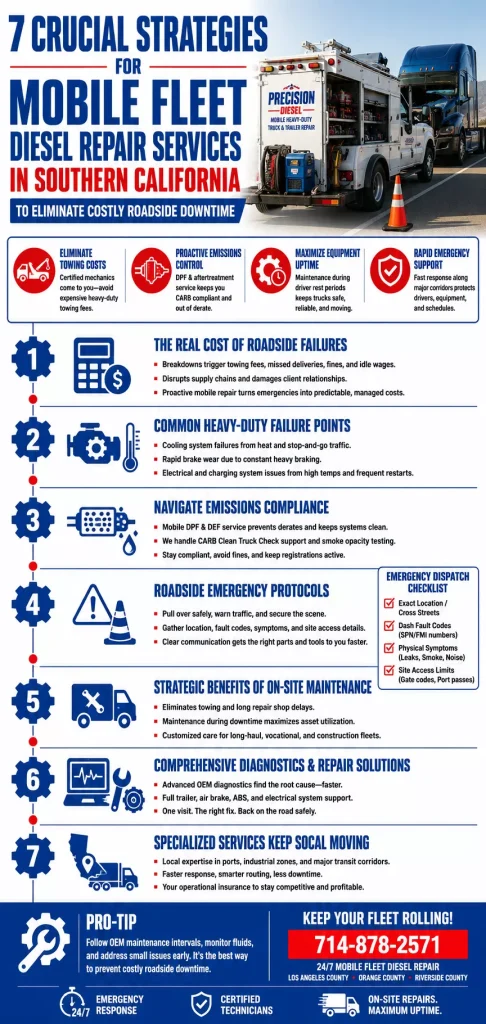
TL;DR
Mobile fleet diesel repair minimizes commercial vehicle downtime by eliminating heavy heavy-duty towing costs and long repair shop delays. On-site diagnostics and repairs keep commercial trucks fully compliant with strict California emissions standards while optimizing fleet utilization.
Key Takeaways
- Eliminate Towing Costs: Bringing certified mechanics directly to the vehicle avoids expensive heavy-duty towing fees and long shop backlogs.
- Proactive Emissions Control: Expert mobile DPF and aftertreatment servicing prevents unexpected engine derates and ensures full compliance with strict CARB regulations.
- Maximize Equipment Uptime: Performing routine maintenance and inspections during standard driver rest periods keeps vehicles safe and moving.
- Rapid Emergency Support: Quick access to specialized roadside assistance along major transit corridors protects drivers, equipment, and tight delivery schedules.
Heavy-duty transportation across Southern California demands absolute mechanical reliability. When a commercial vehicle breaks down on a major corridor, the financial consequences accumulate rapidly. Operating a transport business means navigating intense traffic, strict emissions regulations, and demanding schedules. Securing dependable mobile fleet diesel repair services in Southern California is the most effective way to keep trucks moving and protect thin profit margins.
Unplanned roadside failures interrupt delivery windows and expose logistics companies to steep towing fees and severe regulatory penalties. Managing a regional distribution network or an owner-operator setup requires a clear understanding of mobile maintenance. This comprehensive guide outlines real-world strategies for keeping commercial vehicles operational, minimizing roadside delays, and ensuring full compliance with regional transport regulations.
1. The Real Cost of Commercial Vehicle Roadside Failures
A roadside breakdown involves far more expense than a simple repair bill. When a heavy-duty truck stops on the shoulder of the I-710 near the Port of Long Beach, a complex financial clock begins ticking. Drivers face missed delivery windows, potential freight spoilage, and hefty carrier non-performance fines.
An unexpected failure in stop-and-go freeway traffic often requires emergency dispatch. Finding an immediate mobile diesel mechanic near me open now becomes critical to preventing a minor mechanical defect from escalating into a logistics disaster.
Typical Heavy-Duty Breakdown Cost Accumulation
- Roadside Danger Exposure
- Towing Fees ($500+)
- Missed Delivery Fines ($1,000+)
- Idle Driver Wages
- Missed Delivery Fines ($1,000+)
- Towing Fees ($500+)
Beyond the immediate repair costs, extended downtime damages client relationships. Cargo delayed near the Gateway Cities or stuck on the SR-91 corridor can disrupt supply chains across the region. Relying on reactive maintenance guarantees high operational costs. Partnering with a dedicated team providing on-site fleet diesel repair transforms emergency response into a managed, predictable process.
2. Most Common Heavy-Duty Diesel Failure Points in Southern California
Southern California presents a uniquely challenging environment for commercial vehicles. High ambient temperatures in the Inland Empire combined with heavy stop-and-go traffic create extreme thermal stress. Diesel engines operating under these conditions face predictable mechanical vulnerabilities.
Cooling System Vulnerabilities
Severe traffic congestion on the I-405 or the long climb through the Cajon Pass places immense stress on heavy-duty cooling systems. Radiator caps can fail, hoses split under pressure, and water pumps give out when the engine works hardest.
Our technicians frequently see cooling systems fail because engines run hot for hours in dense traffic. When a truck overheats near Santa Ana or Anaheim, immediate semi truck road service is necessary to prevent catastrophic cylinder head or engine block warping.
Severe Traffic Braking Wear
Constantly stopping and starting a fully loaded big rig on local freeways causes rapid brake degradation. Air brake systems experience high thermal cycles, leading to glazed shoes, cracked drums, and premature air compressor wear.
Regularly checking drum temperatures and brake stroke adjustment helps prevent roadside enforcement violations. If an air lines leaks or a chamber fails near the Commerce business district, a mobile truck repair in Southern California provider must respond quickly to perform safe roadside brake chamber replacements.
Electrical and Charging Failures
Modern commercial trucks depend heavily on complex electrical architectures. High under-hood temperatures degrade wiring harnesses, corrode battery terminals, and accelerate alternator failure.
Starter motors subjected to frequent restarts in staging yards near the Port of Los Angeles experience accelerated wear. When an engine fails to crank at a warehouse terminal in Fontana, dispatching a mobile mechanic near me with advanced diagnostic equipment prevents long delays.
3. Navigating Southern California Commercial Fleet Emissions Compliance
California maintains the strictest diesel emissions standards in the nation. Operating commercial vehicles here requires constant attention to exhaust aftertreatment systems and state regulations.
Managing DPF and DEF System Health
The Diesel Particulate Filter (DPF) and Diesel Exhaust Fluid (DEF) systems require specific operational conditions to function correctly. Extended idling in residential-adjacent industrial zones or prolonged stop-and-go driving prevents the exhaust system from reaching regeneration temperatures.
This causes rapid soot accumulation and forces the engine into a derate condition. Our team handles mobile DPF and DEF system repair directly on-site, using advanced diagnostic software to force regenerations and service faulty SCR sensors without requiring a trip to a traditional shop.
CARB Clean Truck Check Requirements
The California Air Resources Board (CARB) enforces rigorous testing protocols to reduce transport emissions. The Clean Truck Check program mandates regular compliance reporting and emissions testing for nearly all diesel trucks operating in the state.
Failing to meet these standards results in registration blocks and substantial fines. Utilizing comprehensive fleet emissions repair and compliance services ensures every asset remains fully verified. Our technicians provide expert CARB Clean Truck Check support to help fleets pass periodic smoke opacity inspections and maintain clean records.
4. Roadside Emergency Protocols for Heavy-Duty Drivers
When a mechanical failure occurs on a high-speed freeway or a busy logistics corridor, the driver’s initial actions dictate both safety and total repair costs. Following a structured emergency protocol protects the driver, the equipment, and the cargo.
Securing the Vehicle Safely
The moment an engine warning light flashes or air pressure drops, the driver must find a safe location to pull over. If exiting the freeway entirely isn’t possible, parking on a wide, straight section of the shoulder is the next best option.
Drivers should immediately activate hazard lights and properly place reflective triangles within ten minutes of stopping. This visibility is vital on high-traffic routes like the I-5 near downtown Los Angeles or around busy air cargo hubs like Ontario International.
Gathering Critical Diagnostic Data
Before calling for emergency assistance, the driver should gather specific operational data. Note the exact vehicle location, heading, and any active fault codes displayed on the dashboard.
Identifying distinct noises, fluid leaks, or changes in steering feel helps the service coordinator dispatch the right tools. Providing precise details allows a 24 hour mobile diesel mechanic near me to arrive prepared with the exact parts required for the specific issue.
Communicating with Dispatch
Clear communication between the driver, fleet dispatch, and the mobile technician accelerates the recovery process. Relaying structural access restrictions, such as gate protocols at the Long Beach terminals or narrow clearances in industrial parks, ensures the service truck arrives without delay.
Emergency Dispatch Info Checklist
- Exact Location / Cross Streets
- Dash Fault Codes (SPN/FMI numbers)
- Physical Symptoms (Leaks, Smoke, Noise)
- Site Access Limits (Gate codes, Port passes)
5. Strategic Benefits of On-Site Mobile Fleet Maintenance
Transitioning from emergency breakdown response to scheduled, on-site mobile maintenance provides significant operational advantages for commercial operations.
Eliminating Towing Costs and Shop Backlogs
Bringing the repair shop directly to the vehicle eliminates the need for expensive heavy-duty towing. Traditional brick-and-mortar truck repair shops often suffer from deep backlogs, leaving assets stranded for days for basic repairs.
By utilizing mobile diesel repair for commercial fleets, routine maintenance and minor repairs occur at your terminal, warehouse, or jobsite. This avoids shop delays and keeps assets available for scheduled routes.
Maximizing Asset Utilization
Scheduling maintenance during scheduled downtime, such as nights or weekends, ensures high asset availability. Technicians can perform comprehensive semi truck fleet repair services while drivers are off-duty.
Fixing small issues like worn belts, minor air leaks, or aging sensors before they cause a roadside failure dramatically lowers overall operating costs per mile.
Tailored Solutions for Specialized Equipment
Different vocational fleets face distinct mechanical challenges. Over-the-road tractors require meticulous drivetrain and aftertreatment care, while construction assets need rugged hydraulic and chassis support.
Investing in specialized construction fleet diesel repair ensures heavy equipment, dump trucks, and transport trailers receive proper maintenance directly on jobsites across Riverside County and Orange County, preventing project delays.
6. Comprehensive Heavy-Duty Diagnostics and Repair Solutions
Modern diesel trucks are highly complex machines requiring sophisticated tools and extensive technical training to service correctly.
Advanced Fleet Diesel Diagnostics and Repair
The days of troubleshooting diesel engines by ear are long gone. Today’s commercial vehicles feature networked electronic control modules managing everything from injection timing to braking pressures.
Our mobile units carry advanced diagnostic laptops running OEM-level software. This allows our technicians to perform precise fleet diesel diagnostics and repair right on the shoulder or at your yard, reading active faults, verifying sensor outputs, and identifying the root cause of failures quickly.
Advanced Mobile Diagnostic Sequence
- Connect OEM Interface
- Scan Network Modules
- Analyze Live Sensor Data
- Execute Functional Component Tests
- Analyze Live Sensor Data
- Scan Network Modules
Complete Trailer and Air Brake System Service
A roadside failure often involves the trailer rather than the tractor. Broken leaf springs, failed wheel bearings, malfunctioning ABS valves, and slider landing gear problems can ground a load just as fast as an engine failure.
Comprehensive mobile support must include full trailer capabilities. Our teams handle complex air brake adjustments, structural trailer repairs, and light system troubleshooting on-site to keep the entire combination safe and street-legal.
7. How Specialized Mobile Services Keep Southern California Moving
Southern California’s economy depends on fluid logistics. Any interruption in the movement of goods impacts business bottom lines. Specialized mobile fleet diesel repair services in Southern California provide the operational insurance policy that fleet managers and owner-operators need to stay competitive.
Choosing a provider with deep local knowledge makes a major difference. Technicians who understand the unique layout of regional industrial zones, port entry protocols, and common alternate routes can cut response times significantly. This specialized focus ensures heavy-duty assets spend less time stuck on the shoulder and more time generating revenue on the road.
Image Reference and Analysis
To better understand the scale and capabilities of on-site commercial vehicle support, review the deployment configuration of a fully equipped mobile service unit below.
When reviewing this mobile service for commercial trucks setup, notice how the service vehicle positions itself safely behind the disabled semi-truck to provide a protective barrier from passing traffic. A properly equipped mobile repair unit carries an onboard air compressor, heavy-duty diagnostic computers, specialized lifting equipment, and a wide inventory of critical replacement parts. This allows technicians to perform complex mechanical work, from wheel end replacements to advanced engine diagnostics, directly on the roadside or terminal yard without requiring an expensive tow.
Real-World Case Studies: Resolving Southern California Transit Crisis Moments
Case Study 1: Resolving a Port-Bound DPF Derate in Long Beach
A logistics provider operating out of the South Bay area faced an urgent challenge when one of their primary line-haul tractors entered a severe engine derate condition on the I-710, just miles from the Port of Long Beach. The truck was scheduled for a critical container pickup with a strict gate appointment time.
Our mobile technician arrived within 45 minutes and connected specialized diagnostic software to discover a failed exhaust gas pressure sensor had blocked normal DPF regeneration. The technician replaced the faulty sensor from his truck’s stocked inventory and initiated a forced desktop regeneration right on the spot. The truck completed the regeneration cycle and made its scheduled port appointment with minimal delay, saving the company from missed terminal fees and an expensive tow.
Case Study 2: Emergency Air Brake Recovery in the Cajon Pass
During a high-temperature summer afternoon, a loaded tractor-trailer combination traveling down the steep grade of the Cajon Pass experienced an air brake system failure. The driver managed to pull onto an escape shoulder near San Bernardino but was completely stranded due to a ruptured brake chamber that locked up the trailer wheels.
Our emergency team responded directly to the location. The technician safely caged the damaged brake chamber, verified the structural integrity of the mounting brackets, and installed a brand-new type-30/30 long-stroke brake chamber from his service vehicle. After adjusting the slack adjusters and running a full system pressure test, the driver safely completed the descent into the Inland Empire logistics corridor.
Technical Maintenance Specifications for Heavy-Duty Fleets
To maximize vehicle uptime and prevent unexpected roadside failures, fleet operators should maintain strict compliance with standard heavy-duty maintenance intervals. The table below outlines critical service windows based on typical regional operational stress.
| System component | Service Interval (Miles / Hours) | Critical Inspection Points | Regional Stress Factors |
| Engine Lubrication & Filtration | 15,000 – 25,000 Miles | Oil analysis, fuel filter restriction, blow-by verification | High idling times in port staging areas and warehouse queues. |
| Exhaust Aftertreatment (DPF) | 150,000 – 200,000 Miles | Ash load levels, face plugging, SCR doser valve cleanliness | Stop-and-go freeway traffic preventing natural thermal regeneration. |
| Air Brake & Wheel Ends | Monthly / 10,000 Miles | Brake shoe thickness, chamber travel, hub oil levels | Extreme thermal cycling from heavy breaking on steep regional grades. |
| Cooling & Thermal Management | Semi-Annually / 50,000 Miles | Coolant nitrites, hose elasticity, fan clutch engagement | Sustained high ambient temperatures during Inland Empire summers. |
Keeping Your Commercial Fleet Road-Ready and Compliant
Maintaining a productive commercial fleet requires a reliable partner who understands the demands of heavy-duty transportation. Precision Diesel Mobile Heavy-Duty Truck and Trailer Repair delivers comprehensive, on-site mechanical support designed to keep your business moving efficiently. Our team of skilled technicians is fully equipped to handle advanced computer diagnostics, complicated trailer repairs, emergency brake service, and specialized aftertreatment compliance work wherever your truck happens to be.
We provide dependable mobile support across the entire region, serving Los Angeles County, Orange County, and Riverside County. Whether you operate a single big rig or manage a large logistics fleet, our strategically located shops in La Palma, Huntington Beach, El Segundo, and Newport Beach ensure rapid response times when mechanical emergencies arise. For immediate roadside assistance or to schedule regular preventative maintenance at your facility, contact our service team directly at 714-878-2571 to keep your equipment running strong across all of Southern California.
Frequently Asked Questions
What are the primary benefits of using mobile fleet diesel repair services in Southern California over a traditional shop?
Mobile repair services bring certified technicians and advanced diagnostic equipment directly to your vehicle’s location, whether it is broken down on a major freeway shoulder, parked at a shipping terminal, or sitting in your fleet yard. This setup eliminates heavy-duty towing fees, which frequently exceed five hundred dollars, and bypasses the long backlogs common at traditional brick-and-mortar truck repair shops. By completing repairs on-site, companies can schedule maintenance during natural driver downtime, significantly reducing overall operational delays and keeping assets moving.
How do I know if my truck requires an emergency fleet diesel repair service or if it can drive to a shop?
If your vehicle displays a red stop engine light, experiences a sudden drop in air brake system pressure, or shows signs of severe overheating, you must pull over immediately and call for assistance. Attempting to drive a truck with these issues can cause catastrophic internal engine damage or lead to a dangerous brake system failure. For amber warning lights, active fluid leaks, or minor wheel end vibrations, dispatching a mobile technician to address the issue on-site prevents the problem from developing into a hazardous roadside breakdown.
How does mobile DPF and DEF system repair keep my trucks compliant with California laws?
California air quality regulations require strict monitoring of commercial diesel exhaust systems. Extended idling and heavy traffic prevent exhaust systems from reaching the high temperatures needed to burn off accumulated soot naturally, leading to DPF clogging and engine derate modes. Mobile technicians use specialized software to run forced regenerations, clear fault codes, and replace faulty sensors or DEF dosers directly in the field. This service ensures your vehicles pass regular opacity testing and remain fully compliant with CARB standards without needing to visit a physical facility.
What should an owner-operator check before calling for a diesel mechanic near me mobile?
Before placing a service call, note the exact vehicle location, cross streets, or closest highway mile markers. Write down any active fault codes shown on the dashboard display, including the specific SPN and FMI numbers if available. Look for visible signs of trouble, such as fresh fluid puddles under the chassis, unusual exhaust smoke color, or distinct mechanical noises. Providing these specific details helps the service coordinator send a technician stocked with the exact parts and tools needed to resolve your problem on the first visit.
Can big rig fleet maintenance services be performed on-site at our distribution warehouse?
Yes, routine preventative maintenance can be handled effectively through on-site fleet services. Technicians can perform engine oil changes, replace fuel filters, inspect and adjust brake systems, grease chassis points, and troubleshoot electrical systems while your trucks are parked at a warehouse or loading dock. This approach allows fleet managers to maximize equipment utilization during regular driver rest periods, ensuring vehicles are safe and road-ready without interrupting daily delivery schedules.
