

For any fleet manager or owner-operator hauling freight through Southern California, the diesel particulate filter is a frequent source of stress. It is a vital component for keeping your truck running clean, yet it is also a common cause of unexpected roadside breakdowns. Navigating emissions systems can be challenging, especially with strict regulations and the demanding stop and go traffic of major shipping corridors.
When your truck is stuck in derate mode on the shoulder of the Interstate 5 or the Long Beach Freeway, you are losing money every minute. That’s usually when searches like diesel mechanic mobile near me start happening fast because the truck can’t wait. This guide breaks down exactly how to maintain your emissions system, stay compliant with California air regulations, and prevent the costly issues that can sideline your vehicle.
There’s a certain moment every driver recognizes. The truck starts feeling a little off. Maybe it’s a slow climb on the 5 freeway near Commerce, or you’re rolling past Long Beach traffic heading toward the ports and suddenly the power just isn’t there like it used to be.
That’s usually where fleet express dpf cleaning comes into the picture for most of the calls we get at Precision Diesel Mobile Heavy-Duty Truck and Trailer Repair. Drivers don’t always know the exact problem yet, they just know something is clogging up the system and the truck is fighting itself.
And honestly, around Southern California, with stop-and-go freight routes through Los Angeles County, Orange County, and Riverside County, that issue shows up more often than people expect.
So this isn’t theory. This is what our technicians see on the road every week.
We’re going to walk through the real breakdown patterns, what you can actually do before things get worse, and how mobile diesel repair keeps trucks moving instead of sitting in a yard burning hours.
TL;DR
Diesel emissions maintenance is essential for keeping trucks running and staying compliant in California. Regular maintenance prevents costly derate modes and unexpected breakdowns. Working with a mobile specialist ensures your trucks stay on the road and out of the shop.
Key Takeaways
- Routine particulate filter service prevents sudden engine derate and costly roadside calls.
- California regulations require verified testing, making systematic emissions tracking necessary.
- Stop and go traffic near shipping hubs accelerates soot buildup, requiring shorter maintenance intervals.
- Mobile diagnostics and on-site cleaning help minimize downtime for busy fleet operators.
When diesel trucks start losing power on Southern California routes
If you’ve ever been stuck crawling through the 710 near the Port of Los Angeles or inching through Anaheim corridors during delivery hours, you already know how quickly exhaust systems get stressed.
That’s where fleet express dpf cleaning becomes less of a service and more of a save-the-day situation. We see it constantly with fleets running between Santa Ana, Fontana, and the Inland Empire logistics corridors.
The diesel particulate filter (DPF) clogs faster here because trucks don’t always get long highway regeneration cycles. They’re constantly stopping, idling, and restarting.
And once that filter starts loading up… things snowball fast.
Our team at Precision Diesel Mobile Heavy-Duty Truck and Trailer Repair usually gets called after the first warning signs show up, not before. That’s normal. Nobody’s thinking about after-treatment systems while hauling freight through Torrance or waiting at docks in Vernon.
But the truck definitely is.
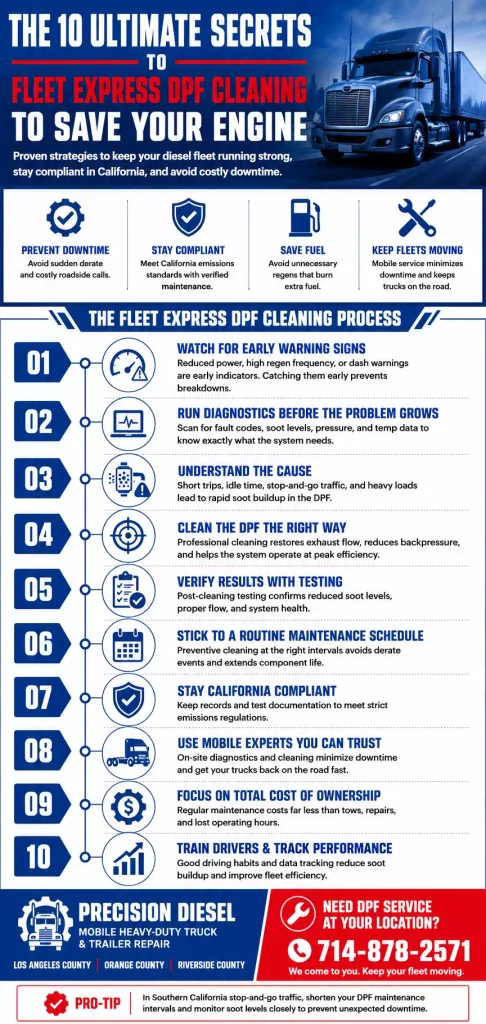
The Reality of Running Diesel Engines in Southern California
Operating heavy duty trucks in the South Bay, the Inland Empire, or across Orange County introduces unique challenges for diesel engines. The sheer volume of traffic on the Interstate 710 and State Route 91 creates a brutal environment for modern after-treatment systems. Modern trucks are engineered to run at sustained high temperatures on the open highway to naturally burn off soot. When your trucks are idling at the Port of Los Angeles or crawling through congestion near Anaheim, the exhaust never reaches the temperatures needed for passive regeneration.
This constant stop and go driving leads to rapid soot accumulation inside the filter. If left unaddressed, this buildup restricts exhaust flow, increases backpressure, and triggers frequent active regenerations that consume extra fuel. Eventually, the system can become overloaded, resulting in a dashboard warning light or an immediate engine derate that leaves your driver stranded.
| Soot Accumulation | Increased Backpressure | Frequent Active Regens | Engine Derate |
Environmental conditions further complicate vehicle maintenance. Summer temperatures in the Inland Empire distribution hubs like Fontana put incredible stress on engine cooling systems, which directly impacts exhaust temperatures. Additionally, navigating steep terrain like the Cajon Pass or the Grapevine under heavy loads forces engines to work harder, generating more soot if the air-fuel mixture is not perfectly balanced. Understanding these factors helps explain why a proactive fleet express dpf cleaning strategy is necessary to prevent minor blockages from turning into major mechanical failures.
7 warning signs your diesel truck is heading toward a breakdown
This is where things get practical. These are the real-world signs we see before a full roadside shutdown happens.
1. Slow acceleration on flat ground
If your truck feels heavy even when empty, that’s often early DPF restriction.
2. Frequent regen cycles
Back-to-back regens are a big red flag.
3. Check engine light that comes and goes
This is where Check engine light diagnostics matter. Don’t ignore it just because it clears itself.
4. Rising exhaust temperature
Especially noticeable on routes like the Cajon Pass or Grapevine climbs.
5. Sudden fuel economy drop
If your MPG falls off fast, something is choking airflow.
6. Limp mode or derate warning
This is where Diesel derate repair becomes urgent, because the truck is protecting itself.
7. Strong diesel smell or excess smoke
Often tied to after-treatment imbalance.
When these start stacking up, drivers usually call for truck dpf cleaning near me, but by then the system is already stressed.
That’s where fleet express dpf cleaning helps prevent a full shutdown instead of reacting to one.
What actually causes DPF problems in SoCal trucking routes
It’s not just mileage. It’s how trucks are used here.
Between Port of Long Beach freight cycles, distribution runs in City of Industry, and constant freeway congestion on the I-405 and I-10, trucks rarely get clean burn cycles.
We also see heat stress from Inland Empire summers. Fontana, Ontario, and Riverside routes push exhaust systems harder than most drivers realize.
Then add:
- Long idle times at loading docks in Santa Fe Springs
- Stop-and-go traffic near Downey and Bellflower
- Grade climbs through the Grapevine
- Short-haul runs between Anaheim and Costa Mesa
It all adds up.
That’s why fleet express dpf cleaning isn’t just maintenance. It’s timing.
How mobile diesel repair actually solves this on the road
When a truck calls in stuck on the 91 freeway or parked near Irvine Spectrum logistics yards, the process is pretty straightforward. In situations like that, drivers often look for a 24 hour mobile diesel mechanic near me just to get someone out there ASAP.
Our technicians typically:
- Run full DPF diagnostics on-site
- Check sensor readings across the after-treatment system
- Inspect DEF quality and dosing
- Evaluate SCR efficiency
- Confirm whether it’s soot load or sensor failure
This is where After-treatment diagnostics matter most, because guessing wrong can waste hours.
If it’s a clog situation, fleet express dpf cleaning is often the fastest reset option before a forced regen or tow becomes necessary.
And yes, sometimes it’s not just the filter. We also handle:
- DEF system repair when dosing issues trigger limp mode
- SCR system repair when NOx levels spike
- Full Diesel emissions repair when multiple faults stack up
A lot of fleets running through Anaheim, Westminster, and Huntington Beach don’t realize how interconnected these systems are until one failure cascades into another.
What a real DPF service call looks like
Let’s say a driver breaks down near Long Beach after leaving the port.
Step one is always safety and scan.
Then our technician checks soot load percentage and backpressure readings.
If it’s recoverable on-site, fleet express dpf cleaning is performed using mobile equipment that restores airflow without needing a shop visit.
If the system is too far gone, we’ll shift to controlled regen support or part replacement depending on damage.
That’s the difference between mobile service and waiting on a tow truck for hours.
And for fleets, downtime isn’t just inconvenient… it’s expensive fast.
That’s why Precision DPF Services are built around field recovery instead of shop dependency.
Where most breakdowns happen in Southern California
You start noticing patterns after enough calls.
We see a lot of issues in:
- Commerce freight corridors
- Vernon industrial zones
- El Segundo airport cargo routes near LAX
- Ontario logistics hubs near I-10 and I-15
- Santa Ana delivery clusters
- Norwalk and Cerritos distribution runs
- Carson port-related haulage routes
- Pasadena and West Covina incline-heavy routes
Each area stresses trucks differently.
For example, port routes near Long Beach often create constant idle cycles, while Inland Empire runs create heat and load stress.
That combination is exactly why fleet express dpf cleaning has become one of the most requested mobile services in the region.
Preventing expensive downtime before it happens
Here’s what actually helps drivers stay ahead of breakdowns:
- Don’t ignore regen frequency changes
- Pay attention to slow throttle response
- Keep DEF tanks clean and properly filled
- Watch fuel economy closely
- Schedule emissions inspections regularly
And if warning signs show up early, calling for truck dpf service near me before a derate happens can save a tow.
A lot of fleets in Orange County now schedule preventive Fleet emissions service runs just to avoid emergency calls.
Because once a truck drops into limp mode on a delivery route through Santa Monica or Inglewood, everything else stops.
Warning Signs That Your After-Treatment System Needs Attention
Your truck usually provides early warnings before entering a full enforcement derate. Recognizing these signs allows you to schedule maintenance before an emergency occurs on the road.
Frequent Manual Regenerations
If your driver reports that the truck constantly requests parked regenerations, the filter is likely reaching its capacity. When a filter becomes packed with unburnable ash, the available surface area for catching soot drops significantly. The engine computer attempts to compensate by initiating more frequent regeneration cycles, wasting fuel and putting excessive heat strain on surrounding components.
Reduced Fuel Economy and Sluggish Performance
A restricted exhaust system acts like a bottleneck for your engine. Our technicians often notice that trucks with neglected filters suffer from a noticeable drop in fuel mileage. If an engine has to fight against high backpressure to push exhaust gases out, it burns more fuel just to maintain highway speeds. Drivers will often complain about a lack of throttle response when pulling away from warehouse docks in Commerce or climbing grades in San Juan Capistrano.
Recurring Dashboard Warning Indicators
The check engine light and the particulate filter status icons are your primary line of defense. Ignoring these warnings will inevitably lead to a standard service shutdown. A yellow warning indicator requires prompt attention, while a flashing light accompanied by a buzzer means the engine computer is about to restrict your horsepower and vehicle speed.
Demystifying the Diesel Derate Process
The diesel derate is a built-in safety mechanism designed to protect the engine and ensure emissions compliance. When sensors detect that exhaust backpressure is too high, or that the selective catalytic reduction system is malfunctioning, the engine control module initiates a multi-stage shutdown procedure.
Our team typically sees this happen in distinct steps:
| Derate Stage | Operational Impact | Driving Experience | Action Required |
| Stage 1: Warning | Solid light on dash | Full power remains available | Schedule shop service soon |
| Stage 2: Power Reduction | 25% horsepower cut | Difficulty maintaining highway speed | Pull over safely or head to a local shop |
| Stage 3: Speed Restriction | Truck restricted to 5 mph | Vehicle crawls, unsafe for highway | Immediate mobile assistance required |
Getting caught in a severe power restriction while passing through high-traffic bottlenecks like the Irvine Spectrum area is dangerous and expensive. Resolving a diesel derate repair on the shoulder of a busy freeway requires specialized diagnostic tools to reset the engine computer parameters after the underlying physical restriction is cleared.
How Professional Particulate Filter Cleaning Works
When a truck is serviced for an emissions issue, a rigorous, step-by-step technical process is required to restore the filter to factory performance levels. A thorough cleaning cannot be achieved with quick chemical flushes or shortcut methods.
Our technician will check the component using a systematic process:
| Visual Inspection | Flow Testing | Pneumatic De-ashing | Thermal Baking | Final Verification |
1. Visual Inspection and Pre-Testing
The process begins by removing the filter from the chassis and performing a detailed internal inspection using high-resolution bore-scopes. Technicians check the face of the ceramic substrate for signs of oil soaking, fuel washing, or physical cracking. If an engine has an internal coolant or oil leak, those fluids will contaminate the filter, baking into a hard glaze that can ruin the element. Next, a pin-gauge test is performed to measure the exact depth of the ash plugs inside the cells.
2. Pneumatic De-Ashing
The filter is placed into an automated pneumatic cleaning cabinet. High-pressure air is directed through the individual cells from the exit side to blow the accumulated ash out through the inlet side. This process removes the loose ash that has built up over hundreds of hours of operation.
3. Thermal Baking
After the initial air cleaning, the filter goes into a computer-controlled kiln for a precise thermal baking cycle. Over several hours, the temperature is raised to carefully burn off any remaining organic soot, turning it into fine ash that can be easily removed. This step requires precise temperature control; heating the filter too quickly can fracture the fragile ceramic core.
4. Final Flash Cleaning and Flow Measurement
Once the filter cools, it undergoes a final pneumatic cleaning cycle to remove the ash freed up during baking. The technician then performs a differential pressure flow test to measure the exact air resistance through the unit. This reading is compared against factory specifications to confirm the component flows like new before reinstalling it on the truck.
The Broader Emissions System: DEF, SCR, and Sensors
While the particulate filter catches physical soot, it is only one part of a complex assembly. A failure in any connected component can trigger an emissions fault and park your vehicle just as quickly as a plugged filter.
DEF System Performance
The diesel exhaust fluid system is sensitive to contamination and temperature variations. The fluid must maintain a precise 32.5% urea concentration to work effectively. Our technicians frequently encounter crusty white urea crystals blocking the injection nozzle, preventing the fluid from atomizing properly into the exhaust stream. When this happens, a def system repair is necessary to clear the physical blockages and restore proper dosing.
SCR System Malfunctions
The selective catalytic reduction catalyst uses the ammonia from the exhaust fluid to convert harmful nitrogen oxides into harmless nitrogen and water vapor. If the catalyst becomes poisoned by poor-fuel quality or unburned engine oil, its efficiency drops below required thresholds, triggering a severe scr system repair code that restricts vehicle operations.
Understanding Sensor Failure
Modern after-treatment systems rely on an array of sensors to monitor performance. Temperature sensors track the heat before and after the catalyst, while differential pressure sensors monitor the soot load inside the filter. Additionally, nitrogen oxide sensors continuously measure upstream and downstream emissions levels. If a single sensor sends inaccurate data or loses communication with the engine computer, the system will enter a protective fault mode, requiring advanced check engine light diagnostics to isolate the bad component.
Staying Ahead of California Air Regulations
Operating commercial vehicles in California requires strict adherence to environmental standards. The California Air Resources Board enforces rules that require continuous vigilance from fleet operators. Failing to maintain your equipment can lead to severe fines and the suspension of your vehicle registrations.
Staying compliant involves understanding the following regulatory pillars:
CARB Clean Truck Check
The CARB Clean Truck Check program requires non-gasoline commercial vehicles with a gross vehicle weight rating over 14,000 pounds operating in California to undergo periodic emissions testing. This program ensures that vehicle emissions control systems are functioning properly throughout the life of the truck. Ensuring your vehicles undergo regular after-treatment diagnostics helps catch hidden faults before they cause an official test failure.
CARB compliance and what drivers actually deal with
California regulations aren’t just paperwork.
Between CARB compliance rules and the CARB Clean Truck Check, fleets running through LA and Riverside counties are under constant emissions monitoring.
When trucks fail roadside inspections or onboard diagnostics, it usually ties back to after-treatment issues.
That’s where Diesel emissions repair becomes not just mechanical work but compliance support.
We’ve seen trucks pass one week and fail the next just because a sensor started drifting out of range.
It doesn’t take much.
Environmental Documentation and Record Keeping
Compliance is not just about clean tailpipes; it requires meticulous record-keeping. Fleet managers must maintain comprehensive service logs showing exactly when filters were inspected, cleaned, or replaced. If enforcement officers audit your fleet at a terminal in Santa Fe Springs or Norwalk, having documented proof of a professional fleet emissions service program protects your business from regulatory liabilities. Maintaining clean, verifiable maintenance records demonstrates a clear commitment to California emissions compliance standards.
Actionable Preventive Maintenance Checklist for Drivers
Drivers are the first line of defense against costly emissions failures. Implementing a daily routine can identify small issues before they escalate into expensive highway emergencies.
Daily Pre-Trip Inspections
During your morning walkaround at the terminal or truck stop, take a moment to look at the exhaust system stack and surrounding components.
- Check the diesel exhaust fluid tank level and look for any white, chalky residue around the filler neck or lines, which indicates a leak.
- Peer under the chassis to check the exhaust piping for loose clamps, fresh soot trails near gaskets, or damaged sensor wiring bundles.
- Turn on the ignition and verify that all dashboard indicator lights cycle properly and turn off after the engine starts.
Smart Driving Practices
Your driving habits directly affect how clean your engine runs. Avoid long periods of unnecessary idling whenever possible. If you are waiting for a load in Fontana or docked in Vernon, use an auxiliary power unit or shut the engine down to prevent wet-nesting, a condition where unburned fuel builds up in the exhaust system due to low combustion temperatures. When on the highway, allow the engine to pull under load at highway speeds to naturally generate the exhaust heat required for clean operation.
Finding Reliable Support When Troubles Arise
When you encounter an emissions fault on the road, you need to know who to call for fast, accurate service. Searching for a generic truck dpf cleaning near me or a truck dpf service near me can return hundreds of results, but you need a partner who understands the urgency of commercial transport. A lot of fleets end up trying cheap mobile diesel mechanic near me options first, but downtime usually costs more than the repair itself.
Precision Diesel Mobile Heavy-Duty Truck and Trailer Repair provides specialized commercial vehicle support across Southern California. This is the kind of situation where people usually end up typing diesel mechanic near me while they are already broken down on the road. Our team focuses on minimizing downtime through advanced mobile diagnostics and precision service options.
Our field technicians handle a wide range of critical field repairs:
- DPF diagnostics using advanced factory-level scan tools to verify exact soot and ash loading.
- Complete diesel emissions repair including sensor replacement and electrical harness tracking.
- Dedicated after-treatment repair to address physical structural failures and cracked filter housings.
- Rapid roadside response to clear computer faults and handle precision dpf services on-site.
Whether your truck is struggling with a failing sensor near Huntington Beach, or a fleet requires comprehensive compliance service at a terminal in La Palma, our experienced team provides clear solutions. We operate across Los Angeles County, Orange County, and Riverside County, ensuring that professional support is always accessible. With key service shops located in El Segundo, Newport Beach, La Palma, and Huntington Beach, our technicians provide fast response times across the entire region.
Mobile response that keeps freight moving
This is where the mobile side really matters.
Precision Diesel Mobile Heavy-Duty Truck and Trailer Repair sends technicians directly to breakdown locations across Southern California. From Laguna Niguel delivery routes to Fontana warehouse clusters, response timing matters as much as the repair itself.
We also support fleets operating near:
- La Palma and Buena Park
- Lake Forest and Mission Viejo
- Redondo Beach and Manhattan Beach routes
- Pomona and Claremont freight corridors
- Gardena, Hawthorne, and Torrance industrial zones
And when drivers call 714-878-2571, it usually starts with one question… “Can you get me moving again today?”
Most of the time, the answer depends on how early the issue is caught.
That’s why fleet express dpf cleaning is often the difference between a roadside repair and a tow yard delay.
Frequently Asked Questions
How often should a commercial truck particulate filter be cleaned?
For typical highway haulers, a deep pneumatic and thermal cleaning is recommended every 150,000 to 200,000 miles. However, if your trucks operate in heavy stop and go traffic around the Port of Long Beach or spend hours idling in warehouse districts, that interval should be shortened to every 100,000 miles or 3,000 engine hours. Regular inspections help identify ash buildup before it restricts exhaust flow.
Can I clear a diesel derate code by simply disconnected the batteries?
No. Modern emissions fault codes are stored in non-volatile memory within the engine control module. Disconnecting the battery terminals will not clear an active enforcement code. The engine computer requires a successful repair confirmation, which often involves a physical component fix followed by a commanded forced regeneration using specialized diagnostic software to prove to the computer that exhaust backpressure has returned to normal parameters.
What is the difference between soot and ash inside a filter?
Soot is unburned carbon particles produced during diesel combustion. It is organic and can be burned off during regular driving or an active parked regeneration cycle. Ash, on the other hand, is the unburnable metallic byproduct of engine oil additives and trace fuel elements. Ash cannot be burned off on the truck; it accumulates permanently over time and can only be removed by removing the filter from the chassis and using specialized pneumatic cleaning equipment and industrial ovens.
Why does my truck keep failing parked regenerations?
A failed parked regeneration usually indicates that the system cannot reach or maintain the high temperatures required to burn off the accumulated soot. This can be caused by a failing hydrocarbon doser injector, malfunctioning exhaust temperature sensors, a defective EGR valve, or a filter that is so heavily packed with ash that there is insufficient airflow to support the regeneration process. Continued operation after a failed regeneration will quickly result in a full engine shutdown.
What is truck DPF cleaning and when do I need it?
It’s removing soot buildup from the diesel particulate filter. You typically need it when regen cycles increase or power drops.
How fast can mobile service respond in SoCal?
In most cases across Los Angeles County and Orange County routes, response depends on traffic but mobile dispatch is built for roadside urgency.
Is DEF system repair always needed with DPF issues?
Not always, but DEF faults often trigger or worsen after-treatment failures, so both systems are checked together.
Can I keep driving with a check engine light on?
Sometimes yes, but if it’s tied to emissions or derate warnings, it can quickly turn into limp mode.
What is SCR system repair in simple terms?
It’s fixing the part of the emissions system that reduces NOx gases after combustion.
Do you handle diesel derate repair on-site?
Yes, if diagnostics show it’s safe and repairable without towing.
Where do mobile repairs usually happen?
Anywhere from ports in Long Beach to Inland Empire logistics yards, including freeway breakdowns across LA and Orange County.
