

What Every Commercial Driver and Fleet Manager Needs to Know
A DOT inspection checklist is the structured set of safety criteria federal and state inspectors use to evaluate whether a commercial motor vehicle is fit to operate on public roads. Knowing exactly what’s on that list, and preparing for it in advance, is the difference between a quick clearance and a costly out-of-service order.
Key Takeaways
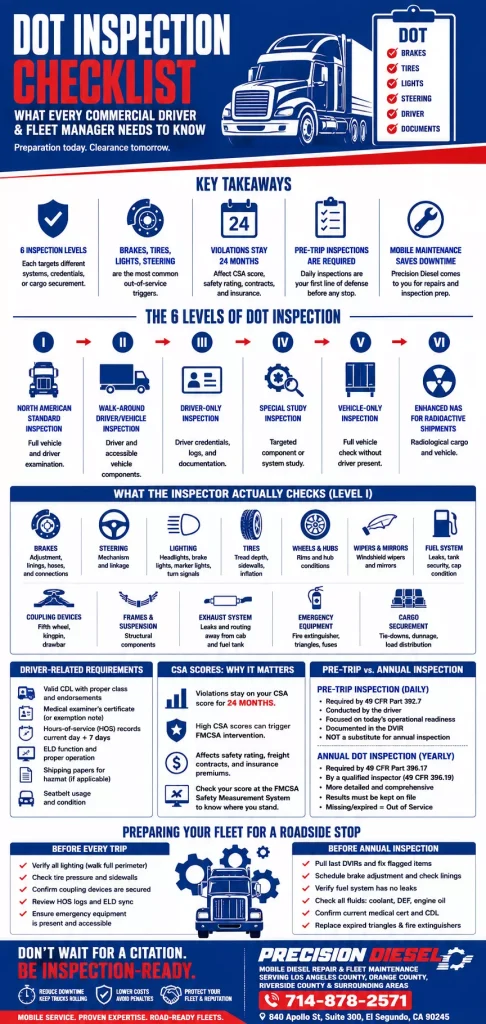
- A DOT inspection covers six inspection levels, each targeting different components of the vehicle, driver credentials, or cargo.
- Brakes, tires, lights, and steering are the most common out-of-service triggers during roadside inspections.
- Violations stay on your CSA score for 24 months and can affect your carrier’s safety rating and insurance premiums.
- Pre-trip inspections performed daily by drivers are your first line of defense against failing a roadside check.
- Mobile maintenance providers like Precision Diesel can handle DOT-required repairs on-site, reducing downtime significantly.
- Annual DOT inspections must be performed by a qualified inspector, but preparation is entirely in your hands.
- A DOT inspection checklist covers six inspection levels, each targeting specific vehicle systems, driver credentials, or cargo securement requirements.
- Brakes, tires, lights, and steering are the most frequent triggers for out-of-service orders at roadside stops.
- Violations recorded during inspections remain on your CSA score for 24 months and can affect your safety rating, freight contracts, and insurance costs.
- Daily pre-trip inspections are legally required and serve as your first line of defense before a formal roadside or annual inspection occurs.
- Annual DOT inspections must be performed by a qualified inspector as defined under 49 CFR Part 396.19 and must be documented and retained on file.
- Mobile maintenance providers like Precision Diesel eliminate the need to take trucks off revenue routes for inspection prep and repairs across Southern California.
Table of Contents
- The Six Levels of DOT Inspection
- What the Inspector Actually Checks
- Brake Systems: The Number-One Out-of-Service Trigger
- Driver-Related Requirements on the Checklist
- How CSA Scores Connect to Inspection Results
- Pre-Trip vs. Annual Inspection: Key Differences
- Preparing Your Fleet for a Roadside Stop
The Six Levels of DOT Inspection
The Federal Motor Carrier Safety Administration (FMCSA) defines six distinct inspection levels, each designed for a specific purpose and situation. Understanding which level applies to your situation helps you focus your preparation accurately.
| Level | Name | What It Covers |
|---|---|---|
| I | North American Standard Inspection | Full vehicle and driver examination |
| II | Walk-Around Driver/Vehicle Inspection | Driver and accessible vehicle components |
| III | Driver-Only Inspection | Driver credentials, logs, and documentation |
| IV | Special Study Inspection | Targeted component or system study |
| V | Vehicle-Only Inspection | Full vehicle check without driver present |
| VI | Enhanced NAS for Radioactive Shipments | Radiological cargo and vehicle |
Level I is the most comprehensive and the one most drivers and fleet managers prepare for. It covers everything from brake adjustment to hours-of-service logs. The FMCSA’s inspection programs page provides the official breakdown of each level and the criteria inspectors use.
What the Inspector Actually Checks
When a Level I inspection takes place, the inspector works through a specific sequence of vehicle systems. Here is what gets evaluated on a standard DOT inspection checklist:
Vehicle Systems Inspected:
- Brakes (adjustment, lining condition, hoses, and connections)
- Steering mechanism and linkage
- Lighting devices and reflectors (headlights, brake lights, marker lights, turn signals)
- Tires (tread depth, sidewall condition, proper inflation)
- Wheels, rims, and hub conditions
- Windshield wipers and mirrors
- Fuel system (leaks, tank security, cap condition)
- Coupling devices (fifth wheel, kingpin, drawbar)
- Frames and suspension components
- Exhaust system (leaks, routing away from the cab and fuel tank)
- Emergency equipment (fire extinguisher, warning triangles, spare fuses)
- Cargo securement (tie-downs, dunnage, load distribution)
Each of these categories has specific thresholds defined in the North American Standard Out-of-Service Criteria, which the Commercial Vehicle Safety Alliance (CVSA) publishes and updates annually. These are the hard limits that determine whether a vehicle stays on the road or gets parked until repairs are made.
Brake Systems: The Number-One Out-of-Service Trigger
Brakes consistently account for a large share of out-of-service violations at roadside inspections across the United States. Inspectors check brake adjustment using a push-rod stroke measurement. If the stroke exceeds the limit set for that brake chamber size, the vehicle can be placed out of service immediately.
Beyond adjustment, inspectors look for:
- Cracked or missing brake drums
- Worn brake linings below minimum thickness
- Leaking air lines or air chambers
- Inoperative anti-lock braking system (ABS) warning lamps on newer vehicles
- Missing or damaged slack adjusters
Automatic slack adjusters do not eliminate the need for maintenance. They compensate for normal lining wear but will not correct a fundamentally worn or improperly installed brake system. Fleet managers in Southern California who operate heavy trucks on routes through the Inland Empire or the ports of Long Beach and Los Angeles know that brake wear accelerates significantly on grades and in stop-and-go freight traffic.
Staying ahead of brake issues is one of the core reasons fleets choose preventive maintenance contracts. Precision Diesel provides mobile brake repair across Orange County, Los Angeles County, and Riverside County, which means a technician comes to your yard or job site rather than pulling a truck off a revenue route.
Driver-Related Requirements on the Checklist
A full DOT inspection does not stop at the vehicle. The driver carries an equal share of responsibility. Inspectors will ask to see and verify:
- A valid Commercial Driver’s License (CDL) appropriate for the vehicle class and endorsements
- Medical examiner’s certificate (or note of exemption on the CDL for applicable states)
- Hours-of-service (HOS) records for the current day and the previous seven days
- Electronic Logging Device (ELD) function and proper operation
- Shipping papers for hazardous materials, if applicable
- Seatbelt usage and condition
Hours-of-service violations are among the most common driver-related citations. The FMCSA hours-of-service regulations set firm limits on driving time, on-duty time, and required rest periods. Drivers who cannot produce a functioning ELD or whose logs show a pattern of violations can expect the inspector to dig deeper into the rest of the inspection.
Driver disqualifications, such as an expired medical certificate or an out-of-jurisdiction CDL suspension, can place the driver out of service even if the truck itself passes every mechanical check.
How CSA Scores Connect to Inspection Results
Every inspection result gets uploaded to the FMCSA’s Safety Measurement System (SMS), where it contributes to your Carrier Safety Assessment (CSA) score. Violations carry point values weighted by severity, and those points stay on your record for 24 months.
High CSA scores in the Unsafe Driving or Vehicle Maintenance Behavioral Analysis Safety Improvement Categories (BASICs) can trigger FMCSA intervention, affect your ability to secure freight contracts, and push your insurance premiums higher. Carriers operating in California also face oversight from the California Highway Patrol’s (CHP) Motor Carrier Safety unit, which runs its own inspection program in addition to federal enforcement.
Reducing your CSA score starts with consistent pre-trip inspections and a documented maintenance program. The FMCSA Safety Measurement System allows carriers to check their current percentile rankings by BASIC category, which helps you understand where your fleet is most exposed.
Pre-Trip vs. Annual Inspection: Key Differences
Many drivers and fleet managers conflate the pre-trip inspection with the annual DOT inspection. They serve different purposes and carry different regulatory weight.
Pre-Trip Inspection:
- Required by 49 CFR Part 392.7 before every trip
- Conducted by the driver
- Focused on operational readiness for that day’s route
- Documented in the Driver Vehicle Inspection Report (DVIR)
- Not a substitute for a formal annual inspection
Annual DOT Inspection (49 CFR Part 396.17):
- Required once every 12 months for every commercial motor vehicle in a fleet
- Must be conducted by a qualified inspector as defined in 49 CFR Part 396.19
- Covers a broader and more detailed set of criteria than a daily pre-trip
- Results must be kept on file and available for roadside inspectors
The 49 CFR Part 396 regulations on vehicle inspection and maintenance define the specific requirements for both. Keeping these records current is not optional. An inspector who finds missing or expired annual inspection stickers has grounds to place the vehicle out of service immediately.
For fleets in Southern California, having a mobile maintenance provider who can perform and document annual inspections at your location removes one more reason for a vehicle to sit idle.
Preparing Your Fleet for a Roadside Stop
Preparation is where most compliance wins or losses happen. A vehicle that is properly maintained and documented will almost always pass a roadside inspection. A vehicle that has been neglected, even if it looks fine from the cab, tends to reveal problems quickly once an inspector gets underneath it.
Here is a practical pre-inspection preparation checklist your drivers and maintenance coordinators can work through:
Before Every Trip:
- Verify all lighting is operational (walk the full vehicle perimeter)
- Check tire pressure and look for sidewall damage or uneven wear
- Confirm coupling devices are properly secured
- Review current hours-of-service logs and ELD sync status
- Ensure emergency equipment is present and accessible
Before Annual Inspection:
- Pull the last DVIR reports and address any flagged items
- Schedule a brake adjustment and lining check
- Verify fuel system has no seeping connections or tank corrosion
- Check all fluid levels including coolant, DEF, and engine oil
- Confirm current medical certificate and CDL are in the vehicle
- Replace any expired emergency triangles or outdated fire extinguishers
Precision Diesel’s mobile fleet maintenance service is built around this kind of systematic preparation. With over 20 years of experience servicing heavy-duty diesel trucks and semi-trucks across Southern California, the team handles everything from brake repairs and DPF filter cleaning to full pre-inspection walkthroughs, all at your location. Reach them at (714) 878-2571 or visit their El Segundo shop at 840 Apollo St, Suite 300, El Segundo, CA 90245.
One area that catches fleets off guard is cargo securement. The North American Cargo Securement Standard requires a specific number of tie-downs based on cargo length and weight, and inspectors know how to spot under-secured loads quickly. The FMCSA cargo securement rules cover everything from working load limits for tie-downs to requirements for blocking and bracing different commodity types.
Southern California fleets carrying construction materials, agricultural products, or industrial equipment through Riverside County should pay particular attention to cargo securement requirements, since these commodities are common on regional routes and represent a frequent source of violations during inspection stops.
Ultimately, the purpose of the DOT inspection checklist is not to catch drivers off guard. It exists because commercial vehicles share highways with millions of passenger cars, and mechanical failures at highway speeds cause catastrophic outcomes. Treating inspections as a benchmark rather than a burden shifts the mindset from reactive to proactive, and that shift pays dividends in reduced downtime, lower insurance costs, and a stronger safety record across your entire operation.
Schedule Your Mobile DOT Inspection Prep in Southern California
Waiting for a roadside stop to find out your fleet has a brake or lighting issue is the most expensive way to manage compliance. Precision Diesel comes directly to your yard, job site, or any location across Los Angeles County, Orange County, Riverside County, and surrounding Southern California areas to handle inspection prep, brake service, DPF cleaning, and full preventive maintenance before problems become violations. Call (714) 878-2571 today and let the Precision Diesel team walk through your fleet so your next inspection is a clearance, not a citation.
Get Your Fleet Inspection-Ready Before the Next Stop
A failed DOT inspection does not just cost you a repair bill. It costs you a parked truck, a CSA point penalty, and potentially a contract. Precision Diesel provides mobile diesel truck and semi-truck maintenance across Los Angeles County, Orange County, Riverside County, and surrounding Southern California areas, coming directly to your yard so your fleet never has to leave to get road-legal. Call Precision Diesel right now at (714) 878-2571 and schedule your mobile inspection prep before the next roadside stop finds the problem first.
Frequently Asked Questions
What is checked on a dot inspection?
A DOT inspection covers vehicle mechanical systems, driver credentials, hours-of-service records, and cargo securement against FMCSA standards.
Inspectors work through brakes, tires, steering, lighting, exhaust, fuel systems, coupling devices, and suspension on the mechanical side. On the driver side, they verify CDL validity, medical certification, ELD compliance, and current hours-of-service logs. Cargo securement is evaluated separately against the North American Cargo Securement Standard, which sets specific tie-down requirements based on load weight and length.
What can fail a dot inspection?
Any condition that meets the North American Standard Out-of-Service Criteria will place the vehicle, the driver, or both out of service on the spot.
Common vehicle failures include brake stroke beyond the legal limit for the chamber size, steering lash exceeding allowable play, tires with less than 2/32-inch tread depth on steering axles, inoperative required lights, and leaking fuel or exhaust systems. On the driver side, an expired CDL, a missing or invalid medical certificate, or hours-of-service log violations are enough to sideline a driver even if the truck itself passes every mechanical check. Cargo securement violations, such as insufficient tie-downs or improper blocking, are also a frequent source of citations.
Where can I find a printable pre-trip inspection checklist for truckers?
The FMCSA and CVSA both publish official inspection forms and driver vehicle inspection report templates that drivers and fleet managers can download and print at no cost.
The CVSA publishes the North American Standard Inspection Procedure documents on its website at cvsa.org, which include the out-of-service criteria and inspection forms used by roadside inspectors. The FMCSA also provides guidance documents and sample Driver Vehicle Inspection Report formats through its official regulations page. Your state’s motor carrier safety division, in California that is the CHP Commercial Vehicle Section, may also have state-specific forms that align with federal standards.
Can I do my own dot annual inspection?
A driver or fleet owner cannot conduct their own annual DOT inspection unless they meet the specific qualifications defined under 49 CFR Part 396.19.
The regulation requires the inspector to have knowledge and experience with the methods, procedures, tools, and equipment used in commercial vehicle inspection, as well as familiarity with the criteria in Appendix G to Subchapter B of 49 CFR. In practice, this means the inspector must be able to demonstrate that they are qualified, typically through training records, certification, or documented work experience. A fleet owner who happens to be a qualified mechanic with the appropriate background can inspect their own vehicles, but the documentation must support that qualification. For most carriers, using a third-party qualified inspector or a certified mobile maintenance provider is the safer path for audit purposes.
How much do dot annual inspections cost?
The cost of a DOT annual inspection in the United States varies depending on your region, the type of vehicle, and whether the inspection is performed at a shop or by a mobile provider.
Inspections at fixed shops can range from under $100 for a basic tractor inspection to several hundred dollars for a full tractor-trailer combination, depending on local labor rates and the depth of the inspection. Mobile inspection services often carry a service call fee on top of the inspection cost, though that cost is frequently offset by the savings from not repositioning a truck. In Southern California, where shop labor rates and operating costs are higher than the national average, budgeting accordingly is practical. Precision Diesel offers mobile DOT inspection preparation and related services across Orange County, Los Angeles County, and Riverside County. Call (714) 878-2571 for current pricing and availability.
The Bottom Line on the DOT Inspection Checklist
Running a commercial fleet in Southern California means operating in one of the most heavily regulated freight environments in the country. The DOT inspection checklist exists to enforce the standards that keep commercial vehicles safe for drivers and the public alike, and the carriers who treat those standards as a baseline rather than a ceiling consistently outperform those who treat compliance as an afterthought. Pre-trip diligence, documented maintenance history, and qualified annual inspections are not optional overhead costs. They are the foundation of a fleet operation that stays on the road and out of trouble.
If your fleet is due for an annual inspection, overdue on brake service, or simply needs a qualified set of eyes before the next roadside stop, Precision Diesel is ready to come to you. Serving Los Angeles County, Orange County, Riverside County, and surrounding areas with mobile diesel repair and fleet maintenance backed by over 20 years of experience, the team at Precision Diesel can be reached at (714) 878-2571 or at their El Segundo location at 840 Apollo St, Suite 300, El Segundo, CA 90245. Schedule your mobile service call today and make sure your fleet is ready before an inspector is.
