

Trucks fail DOT inspections most often because of brake system defects, tire problems, and lighting failures, which together account for more than 75% of all out-of-service orders issued by FMCSA-certified inspectors. During the 2025 CVSA International Roadcheck, 22.6% of commercial motor vehicles inspected were placed out of service, meaning roughly 1 in 5 trucks failed on the spot. Knowing exactly which violations trigger these outcomes lets you correct them before an inspector does.
Key Takeaways
- Brake defects are the single most common reason trucks fail DOT inspections, consistently leading FMCSA violation charts year after year.
- Brakes, tires, and lighting combined account for more than 75% of all out-of-service orders issued at roadside inspections.
- During the 2025 CVSA International Roadcheck, 22.6% of trucks were placed out of service, shutting down 10,148 vehicles within 72 hours.
- Hours-of-service violations are the leading driver-side cause of inspection failures, accounting for 32.4% of driver out-of-service orders.
- An out-of-service violation can trigger fines up to $19,277 per occurrence and raise insurance premiums by 10 to 30%.
- DOT inspection violations remain on your CSA record for 24 months, affecting BASIC scores, audit likelihood, and shipper relationships throughout that period.
What Are the Most Common Reasons Trucks Fail DOT Inspections?
DOT inspection failures fall into two broad categories: vehicle mechanical defects and driver or documentation violations. The Federal Motor Carrier Safety Administration (FMCSA) tracks every violation through its Compliance, Safety, Accountability (CSA) program, and the ranking of top violations has remained remarkably stable for years. Brakes, tires, lights, suspension, cargo securement, hours-of-service records, fuel system integrity, steering, hazmat documentation, and incomplete DVIRs make up the 10 reasons covered in detail below.
Understanding each category gives you a concrete checklist to run before every dispatch. A single preventable defect can sideline your truck, damage your CSA score, and cost thousands of dollars in fines and lost revenue.
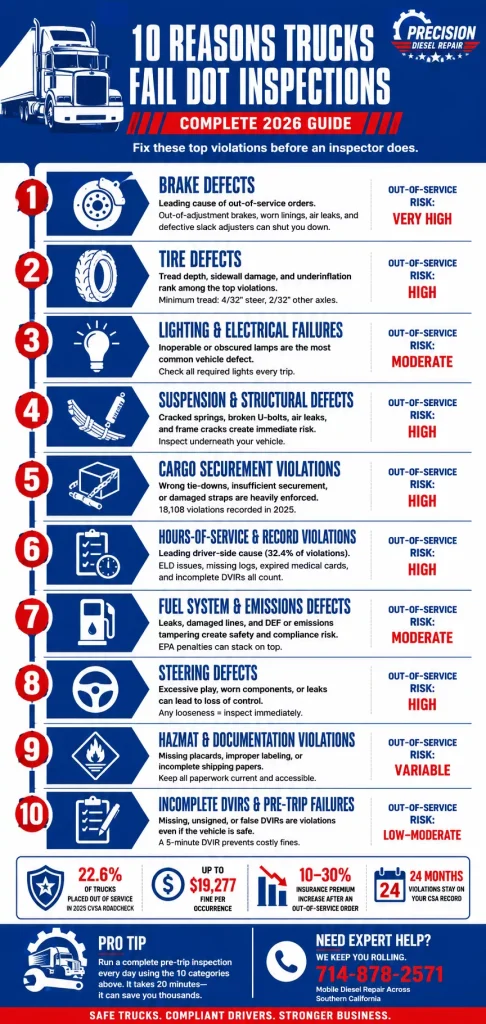
Reason 1: Why Do Brake Defects Lead to the Most Out-of-Service Orders?
Brake system defects are the leading cause of out-of-service orders in FMCSA data, flagging vehicles for worn pads, air leaks, poor adjustment, and defective automatic slack adjusters. Inspectors evaluate every brake component on each axle, and a single axle with brakes out of adjustment can trigger the 20% defective brake rule, putting your entire rig out of service immediately.
Common brake violations inspectors cite include:
- Brake out of adjustment (pushrod travel exceeding limits)
- Worn or cracked brake linings
- Air or hydraulic leaks in brake hoses or tubing
- Chafing, kinking, or deteriorated brake hoses
- Defective or inoperative automatic slack adjusters
- Broken or missing brake components
One documented example from roadside data shows a truck failing inspection at mile 48,200 after a full brake service, because 3 of 10 brakes exceeded pushrod travel limits. That scenario illustrates exactly why post-maintenance verification matters as much as the maintenance itself.
The key point is: brake inspections go axle by axle, and one defective axle can fail your entire vehicle.
Reason 2: How Do Tire Defects Cause DOT Inspection Failures?
Tire defects rank among the top three vehicle violations in every annual FMCSA reporting cycle, covering tread depth, sidewall integrity, load ratings, and proper inflation. Inspectors check whether your tires meet the minimum tread depth of 4/32 inch on steer axles and 2/32 inch on other axles, and they look for any condition that compromises structural integrity.
The most frequently cited tire violations include:
- Tread worn below DOT minimum standards
- Sidewall damage, bulges, or cuts exposing cords
- Underinflation or overinflation relative to load rating
- Tires not rated for the load being carried
- Loose, missing, or mismatched wheel fasteners
- Regrooved tires on steer axles (prohibited)
Underinflation is particularly common because it is not visible to the naked eye without a gauge. A tire that looks acceptable can still be 20 to 30 PSI below its rated pressure, creating a blowout risk and an automatic violation.
The bottom line is: carry a calibrated tire pressure gauge on every trip and verify inflation against the load rating, not just the sidewall maximum.
Reason 3: Why Are Lighting and Electrical Failures So Frequently Cited?
Lighting violations are the most administratively simple failures to prevent, yet inoperable required lamps are the single most common vehicle defect found during roadside inspections. Inspectors check every required lamp: headlights, taillights, brake lights, turn signals, clearance lamps, identification lamps, side marker lamps, and hazard flashers.
Texas Department of Public Safety data from May 2025 listed four distinct lighting violations among the top 25 commercial violations, including:
- Inoperable identification lamps
- Inoperable turn signal lamps
- Inoperable side marker lamps
- Inoperable or obscured stop lamps
A burned-out marker lamp costs under $10 to replace but generates a violation that goes directly onto your CSA record. Inspectors are not required to give you time to fix it on the spot. Conducting a full walk-around lamp check before each trip, including with a second person in the cab activating signals and brakes, catches these issues in minutes.
The key point is: lighting defects are the easiest violations to prevent and among the most frequently cited, making a daily pre-trip lamp check non-negotiable.
Reason 4: What Suspension and Structural Defects Trigger Out-of-Service Orders?
Suspension system defects are violations involving components that support vehicle weight, maintain directional stability, and distribute load forces across all axles. When suspension fails, vehicle handling degrades in ways that are immediately dangerous, which is why FMCSA treats many suspension defects as automatic out-of-service conditions.
Inspectors look for the following suspension violations:
- Cracked, broken, or missing leaf springs
- Broken U-bolts or axle positioning parts
- Worn or deteriorated rubber bushings
- Damaged torque arms or radius rods
- Air bag suspension leaks or damage
- Frame cracks, breaks, or unauthorized modifications
Structural frame defects fall under the same inspection category. A cracked frame rail or a weld repair done without proper engineering documentation can pull your truck out of service regardless of how the rest of the vehicle looks.
The bottom line is: suspension and frame inspections require a creeper and a flashlight, not just a walk-around, because the most serious defects are only visible from underneath the vehicle.
Reason 5: How Do Cargo Securement Violations Lead to Inspection Failures?
Cargo securement violations occur when loads are not restrained in compliance with FMCSA regulations at 49 CFR Part 393, Subpart I, which specifies the number of tie-downs, working load limits, and securement methods for each cargo type. CVSA data recorded 18,108 cargo securement violations in 2025 alone, making it one of the most active enforcement categories.
The most common cargo securement deficiencies include:
- Insufficient number of tie-downs for cargo length and weight
- Tie-downs with working load limits below the required aggregate
- Damaged, frayed, or improperly attached straps and chains
- No edge protection where tie-downs contact cargo
- Unsecured or improperly braced headerboards and bulkheads
- Overweight conditions exceeding gross vehicle weight ratings
Cargo securement rules are commodity-specific, meaning lumber, steel coils, logs, and automobiles each have their own securement standards. Operating with a load type you are unfamiliar with without reviewing the applicable FMCSA securement table is a common source of preventable violations.
The key point is: cargo securement compliance depends on knowing the specific rules for each load type, not just applying generic tie-down counts.
Reason 6: Why Do Hours-of-Service and Record Violations Shut Drivers Down?
Hours-of-service (HOS) violations are the leading driver-side cause of out-of-service orders, accounting for 32.4% of driver violations in FMCSA enforcement data, followed by operating without a valid CDL at 24.4% and missing medical certificates at 14.9%. Inspectors review ELD records, paper logs where applicable, supporting documents, and driver qualification files during any Level 1 inspection.
Common HOS and documentation violations include:
- Exceeding the 11-hour driving limit or 14-hour on-duty window
- Insufficient off-duty time between shifts
- ELD malfunctions with no compliant backup log
- Failure to transfer ELD data to an inspector upon request
- Incomplete or unsigned driver vehicle inspection reports (DVIRs)
- Expired or missing medical examiner’s certificate
- CDL not valid for the vehicle class or endorsement required
False logs and incomplete DVIRs are treated as separate violations from the underlying HOS offense, meaning one bad record-keeping decision can generate multiple CSA points from a single inspection. Maintaining accurate electronic logs and keeping all qualification documents current in the cab is the only compliant approach.
The bottom line is: an inspector can place your driver out of service without touching the vehicle if the paperwork is out of order.
Reason 7: What Fuel System and Emissions Defects Do Inspectors Look For?
Fuel system violations involve any condition that creates a fire or environmental hazard, including leaking fuel tanks, deteriorated fuel lines, and improperly secured tanks. Inspectors follow FMCSA regulations at 49 CFR 393.65 through 393.67, which address tank location, mounting, venting, and line integrity.
Specific fuel system defects that trigger violations include:
- Fuel leaks at any point in the system
- Cracked, chafed, or improperly routed fuel lines
- Fuel tanks not securely mounted or missing required straps
- Diesel exhaust fluid (DEF) system tampering or defeat devices
- Emission control system modifications that violate EPA standards
Emission system violations carry additional exposure beyond FMCSA because the EPA independently enforces tampering prohibitions. A deleted DPF or a defeated DEF system can result in EPA civil penalties that stack on top of any DOT fine.
The key point is: fuel and emissions violations are both a safety and an environmental compliance issue, and inspectors are trained to identify defeat device installations.
Reason 8: How Do Steering Defects Affect DOT Inspection Outcomes?
Steering system defects are inspection violations involving components that directly control vehicle direction, including the steering gear, linkages, tie rods, and power steering system. Because a steering failure at highway speed can be catastrophic, FMCSA places many steering defects on the out-of-service criteria list.
Inspectors check the following steering components:
- Steering wheel free-play exceeding limits (generally 2 inches on a 20-inch wheel)
- Worn or loose tie rod ends and drag links
- Damaged or leaking power steering units and hoses
- Loose steering gear mounting bolts
- Worn king pins or ball joints beyond tolerance
- Missing or damaged steering column components
Power steering fluid leaks are a common finding because they develop gradually and may not be obvious until pressure drops under load. Checking fluid level and inspecting hoses for seepage during every pre-trip inspection catches this before it becomes a roadside violation.
The bottom line is: steering defects are low-frequency but high-severity violations, and any looseness or play in the steering system warrants immediate inspection by a qualified technician.
Reason 9: What Hazmat and Documentation Violations Do DOT Inspectors Cite?
Hazmat violations encompass failures in the labeling, placarding, packaging, and documentation of regulated materials transported under 49 CFR Parts 171 through 180. Even carriers who rarely transport hazmat freight can face violations if a single package in a mixed shipment is misclassified or improperly labeled.
The most common hazmat and documentation deficiencies include:
- Missing or incorrect placards for the hazard class being transported
- Improper labeling on individual packages
- Leaking containers of regulated materials
- Shipping papers not accessible to the driver or not in the required location
- Emergency response information missing or incomplete
- Incompatible hazmat materials loaded together
On the general documentation side, inspectors also verify that the carrier’s operating authority (MC number), USDOT number, and liability insurance filings are current and displayed correctly on the vehicle. A lapsed insurance filing pulled from the FMCSA system is enough to generate a violation even if all vehicle components pass.
The key point is: hazmat compliance requires both the physical load to be correctly prepared and the paperwork chain to be complete and accessible in the cab.
Reason 10: How Do Incomplete DVIRs and Pre-Trip Failures Lead to Violations?
Driver Vehicle Inspection Reports (DVIRs) are federally required records under 49 CFR 396.11 that drivers must complete at the end of each day and review at the start of the next trip, signing off that any defects noted by the previous driver have been repaired or are not safety-affecting. An incomplete, unsigned, or missing DVIR is a direct violation independent of the vehicle’s actual mechanical condition.
Common DVIR-related violations include:
- No DVIR completed for the previous 24-hour period
- DVIR completed but defects not signed off by a mechanic
- Driver failing to review and sign the prior driver’s DVIR
- Falsified entries indicating inspections were performed when they were not
- Failure to report a known defect on the DVIR
The DVIR creates a documented maintenance loop: the driver reports a defect, a mechanic certifies repair, and the next driver acknowledges the repair. When any link in that chain is missing, you have both a regulatory violation and a liability exposure if the unreported defect contributes to a crash.
The bottom line is: a DVIR takes less than five minutes to complete correctly and failing to do so is one of the most easily avoidable violations on this list.
DOT Inspection Violation Risk: Quick-Reference Comparison Table
| Violation Category | Primary Regulation | Out-of-Service Risk | CSA BASIC Affected |
|---|---|---|---|
| Brake Defects | 49 CFR 393.40-393.55 | Very High | Vehicle Maintenance |
| Tire Defects | 49 CFR 393.75 | High | Vehicle Maintenance |
| Lighting Failures | 49 CFR 393.9-393.33 | Moderate | Vehicle Maintenance |
| Suspension/Frame | 49 CFR 393.201-393.211 | High | Vehicle Maintenance |
| Cargo Securement | 49 CFR 393.100-393.136 | High | Cargo-Related |
| Hours of Service | 49 CFR 395 | High | HOS Compliance |
| Fuel System | 49 CFR 393.65-393.67 | Moderate | Vehicle Maintenance |
| Steering Defects | 49 CFR 393.209 | High | Vehicle Maintenance |
| Hazmat/Documentation | 49 CFR 171-180 | Variable | Hazmat Compliance |
| DVIR Violations | 49 CFR 396.11 | Low-Moderate | Vehicle Maintenance |
What Does a Failed DOT Inspection Actually Cost Your Operation?
A failed DOT inspection creates three distinct categories of financial impact: immediate fines, CSA score damage, and operational disruption. Operating an out-of-service vehicle carries fines up to $19,277 per occurrence under current FMCSA civil penalty guidelines.
CSA score damage compounds the immediate fine. A single out-of-service violation can increase insurance premiums by 10 to 30%, and five of the seven BASIC categories are publicly visible to shippers and brokers, meaning load access can be affected within days of a violation posting. Violations remain on your CSA record for 24 months, so the cost of one bad inspection extends well beyond the day it happens.
Operational disruption includes the cost of roadside repairs, towing if the vehicle cannot be made compliant on-site, driver detention time, missed delivery windows, and potential shipper chargebacks. When you add those costs to fines and insurance adjustments, a single preventable brake or tire violation routinely costs a carrier far more than any deferred maintenance ever saved.
What Is the Most Effective Way to Prevent DOT Inspection Failures?
Preventing DOT inspection failures requires a structured pre-trip inspection protocol, a documented maintenance schedule, and accurate record-keeping on every trip. The FMCSA’s Level 1 North American Standard Inspection is the most comprehensive roadside check, covering 37 inspection items on the driver and 66 items on the vehicle, and your internal inspection process should mirror that structure.
A practical pre-dispatch checklist should cover:
- Brake adjustment and lining thickness on all axles
- Tire pressure verified with a calibrated gauge against load rating
- Full lamp walk-around with a second person activating controls
- Suspension and frame visual check from underneath
- Cargo securement count and working load limit verification
- ELD sync and HOS record review
- Fuel system visual for leaks or damaged lines
- Steering play check and power steering fluid level
- Hazmat placards and shipping papers if applicable
- Prior DVIR reviewed, defects certified repaired, new DVIR started
Carriers with documented pre-trip inspection programs and consistent DVIR completion demonstrate to FMCSA auditors that safety is being managed proactively. That documentation also provides a defense record if a violation is challenged.
The bottom line: a systematic pre-trip process that mirrors the Level 1 inspection criteria is the most direct and cost-effective way to reduce your out-of-service rate.
Frequently Asked Questions
What is the most common DOT inspection violation?
Brake system defects are the most common DOT inspection violation, consistently leading FMCSA violation data year over year. Worn brake linings, out-of-adjustment brakes, and defective automatic slack adjusters are the specific brake violations cited most frequently at roadside inspections.
Can you fight a failed dot inspection?
Yes, you can challenge a DOT inspection violation by submitting a DataQ request through the FMCSA DataQs system, which allows carriers and drivers to dispute inaccurate inspection records. A successful challenge removes or corrects the violation from your CSA record, reducing BASIC scores and eliminating the long-term insurance and audit risk associated with the error.
What fails a dot inspection?
Any defect or documentation gap that violates FMCSA regulations in 49 CFR Parts 393, 395, or 396 can fail a DOT inspection. The most common failures involve brakes, tires, lights, suspension, cargo securement, hours-of-service records, fuel system integrity, steering, hazmat documentation, and incomplete DVIRs, with out-of-service thresholds varying by the severity of each defect.
What do I need in my truck to pass a dot inspection?
To pass a DOT inspection, your truck needs mechanically sound brakes, tires, lights, steering, and suspension, plus a complete documentation package in the cab. That package includes a valid CDL with appropriate endorsements, a current medical examiner’s certificate, ELD records or paper logs for the past 8 days, the current DVIR signed by the previous driver, vehicle registration, and proof of insurance.
What changed in CSA scoring for 2026?
CSA scoring methodology and BASIC weighting remain an area of ongoing regulatory review, and FMCSA has continued refining how inspection data feeds into carrier safety scores through 2026. Carriers should monitor the FMCSA’s Safety Measurement System portal directly for the most current scoring parameters, as changes can affect which violations carry the highest severity weights and how quickly scores respond to new inspection data.
Conclusion: What Should You Do After Reading This Guide?
The 10 reasons trucks fail DOT inspections, from brake defects to incomplete DVIRs, are not random or unpredictable. They are the same violations that FMCSA data has flagged as the highest-frequency problems for years, and every one of them is correctable before an inspector ever walks up to your cab. The carriers with the lowest out-of-service rates are not operating newer equipment; they are operating equipment that gets inspected systematically before every dispatch.
Your next step is straightforward: map your current pre-trip inspection process against the 10 categories in this guide, identify which items lack a formal check, and add them to a documented daily protocol. A process that takes 20 minutes per day is far less expensive than a single roadside out-of-service order, and it is the only reliable way to keep your CSA scores, your insurance rates, and your shipper relationships intact.
The bottom line: trucks fail DOT inspections because of brake defects, tire problems, lighting failures, and documentation gaps, and all of them are preventable with a systematic pre-trip inspection process that mirrors the FMCSA’s own Level 1 criteria.
References
- FMCSA Roadside Inspection Activity Portal – Real-time FMCSA inspection and violation data, updated May 15, 2026.
- DOT Vehicle Inspections and Violations Data Portal – Department of Transportation dataset including FMCSR violations, last updated June 18, 2026.
- FMCSA Common Violations Reference – FMCSA Safety Planner document listing common CSA violations by BASIC category.
- FMCSA Newsroom: Roadside Inspections Save Lives – FMCSA report on the safety impact of roadside inspection programs.
Last Updated: August 14, 2026
