

The best heavy truck battery brand for your fleet depends on your duty cycle, climate, and whether your trucks run diesel engines with high cold-cranking amp demands. In commercial trucking, a dead battery does not just inconvenience a driver, it can cost hundreds or thousands of dollars in downtime, missed loads, and emergency service calls.
Key Takeaways
- Cold-cranking amps (CCA) and reserve capacity matter more than brand name alone when selecting a commercial battery.
- AGM (Absorbent Glass Mat) batteries outperform flooded lead-acid in high-vibration, high-demand diesel applications.
- Group 31 is the industry-standard battery size for most Class 6-8 heavy trucks.
- Top-performing brands include Optima, Interstate, Odyssey, Deka, and ACDelco each with different strengths.
- Southern California’s warm climate reduces cold-start stress but accelerates internal plate corrosion if batteries are not maintained.
- Mobile service providers like Precision Diesel can deliver and install replacement batteries directly at your yard or jobsite.
Why Battery Selection Is a High-Stakes Decision for Heavy Trucks
A standard passenger car battery and a heavy truck battery are not remotely comparable. Class 7 and Class 8 diesel trucks typically run dual-battery systems, require 900 to 1,100 cold-cranking amps to turn over a large displacement diesel engine, and place constant electrical demands on the system through APUs, refrigeration units, lighting, and telematics hardware.
According to data from the American Trucking Associations, battery and electrical failures consistently rank among the top causes of roadside breakdowns for commercial vehicles. Choosing the wrong battery or delaying a replacement, translates directly into unplanned downtime that affects your entire operation.
The battery group size most commonly specified for heavy-duty trucks is Group 31, which is why companies like Precision Diesel, a mobile diesel repair provider serving Los Angeles County, Orange County, Riverside County, and surrounding areas in Southern California, stock Group 31 batteries as part of their standard parts inventory and maintain an excellent mobile truck repair response time. They deliver and install these directly at your yard or jobsite, eliminating the need to bring a truck off the road.
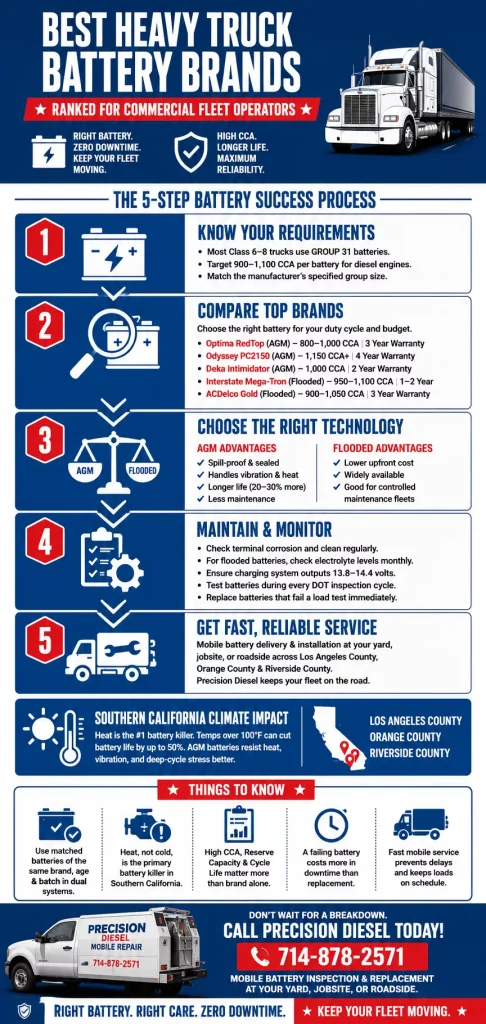
The Top Heavy Truck Battery Brands, Compared
Not every battery brand performs the same under commercial diesel conditions. Below is a breakdown of the most widely used and highly rated options in the U.S. market.
| Brand | Battery Type | Typical CCA | Warranty | Best For |
|---|---|---|---|---|
| Optima RedTop | AGM Spiral Cell | 800-1,000 | 3 years | High-vibration applications |
| Interstate Mega-Tron | Flooded Lead-Acid | 950-1,100 | 1-2 years | Cost-conscious fleets |
| Odyssey PC2150 | AGM | 1,150 | 4 years | Extreme reliability demands |
| Deka Intimidator | AGM | 1,000 | 2 years | Dual-battery diesel setups |
| ACDelco Gold | Flooded Lead-Acid | 900-1,050 | 3 years | OEM replacement applications |
| Northstar NSB-AGM31 | Pure Lead AGM | 1,150+ | 4 years | Deep cycle and starting combined |
Optima RedTop
Optima’s spiral-cell AGM design gives it a major edge in high-vibration environments, exactly the conditions found in diesel semi-trucks running on California’s freeways and port roads. The RedTop is not the highest CCA option on this list, but its internal construction resists vibration-induced plate damage better than conventional flooded batteries. It is a strong choice for regional fleets running high mileage on rough surfaces.
Interstate Mega-Tron Plus
Interstate is one of the most widely distributed battery brands in the U.S., with a dealer network that spans nearly every state. The Mega-Tron Plus line is purpose-built for heavy commercial applications and delivers solid CCA numbers at a more accessible price point than premium AGM options. For fleets managing costs carefully, Interstate offers a reliable middle ground.
Odyssey PC2150
The Odyssey is the gold standard when pure performance is the priority. With CCA ratings exceeding 1,150 and a four-year full replacement warranty, it is the battery of choice for operations that cannot afford any battery-related downtime. The price is higher, often $300 to $400 per unit, but the total cost of ownership justifies it when you factor in the longer service life and near-zero maintenance requirements.
Deka Intimidator AGM
Made by East Penn Manufacturing, the Deka Intimidator is a purpose-built commercial AGM battery that performs exceptionally well in dual-battery diesel systems. East Penn is one of the largest battery manufacturers in the U.S. and produces batteries to strict quality standards. The Intimidator line is popular among owner-operators who want AGM performance without the Odyssey price premium.
AGM vs. Flooded Lead-Acid: Which Is Right for Your Fleet?
This is the most common question fleet managers face when replacing batteries. Both technologies work, but they are not interchangeable in every situation.
Flooded lead-acid batteries are less expensive upfront, typically $150 to $220 per Group 31 unit, and are widely available. They require periodic water topping, can spill if tipped, and are more vulnerable to vibration damage over time. For fleets with a tight maintenance schedule and controlled environments, they are still a viable option.
AGM batteries are sealed, spill-proof, and internally constructed to handle the vibration, heat, and deep-discharge cycles common in commercial diesel applications. They cost more upfront, often $250 to $400 per unit, but typically last 20 to 30 percent longer than flooded equivalents, according to battery performance research published by the Battery Council International.
For heavy trucks running in Southern California’s warm climate, AGM batteries have an additional advantage: heat is one of the primary killers of lead-acid batteries, accelerating the internal chemical reactions that degrade plate capacity. AGM construction slows this process meaningfully.
If you want to understand how battery problems connect to broader truck maintenance costs, the breakdown of the cost of heavy duty truck repair shows just how quickly electrical and starting failures compound into larger repair bills when not addressed early.
What to Look for Beyond the Brand Name
Choosing the best heavy truck battery brand is not purely about the label on the case. Several technical specifications should guide your decision more than brand loyalty.
Cold-Cranking Amps (CCA): This is the number of amps a battery can deliver for 30 seconds at 0°F while maintaining at least 7.2 volts. For a large diesel engine, you generally want 900 CCA minimum per battery in a dual-battery setup.
Reserve Capacity (RC): RC tells you how long the battery can sustain a 25-amp load if the charging system fails. Higher RC means more time before a complete shutdown critical for drivers who may be stranded waiting for emergency roadside assistance.
Group Size: Always match the manufacturer’s specified group size. Group 31 is standard for most Class 6-8 trucks, but some applications use Group 4D or 8D batteries.
Cycle Life: If your trucks use significant accessory power while idling, cycle life matters. AGM batteries handle deep cycling far better than flooded units.
Key maintenance-related factors to monitor:
- Terminal corrosion buildup, which increases resistance and reduces cranking performance
- Electrolyte levels in flooded batteries (check monthly in hot climates)
- State of charge during extended vehicle storage periods
- Charging system voltage output (should read 13.8 to 14.4 volts at idle)
How Southern California’s Conditions Affect Battery Choice
Operating in Southern California presents a specific set of challenges for commercial battery life. Unlike cold-climate states where CCA is the dominant concern, the primary battery stressors in the LA Basin and Inland Empire regions are heat and long idle cycles.
Temperatures in Riverside County and the San Fernando Valley regularly exceed 100°F in summer. At those temperatures, a standard flooded battery can lose up to 50 percent of its expected service life, according to battery thermal management data from the National Renewable Energy Laboratory. This is a significant reason why fleet operators in Southern California increasingly favor AGM chemistry.
Diesel engine maintenance practices also influence how hard your batteries work, and engines that are not running efficiently put more strain on the electrical system, which is why reviewing diesel engine maintenance the key to truck owner success in los angeles covers how proactive maintenance habits protect both your engine and your electrical components. It is also worth considering that components like the alternator and voltage regulator directly affect battery life. A failing alternator that undercharges your batteries will cause premature failure regardless of which brand you choose, and similarly, a timing belt failure can create conditions that stress the entire electrical system, understanding diesel engine timing belt replacement intervals is part of keeping the whole drivetrain operating within spec.
Things to Know
- Group 31 AGM batteries are the most versatile and widely compatible option for Class 6-8 trucks when in doubt, start there.
- Dual-battery systems should always use matched batteries from the same brand and production batch to prevent uneven charging.
- A battery that fails a load test should be replaced immediately, surface charge can mask a weak battery and give a false sense of remaining capacity.
- Heat, not cold, is the primary battery killer in Southern California; shade your trucks where possible during extended parking in summer.
- Always check the mobile truck repair response time when planning for emergency battery replacements, since a fast-responding mobile mechanic can get your truck moving before cargo is delayed.
- Batteries should be tested as part of every DOT inspection cycle, not just when symptoms appear.
Ready to Replace Your Fleet’s Batteries Before the Next Breakdown?
Contact Precision Diesel at (714) 878-2571 and schedule a mobile battery inspection and replacement at your yard, jobsite, or roadside location across Los Angeles County, Orange County, and Riverside County. Their technicians carry Group 31 batteries and the diagnostic tools to test your charging system on the spot, no shop visit required.
For more technical guidance on maintaining your diesel fleet, browse their articles library, which covers topics from battery selection to full preventative maintenance schedules.
Frequently Asked Questions
What is the best heavy truck battery brand for a Class 8 diesel with dual batteries?
Odyssey and Deka Intimidator are consistently top-rated choices for dual-battery Class 8 applications. Both offer AGM construction, high CCA ratings above 1,000, and strong cycle life suited to the constant electrical demands of modern semi-trucks. If budget is a constraint, Interstate Mega-Tron Plus delivers solid performance at a lower price per unit.
How often should heavy truck batteries be replaced?
Most commercial truck batteries last between 3 and 5 years depending on usage, climate, and maintenance quality. In hot climates like Southern California, expect the lower end of that range for flooded batteries. AGM units typically extend service life by 1 to 2 years under comparable conditions. Annual load testing helps identify weak batteries before they cause a breakdown.
Is AGM always better than flooded lead-acid for commercial trucks?
AGM is generally superior for high-vibration, high-heat, and deep-cycle applications, which describes most commercial diesel truck operations. However, flooded batteries remain a cost-effective option for fleets with strict maintenance schedules and controlled storage environments. The total cost comparison often favors AGM once you account for longer service life and reduced maintenance labor.
Can I mix battery brands in a dual-battery truck system?
Mixing brands or ages in a dual-battery system is not recommended and can cause uneven charging, reduced capacity, and premature failure of the newer battery. When replacing batteries in a dual system, always replace both units at the same time using matched batteries from the same manufacturer and production run. This ensures balanced charging and consistent performance across both units.
What warning signs indicate a heavy truck battery needs immediate replacement?
Slow engine cranking, dimming headlights under load, and a battery warning light are the three most common early indicators of battery failure. A battery that fails a load test even after a full charge should be replaced before the next dispatch. Waiting for a complete failure in the field is significantly more expensive than a proactive replacement at your yard.
The Bottom Line on the Best Heavy Truck Battery Brand
No single brand dominates every use case, but if you are running Class 7 or Class 8 diesel trucks in Southern California, AGM batteries from Odyssey, Deka, or Optima consistently outperform flooded alternatives in longevity and reliability. The best heavy truck battery brand for your fleet is the one that matches your duty cycle, fits your budget per unit, and is supported by a supplier who can get it to you fast when you need it most.
For Southern California fleet operators, Precision Diesel offers mobile battery delivery and installation across the region. You can reach them at (714) 878-2571 or visit their website to request service and keep your fleet moving without an unnecessary shop visit. You can also find additional guidance from the NIH’s National Library of Medicine on occupational fatigue related to commercial vehicle downtime a reminder that operational delays have costs beyond just the repair bill itself.
