
When a semi-truck, fleet vehicle, or RV breaks down on a Southern California freeway, every minute of downtime translates directly into lost revenue, missed deliveries, and frustrated customers. Emergency Roadside Assistance Semi Trucks, Fleets and RVs in Southern California is a specialized mobile service that dispatches trained diesel technicians to your exact location, performs on-site diagnostics and repairs, and gets your vehicle moving again without the wait or cost of a tow.
Key Takeaways
- Southern California’s freight corridors, including the I-10 through Ontario and Fontana, generate the highest density of commercial breakdown calls in the region.
- Tire issues are the second most common violation in commercial vehicles, according to the Commercial Vehicle Safety Alliance, making roadside tire service a top priority.
- On-site repair is almost always faster and less expensive than towing, especially for diagnosable engine and electrical failures.
- Advanced diesel diagnostics during a roadside call can prevent the same breakdown from happening twice.
- California’s strict emissions and after-treatment regulations create unique failure points that require technicians certified in DPF, DEF, and SCR systems.
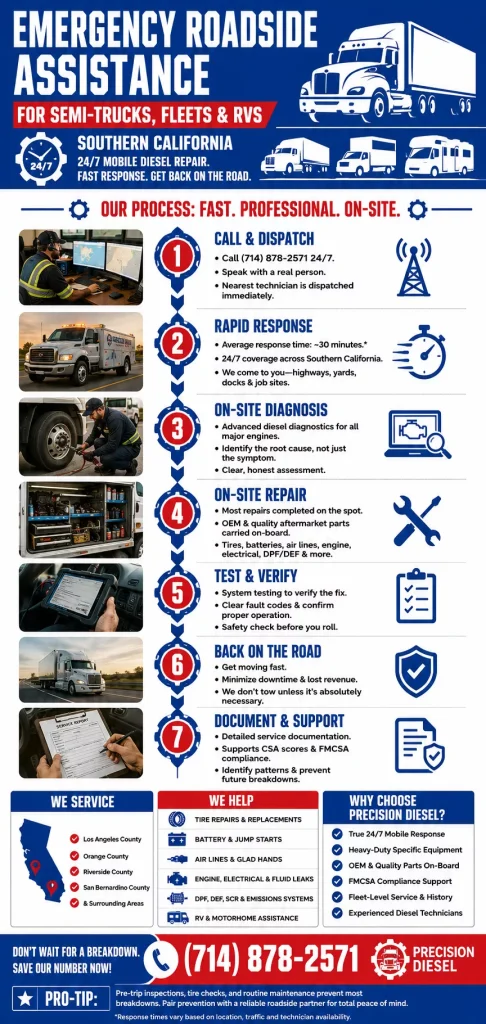
- Precision Diesel covers Los Angeles County, Orange County, Riverside County, and surrounding areas with 24/7 mobile repair services.
Semi-Truck and Big Rig Roadside Breakdowns: What Actually Happens at the Scene
A semi-truck breakdown on the I-15 or I-10 is not just an inconvenience. It is a safety event. When your rig stops moving on a high-volume freight corridor, you are dealing with tight shoulders, fast-moving traffic, and a vehicle that can weigh up to 80,000 lbs fully loaded. Precision Diesel’s mobile technicians arrive equipped to handle the most common big rig failure points, including:
- Tire failures: Flat tires, blown steer tires, and trailer tire blowouts. The rate of flat tires requiring a tow increased 6% in 2024 compared to 2023, partly because newer vehicles no longer ship with spare tires.
- No-start situations: Dead batteries, failed starter motors, and fuel system issues that leave a truck stranded in a yard or at a loading dock.
- Air line and glad hand failures: Broken or leaking air lines that prevent the trailer brakes from releasing.
- Jump starts: For Group 31 heavy-duty battery systems, including full battery testing to determine whether a replacement is needed.
- Basic fluid and filter emergencies: Oil leaks, coolant loss, and fuel filter plugging that cause sudden derating or shutdown.
Precision Diesel carries OEM and quality aftermarket parts on its service trucks, which means many repairs happen at the roadside without sourcing a part from a distant supplier. You can reach the team directly at (714) 878-2571 any time of day or night.
Commercial Fleet Roadside Assistance: Minimizing Downtime Across Multiple Units
Fleet operators face a compounding risk that individual truck owners do not. When one unit goes down, dispatch scrambles to cover the load. When two or three go down on the same day, operations can stall entirely. Research from FleetNet and the American Trucking Associations’ Technology and Maintenance Council found that commercial trucks cover an average of 10,000 miles between breakdown events. For a fleet running 20 or 30 units, that math adds up quickly.
Understanding what is fleet maintenance as a proactive discipline is the starting point for reducing how often your units need emergency help. But when emergencies happen regardless, fleet operators need a roadside partner who can:
- Respond to multiple simultaneous breakdowns without triaging one job over another.
- Generate service documentation for each repair event, supporting your CSA score management and FMCSA compliance records.
- Identify repeat failure patterns and recommend preventative fixes before the next breakdown.
- Coordinate directly with dispatch to communicate realistic return-to-service timelines.
Precision Diesel’s fleet clients across Orange County, Los Angeles County, and Riverside County rely on the team not just for emergency calls but for the kind of commercial fleet repair california work that keeps units out of the shop and on the road. The broader collection of articles also covers fleet management topics in depth.
According to NIH-linked transportation safety research and the FMCSA, inadequate vehicle maintenance is a leading contributing factor in large-truck crashes, which underscores the value of pairing emergency response with a structured maintenance program.
RV Roadside Emergencies: Unique Challenges Most Providers Miss
RVs occupy a difficult middle ground in commercial roadside assistance. They are too large and mechanically complex for standard auto roadside services, but they are not always covered under commercial truck programs. Class A diesel pusher motorhomes, fifth-wheel tow vehicles, and large Class C RVs share many of the same failure points as commercial vehicles, including diesel engine faults, air suspension issues, and slide-out system failures.
Common RV roadside scenarios that Precision Diesel handles include:
- Diesel engine no-starts and fuel system problems on Class A and Class C motorhomes.
- Chassis electrical failures, including battery banks and inverter systems.
- Slide-out mechanical issues that prevent the RV from being road-legal.
- Trailer hitch and brake controller problems for fifth-wheel and travel trailer setups.
- Tire changes and blowout recovery on large-profile RV tires.
If you tow a trailer behind your RV or tow vehicle, reviewing expert tips for how to best back up a trailer before your next trip can help you avoid positioning problems that make a breakdown situation even harder to manage.
On-Site Roadside Repair vs. Towing: Making the Right Call
One of the most costly mistakes fleet managers and drivers make is defaulting to a tow when on-site repair is both faster and cheaper. Towing a loaded semi-truck in Southern California can cost anywhere from $500 to $2,500 or more depending on distance, and that does not include the shop labor and downtime that follows.
Here is a straightforward framework for deciding between on-site repair and towing:
| Situation | On-Site Repair Likely | Towing Likely Needed |
| Dead battery or failed starter | Yes | No |
| Blown tire with spare available | Yes | No |
| Air line or glad hand failure | Yes | No |
| Minor coolant or oil leak | Yes | Possibly |
| Engine seized or catastrophic failure | No | Yes |
| Transmission failure | No | Yes |
| Frame or structural damage | No | Yes |
| DPF or after-treatment issue | Yes (in many cases) | Depends on severity |
Precision Diesel’s technicians assess the situation on arrival and give you a direct recommendation. The goal is always to repair at the roadside when it is safe and technically feasible. When towing is unavoidable, the team coordinates with trusted tow operators across Southern California to minimize the gap between breakdown and shop arrival.
Advanced Diesel Diagnostics at the Roadside: Solving the Problem, Not Just the Symptom
Modern semi-trucks and commercial vehicles run sophisticated engine management systems. A Cummins ISX15, a Detroit DD15, a PACCAR MX-13, or an International A26 each have thousands of active fault codes that can trigger a shutdown or derate. Without proper diagnostic equipment at the roadside, a technician is guessing.
Precision Diesel’s mobile units carry professional-grade diagnostic tools capable of reading and clearing codes on all major heavy-duty engine platforms. According to fleet technology research published by the American Trucking Associations, integrating real-time diagnostics with GPS telematics significantly reduces time-to-repair and repeat breakdown rates. Precision Diesel applies this same principle by using diagnostic data from the roadside call to inform future preventative maintenance recommendations, which demonstrates why diesel fleet maintenance is crucial for california businesses.
California Emissions and After-Treatment Failures: A Southern California-Specific Problem
No other state imposes emissions requirements as stringent as California’s. The California Air Resources Board (CARB) enforces regulations that require commercial diesel trucks operating in the state to maintain fully functional Diesel Particulate Filters (DPF), Diesel Exhaust Fluid (DEF) systems, and Selective Catalytic Reduction (SCR) systems. When any of these components fail, the truck derate or shuts down, and in many cases the driver cannot legally continue operating.
Common after-treatment roadside failures Precision Diesel addresses include:
- DEF quality faults and contaminated fluid causing SCR derates.
- DPF pressure sensor failures and regeneration cycle failures.
- EGR valve and cooler failures triggering engine protection mode.
- NOx sensor failures that put the truck into a compliance derate.
For more information on California’s specific commercial vehicle emissions standards, the California Air Resources Board’s commercial vehicle regulations page is the authoritative source. Precision Diesel’s technicians are experienced with CARB-compliant after-treatment systems and can perform many of these repairs at the roadside, avoiding a costly shop visit.
Why Precision Diesel Is the Right Call for Southern California Roadside Emergencies
Generic roadside assistance programs are built for passenger cars. They send a flatbed for a diesel truck because they do not have the equipment or the personnel to fix it at the scene. Precision Diesel is built differently.
Here is what sets Precision Diesel apart from standard emergency roadside repair tools providers:
- True 24/7 mobile response across Los Angeles County, Orange County, Riverside County, and surrounding areas.
- Heavy-duty specific equipment on every service truck, including air supplies, heavy-duty battery support, and diesel diagnostic tools.
- OEM and quality aftermarket parts carried on-board, reducing wait times for common components.
- FMCSA compliance support, including help maintaining a strong CSA score through accurate repair documentation.
- Fleet-level service relationships, meaning repeat clients get priority dispatch and service history tracking.
Understanding the full scope of fleet operations southern california helps explain why having a single reliable partner for both emergency response and scheduled maintenance creates significant operational advantages.
Southern California Service Coverage: Where Precision Diesel Operates
Southern California’s freight infrastructure runs through some of the most congested and geographically diverse corridors in the country. The I-10 corridor through Ontario, Fontana, and Beaumont is the highest-volume commercial freight route in the region, with breakdown call density peaking around the Etiwanda exit and the Beaumont split. The I-5 corridor through Los Angeles and the I-15 through Riverside County add thousands of additional commercial vehicle miles daily.
Precision Diesel covers the full footprint of Southern California’s commercial transportation network, including:
- Los Angeles County: from downtown LA through the San Gabriel Valley and out to the 605 corridor.
- Orange County: from Anaheim and Santa Ana through Irvine and down to San Clemente.
- Riverside County: from Corona and Moreno Valley through Hemet and into the Coachella Valley.
- Surrounding areas including San Bernardino County’s Inland Empire freight hub.
The Mayo Clinic’s occupational health guidelines and OSHA’s commercial transportation safety standards both emphasize that driver safety during a breakdown depends heavily on rapid professional response, which is exactly what geographic coverage breadth enables.
Things to Know
- Response times for mobile diesel roadside services in Southern California average around 30 minutes, but freeway incidents in high-density corridors like the I-10 through Fontana can involve longer waits due to traffic.
- Tire issues are the most frequently cited violation during CVSA roadside inspections, making pre-trip tire checks a non-negotiable habit.
- California’s CARB regulations mean an after-treatment failure is not just a mechanical problem. It can be a compliance violation with financial penalties.
- Many roadside no-start situations are caused by battery failure, not engine failure. A battery test at the roadside often saves the cost of a full diagnostic work-up.
- Fleet operators should request written documentation for every roadside repair event. This supports CSA score management and provides a paper trail for repeat failure analysis.
- RV owners should verify that their roadside assistance plan specifically covers diesel chassis before they need it. Many consumer plans exclude commercial-grade powertrains.
Ready to Put Precision Diesel in Your Emergency Contact List?
Do not wait until a breakdown happens to figure out who to call. Save Precision Diesel’s number in your phone, your dispatch system, and your driver’s glove box right now: (714) 878-2571. One call connects you to a trained mobile diesel technician who covers all of Southern California, 24 hours a day, 7 days a week.
Frequently Asked Questions
How quickly can Precision Diesel respond to a roadside breakdown in Southern California?
Most calls in Orange County, Los Angeles County, and Riverside County receive a response within 30 minutes of dispatch. Response time varies based on your exact location, traffic conditions, and technician availability, but Precision Diesel prioritizes emergency calls and dispatches the nearest available unit to your location.
What is the difference between on-site diesel repair and standard roadside assistance?
Standard roadside assistance typically sends a tow truck, while on-site diesel repair dispatches a trained mechanic with tools and parts to fix your vehicle where it stopped. On-site repair is almost always faster and less expensive than towing, particularly for common failures like tire blowouts, battery failures, air line breaks, and minor engine faults.
Can Precision Diesel handle after-treatment and emissions-related breakdowns on California-compliant trucks?
Yes, Precision Diesel’s technicians are experienced with DPF, DEF, SCR, and EGR systems that are required under California Air Resources Board regulations. Many after-treatment faults that cause engine derate or shutdown can be diagnosed and resolved at the roadside without a shop visit.
Does Precision Diesel provide roadside assistance for RVs, or only commercial trucks?
Precision Diesel serves Class A diesel motorhomes, Class C RVs, and fifth-wheel tow vehicles in addition to semi-trucks and commercial fleet vehicles. RV-specific services include diesel engine diagnostics, chassis electrical repair, and tire changes for large-profile RV tires.
