

When your vehicle breaks down on the side of a busy Southern California freeway, having the right emergency roadside repair tools can be the difference between a 15-minute fix and a 4-hour wait. These tools are not just for DIY enthusiasts, fleet operators, truck drivers, and everyday commuters all benefit from keeping a well-stocked kit within reach.
Key Takeaways
- A basic roadside kit should include jumper cables, a tire inflator, basic hand tools, a flashlight, and safety gear at minimum.
- Commercial truck operators and fleet vehicles require a more robust set of tools that goes well beyond what a passenger car kit typically covers.
- According to Tool Troopers (2026), there are 69 million vehicle breakdowns annually in the United States, roughly 189,000 every single day, which underlines how common roadside situations really are.
- Knowing your limits matters as much as having tools; some repairs require professional-grade diagnostics that a roadside kit simply cannot handle.
- Mobile diesel services, like Precision Diesel in Southern California, can come to you when a breakdown exceeds what your kit can address.
- Digital dispatch platforms now handle about 56% of roadside calls, according to Global Growth Insights (2025), so knowing who to call and how to reach them fast is part of any smart preparedness plan.
Why Roadside Preparedness Is a Bigger Deal Than Most Drivers Realize
The roadside assistance industry is growing fast. According to Market.us (2025), the global vehicle roadside assistance market is expected to reach USD 39.7 billion by 2034, up from USD 25.3 billion in 2024, growing at a CAGR of 4.6%. Alternative projections from Precedence Research (2025) place that figure even higher, at USD 43.80 billion by 2034. That kind of growth signals one thing clearly: breakdowns are not going away, and demand for reliable response is accelerating.
For commercial operators especially, the financial pressure is real. According to Tool Troopers (2026), the average annual maintenance cost for passenger vehicles climbed to $1,234 in 2025, a 12% jump from the previous year. For fleets running heavy-duty diesel trucks, those costs scale considerably higher. Having the right tools on board does not eliminate repair bills, but it can prevent a minor issue from turning into a tow-truck call and a lost delivery day.
The Technavio Vehicle Roadside Assistance Market report also highlights towing as the dominant service type at 40.2% of all roadside service calls. Many of those towing calls happen because a driver lacked the basic tools to address a problem that was genuinely fixable on the spot.
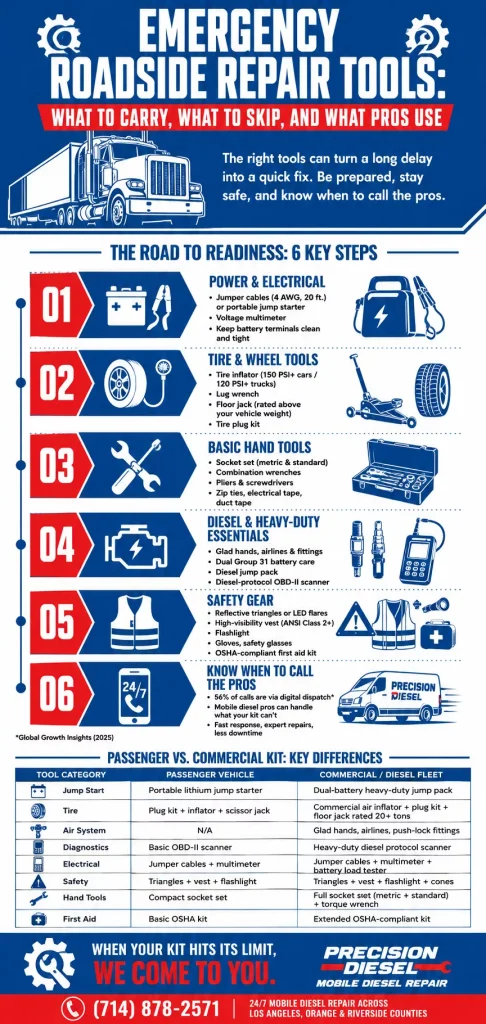
The Core Kit: Tools Every Driver Should Have
Whether you drive a pickup, a box truck, or a passenger car, there is a baseline set of tools that should live in your vehicle at all times. Think of this as the foundation before you start layering in vehicle-specific additions.
Electrical and Power Tools
A dead battery is one of the most common reasons drivers end up stranded. A quality set of heavy-gauge jumper cables, rated for at least 4 AWG and 20 feet in length, gives you enough reach to connect to another vehicle safely. For drivers who travel solo or through remote areas of Southern California’s desert stretches, a portable jump starter pack removes the need for a second vehicle entirely. Modern lithium-ion jump starters can fit in a glove box and still deliver enough cranking amps to start a gasoline engine or a light diesel.
A voltage multimeter is worth including if you are comfortable using one. It helps you determine whether your charging system is producing the right output, which tells you if the battery is the problem or if your alternator is failing.
Tire and Wheel Tools
Flat tires represent a massive share of roadside stops. Your kit should include:
- A quality tire inflator with a built-in pressure gauge, capable of reaching at least 150 PSI for passenger tires or 120 PSI for larger truck tires
- A lug wrench that fits your vehicle’s specific lug nut size
- A hydraulic floor jack or a heavy-duty scissor jack rated well above your vehicle’s weight
- Tire plugs or a plug kit for repairing minor punctures without removing the tire
One thing drivers frequently overlook is the condition of their spare tire. A spare that has been sitting in the truck bed for three years at 15 PSI is not going to help anyone. Checking your spare monthly takes about 90 seconds and can save hours on the road.
Basic Hand Tools
A compact socket set covering both standard and metric sizes, a set of combination wrenches, needle-nose pliers, slip-joint pliers, and a few flathead and Phillips screwdrivers will handle the majority of minor mechanical issues you can realistically fix roadside. Add zip ties, electrical tape, and a roll of duct tape, and you have the ability to make temporary repairs that at least get you to a service location safely.
Heavy-Duty and Diesel-Specific Tools
If you operate a semi-truck, Class 7 or 8 diesel vehicle, or a commercial trailer, the standard passenger car kit is nowhere near sufficient. Diesel systems, air brake lines, and heavy freight loads introduce entirely different failure modes.
Air System Components
Diesel trucks with air brakes rely on glad hands, airlines, and air fittings that can fail from wear, weather, or physical damage. Carrying a spare set of glad hands, pre-made airline sections in 15-foot and 30-foot lengths, and a handful of push-lock fittings gives you the ability to restore an air connection at the trailer king pin quickly. Precision Diesel, which services fleets across Los Angeles County, Orange County, and Riverside County, stocks parts including glad hands and airlines as part of its mobile service inventory, so even if you do not have a spare on hand, a mobile technician can arrive with the right part.
Battery Management for Heavy Equipment
Commercial diesel trucks typically run dual Group 31 batteries in series to produce the cranking power those engines require. A single dead battery in a series pair can prevent the truck from starting entirely. Carrying a heavy-duty jump starter rated for diesel, or at least knowing your battery group size and keeping your battery terminals clean and tight, can prevent a no-start situation from escalating.
The NIH National Library of Medicine and automotive safety researchers consistently note that battery failure is the single most common cause of vehicle no-starts across all vehicle classes, which makes battery management tools a high-priority investment.
Diagnostic Tools
Modern diesel trucks are controlled by sophisticated ECMs (Engine Control Modules). Without a capable OBD-II scanner that supports heavy-duty diesel protocols, a check engine light on a commercial truck is essentially unreadable at the roadside. Carrying a mid-range scanner that reads diesel-specific fault codes, including those related to DPF systems and EGR components, can tell you immediately whether a warning light is a minor sensor flag or a genuine stop-now situation.
TOPDON USA (2025) surveyed more than 3,000 professional automotive technicians and DIY mechanics across North America and found that diagnostic capability was among the top challenges facing professionals working on modern smart vehicles, reinforcing why diagnostic tools are no longer optional for serious fleet operators.
Safety Gear: The Tools That Protect You While You Work
No discussion of emergency roadside repair tools is complete without addressing personal safety. Working on the shoulder of a California highway, especially on I-5, the 405, or the 91, puts you in proximity to fast-moving traffic. The NHTSA safety guidelines for roadside emergencies recommend maintaining maximum distance from the travel lane at all times.
Your safety kit should include:
- At least three ANSI-rated reflective triangles or LED road flares, placed 100 feet, 200 feet, and 300 feet behind your vehicle
- A high-visibility safety vest rated to ANSI Class 2 or higher
- A heavy-duty flashlight with fresh batteries or a rechargeable unit kept topped off
- Heavy work gloves and safety glasses to protect your hands and eyes during repairs
- A basic first aid kit compliant with OSHA recommendations for vehicle-based kits
These items are inexpensive relative to the protection they provide. A full safety setup costs well under $100, and it can prevent a roadside breakdown from becoming a fatal incident.
Comparing Passenger Vehicle Kits vs. Commercial Fleet Kits
The table below outlines key differences between what a passenger vehicle driver and a commercial fleet operator should carry.
| Tool Category | Passenger Vehicle | Commercial/Diesel Fleet |
|---|---|---|
| Jump Start | Portable lithium jump starter | Dual-battery heavy-duty jump pack |
| Tire | Plug kit + inflator + scissor jack | Commercial air inflator + plug kit + floor jack rated 20+ tons |
| Air System | N/A | Glad hands, airlines, push-lock fittings |
| Diagnostics | Basic OBD-II scanner | Heavy-duty diesel protocol scanner |
| Electrical | Jumper cables + multimeter | Jumper cables + multimeter + battery load tester |
| Safety | Triangles + vest + flashlight | Triangles + vest + flashlight + cones |
| Hand Tools | Compact socket set | Full socket set (metric + standard) + torque wrench |
| First Aid | Basic OSHA kit | Extended OSHA-compliant kit |
When Your Tools Are Not Enough
Even the best-prepared driver will eventually face a breakdown that exceeds what a roadside kit can handle. DPF filter failures, EGR system problems, blown head gaskets, or air compressor failures on a diesel are not situations where a socket set and a can-do attitude are going to get you back on the road safely.
This is where mobile diesel repair services prove their value. According to Global Growth Insights (2025), more than 61% of roadside service calls are now initiated through digital platforms, and about 48% are handled through subscription-based or on-demand plans. The shift toward app-based dispatch, covering roughly 56% of calls, means that reaching a qualified technician has never been faster. You can review market growth data from the Custom Market Insights US Roadside Assistance report for more context on how service delivery is evolving.
For commercial operators in Southern California, Precision Diesel operates as a fully mobile heavy-duty diesel repair service covering Los Angeles County, Orange County, Riverside County, and surrounding areas. Their technicians come to your location with OEM and aftermarket parts already on board, handling everything from engine diagnostics and brake repairs to DPF cleaning and DOT inspections. You can reach them directly at (714) 878-2571 for roadside assistance dispatch.
The Market Data Forecast Roadside Assistance Market report projects continued growth in mobile professional repair services, particularly for commercial vehicles, which reflects exactly the kind of demand that businesses like Precision Diesel are built to meet.
Building Your Kit Without Overspending
You do not need to buy everything at once. A tiered approach works well for most drivers and fleet managers.
Tier 1 (under $75): Jumper cables, tire inflator, reflective triangles, safety vest, flashlight, basic first aid kit, zip ties, duct tape.
Tier 2 ($75 to $200): Portable lithium jump starter, tire plug kit, compact socket and wrench set, work gloves, basic OBD-II scanner.
Tier 3 ($200+): Heavy-duty diesel jump pack, commercial-grade floor jack, diesel-protocol diagnostic scanner, glad hands and airlines (commercial operators), torque wrench.
Starting with Tier 1 and building up as your budget allows means you are always better prepared than you were the week before. For fleet operators, the return on investment becomes clear the first time a driver handles a minor issue without requiring a service call.
The Bottom Line on Emergency Roadside Repair Tools
The right emergency roadside repair tools give you real options when something goes wrong on the road, whether you are driving a sedan down the Pacific Coast Highway or hauling freight across the Inland Empire at 3 a.m. Start with the basics, add vehicle-specific tools as your situation demands, and always keep your safety equipment current and visible.
For breakdowns that go beyond your kit’s capabilities, Precision Diesel is ready to come to you anywhere in Los Angeles County, Orange County, Riverside County, and surrounding Southern California areas. Call (714) 878-2571 and get a qualified mobile diesel technician on the way so you can get back on the road without the wait.
Things to Know
- Tire-related issues and dead truck batteries together account for the majority of roadside breakdowns in the United States, which means those two categories deserve the most attention when you are building your kit.
- Not all jumper cables are created equal. Thin, cheap cables with low-gauge wire can overheat or fail to deliver enough amperage to start a diesel engine. Always check the AWG rating before you buy.
- Reflective triangles and road flares have different strengths. Triangles are reusable and stable in wind, while LED flares are more visible in fog and rain. Carrying both covers more scenarios than either alone.
- For commercial truck operators, DOT regulations under 49 CFR Part 393 require that certain safety equipment, including warning devices and fire extinguishers, be present in the vehicle at all times. A missing required item during a roadside inspection can result in a violation and out-of-service order.
- EV drivers face a different set of roadside challenges than combustion vehicle drivers. According to Global Growth Insights (2025), about 48% of EV-related roadside requests now involve battery jump-starts or mobile charging services, and roughly 32% of providers are actively deploying EV-compatible service options. Standard jumper cables and gas cans do not apply here.
- Keeping your kit organized matters as much as having it. A tool bag or case with labeled compartments means you can find what you need under stress, in the dark, on the shoulder of a busy freeway, without rummaging through loose items scattered in your truck bed.
Let Precision Diesel Come to You When Your Kit Hits Its Limit
There are breakdowns that no roadside kit can fully resolve, and when you hit that wall, every minute counts. Precision Diesel is a fully mobile heavy-duty diesel repair service covering Los Angeles County, Orange County, Riverside County, and surrounding areas in Southern California, bringing qualified technicians and OEM-grade parts directly to your location. Whether you are dealing with a DPF failure, a blown air line, a diagnostic code you cannot clear, or a brake issue that cannot wait, Precision Diesel has the equipment and experience to handle it on the spot.
Call Precision Diesel right now at (714) 878-2571 and get a mobile diesel technician dispatched to your location before your downtime turns into a missed delivery or a costly tow.
Frequently Asked Questions
What tools are needed for roadside assistance?
The core tools for roadside assistance include jumper cables or a portable jump starter, a tire inflator with pressure gauge, a lug wrench, a hydraulic or scissor jack, reflective warning triangles, a flashlight, and a basic hand tool set.
Beyond those essentials, adding a tire plug kit, electrical tape, zip ties, and a compact OBD-II scanner will prepare you for a wider range of common breakdowns. Commercial and diesel vehicle operators should also carry air system components such as glad hands and spare airline sections, since air brake failures represent a category that passenger car kits simply do not address.
What is the best emergency car tool kit?
The best emergency car tool kit is one matched to your specific vehicle type, driving environment, and mechanical comfort level, rather than a generic one-size-fits-all box from a big-box retailer.
For passenger vehicles, a quality kit includes a lithium jump starter, a plug-and-inflate tire kit, a compact socket and wrench set, safety triangles, and a first aid kit. For diesel truck drivers and fleet operators, the best kit expands to include a heavy-duty diesel jump pack, a diesel-compatible diagnostic scanner, commercial air fittings, and a torque wrench. Spending a little more on individual quality components often delivers better results than buying a pre-assembled bargain kit where half the tools are undersized for real-world use.
What is a good roadside emergency kit?
A good roadside emergency kit covers four key categories: power and starting, tire repair, personal safety, and basic mechanical repairs.
Start with jumper cables or a jump starter, a tire inflator, plugs, and a lug wrench for the mechanical side. Add reflective triangles, a high-visibility vest, gloves, and a flashlight for safety. Round it out with a compact tool set, zip ties, duct tape, and a basic first aid kit. If you drive a commercial diesel vehicle in Southern California, adding air system spare parts and a diesel-protocol scanner moves your kit from good to genuinely field-ready.
What tools do you need for car repairs?
For basic car repairs, you need a socket set in both metric and standard sizes, a set of combination wrenches, flathead and Phillips screwdrivers, needle-nose and slip-joint pliers, a rubber mallet, and an OBD-II diagnostic scanner.
Roadside repairs specifically tend to focus on a narrower set of tasks than a full shop job, so you do not need to carry an entire workshop in your vehicle. Prioritize tools that address the most statistically common failures: battery issues, tire problems, and loose or failed connectors. A multimeter is also worth having in your kit if you are comfortable using one, since it can help you diagnose electrical faults quickly without guesswork.
What should I include in an emergency roadside kit?
An emergency roadside kit should include a jump starter or jumper cables, a tire inflator and plug kit, a lug wrench and jack, reflective warning triangles, a high-visibility safety vest, a flashlight, a first aid kit, and a compact hand tool set.
Extras that significantly improve your preparedness include a portable phone charger, a mylar emergency blanket, a small fire extinguisher rated for automotive use, and bottled water, especially if you travel through remote desert areas in Southern California where temperatures regularly exceed 100°F and wait times for outside help can be long. For fleet operators, keeping a printed emergency contact list that includes your mobile repair provider’s number alongside your roadside kit ensures you can get help dispatched quickly even if your phone battery is low.
Where Emergency Roadside Repair Tools Fit Into Your Broader Safety Plan
Emergency roadside repair tools are not a replacement for preventive maintenance, and they are not a substitute for professional help when a repair exceeds your skill level or your kit’s capacity. They are the bridge that gets you from a breakdown to a resolution, whether that resolution is a quick self-fix or a fast call to a qualified technician who can reach you within the hour.
Build your kit in stages, check it every few months, and make sure every driver in your fleet or household knows where it is stored and how to use the basic items inside it. For Southern California fleet operators and commercial truck drivers, pairing a well-stocked kit with a reliable mobile repair partner like Precision Diesel gives you a complete roadside strategy. When a breakdown happens that goes beyond what your tools can handle, call Precision Diesel at (714) 878-2571 and get a mobile diesel technician on the way fast.
