
Mobile Diesel Mechanic vs. Tow Truck: When your diesel breaks down, a mobile diesel mechanic comes to your location and repairs the vehicle on-site, while a tow truck transports it to a shop. A mobile mechanic is the faster, cheaper option for most mechanical failures including engine faults, brake issues, electrical problems, and dead batteries. A tow truck is the correct choice when the vehicle is unsafe to work on roadside, structurally damaged, or requires equipment only found in a shop.
Key Takeaways
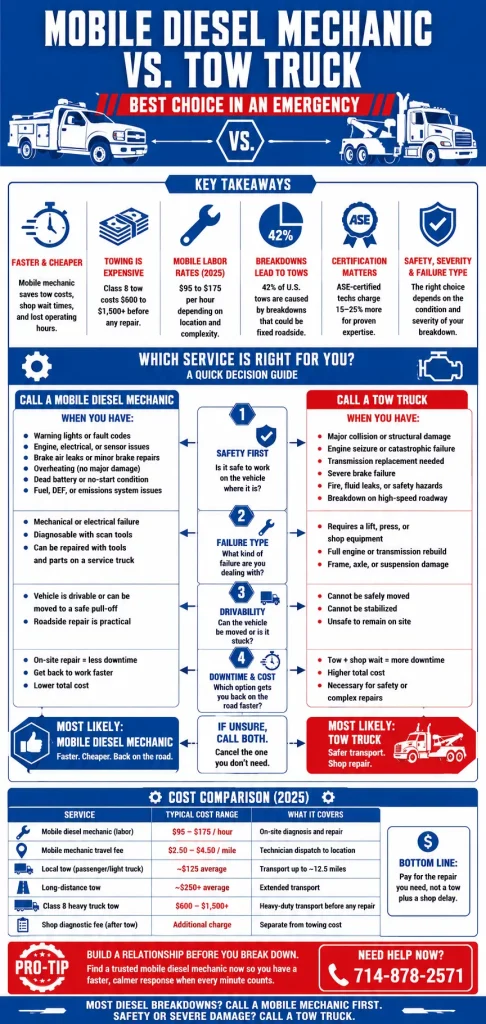
- A mobile diesel mechanic repairs your vehicle on-site, eliminating tow costs, shop wait times, and lost operating hours.
- Towing a Class 8 truck can cost $600 to over $1,500 before a single repair begins, according to industry data.
- Mobile diesel repair labor rates range from $95 to $175 per hour in 2025, depending on location, certification, and job complexity.
- 42% of U.S. tows are caused by breakdowns, many of which could be resolved roadside by a qualified technician.
- ASE-certified mobile technicians command rates 15-25% higher than non-certified providers, reflecting verifiable skill premiums.
- The decision between the two services comes down to safety, severity, and the type of failure your vehicle has experienced.
What Is a Mobile Diesel Mechanic and What Can They Fix?
A mobile diesel mechanic is a certified technician who travels to your vehicle’s location and performs on-site diagnostics and repairs using a fully equipped service truck. According to the U.S. Bureau of Labor Statistics, diesel service technicians diagnose, repair, and maintain diesel engines in trucks, buses, and heavy equipment. Mobile technicians perform this same work roadside, at job sites, or in fleet yards.
The range of repairs a mobile diesel mechanic can handle is broader than most drivers expect. Common on-site fixes include:
- Engine diagnostics using advanced scan tools to read and clear fault codes
- Brake system repairs, including air brake components on commercial trucks
- Electrical system troubleshooting, including wiring, sensors, and battery replacement
- Cooling system service, such as thermostat replacement or coolant leak repair
- Fuel system work, including fuel filter replacement and injector diagnostics
- Transmission fluid service and minor driveline repairs
- DEF system and emissions component diagnosis on modern diesel engines
Most warning lights can be diagnosed roadside. The key point is that a qualified mobile technician brings the shop to your truck, and for a wide range of failures, that is genuinely sufficient to get you rolling again.
When Should You Call a Tow Truck Instead?
A tow truck is the correct choice when the vehicle’s condition makes roadside repair unsafe, structurally impossible, or impractical without specialized shop equipment. Not every breakdown is a mobile-mechanic scenario, and choosing the wrong service costs you time and money.
Call a tow truck when your situation involves any of the following:
- Major collision damage that has compromised the frame, axle, or suspension geometry
- Engine seizure or catastrophic internal failure requiring full disassembly
- Transmission replacement on a heavy-duty platform
- Brake system failure so severe the vehicle cannot be safely stabilized for roadside work
- Fire damage or fluid-related safety hazards at the breakdown site
- Freeway or high-speed roadway breakdowns where technician safety cannot be maintained
- Overheating with suspected head gasket or block damage that requires a full teardown
A standard heavy tow can cost thousands of dollars just to move a vehicle a few miles. Once at a shop, the truck typically waits in an intake lot for an available bay and technician, adding further delay. The bottom line is that towing is the right call when the repair genuinely cannot be completed safely or effectively on the road.
How Do the Costs Compare: Mobile Mechanic vs. Tow Truck?
The cost difference between a mobile mechanic and a tow truck is significant, and the full financial picture includes more than just the service call fee. Mobile diesel repair labor rates in 2025 typically range from $95 to $175 per hour, depending on geographic location, technician certification level, and service complexity. Travel charges typically range from $2.50 to $4.50 per mile.
Towing costs are a separate expense that precede any repair billing. Consider the following cost comparison:
| Service | Typical Cost Range (2025) | What It Covers |
|---|---|---|
| Mobile diesel mechanic (labor) | $95-$175/hour | On-site diagnosis and repair |
| Mobile mechanic travel fee | $2.50-$4.50/mile | Technician dispatch to location |
| Local tow (passenger/light truck) | ~$125 average | Transport up to ~12.5 miles |
| Long-distance tow | ~$250+ average | Extended transport |
| Class 8 heavy truck tow | $600-$1,500+ | Heavy-duty transport before any repair |
| Shop diagnostic fee (after tow) | Additional charge | Separate from towing cost |
For a commercial diesel operator, the financial case for calling a mobile mechanic first is clear. You pay for the repair and a travel fee, not a tow plus a repair plus a shop queue delay. The key point is that for any repairable roadside failure, the mobile mechanic route almost always costs less in total.
How Quickly Can Each Service Respond?
Response time is one of the most practical factors separating mobile diesel mechanics from tow trucks, particularly for commercial operators where downtime has a direct revenue cost. Mobile diesel mechanics operating in urban and suburban corridors often respond within one to two hours, though rural response times vary considerably based on technician availability.
Tow truck response times are shaped by different variables. The BLS Occupational Outlook confirms that diesel technicians sometimes repair vehicles on roadsides or at worksites, reflecting the established role of mobile service in the industry. Tow operators, by contrast, transport the vehicle but add shop wait time on the back end, which can stretch from hours to days during peak periods.
For fleet operators, every unplanned downtime hour carries a measurable cost. The towing model compounds downtime by adding transportation time, intake processing, and bay availability to the equation. The bottom line is that for time-sensitive commercial operations, a mobile mechanic’s single-step resolution is almost always faster than the multi-step tow-and-repair chain.
What Are the Limits of Mobile Diesel Repair?
Mobile diesel repair has genuine limitations that every operator should understand before assuming it covers every scenario. The most significant constraint is equipment: a service truck carries a finite inventory of tools, diagnostic equipment, and parts. Repairs requiring a lift, a press, or a full disassembly environment cannot be completed roadside.
Additional practical limits include:
- Parts availability: If your repair requires a part not stocked on the service truck, the technician must source it, adding time or requiring a follow-up visit.
- Weather and site conditions: Extreme weather, soft ground, or unsafe roadway positions can prevent safe roadside work.
- Regulatory environment: Some jurisdictions restrict roadside work beyond basic repairs, particularly near highways.
- Repair complexity: Full engine rebuilds, frame straightening, and major transmission overhauls require shop infrastructure.
The diesel technician shortage also affects mobile service availability. According to data cited by the American Transportation Research Institute, 65.5% of shops reported being understaffed in 2024, with an average vacancy rate of 19.3%. This means mobile technician availability can be limited in some markets, and response times may reflect that gap. The key point is that mobile diesel repair is highly capable but not unlimited, and knowing its boundaries helps you make the right call fast.
How Do You Decide Which Service to Call in the Moment?
The decision between a mobile diesel mechanic and a tow truck comes down to three questions you can answer at the breakdown site. First, is the vehicle safe to remain stationary while a technician works on it? Second, is the failure a mechanical or electrical issue that does not require shop infrastructure? Third, is the vehicle drivable or partially functional?
Use this decision protocol at the roadside:
- Assess safety first. If you are on a high-speed roadway, in a hazardous position, or the vehicle presents a fire or fluid risk, call a tow truck immediately.
- Identify the symptom. Warning lights, no-start conditions, brake air leaks, overheating, and electrical failures are mobile-mechanic scenarios. Collision damage, engine seizure, and frame damage are tow-truck scenarios.
- Check for drivability. If the vehicle can limp safely to a pull-off, a mobile mechanic can often reach you there. If it cannot move at all but is in a safe position, a mobile mechanic is still a viable first call.
- Consider your commercial obligations. If you are carrying a time-sensitive load, call both services simultaneously and cancel whichever is not needed once you have more diagnostic information.
- Confirm technician scope before booking. Ask the mobile mechanic directly whether they carry the parts and tools your failure likely requires. A qualified technician will tell you honestly if the job exceeds their roadside capability.
The bottom line is that most diesel breakdowns that are not accident-related or catastrophically mechanical fall within a mobile mechanic’s scope.
What Does the Diesel Technician Workforce Look Like in 2026?
The diesel technician workforce is a critical backdrop to service availability when you need help on the road. The BLS Occupational Outlook Handbook reports that diesel service technicians and mechanics held approximately 319,900 jobs in 2024, with a median annual wage of $60,640 as of May 2024. Employment is projected to grow 2% from 2024 to 2034.
About 26,500 annual job openings are projected each year over the decade, largely driven by the need to replace workers who retire or leave the field. The broader category of heavy vehicle and mobile equipment service technicians, which includes mobile roles, held about 245,600 jobs in 2024 and is projected to grow 6% through 2034, faster than the average for all occupations.
Despite projected growth, the current shortage is real. The industry needs roughly 30,500 new technician hires annually according to ATRI data, and vacancy rates remain elevated. This workforce dynamic directly affects how quickly a mobile diesel mechanic can reach you in a given market. The key point is that demand for qualified diesel technicians exceeds supply in many regions, making it worthwhile to identify a reliable mobile provider before you have an emergency.
Is a Mobile Diesel Mechanic Right for Fleet Operators?
Fleet operators have a different calculus than individual owner-operators when evaluating mobile diesel repair. For a fleet, every unit off the road represents lost revenue, and the tow-plus-shop model multiplies downtime across multiple variables. Mobile diesel service allows a technician to come to the vehicle rather than routing the vehicle through a centralized shop intake process.
Fleet managers often establish on-call relationships with mobile diesel providers for exactly this reason. Key advantages for fleet use include:
- On-site repairs reduce repositioning costs for tractors and trailers
- Preventive maintenance visits can be scheduled at the fleet yard, eliminating shop drop-off time
- Multi-unit service calls are possible when a technician services several vehicles in one location visit
- Detailed repair documentation from a mobile provider supports fleet maintenance records
The towing industry, by contrast, is a $16.2 billion sector built primarily around transport, not repair. Towing is a necessary and valuable service, but it is a logistics solution, not a maintenance solution. The bottom line is that for fleets prioritizing uptime and cost control, integrating a mobile diesel mechanic into the maintenance program is a strategically sound choice.
What Is the Right Choice for Mobile Diesel Mechanic vs. Tow Truck?
The right choice between a mobile diesel mechanic and a tow truck depends entirely on the nature and severity of the breakdown. For the majority of diesel breakdowns involving warning lights, electrical faults, brake system issues, cooling problems, and no-start conditions, a mobile mechanic provides faster resolution at lower total cost. For accidents, catastrophic mechanical failures, or situations where roadside work is unsafe, a tow truck is the appropriate and necessary response.
Understanding the cost structure of each option changes how you respond in the moment. Paying $95 to $175 per hour for a technician who resolves the problem at your location is almost always less expensive than paying $600 to $1,500 to transport a Class 8 truck before any repair begins. Building a relationship with a qualified mobile diesel provider before a breakdown occurs gives you a faster, calmer response when one does.
The bottom line: a mobile diesel mechanic is the right first call for most diesel breakdowns, and a tow truck is the right call when safety or repair complexity makes roadside work impossible.
Frequently Asked Questions
What is the 80% rule in towing?
The 80% rule in towing states that your loaded tow weight should not exceed 80% of your vehicle’s maximum tow rating. This safety guideline preserves braking performance, steering control, and drivetrain integrity by keeping a buffer below the rated maximum. Most manufacturers and towing safety organizations recommend this threshold for all towing situations.
What are the drawbacks of using a mobile mechanic?
The main drawbacks of using a mobile mechanic are limited parts inventory, weather-dependent work conditions, and the inability to perform repairs requiring shop equipment like lifts or presses. Response times can also be longer in rural areas due to technician shortages. For complex or structural repairs, a shop remains necessary.
Is a diesel truck better for towing?
A diesel truck is generally better for towing heavy loads because diesel engines produce higher torque at lower RPMs, improving control and reducing drivetrain strain during sustained pulls. Diesel trucks also tend to have higher tow ratings than comparable gasoline models. For loads exceeding 10,000 pounds, a diesel platform is the practical choice for most operators.
Do I need a CDL to pull a 20,000 lb trailer for personal use?
Whether you need a CDL to pull a 20,000 lb trailer for personal use depends on your state, as federal CDL requirements apply to commercial operation. Federally, a CDL is required for commercial vehicles with a GVWR over 26,001 lbs or any vehicle towing over 10,000 lbs commercially. For personal use, check your specific state’s requirements, as rules vary significantly.
What size truck do I need to pull a 10,000 pound camper?
To pull a 10,000 pound camper, you need a truck with a manufacturer-rated tow capacity of at least 12,500 pounds, applying the 80% towing safety rule. Half-ton trucks like the Ford F-150 or Ram 1500 with properly configured tow packages can meet this threshold, but three-quarter-ton trucks offer more control and stability margin. Always verify your specific truck’s tow rating on the door jamb sticker or owner’s manual, not generalized model claims.
References
- U.S. Bureau of Labor Statistics: Diesel Service Technicians and Mechanics – Occupational Outlook Handbook, employment data, wages, and job projections for diesel technicians, May 2024.
- U.S. Bureau of Labor Statistics: Heavy Vehicle and Mobile Equipment Service Technicians – Employment projections and wage data for heavy vehicle technicians, 2024.
