
When your Isuzu truck’s fuel pump fails, it can bring your entire operation to a standstill. Understanding how to repair Isuzu truck fuel pump repairing processes correctly can save you time, money, and costly downtime on the road.
Key Takeaways
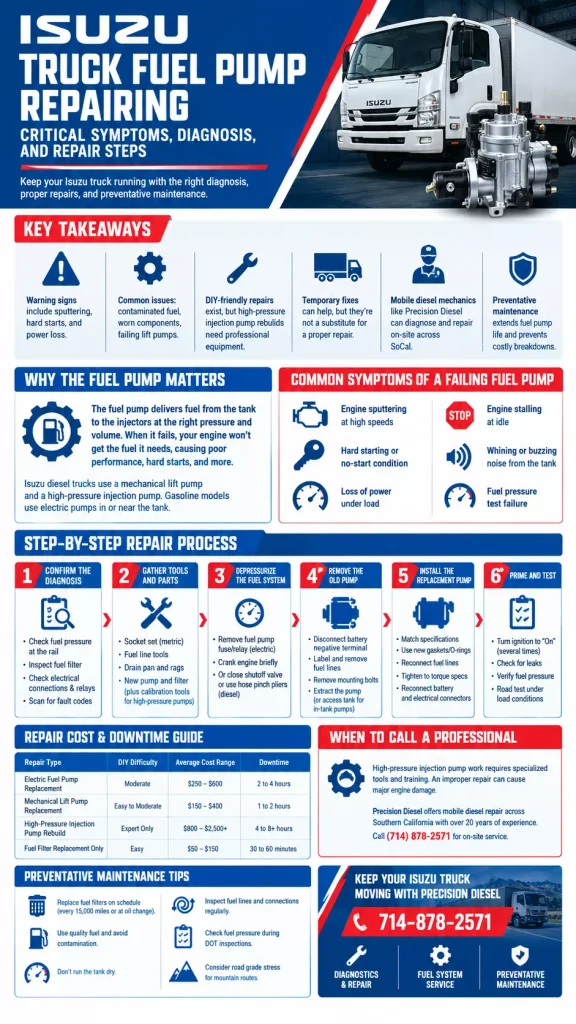
- A failing fuel pump often shows warning signs before it fails completely, including engine sputtering, hard starts, and power loss under load.
- Isuzu diesel trucks are prone to specific fuel pump issues related to contaminated fuel, worn injection pump components, and failing lift pumps.
- Some fuel pump repairs are DIY-friendly, but high-pressure injection pump rebuilds typically require professional equipment and expertise.
- Temporary fixes can keep a truck moving in an emergency, but they are not substitutes for a proper repair.
- Mobile diesel mechanics, like those at Precision Diesel, can diagnose and repair fuel pump problems on-site across Southern California.
- Preventative maintenance is the most effective way to extend fuel pump life on any Isuzu commercial vehicle.
Isuzu commercial trucks, including the popular NPR, NQR, NRR, and FTR series, are workhorses across industries in the United States. Whether you’re running a fleet across Los Angeles County or hauling freight through Orange County, a fuel pump failure is one of the most disruptive mechanical problems you can face. Knowing the signs early and understanding the repair process gives you a clear advantage before a small problem becomes an expensive breakdown.
Why the Fuel Pump Is Critical to Your Isuzu Truck’s Performance
The fuel pump is the heart of your truck’s fuel delivery system. Its job is simple in principle: draw fuel from the tank and deliver it to the injectors or injection pump at the correct pressure and volume. When it fails, the engine does not receive the fuel it needs to run efficiently, or at all.
Isuzu diesel trucks typically use a mechanical lift pump combined with a high-pressure injection pump. Gasoline-powered Isuzu light trucks use electric fuel pumps mounted in or near the fuel tank. Each type has its own failure modes and repair approaches, which is why proper diagnosis matters before you start replacing parts.
A weak or failing fuel pump causes cascading problems throughout the engine. Low fuel pressure can cause lean-running conditions, premature injector wear, and in diesel systems, it can allow air into the fuel lines, making the engine extremely difficult to start. According to the National Institute for Automotive Service Excellence, improper fuel system diagnosis is one of the leading causes of unnecessary part replacement in commercial truck repair.
Understanding these stakes is why reading reliable diesel truck repair tips is a smart first step before picking up a wrench.
Common Symptoms of a Failing Isuzu Fuel Pump
Catching the problem early is always better than waiting for a complete failure. Here are the most recognizable symptoms to watch for on your Isuzu truck:
Engine Sputtering at High Speeds
If your engine runs smoothly at low speeds but sputters or hesitates when you accelerate or climb grades, the fuel pump may be struggling to maintain adequate pressure under demand.
Hard Starting or No-Start Condition
A worn pump may not build pressure quickly enough on startup. You might notice the engine cranking longer than normal before it fires, or it may not start at all.
Loss of Power Under Load
When hauling heavy loads, your engine needs more fuel. A weak pump cannot keep up, resulting in noticeable power loss, especially on grades or when merging onto highways.
Engine Stalling at Idle
Intermittent stalling, particularly after the Isuzu 4JA1 engine has warmed up, often points to a pump that is failing under heat stress.
Whining or Buzzing Noise from the Fuel Tank
On electric pump systems, a high-pitched whine from the rear of the truck is a classic early warning sign. Healthy electric pumps make minimal noise.
Fuel Pressure Test Failure
This is the definitive diagnostic step. Using a fuel pressure gauge connected to the fuel rail test port, you can compare your readings against Isuzu’s manufacturer specifications. Any reading outside the specified range confirms a fuel delivery problem.
Step-by-Step Isuzu Truck Fuel Pump Repair Process
Whether you are handling this yourself or working alongside a mechanic, understanding the full process for semi truck radiator replacement cost will help you make smarter decisions at every stage.
Step 1: Confirm the Diagnosis
Before removing anything, verify the fuel pump is actually the problem. Check the following:
- Fuel pressure at the rail or injection pump inlet using a calibrated gauge
- Fuel filter condition (a clogged filter mimics pump failure symptoms)
- Electrical connections and relay condition (for electric pump systems)
- Check for fault codes using an OBD-II or diesel-specific scan tool
For Isuzu 4HK1 and 6HK1 diesel engines commonly found in NPR and FTR trucks, low rail pressure codes will often point to the high-pressure fuel pump or the supply pump separately.
Step 2: Gather Tools and Parts
For a mechanical lift pump replacement, you will need:
- Basic socket set (metric)
- Fuel line disconnect tools
- Drain pan and rags
- Replacement lift pump (OEM or quality aftermarket)
- New fuel filter
For a high-pressure injection pump rebuild or replacement, you will additionally need access to calibration equipment, which is why most fleets defer this work to a qualified diesel injection specialist.
Step 3: Depressurize the Fuel System
On electric systems, locate the fuel pump fuse or relay in the fuse box, remove it, and crank the engine briefly to bleed off line pressure. On mechanical diesel systems, close the fuel shutoff valve if equipped, or use hose pinch pliers to isolate the supply line.
Step 4: Remove the Old Pump
- Disconnect the battery negative terminal first.
- Label and disconnect all fuel lines attached to the pump. Use clean rags to catch residual fuel.
- Remove the mounting bolts and carefully extract the pump.
- On in-tank electric pumps, you will need to remove the fuel tank or access the pump through a panel under the cab or bed.
Step 5: Install the Replacement Pump
- Confirm the replacement pump matches the flow rate and pressure specifications for your Isuzu model.
- Install with new gaskets or O-rings where required.
- Reconnect all fuel lines and tighten fittings to manufacturer torque specs.
- Reconnect the battery and electrical connectors.
Step 6: Prime and Test
- Turn the ignition key to the “On” position (without cranking) several times to prime the system.
- Check all connections for fuel leaks.
- Start the engine and verify fuel pressure with your gauge.
- Road test the truck under normal load conditions to confirm the repair held.
| Repair Type | DIY Difficulty | Average Cost Range | Downtime |
|---|---|---|---|
| Electric Fuel Pump Replacement | Moderate | $250 to $600 | 2 to 4 hours |
| Mechanical Lift Pump Replacement | Easy to Moderate | $150 to $400 | 1 to 2 hours |
| High-Pressure Injection Pump Rebuild | Expert Only | $800 to $2,500+ | 4 to 8+ hours |
| Fuel Filter Replacement Only | Easy | $50 to $150 | 30 to 60 minutes |
When to Call a Professional Instead of DIYing
Certain aspects of fuel pump work fall outside what most fleet operators or owner-operators should attempt without specialized training and equipment. High-pressure injection pump calibration on common rail diesel systems, for example, requires bench calibration tools that cost tens of thousands of dollars. An improperly calibrated injection pump can destroy injectors within hours of operation, turning a $1,000 repair into a $5,000 engine problem.
Precision Diesel, a mobile diesel mechanic service operating across Southern California including Los Angeles County, Orange County, and Riverside County, brings the repair shop to your location. With over 20 years of experience, Precision Diesel handles fuel system diagnosis and repair on Isuzu trucks and other heavy-duty diesels without requiring you to tow your truck to a brick-and-mortar shop. Call them at (714) 878-2571 for immediate assistance.
If you are managing a fleet, staying current on the importance of semi truck fleet maintenance will help you understand why fuel system inspections should be part of your regular preventative maintenance schedule, not just a reactive fix.
While managing operating costs, fleet operators sometimes forget that fuel system failures can trigger other expensive repairs. For example, a clogged or air-starved injection pump can cause overheating events that lead to coolant system damage, the kind that drives up semi truck radiator replacement cost significantly.
Similarly, staying compliant with regulations matters alongside mechanical upkeep. Isuzu trucks operating in California must meet strict emission standards, and a malfunctioning fuel system can trigger check engine lights that affect your california truck emissions compliance status during inspections.
For fleet managers and independent operators who want to stay ahead of mechanical issues, the Precision Diesel articles library is a valuable resource covering a wide range of heavy-duty truck maintenance topics.
Fuel Pump Maintenance to Prevent Future Failures
Preventing a fuel pump failure is significantly cheaper than repairing one. Here are the most effective practices:
- Replace fuel filters on schedule. A clogged filter forces the pump to work harder, dramatically shortening its service life. For most Isuzu diesel trucks, this means replacing the primary and secondary fuel filters every 15,000 miles or at each oil change, whichever comes first.
- Use quality fuel. Contaminated diesel with high water content or particulate matter accelerates pump and injector wear. If your truck fuels at locations with questionable fuel quality, add a quality fuel conditioner.
- Avoid running the tank dry. Fuel lubricates and cools the pump in electric systems. Running consistently low on fuel increases heat stress on the pump motor.
- Inspect fuel lines and connections regularly. Cracked or deteriorating fuel hoses allow air ingestion in diesel systems, which starves the pump and creates hard-start conditions.
- Include fuel pressure checks in your DOT inspection prep. Low fuel pressure is a precursor to failure and is easily caught during routine diagnostics.
For operators who run routes through mountainous terrain in Southern California, understanding how road grades affect drivetrain stress adds another layer to preventative planning. Resources like information on runaway truck ramp southern california serve as a reminder that drivetrain and fuel system health directly affect safety in demanding terrain.
Comparing Repair Options for Isuzu Fuel Pump Problems
Not every fuel pump problem requires a full replacement. Here is a practical breakdown of your options:
Repair the existing pump: Possible for some mechanical lift pumps where only the diaphragm or check valves have failed. Rebuild kits are available for select Isuzu models at prices typically between $30 and $80. This approach works well when the pump body and housing are undamaged.
Replace with OEM: Isuzu-branded replacement pumps guarantee fitment and meet original performance specifications. They cost more upfront but carry manufacturer warranty coverage.
Replace with quality aftermarket: Brands like Denso, Bosch, and Carter produce well-regarded replacement pumps for Isuzu applications. These offer a strong balance of cost and reliability for high-mileage fleet trucks.
Mobile on-site repair: For fleets that cannot afford extended downtime, having a mobile diesel mechanic like Precision Diesel come to your location eliminates towing costs and gets trucks back in service faster than traditional shop visits.
The Mayo Clinic’s principles on workplace safety are a useful reminder that working around fuel systems requires proper safety precautions, including fire suppression equipment, proper ventilation, and grounding to prevent static discharge.
For detailed technical specifications on fuel system standards and safe handling of diesel fuel, the U.S. Department of Energy’s Alternative Fuels Data Center provides verified reference information applicable to diesel truck operators across the country.
The Occupational Safety and Health Administration (OSHA) also publishes guidelines for safe fuel system service in commercial vehicle maintenance environments, which any shop or mobile mechanic should reference before beginning fuel system work.
Let Precision Diesel Handle Your Fuel System Repairs On-Site
If your Isuzu truck is showing signs of fuel pump trouble, every hour it sits idle costs your operation money. Precision Diesel brings certified mobile diesel mechanics directly to your location across Los Angeles County, Orange County, Riverside County, and surrounding areas in Southern California, so you never have to arrange an expensive tow or lose days waiting at a shop. With over 20 years of experience and a full range of fuel system diagnostics, repair, and preventative maintenance services, Precision Diesel keeps your fleet moving and your routes running on schedule.
Call Precision Diesel right now at (714) 878-2571 and get a mobile diesel mechanic dispatched to your location today.
Frequently Asked Questions
Can a failing fuel pump be repaired?
In many cases, yes, a failing fuel pump can be repaired rather than fully replaced, depending on the type and extent of the damage.
Mechanical lift pumps, for example, often fail due to worn diaphragms or faulty check valves, both of which can be addressed with inexpensive rebuild kits. However, electric fuel pumps and high-pressure common rail injection pumps that have suffered internal mechanical damage or electrical failure typically require full replacement rather than repair. A proper diagnosis using a fuel pressure gauge and scan tool will help determine whether a repair or a replacement is the more cost-effective path for your specific situation.
What are some common fuel pump problems with Isuzu vehicles?
Isuzu trucks commonly experience fuel pump issues related to contaminated fuel, worn injection pump components, clogged fuel filters, and failing lift pumps on diesel models.
On the popular 4HK1 and 6HK1 diesel engines found in Isuzu NPR, NQR, and FTR trucks, low rail pressure is a frequently reported fault code that points to supply pump wear or injector return line problems. Gasoline-powered Isuzu light trucks are more prone to electric fuel pump motor failure, particularly in high-mileage vehicles where the pump has been regularly stressed by low fuel levels. Water contamination in the fuel supply is another common culprit, especially for trucks that fuel at high-volume commercial stations where tank turnover and water separator maintenance can be inconsistent.
How to repair a bad fuel pump?
Repairing a bad fuel pump starts with confirming the diagnosis through a fuel pressure test, followed by isolating the system, removing the faulty pump, installing a verified replacement or rebuild kit, and testing the system under load.
For mechanical lift pumps, a rebuild kit addressing the diaphragm and check valves is often sufficient and can be completed with basic hand tools. For electric pumps, replacement is almost always the correct approach since the internal motor windings and brushes are not serviceable in the field. High-pressure injection pumps on diesel trucks require bench calibration equipment to repair properly, making professional service the only responsible option for that component. Always replace the fuel filter at the same time as any pump repair to ensure clean fuel flow through the new or rebuilt pump from day one.
Can a diesel fuel pump be repaired?
Yes, diesel fuel pumps can be repaired, but the feasibility depends entirely on which pump in the system has failed and what type of damage it has sustained.
Mechanical lift pumps on older diesel engines are the most repairable, with rebuild kits widely available for Isuzu applications. Transfer pumps that move fuel from the tank to the injection system can also sometimes be serviced with new seals and diaphragms. However, modern high-pressure common rail injection pumps, like those found in newer Isuzu diesel trucks, operate at pressures exceeding 20,000 PSI and require specialized calibration equipment to repair and verify correctly. Attempting to rebuild a common rail injection pump without proper bench equipment can result in calibration errors that damage injectors and cause serious engine problems. In most cases, a professionally remanufactured unit is the most reliable and cost-effective solution for this component.
How to temporarily fix a bad fuel pump?
A temporary fix for a bad fuel pump is only appropriate in emergency situations and should never be treated as a long-term solution, but a few approaches can get a truck moving when you are stranded.
On diesel trucks with mechanical lift pumps, if the pump has partially failed, priming the system manually using the hand primer lever found on many lift pumps can restore enough fuel pressure to start the engine and move the truck a short distance. On electric pump systems, tapping the bottom of the fuel tank firmly while a second person cranks the engine can sometimes free a stuck pump motor temporarily.
Keeping the fuel tank as full as possible also reduces heat stress on the electric pump and may stabilize intermittent failures long enough to reach a service location. None of these measures address the underlying failure, and operating a truck with a compromised fuel pump risks injector damage, hard starts, and complete roadside breakdowns. Contact a mobile diesel mechanic as soon as possible after using any temporary measure.
The Bottom Line on How to Repair Isuzu Truck Fuel Pump Repairing
Fuel pump failures do not have to sideline your Isuzu truck for days or drain your maintenance budget if you catch the warning signs early and respond with the right repair strategy. Whether you are dealing with a straightforward lift pump replacement or a more complex high-pressure injection pump issue, the process of how to repair Isuzu truck fuel pump repairing is manageable when you understand the system, follow the correct diagnostic steps, and use quality replacement parts matched to your specific Isuzu model.
For fleet operators and owner-operators across Southern California, the smartest move is to partner with a mobile diesel repair service that comes to you. Precision Diesel serves Los Angeles County, Orange County, Riverside County, and surrounding areas with on-site fuel system diagnosis, repair, and preventative maintenance for Isuzu trucks and other heavy-duty diesels. Call (714) 878-2571 today and get your truck back on the road without the tow bill.
