
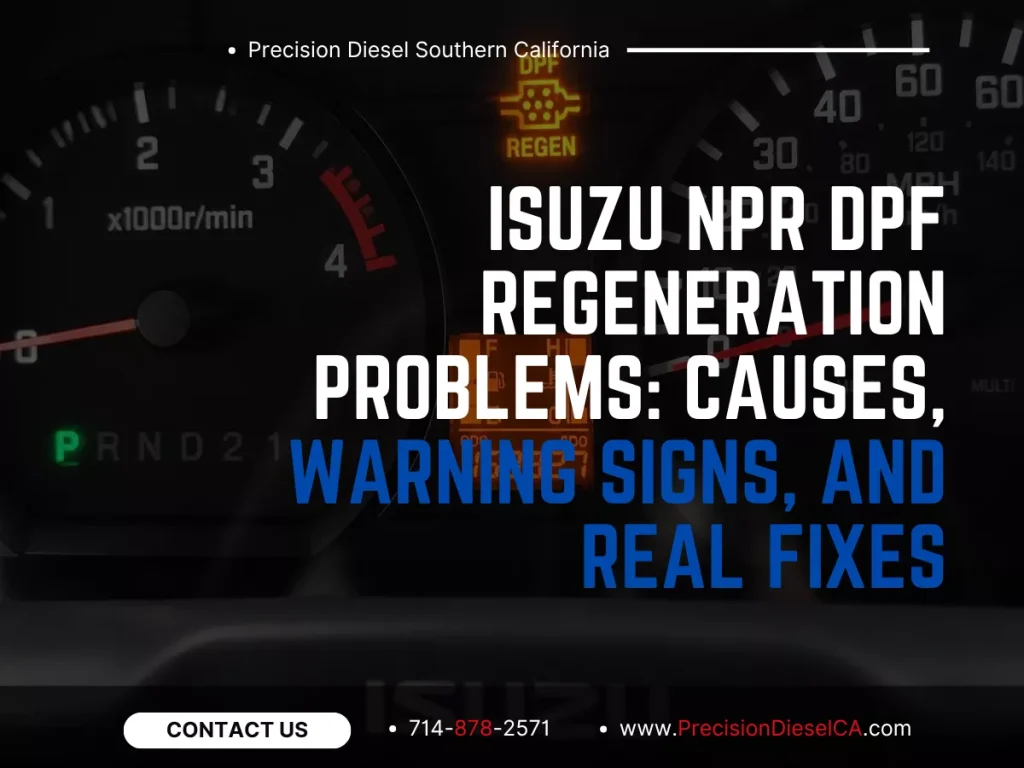
Isuzu NPR DPF regeneration problems occur when the diesel particulate filter cannot complete its burn-off cycle, causing soot to accumulate until the engine enters limp mode or shuts down. Understanding why regens fail, what the warning lights mean, and how to fix them before they cascade into expensive repairs is essential for any NPR operator or fleet manager.
Key Takeaways
- A yellow regen light means the filter is loading up and needs attention soon; a red or flashing light is an immediate stop situation.
- Stop-and-go city routes are the single biggest contributor to incomplete regeneration cycles on the NPR.
- Parked (forced) regens are a short-term tool, not a long-term solution. Repeated forced regens without diagnosing the root cause will not clear ash buildup.
- Multiple failed regens usually point to a hardware failure, such as a faulty differential pressure sensor, a stuck EGR valve, or a failing exhaust brake, rather than a simple clog.
- DPF cleaning or replacement should be considered when parked regens no longer bring soot levels down to baseline.
- According to Global Growth Insights (2026), DPF installation increases vehicle operating expenses by 20% due to fuel consumption penalties and periodic maintenance, making proactive management critical for fleet economics.
What the NPR Regen Warning Lights and Messages Actually Mean
Most drivers see a warning light and assume it can wait until the next stop. With the NPR’s diesel particulate filter system, that assumption can cost you thousands of dollars.
Is It a DPF or a DPD?
Isuzu officially calls its system a Diesel Particulate Diffuser (DPD), though many technicians and parts suppliers use the terms DPF and DPD interchangeably. The underlying hardware and the regeneration process are essentially the same. The DPD traps soot particles from combustion, and periodically the system burns that soot off at high temperatures. When the burn-off cycle is the topic of conversation with your mechanic or when you are reading articles about medium-duty truck maintenance, knowing that “DPF” and “DPD” refer to the same system on your NPR will prevent confusion.
Here is a quick breakdown of the warning escalation sequence:
| Warning Stage | Light Color | What It Means | Action Required |
|---|---|---|---|
| Stage 1 | Amber/Yellow | Filter loading, passive regen not keeping up | Plan a highway run or parked regen soon |
| Stage 2 | Amber + message | Active regen needed immediately | Perform parked regen at first safe opportunity |
| Stage 3 | Red or Flashing | Filter near-full, limp mode imminent | Stop safely, perform parked regen or call a tech |
| Stage 4 | Red + fault code | Regen failed, engine protection active | Do not drive; professional diagnosis required |
Missing stage 1 and 2 warnings and driving into stage 3 or 4 is the most common mistake NPR operators make. The system is telling you early. Listen to it.

Why Your NPR Won’t Finish a Regen: The Real Root Causes
A failed or incomplete regeneration is almost never just about a dirty filter. The DPF system depends on a chain of components all performing correctly at the same time. If any link in that chain breaks, the regen cycle stalls.
The most common hardware failures that interrupt a regen on the Isuzu NPR-HD include:
- Differential pressure sensor failure: This sensor measures soot load by comparing exhaust pressure before and after the filter. A failed sensor gives the ECU false readings, causing it to either skip regens or repeat them endlessly. The P2463 fault code, which flags DPF soot accumulation, is frequently traced back to this sensor on 2011 to 2024 NPR-HD models, according to Go-Parts.com.
- Exhaust brake malfunction: The exhaust brake generates back-pressure that raises exhaust temperatures during a regen cycle. If it is stuck open or not engaging, exhaust temperatures stay too low to complete combustion of trapped soot.
- Faulty thermostat: A thermostat that opens too early keeps coolant and exhaust temperatures below the threshold the ECU requires to authorize a regen.
- Clogged or failing EGR valve: The EGR system recirculates exhaust gases as part of the combustion management strategy. A stuck or heavily carboned EGR valve disrupts the combustion balance and reduces exhaust temperatures.
- Worn injectors: Injectors that are not atomizing fuel properly produce incomplete combustion, which increases raw soot loading on the DPF faster than the regeneration system can compensate.
- Air intake restrictions: A dirty air filter or a cracked intake hose lowers combustion efficiency, generating excess particulate and starving the regen of the oxygen it needs to burn soot at high temperature.
For fleet managers tracking the importance of semi truck fleet maintenance across multiple vehicles, establishing a documented inspection interval for each of these components is far cheaper than repeated DPF cleanings.
Why City Delivery Routes Are the Primary Culprit for NPR Regen Failures
The Isuzu NPR is one of the most popular last-mile delivery and municipal fleet vehicles on American roads, and that operational profile is precisely what makes DPF problems so common on this platform.
Passive regeneration, which is the system’s preferred and lowest-cost method, requires sustained exhaust temperatures typically above 570°F. Those temperatures are only achievable at highway speeds under moderate to heavy load. A truck running urban delivery routes in Los Angeles, doing short blocks between stops, idling for pickups, and rarely exceeding 35 mph, may go entire days without the exhaust ever getting hot enough for passive regen to occur.
The result is progressive soot accumulation. According to Global Growth Insights (2026), cordierite DPFs, the type used in many medium-duty applications, require frequent regeneration cycles, leading to a 30% higher maintenance rate compared to newer emission control technologies. City-duty NPR trucks sit squarely in this high-maintenance category.
Operators working in Southern California should also be aware that california truck emissions compliance requirements add another layer of urgency. A malfunctioning DPF system can result in a failed smog inspection and compliance violations under the California Air Resources Board regulations, creating both financial and operational headaches.
When routes cannot be changed, the answer is scheduled forced regens. Building a parked regen into the end-of-shift routine, before the truck ever reaches stage 3, keeps the filter from loading to failure levels.
How Long a Parked Regen Actually Takes and What to Do During It
A parked (forced) regen on the Isuzu NPR typically takes 20 to 40 minutes to complete, depending on the current soot load and ambient conditions. The ECU runs the engine at elevated RPM, uses the post-injection strategy to spike exhaust temperatures, and burns the accumulated soot down to ash.
To perform a parked regen safely:
- Park the truck on a flat, fireproof surface away from flammable materials. Exhaust temperatures during regen can exceed 1,000°F at the tailpipe.
- Make sure the fuel level is at least one-quarter tank. The ECU will abort the regen if it detects low fuel.
- Keep the transmission in park or neutral with the parking brake engaged.
- Do not leave the truck unattended during the cycle.
- Allow the process to run until the warning light extinguishes. Interrupting a regen mid-cycle increases the risk of fuel dilution in the engine oil.
One critical point that many operators miss: a successful parked regen only burns off soot. It does not remove ash. Ash is the non-combustible residue that accumulates from engine oil additives and cannot be burned away. Over time, ash reduces filter capacity regardless of how often you run regens. That is why the filter eventually needs physical cleaning or replacement, not just more burn cycles.
Understanding the difference between soot and ash is also valuable context when discussing semi truck radiator replacement cost and similar maintenance budget conversations. Coolant system health and DPF health are connected: a failing radiator that allows the engine to run rich and hot accelerates both soot production and filter degradation.
When the Filter Needs Cleaning or Replacement Instead of Another Regen
A common and costly mistake is using forced regens to chase a problem that has already moved beyond what regeneration can fix. If your NPR is running parked regens with increasing frequency, or if a forced regen completes but the warning light returns within a day or two, the filter itself is the issue.
Signs that cleaning or replacement is overdue:
- Regen warning lights return within 24 to 48 hours of a completed forced regen
- The ECU reports a regen as complete, but the P2463 or similar soot accumulation code comes back immediately
- A technician’s differential pressure reading shows restriction even after a successful cycle
- The truck has accumulated significant miles without a documented professional DPF cleaning
Industry guidance generally suggests professional ultrasonic or pneumatic DPF cleaning at approximately every 100,000 miles for trucks in normal operation, with shorter intervals for city-duty or stop-and-go routes. Replacement becomes the conversation when cleaning no longer restores filter flow to within spec.
For fleet operators in Southern California, mobile diagnostics can identify whether the filter or a supporting component is the root cause before committing to replacement costs. Reading diesel truck repair tips on component-level diagnostics can help you ask the right questions when talking to a technician.
The global DPF retrofit market reached $8.2 billion in 2025 and is projected to expand to $14.7 billion by 2033 at a CAGR of 7.8%, according to DataIntelo (2025). That market growth reflects just how common DPF service has become across commercial fleets, and why understanding the distinction between a cleaning and a replacement matters for budgeting.
Preventing Regen Failures: Proactive Habits That Reduce DPF Problems
Reactive repairs are always more expensive than prevention. The following habits significantly reduce the frequency and severity of Isuzu NPR DPF regeneration problems:
- Use the correct engine oil: Low-SAPS (Sulfated Ash, Phosphorus, Sulfur) engine oil is specified for DPF-equipped diesel engines. Standard oil increases ash loading and shortens filter service life.
- Change oil on schedule: Extended oil intervals allow blow-by contamination to accelerate soot production. Follow Isuzu’s specified interval, not a generic one.
- Run highway miles periodically: Even one highway segment per week gives the passive regen system an opportunity to complete a cycle naturally, reducing the burden on forced regens.
- Avoid excessive idling: Extended idling keeps exhaust temperatures low, which is the worst operating condition for a DPF system.
- Inspect the air filter regularly: A restricted intake directly reduces combustion efficiency and increases particulate output.
- Monitor coolant and thermostat condition: Exhaust temperature management starts with a properly functioning cooling system. A thermostat that fails open is a regen killer.
For trucks operating on challenging terrain, it is worth knowing where runaway truck ramp southern california infrastructure is located, but for daily urban fleet management, the preventive list above will do more to protect your equipment than almost any other investment.
According to Global Growth Insights (2026), advanced passive regeneration technologies reduce active regeneration cycle frequency by 25%, improving fuel efficiency and reducing maintenance costs. While newer filter designs benefit from this, older NPR models in city service still rely heavily on operator habits to compensate.
Keeping NPR Fleets Running in Southern California: What Mobile Service Makes Possible
For fleet operators in Los Angeles County, Orange County, and Riverside County, the logistics of getting a truck into a fixed shop for DPF diagnostics can mean a full day of lost revenue. Mobile diesel service changes that equation entirely.
Precision Diesel provides on-site DPF filter cleaning, EGR filter cleaning, engine computer diagnostics, and exhaust system repair across Southern California without requiring your truck to leave your yard or your route. With over 20 years of experience in heavy-duty diesel repair, the Precision Diesel team can diagnose whether your NPR’s regen failure is a sensor issue, a hardware problem, or a filter-end-of-life situation, and handle the repair on the spot.
Cities implementing low-emission zones have seen a 30% rise in DPF retrofits for public transportation and commercial fleets, according to Global Growth Insights (2026), which signals that DPF compliance is only going to become more scrutinized, not less, for Southern California operators already navigating CARB requirements.
Whether your truck is in Santa Ana, Long Beach, Pomona, or anywhere across the region, you can reach Precision Diesel at (714) 878-2571 to schedule mobile DPF service, diagnostics, or preventive maintenance before the next regen failure takes your vehicle out of service. For additional technical background on DPF systems, the Mayo Clinic approach of “diagnose first, treat second” applies equally well to diesel emissions systems as it does to medicine. Always confirm the root cause before replacing parts.
For broader industry context on emission control system performance and regulatory trends, the EPA’s emissions standards resources provide authoritative detail on what compliance thresholds your NPR must meet. The Wikipedia overview of diesel particulate filters also offers a solid foundational reference on how these systems function across different engine platforms, including those used in the Isuzu NPR-HD lineup. For technical fault code specifics on the 4HK1-TC engine, the documented P2463 analysis at Go-Parts.com is a reliable starting reference before booking a diagnostic appointment.
Schedule Mobile DPF Service Before Your Next Regen Failure Costs You
If your Isuzu NPR is throwing regen warning lights, cycling through forced regens without clearing, or already sitting in limp mode, every hour you wait is a hour of lost revenue and a longer repair bill. Precision Diesel brings fully equipped mobile diesel mechanics directly to your location across Los Angeles County, Orange County, Riverside County, and surrounding Southern California areas, so your truck gets diagnosed and repaired without leaving your yard or your route.
With over 20 years of heavy-duty diesel experience and services that include DPF filter cleaning, EGR filter cleaning, engine computer diagnostics, and full exhaust system repair, the team at Precision Diesel can identify the root cause of your regen problem and fix it on the spot. Call Precision Diesel now at (714) 878-2571 and get a mobile technician dispatched to your location today.
Frequently Asked Questions
Q: Can I just keep doing parked regens?
Parked regens are a short-term management tool, not a permanent fix, and relying on them repeatedly without diagnosing the root cause will eventually damage your engine and your filter.
Each time you run a forced regen, you are burning off soot, but ash continues to accumulate inside the filter and cannot be removed through any regeneration cycle. If you are running parked regens more than once a week, that frequency is a symptom of a deeper problem, whether it is a faulty sensor, a misfiring injector, or a route profile that never allows passive regeneration to occur.
Beyond the filter itself, repeated forced regens carry a real risk of fuel dilution in the engine oil, because the post-injection strategy used to spike exhaust temperatures can push raw diesel past the rings and into the crankcase. Check your oil level and viscosity regularly if forced regens are a regular part of your routine, and schedule a professional diagnostic to find out why the system cannot keep up on its own.
Q: Is it OK to drive with the yellow regen light on?
You can continue driving when the yellow regen light first comes on, but you should treat it as an immediate action item rather than a light you can ignore for days.
The yellow regen light at stage 1 means the filter is loading up and passive regeneration has not been keeping pace with soot accumulation. At this point, the truck is still operational and limp mode is not imminent, but the window to address the issue on your terms is open. The best response is to find a safe stretch of highway where you can run at steady speed for 20 to 30 minutes, which gives the passive regen system the exhaust temperature it needs to complete a cycle naturally.
If highway driving is not practical, plan a parked regen at the end of your shift. Ignoring the yellow light and allowing it to escalate to a flashing or red warning is when you lose control of the situation, because at that stage the ECU begins restricting engine power and you are no longer choosing when to deal with the problem.
Q: Why did my NPR go into limp mode after a regen light?
Your NPR entered limp mode because the DPF reached its maximum allowable soot load threshold and the ECU activated engine protection to prevent filter damage or a thermal event.
The ECU monitors soot levels continuously through the differential pressure sensor. When that sensor reports that the filter has loaded beyond a programmed limit, and either a regen attempt has failed or no regen was performed in response to the warning lights, the engine management system reduces power output to lower exhaust temperatures and particulate production. This is a protective response, not a mechanical failure in itself, but it signals that the system has already escalated through multiple warning stages without resolution.
Limp mode on the NPR typically means the truck should not be driven further until a parked regen is completed or a technician clears the fault and addresses the underlying cause. Driving in limp mode for extended distances risks forcing soot so deep into the filter substrate that no regen cycle, forced or passive, can recover it.
Q: How to fix DPF limp mode?
Fixing DPF limp mode on the Isuzu NPR requires first performing a parked regen to attempt to lower the soot load, then using a diagnostic scanner to clear active fault codes, and finally identifying and repairing whatever component failure caused the regen to fail in the first place.
If the parked regen completes successfully and the fault codes clear, the truck may exit limp mode on its own or after a key cycle. However, if the regen does not complete, if the codes return immediately, or if the differential pressure reading remains elevated after a full cycle, the filter itself or a supporting component requires professional attention. A technician with a factory-level or professional-grade scanner can read live data from the differential pressure sensor, exhaust temperature sensors, and injector performance to pinpoint the failure.
Common repairs at this stage include differential pressure sensor replacement, EGR valve cleaning or replacement, exhaust brake repair, and in more advanced cases, DPF cleaning or outright filter replacement. Attempting to clear codes without addressing the root cause will result in the truck returning to limp mode within a short period of operation.
Q: My Isuzu DPF light is flashing. What does this mean and how can I fix it?
A flashing DPF light on your Isuzu NPR is a critical warning indicating that the filter has reached or is approaching maximum soot capacity and that the system may have already attempted and failed a regeneration cycle.
At this stage, you should stop driving as soon as it is safe to do so. A flashing light is not the same as a steady amber warning. It means the system has escalated past the advisory phase and the ECU is actively telling you that continued operation risks permanent filter damage or an uncontrolled thermal event inside the exhaust. To attempt a fix, park the truck on a non-flammable surface, engage the parking brake, ensure the fuel level is above one-quarter tank, and initiate a parked regen using the dash-mounted switch or the procedure outlined in your NPR operator manual.
If the regen completes and the light extinguishes, monitor the truck closely over the next 24 hours. If the light returns quickly, returns flashing, or if the regen will not initiate at all, the truck needs a professional diagnosis before it is returned to service. At that point, the issue has moved beyond operator-level troubleshooting and into component-level repair.
The Bottom Line on Isuzu NPR DPF Regeneration Problems
Isuzu NPR DPF regeneration problems are among the most common and most mismanaged maintenance issues in the medium-duty truck segment, precisely because the early warning signs are easy to dismiss and the consequences of dismissing them are expensive. The filter warning system on your NPR gives you multiple opportunities to intervene before the situation becomes a limp-mode event or a filter replacement. Taking those early warnings seriously, building parked regens into your end-of-shift routine, keeping up with oil changes and air filter inspections, and scheduling professional diagnostics at the first sign of repeated or failed regens will keep your operating costs predictable and your truck on the road.
If you are managing an NPR fleet in Southern California and regen issues are becoming a recurring problem, the most effective next step is a mobile diagnostic appointment with a technician who can pull live sensor data and tell you exactly which component is failing, rather than guessing at parts replacements. Contact Precision Diesel at (714) 878-2571 to schedule on-site DPF diagnostics and service across Los Angeles County, Orange County, Riverside County, and surrounding areas. Get the root cause identified today, before the next regen failure takes another truck out of rotation.
