
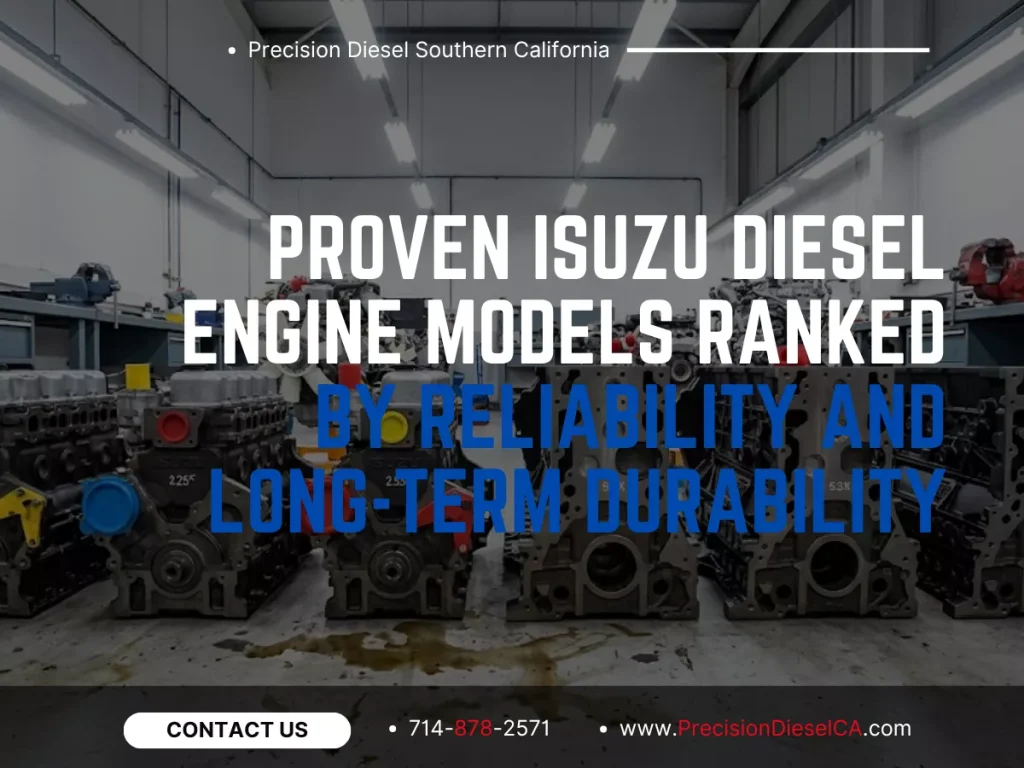
The Isuzu diesel engine is widely regarded as one of the most dependable powerplants in commercial trucking, with production exceeding 26 million units worldwide according to Isuzu’s 2023 annual report. Whether you operate a light-duty pickup or a heavy-duty semi, understanding which Isuzu engine best fits your application can directly affect your maintenance costs, downtime, and total cost of ownership.
Key Takeaways
- Isuzu has produced more than 26 million diesel engines to date, with annual production capacity exceeding 1 million units globally (Isuzu, 2023).
- The 4JJ1 remains the strongest all-around choice for operators who need a balance of fuel economy, reliability, and parts availability.
- Selecting the correct Isuzu diesel engine for your application ensures optimal reliability, fuel efficiency, and lower overall operational costs.
- Isuzu diesel engines carry a B10 durability rating of 375,000 miles, meaning 90% of engines are expected to reach that mileage without major failure.
- The global diesel engine market is projected to grow from $56.86 billion in 2026 to $92.15 billion by 2034, at a CAGR of 6.22% (Straits Research, 2026).
- Regular EGR cleaning, injector maintenance, and coolant system checks are the most impactful service tasks for extending Isuzu engine life.
- Fleet operators in Southern California should ensure their Isuzu-powered trucks meet current state emissions standards to avoid costly penalties.
At a Glance: The Most Reliable Isuzu Engines Ranked
Before going deep into each model, here is a quick-reference table showing the top engines, their displacements, primary applications, and what makes each one stand out from a fleet management perspective.
| Engine Model | Displacement | Primary Application | Key Strength |
|---|---|---|---|
| 4JJ1 | 3.0L | Light/medium trucks, pickups | All-around balance of power and economy |
| 4HK1 | 5.2L | Medium-duty trucks, buses | Heavy-cycle durability |
| 4JB1 | 2.8L | Light commercial, pickups | Simplicity, low cost of ownership |
| 4JG2 | 3.1L | Forklifts, light trucks | Proven long-term reliability |
| 6HK1 | 7.8L | Medium-duty, construction | High torque, sustained load capacity |
| 4BD1 | 3.9L | Light-medium trucks | Tough block, easy to rebuild |
| 4JA1 | 2.5L | Light commercial | Budget-friendly, wide parts network |
| 4JH1 | 2.5L | Mid-generation light trucks | Improved injection over 4JA1 |
| 4HL1 | 2.6L | Light trucks, vans | Economical, low-maintenance |
How Reliability Gets Measured for Commercial Diesel Engines
Ranking diesel engines by reliability is not simply a matter of horsepower or age. Shops and fleet managers assess engines using a combination of documented service life, B10 ratings, parts availability, and real-world maintenance complexity. Isuzu diesel engines have a B10 durability rating of 375,000 miles, meaning 90% of all units are statistically expected to exceed that mileage before requiring a major overhaul. That figure, current as of the 2017 specification update, remains one of the highest published B10 ratings in the light-to-medium duty segment.
Additional factors used in this ranking include:
- Maintenance complexity: How many specialized tools or dealership visits are required for routine service.
- Parts availability: Whether components can be sourced in the U.S. through OEM or quality aftermarket channels.
- Repair cost per mile: How much operators typically spend keeping the engine running across its service life.
- Mechanic feedback: The general consensus from technicians who work on these engines regularly across commercial fleets.
For fleet operators running multiple vehicles, you can find additional practical guidance through diesel truck repair tips that cover preventive strategies applicable to Isuzu-powered trucks.

In-Depth Look at the Most Reliable Isuzu Engine Models
Every Isuzu diesel engine in this lineup has been field-tested across millions of commercial highway miles to ensure maximum uptime and lower total cost of ownership.
4JJ1: The Strongest All-Around Isuzu Diesel Engine
The 4JJ1 is the most versatile engine in Isuzu’s lineup and consistently earns the top spot among fleet professionals. Displacing 3.0 liters and available in both naturally aspirated and turbocharged configurations, it powers everything from the Isuzu D-Max to the NPR light-duty truck series. Its common-rail direct injection system delivers fuel economy that significantly outperforms older mechanical injection engines, while its variable geometry turbocharger keeps torque delivery smooth across a wide RPM range.
According to Accio trend analysis (2025), the 1.9L Blue Power Turbo Diesel dominated the D-Max sales mix in Malaysia, contributing 60% of total units sold in the first half of 2025. While that specific variant targets smaller displacement markets, the 3.0L 4JJ1 family remains the dominant seller in commercial applications globally.
Known failure points to watch: injector wear after 150,000 miles and EGR valve buildup in stop-and-go duty cycles. Cleaning the EGR system every 60,000 miles and replacing injector return lines proactively can extend service life well beyond the average mileage threshold.
4HK1: Built for Heavy Sustained Cycles
The 4HK1 displaces 5.2 liters and is the workhorse of Isuzu’s medium-duty truck range, commonly found in the NPR-HD and NQR series. It uses a four-cylinder configuration that favors simplicity over complexity, which keeps rebuild costs lower than comparable six-cylinder competitors. Torque output is high enough for fully loaded delivery routes and construction site cycles, making it a preferred choice for vocational fleets.
Fleet managers tracking the importance of semi truck fleet maintenance will recognize the 4HK1 as a strong candidate for preventive maintenance programs, since its failure modes are predictable and well-documented.
Common issues include head gasket wear in engines operating above the recommended coolant temperature range and DPF regeneration problems in units with excessive idle time. Addressing these early with proper coolant system monitoring and active regen protocols keeps this engine running reliably for extended periods.
4JB1: Simple, Proven, and Easy to Source Parts For
The 4JB1 is a 2.8-liter mechanical injection engine with a reputation for being one of the easiest diesels to maintain in the field. It lacks the electronic complexity of newer common-rail systems, which means a skilled technician can diagnose and repair most issues without expensive scan tools. For small operators and owner-operators running older equipment, this engine represents one of the lowest costs of ownership in the segment.
Parts are widely available through both OEM channels and the aftermarket. You can review a broad range of sourcing options through this Isuzu Turbo Diesel Engine Buying Guide to understand current market pricing on replacement components.
4JG2: A Durable Older Platform Still Worth Considering
The 4JG2 displaces 3.1 liters and was widely used in industrial applications, particularly forklifts and light trucks. Its naturally aspirated design makes it simpler to service than turbocharged variants, and its cast-iron construction contributes to long-term durability even under high-vibration conditions. While it does not meet modern emissions standards without aftertreatment modifications, for off-road or industrial use it remains a reliable and cost-effective option.
6HK1: High Torque for Medium-Duty Commercial Work
The 6HK1 is Isuzu’s 7.8-liter six-cylinder engine, designed for sustained heavy-cycle performance in medium-duty applications including larger NPR and NRR platforms. Its six-cylinder layout provides smoother power delivery than four-cylinder alternatives, and the engine’s torque curve is optimized for stop-and-go urban delivery routes.
One area to monitor closely is the fuel injection system. Higher injection pressures in the 6HK1 demand cleaner fuel, and operators in regions with variable fuel quality should use quality fuel filters and replace them on schedule. Staying current on california truck emissions compliance is also critical for Southern California fleet operators running 6HK1-powered trucks, since state standards apply regardless of truck age in many cases.
4BD1: A Tough Block That Mechanics Actually Enjoy Rebuilding
The 4BD1 is a 3.9-liter engine that powered Isuzu trucks through the 1980s and 1990s and earned a following among independent mechanics for its straightforward design. Its block is extremely robust, and it responds well to rebuilding, making it a popular choice for operators who buy used equipment and want a platform they can cost-effectively restore. Cylinder head cracks are the most documented failure point, typically caused by overheating events.
4JA1: Practical Engineering for Light Commercial Work
The 4JA1 displaces 2.5 liters and was positioned as an entry-level commercial diesel throughout its production run. Its indirect injection system is less efficient than modern direct-injection designs, but it compensates with mechanical simplicity and widespread parts availability. For small business operators running light delivery vehicles, this engine offers predictable maintenance cycles and affordable Isuzu repair costs.
4JH1: Bridging Mechanical Simplicity and Electronic Refinement
The 4JH1 sits between the older 4JA1 and the more modern 4JJ1 in terms of technology. It introduced direct injection to this displacement class, improving fuel efficiency while retaining much of the mechanical accessibility that made its predecessor popular. Common issues include injector seal wear and occasional timing belt failures, both of which are addressable with scheduled preventive maintenance.
For operators who want to stay informed on broader technical topics, the Precision Diesel articles section covers a range of diesel maintenance and fleet management subjects.
4HL1: An Economical Light Truck Engine with Low Complexity
The 4HL1 displaces 2.6 liters and was designed primarily for light truck and van applications where fuel economy took priority over outright performance. It is not a high-power engine, but its low maintenance demand and small displacement make it an economical choice for urban fleet operations with predictable duty cycles.
Maintenance Costs and Service Intervals Across Isuzu Engine Families
One of the most significant gaps in competitor coverage is actual cost guidance. Here is a practical breakdown based on typical service needs across Isuzu engine families.
Following recommended service intervals for your Isuzu diesel engine prevents costly downtime and keeps critical components operating within OEM tolerances.
| Service Item | Typical Interval | Estimated Cost Range |
|---|---|---|
| Oil and filter change | Every 7,500-10,000 miles | $80-$150 |
| Fuel filter replacement | Every 30,000 miles | $60-$120 |
| EGR valve cleaning | Every 60,000 miles | $200-$500 |
| DPF cleaning | Every 150,000-200,000 miles | $300-$700 |
| Injector replacement (per injector) | As needed | $350-$800 |
| Coolant system service | Every 60,000 miles | $150-$300 |
Coolant system integrity is especially important for preventing head gasket failures in engines like the 4HK1. For reference on what related repairs can cost at the system level, reviewing semi truck radiator replacement cost gives a useful benchmark for coolant system repair budgeting.
Isuzu’s Production Scale and Market Position in 2026
According to Isuzu’s 2023 annual report, the company has produced more than 26 million diesel engines to date, with annual production capacity exceeding 1 million units worldwide. In fiscal year 2025, Isuzu Motors Limited sold approximately 525,000 vehicles globally, with around 77,000 units sold domestically in Japan, according to Statista (2025).
Isuzu invested $1.2 billion in research and development in 2023, with plans to increase that figure to $1.5 billion in 2024 (Isuzu Statistics, 2023-2024). That level of R&D investment is channeled heavily into emissions reduction and fuel efficiency improvements. As covered by Cars Guide (2025), Isuzu has introduced a new 2.2-liter engine in its D-Max and MU-X lineup to meet tightening global emissions regulations, signaling a clear shift in the company’s product direction.
The broader diesel engine market underlines why this matters commercially: Straits Research (2026) projects global diesel engine market growth from $56.86 billion in 2026 to $92.15 billion by 2034, at a CAGR of 6.22%. Isuzu is well-positioned to capture a significant portion of that growth given its production scale and brand reputation.
What Southern California Fleet Operators Should Know About Isuzu Engines
For fleets operating across Los Angeles County, Orange County, and Riverside County, Isuzu-powered trucks present both strong advantages and specific regulatory considerations. California Air Resources Board (CARB) rules govern diesel emissions standards strictly, and older Isuzu engines without modern aftertreatment systems may require upgrades or replacement to remain compliant. Keeping track of these requirements is essential for avoiding fleet downtime and fines. Staying current on state maintenance standards helps ensure your Isuzu diesel engine stays compliant while navigating strict regional air quality regulations.
Operators running Isuzu trucks through mountain corridors should also be aware of safety infrastructure. Understanding where a runaway truck ramp southern california is located on key routes can be a critical safety consideration for loaded commercial vehicles.
Precision Diesel Can Handle Your Isuzu-Powered Fleet
If your fleet runs Isuzu-powered trucks across Southern California and you need mobile maintenance or repair support, Precision Diesel provides on-site heavy-duty diesel service across Los Angeles County, Orange County, and Riverside County. From EGR cleaning and DPF service to engine diagnostics and coolant system repair, the team at Precision Diesel brings the shop to your location. Call (714) 878-2571 to schedule service for your Isuzu fleet today.
Frequently Asked Questions
What’s the best Isuzu diesel engine?
The 4JJ1 is widely considered the best Isuzu diesel engine for all-around commercial use.
It combines common-rail direct injection, a variable geometry turbocharger, and strong fuel economy in a compact 3.0-liter package. Its B10 durability rating and widespread parts availability make it the top choice for fleet operators who prioritize uptime and low total cost of ownership.
Is the 6.6 Duramax an Isuzu engine?
The 6.6L Duramax was co-developed by General Motors and Isuzu through their DMAX Ltd. joint venture.
Isuzu contributed significant diesel engineering expertise to the project, and the engine was manufactured at a facility in Moraine, Ohio. While Isuzu was deeply involved in its development and early production, the Duramax is generally classified as a GM product rather than a standalone Isuzu design.
What is the holy grail of diesel engines?
Among enthusiasts and mechanics, the Cummins 12-valve 5.9L (6BT) is often called the “holy grail” of diesel engines.
Its fully mechanical injection system, iron block construction, and extreme longevity have built a legendary reputation. That said, Isuzu’s 4JJ1 and 6HK1 are considered equivalent benchmarks within the light and medium commercial truck segment.
Who makes Isuzu diesel engines?
Isuzu Motors Limited, headquartered in Tokyo, Japan, manufactures Isuzu diesel engines at facilities across Japan, Thailand, and other global production sites.
The company operates with an annual production capacity exceeding 1 million engines and has produced more than 26 million diesel engines to date. Isuzu also has joint ventures with partners including GM and Cummins for specific engine programs.
Does Isuzu use Cummins engine?
Yes, Isuzu and Cummins have partnered to introduce co-developed engines for select markets.
According to a Cummins press release, the two companies jointly introduced a new 6.7-liter engine targeting Japan, Southeast Asia, and other international markets. This collaboration reflects a broader industry trend of established manufacturers sharing development costs and emissions compliance expertise rather than building entirely parallel product lines. For everyday commercial applications in the U.S., however, the Isuzu engines you will encounter in NPR and NQR trucks are Isuzu-designed and Isuzu-manufactured powerplants.
The Bottom Line on the Isuzu Diesel Engine
The Isuzu diesel engine has earned its reputation through decades of documented field performance, a B10 durability rating of 375,000 miles, and a production scale that gives fleet operators confidence in parts availability and long-term support. From the mechanically simple 4JB1 to the high-torque 6HK1, each engine in the Isuzu lineup fills a specific role, and choosing the right one for your application comes down to duty cycle, emissions requirements, and maintenance budget rather than raw specs alone.
With the global diesel engine market projected to reach $92.15 billion by 2034 (Straits Research, 2026) and Isuzu continuing to invest heavily in R&D, the brand’s commercial engine lineup will only grow more refined and emissions-compliant in the years ahead. If you operate Isuzu-powered trucks in Southern California and want to protect that investment with proactive mobile maintenance, contact Precision Diesel at (714) 878-2571 to schedule service at your location today.
