
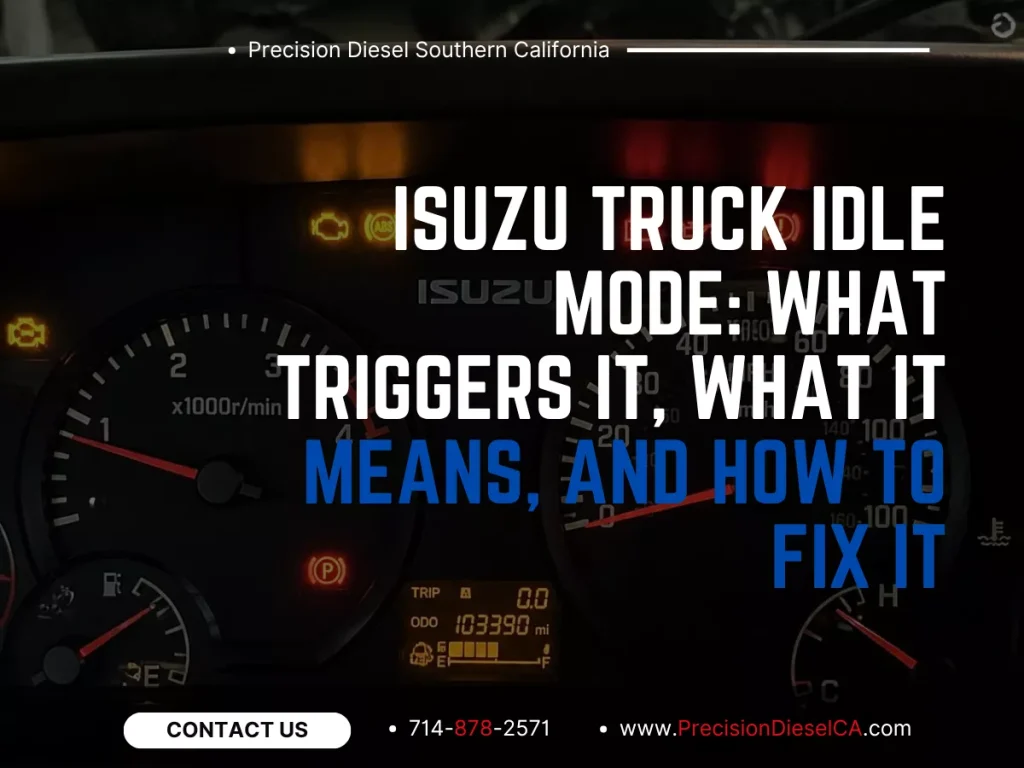
Isuzu Truck Idle Mode is a protective engine state that your truck enters when the ECM (Engine Control Module) detects a fault severe enough to restrict normal operation. Think of it as your truck’s built-in self-preservation response, forcing reduced power and speed to prevent catastrophic engine damage while still allowing you to move the vehicle to safety.
Key Takeaways
- Isuzu Truck Idle Mode is a fault-triggered protection state, not a standard feature you activate voluntarily.
- Common triggers include overheating, low oil pressure, DPF issues, and sensor failures.
- Resetting idle mode requires diagnosing and clearing the root fault, not just restarting the engine.
- Ignoring idle mode and continuing to push your truck can result in severe and costly engine damage.
- Mobile diagnostics services like Precision Diesel can reach you roadside across Southern California to get you back on the road fast.
- New federal regulations introduced for 2026 model year trucks require automatic engine shutdown after five minutes of idling.
What Isuzu Truck Idle Mode Actually Is
The term “idle mode” in the context of Isuzu commercial trucks does not refer to a standard fuel-saving feature you toggle on from the cab. It refers specifically to the engine protection state triggered when the ECM logs a critical fault code. When this mode activates, the engine typically limits itself to a low RPM ceiling, often around 1,000 to 1,200 RPM, making it impossible to accelerate under normal load.
This is a deliberate design decision. Isuzu builds these trucks to serve demanding commercial applications: deliveries, utility work, fleet operations. The ECM is programmed to prioritize long-term engine integrity over short-term performance. When it detects conditions that could lead to irreversible damage, idle mode kicks in as a last line of defense.
It is worth separating this from standard low-speed idling, which simply describes an engine running at low RPM while stationary. Idle mode, as experienced by Isuzu truck operators, is a forced restriction state with accompanying fault codes. For a broader look at how these protective systems relate to overall truck health, the diesel truck repair tips section at Precision Diesel covers many of the key concepts you need to know.

Common Causes That Trigger Idle Mode on Isuzu Trucks
Understanding what sends your truck into this protective state is the first step toward getting out of it. Several root causes are well-documented among Isuzu NPR, NQR, and NRR operators:
Overheating: When coolant temperature exceeds safe thresholds, the ECM restricts engine output to slow heat buildup. This is one of the most frequent triggers, especially in stop-and-go urban environments like those across Los Angeles and Orange County. Issues like a failing thermostat, low coolant, or a deteriorating radiator can all lead here. If your truck is regularly running hot, it may be worth reviewing what semi truck radiator replacement cost looks like before a small problem becomes a full breakdown.
DPF and Aftertreatment Faults: Diesel Particulate Filter issues are among the most common fault triggers on Isuzu’s diesel platforms. A clogged DPF restricts exhaust flow, raises back pressure, and can trigger idle mode. Active regeneration failures compound the problem quickly.
Low Oil Pressure: If the ECM registers oil pressure below the safe operating floor, it immediately restricts engine output. This can be caused by a failing oil pump, low oil level, or a clogged oil passage.
EGR System Problems: A stuck or failed EGR valve disrupts combustion efficiency and emissions performance, often generating fault codes that send the truck into a restricted operating state.
Sensor Failures: A malfunctioning MAP sensor, coolant temp sensor, or crankshaft position sensor can send false readings to the ECM, triggering idle mode even when no actual mechanical problem exists.
Transmission and Driveline Faults: In some configurations, gearbox or driveline sensor faults can also restrict engine output in a similar protective manner.
Reading the Fault Codes: Your First Move
Before anything else, you need to pull the fault codes from the ECM. Guessing at the cause without diagnostic data wastes time and money. Isuzu trucks use standard OBD-II and J1939 diagnostic protocols, meaning a quality heavy-duty scan tool will communicate with the ECM and surface the stored fault codes.
Some operators attempt to clear codes by disconnecting the battery. This can temporarily bring the truck out of idle mode, but if the underlying fault remains, the truck will re-enter the restricted state quickly. Clearing codes without addressing the root cause is a short-term workaround, not a repair.
For fleet operators managing multiple units, staying on top of these faults is part of responsible fleet stewardship, and the the importance of semi truck fleet maintenance resource from Precision Diesel outlines why proactive maintenance scheduling prevents these situations from becoming costly downtime events.
Resetting Idle Mode on Isuzu NPR and NQR Models
Resetting idle mode on an Isuzu NPR follows a specific process. Simply turning the truck off and back on rarely resolves the condition. Here is the standard sequence that technicians follow:
- Connect a diagnostic scanner capable of communicating with Isuzu’s ECM. Pull all stored and pending fault codes.
- Identify the root fault. Do not attempt to clear codes before understanding what caused them.
- Repair the triggering condition. This could mean topping off coolant, replacing a sensor, cleaning the DPF, or addressing an oil pressure fault.
- Clear the fault codes using the scan tool after completing the repair.
- Perform a drive cycle to confirm the fault does not return. On some Isuzu models, a complete key-off, key-on cycle after clearing codes is also required.
- Monitor the truck during the first post-repair run for any recurrence of warning lights or restricted performance.
If the fault returns after clearing, the repair was either incomplete or the wrong component was addressed. This is where mobile diagnostics become particularly valuable for operators who cannot afford to keep a truck parked at a shop for days.
How Federal Idling Regulations Affect Your Isuzu in 2026
Separate from fault-triggered idle mode, there is a regulatory layer every Isuzu operator needs to be aware of in 2026. New U.S. greenhouse gas regulations now require all 2026 and newer commercial trucks to automatically shut off after five minutes of idling. This is a compliance mandate, not a manufacturer preference, and it applies across the commercial truck segment.
For California operators specifically, california truck emissions compliance adds further layers of state-level regulation that stack on top of federal requirements. California’s CARB standards are among the most stringent in the country, and operators running routes through Los Angeles, Orange, and Riverside counties need to stay current.
The broader idle management picture also ties into fleet economics. According to STATS N DATA market analysis, a single heavy-duty truck can waste over 1,500 gallons of diesel per year just from idling. At current diesel prices in California, that represents a significant avoidable expense across a fleet. The idle management system market is projected to grow at a 10.2% compound annual growth rate from 2025 to 2032, reflecting how seriously the industry is taking idle reduction as a cost and compliance issue.
Isuzu itself has been on a strong commercial trajectory. According to a press release from Isuzu Commercial Truck of America, the company set an all-time retail sales record in 2024, topping the previous low cab forward sales record by 4%. As more Isuzu trucks enter service across the country, understanding their protective systems and compliance requirements becomes increasingly important for fleet managers and owner-operators alike.
For further background on commercial truck regulations and safety infrastructure in Southern California, the runaway truck ramp southern california resource provides useful regional context for operators navigating local terrain and safety rules.
Idle Mode vs. Limp Mode: Clearing Up the Confusion
Many operators use “idle mode” and “limp mode” interchangeably, but there is a meaningful distinction. Limp mode is a broader term used across the trucking industry to describe any ECM-triggered power restriction. Idle mode, as Isuzu operators typically experience it, is a specific subset of that category where the engine is limited to near-idle RPM regardless of throttle input.
Limp mode may allow slightly more power and speed, sometimes up to 30-40 mph with reduced torque, while idle mode is more restrictive and typically indicates a more acute fault condition. Both require diagnostic attention, and neither should be driven through without identifying the cause.
Comparison: Common Triggers and Their Typical Resolution
| Fault Trigger | Idle Mode? | Typical Fix | Diagnostic Priority |
|---|---|---|---|
| Coolant overheating | Yes | Thermostat, coolant flush, radiator | High |
| DPF blockage | Yes | DPF cleaning or replacement | High |
| Low oil pressure | Yes | Oil pump, oil level check | Critical |
| EGR valve failure | Yes | EGR cleaning or replacement | Medium-High |
| Faulty coolant sensor | Sometimes | Sensor replacement | Medium |
| Transmission fault | Sometimes | TCM diagnostic, sensor check | Medium-High |
| Battery/charging issue | Rarely | Alternator, battery test | Low-Medium |
This table reflects common field experience with Isuzu 4JA1 Engine or Isuzu diesel platforms. Not every fault will trigger full idle mode; the severity of the restriction depends on how the ECM interprets the fault’s risk level.
Keeping Your Isuzu Out of Idle Mode Long-Term
Prevention is far more cost-effective than diagnosis and repair after the fact. Several practical habits dramatically reduce the frequency with which Isuzu trucks enter fault-triggered idle mode:
- Stay current on DPF maintenance. Regular cleaning intervals prevent the clogging that is one of the most common idle mode triggers on Isuzu diesel platforms.
- Monitor coolant levels and condition. Degraded coolant loses its ability to transfer heat efficiently, accelerating overheating faults.
- Service the EGR system on schedule. Carbon buildup in EGR passages is a slow creep that ends in fault codes and restricted operation.
- Check oil pressure at every service interval. A slow oil pump deterioration often goes unnoticed until the ECM finally logs a fault.
- Run scheduled diagnostics. Even when no warning lights are present, periodic ECM scans can surface pending codes before they escalate.
For fleet operators across Southern California looking for additional maintenance knowledge, the articles section at Precision Diesel covers a wide range of diesel truck topics relevant to keeping your units operational.
The Fleet Owner report on Isuzu’s 2024 sales record notes the brand’s growing presence in the commercial market. More trucks in service means more operators who need access to timely, qualified diesel repair support, particularly when fault conditions like Isuzu Truck Idle Mode occur unexpectedly on a route.
Additional background on commercial diesel engine standards can be found through the U.S. Environmental Protection Agency’s heavy-duty engine regulations, which govern many of the fault thresholds built into modern ECM programming. For health-related impacts of diesel emissions on communities near busy freight corridors, the California Air Resources Board’s overview of diesel risk reduction provides important regional context. Fleet managers interested in the broader regulatory environment should also review DOT’s Federal Motor Carrier Safety Administration resources on commercial vehicle compliance.
Why Mobile Diagnostics Are the Right Tool for Idle Mode Incidents
When your Isuzu enters idle mode mid-route in Anaheim, Long Beach, or Riverside, the last thing you want is a multi-day wait for a shop appointment. Mobile diesel diagnostics bring the repair capability directly to your location, eliminating tow costs and keeping your schedule intact.
Precision Diesel provides exactly this kind of support across Los Angeles County, Orange County, and Riverside County. With over 20 years of experience in heavy-duty diesel truck and semi truck repair, the team handles engine diagnostics, DPF cleaning, EGR service, coolant system repair, and ECM fault resolution, all from a mobile service unit that comes to you. Reach the team directly at (714) 878-2571 to get a technician dispatched to your location.
Get Your Isuzu Back on the Road Today – Call Precision Diesel Now
When Isuzu Truck Idle Mode strikes mid-route, every hour of downtime costs you money, customers, and momentum. Precision Diesel’s mobile diesel mechanics serve Los Angeles County, Orange County, Riverside County, and surrounding Southern California areas, bringing full diagnostic and repair capability directly to your location so you avoid tow bills and shop delays. With over 20 years of hands-on experience in heavy-duty diesel truck repair, our technicians know Isuzu platforms inside and out, from DPF cleaning and EGR service to ECM fault diagnosis and coolant system repair.
Call Precision Diesel right now at (714) 878-2571 and get a mobile technician dispatched to your location today.
Frequently Asked Questions
Why does my Isuzu truck go into idle mode?
Your Isuzu truck enters idle mode because the ECM has detected a fault condition serious enough to warrant restricting engine output to protect against further damage.
Common triggers include overheating, DPF blockage, low oil pressure, EGR system failures, and faulty sensors. The ECM interprets these conditions as immediate risks to engine integrity and responds by capping RPM at a near-idle level until the fault is diagnosed and cleared. Pulling the stored fault codes with a heavy-duty diagnostic scanner is the first step toward identifying the exact cause.
How do I reset idle mode on an Isuzu NPR?
Resetting idle mode on an Isuzu NPR requires diagnosing and repairing the root fault first, then clearing the stored codes using a compatible scan tool.
Simply turning the key off and back on, or disconnecting the battery, will not produce a lasting reset if the underlying problem remains. After completing the repair, clear all fault codes through the scanner, perform a complete key-off and key-on cycle, and then run the truck through a short drive cycle to confirm the fault does not return. If warning lights or power restrictions reappear quickly, the original fault was either misdiagnosed or incompletely repaired.
Is idle mode the same as limp mode?
Idle mode and limp mode are related but not identical: limp mode is a broad term for any ECM-triggered power restriction, while idle mode is a more severe subset that limits the engine to near-idle RPM regardless of throttle input.
In limp mode, your truck may still be drivable at reduced speed, sometimes up to 30 or 40 mph with lowered torque output. In a full idle mode condition, the engine will not build RPM under load, making normal forward progress nearly impossible. Both states require fault code diagnosis and repair before the restriction will fully clear, and neither should be ignored or driven through without understanding the cause.
How long should I let my diesel truck idle before shutting off?
A brief idling period of two to three minutes after heavy operation is generally sufficient to allow the turbocharger and exhaust aftertreatment system to stabilize before shutdown.
Extended idling beyond that window provides diminishing returns and introduces real costs. According to STATS N DATA market analysis, a single heavy-duty truck can waste over 1,500 gallons of diesel per year from idling alone, a significant expense at California pump prices. It is also worth noting that 2026 federal greenhouse gas regulations now require 2026 and newer commercial trucks to shut off automatically after five minutes of idling, making prolonged idling a compliance issue in addition to a fuel cost concern.
How do I get my truck out of limp mode?
Getting your truck out of limp mode requires identifying and repairing the specific fault code stored in the ECM, then clearing that code using a diagnostic scan tool.
Start by connecting a heavy-duty OBD or J1939 compatible scanner to read all stored and pending fault codes. Do not attempt to clear codes before understanding what caused them, as that step alone will not fix the underlying problem. Once the fault is repaired, whether that means replacing a sensor, cleaning the DPF, addressing an oil pressure issue, or servicing the EGR system, clear the codes and perform a test drive to confirm normal operation has been restored. If the restriction returns within a short drive, the fault source has not been fully resolved and further diagnosis is needed.
The Bottom Line on Isuzu Truck Idle Mode
Isuzu Truck Idle Mode is not a glitch or a mystery: it is your truck’s ECM doing exactly what it was designed to do, protecting a valuable asset from damage that could cost far more to repair than the original fault. The challenge for operators and fleet managers is responding quickly with the right diagnostic approach rather than attempting workarounds that leave the root cause in place.
The most effective path forward is always the same: pull the codes, fix the fault, clear the codes, and verify the repair with a proper drive cycle. For fleet operators running routes across Southern California, having a trusted mobile diesel repair partner on call means idle mode incidents do not have to become multi-day shutdowns. Call Precision Diesel at (714) 878-2571 to reach a mobile technician who can come to your location across Los Angeles County, Orange County, Riverside County, and surrounding areas and get your Isuzu back to full operation today.
