
California’s Clean Truck Check program requires nearly all heavy-duty diesel, alternative fuel, and hybrid vehicles over 14,000 lbs GVWR operating on public roads in California to register, pay annual fees, and pass emissions testing. As of October 1, 2024, emissions compliance testing is fully in effect, and enforcement is active statewide.
Key Takeaways
- Clean Truck Check applies to any heavy-duty vehicle over 14,000 lbs GVWR operating in California, regardless of where it is registered.
- Annual compliance fees are set at $31.18 for 2025, indexed to the Consumer Price Index each year.
- Emissions testing deadlines are now active, with the first hard deadline having passed on January 1, 2025.
- The California Highway Patrol can pull your vehicle out of service immediately if it lacks a current passing sticker.
- Testing frequency increases to quarterly in 2027, so fleets that are barely keeping up now will face tighter windows soon.
- Proactive preventative maintenance is the single most effective strategy for passing emissions tests on the first attempt.
What Clean Truck Check Actually Is and Why It Exists
The California Air Resources Board (CARB) approved the Heavy-Duty Vehicle Inspection and Maintenance (HD I/M) Regulation in December 2021. The program, officially branded Clean Truck Check, targets a specific and long-documented problem: heavy-duty vehicles represent only about 3% of all vehicles on California’s roads, yet they are responsible for more than half of smog-causing pollution and fine particulate matter generated by the state’s vehicle fleet.
That disproportionate impact is the core reason for the regulation’s existence. CARB projects the program will prevent approximately 7,500 air-quality-related deaths and 6,000 hospitalizations and emergency room visits between 2023 and 2050. The estimated $75 billion in health benefits is more than 18 times the estimated $4 billion compliance cost, a ratio that makes the regulation’s economic case difficult to dispute regardless of where you stand on emissions policy.
The practical reality for fleet operators is that emissions control systems installed at the factory degrade over time, particularly in high-mileage work trucks, and you can explore more articles on this topic. Without a mandatory inspection regime, there is no systematic way to catch vehicles whose DPF, EGR, or SCR systems have quietly failed or been tampered with. Clean Truck Check closes that gap.
Which Vehicles Are Subject to the Program
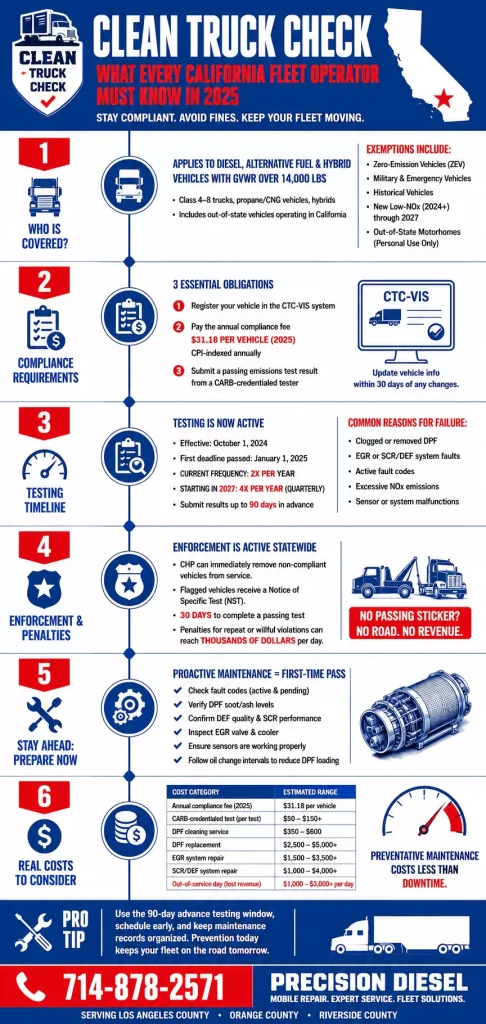
Clean Truck Check applies to diesel, alternative fuel, and hybrid vehicles with a Gross Vehicle Weight Rating (GVWR) over 14,000 lbs operating on California’s public roads and highways. This includes vehicles not registered in California. If your out-of-state truck makes deliveries into Los Angeles or runs loads through the Inland Empire, it falls under this regulation.
The CARB fact sheets and guides page outlines the exact GVWR thresholds and vehicle categories. Key vehicle types that fall under the program include:
- Class 4 through Class 8 diesel trucks
- Propane and natural gas-powered heavy-duty vehicles
- Hybrid vehicles above the 14,000 lb threshold
- Out-of-state registered vehicles operating commercially in California
Vehicles exempt from the program include:
- Zero-emission vehicles (ZEV)
- Military vehicles
- Emergency response vehicles
- Vehicles with “historical vehicle” registration
- New low-NOx vehicles meeting the 2024 or later engine standards (with a phase-in period through 2027)
- Out-of-state registered motorhomes used solely for personal use
If you operate a mixed fleet that includes vehicles near the 14,000 lb boundary, it is worth checking each unit’s GVWR against the compliance requirements individually rather than assuming an entire class is covered or exempt.
For fleets that regularly cross state lines, understanding what an empty semi trailer weighs relative to your combined GVWR is a useful first step in confirming whether each unit in your fleet meets the threshold.
Compliance Requirements: Registration, Fees, and Reporting
Every subject vehicle must be registered in the CTC Vehicle Information System (CTC-VIS), CARB’s dedicated compliance portal. Fleet managers with large numbers of units can manage multiple vehicles under a single account, but each vehicle must be individually enrolled and tracked.
The three core compliance obligations are:
- Report to the CTC-VIS system with accurate vehicle and owner information.
- Pay the annual compliance fee, currently set at $31.18 for 2025. This fee is indexed to the California Consumer Price Index, so expect modest annual increases.
- Submit a passing emissions test result from a CARB-credentialed tester within the required testing window.
Payments are accepted only through the CTC-VIS payment portal via credit card, debit card, or eCheck. No cash, checks mailed to agencies, or third-party payment processors are accepted.
Fleet administrators must update vehicle information within 30 days of any changes, including ownership transfers or additions to the fleet. For vehicles with temporary plates or that have recently been purchased, there are specific procedures for getting those units registered in the system before testing deadlines apply.
You can review the full FAQ published by CARB at the Clean Truck Check FAQ page for edge cases including recently purchased vehicles, temporary plates, and address changes.
Emissions Testing: Timelines, Frequency, and What Gets Tested
Emissions compliance testing became effective October 1, 2024. The first hard compliance testing deadline was January 1, 2025. If you have not yet submitted a passing test result for a required vehicle, you are already operating outside compliance.
Testing is currently semi-annual, with the specific testing window tied to the vehicle’s VIN. Starting in 2027, testing frequency increases to quarterly, which significantly compresses the window for catching a failed vehicle, scheduling a re-test, and completing any required repairs.
Tests must be conducted by a CARB-credentialed tester. The testing process uses Remote Emissions Monitoring Devices (REMD) and on-board diagnostics (OBD) to evaluate whether a vehicle’s emissions control systems are functioning correctly. You can submit test results up to 90 days in advance of a deadline, which gives proactive fleet managers a useful buffer to handle unexpected failures without scrambling.
Common reasons vehicles fail the emissions test include:
- DPF (Diesel Particulate Filter) that is clogged or has been illegally removed
- EGR (Exhaust Gas Recirculation) system malfunctions
- SCR/DEF system faults or tampering
- Active fault codes stored in the engine control module
- Excessive NOx output above calibrated thresholds
The Geotab Clean Truck Check compliance overview provides a useful technology-focused breakdown of how telematics data intersects with compliance monitoring for larger fleets.
Staying current on how often to change diesel oil is one of the most straightforward ways to reduce soot accumulation and extend the life of your DPF, directly improving your odds of passing emissions testing.
Enforcement: Roadside Inspections, REMD Screening, and Penalties
CARB began roadside REMD screening in January 2023, well before the formal testing deadline, giving the agency nearly two years of baseline emissions data on the California truck fleet before enforcement fully kicked in.
The California Highway Patrol is authorized to immediately remove any required vehicle without a current passing sticker from service. That means an out-of-service order at a roadside inspection, which can strand a driver and a load with no recourse until compliance is restored.
When a vehicle is flagged during roadside screening, the owner receives a Notice of Specific Test (NST), which triggers a 30-day window to complete a formal passing emissions test. Missing that 30-day deadline escalates the compliance issue significantly.
Penalty specifics beyond the immediate out-of-service authority are tied to CARB’s broader enforcement structure. Civil penalties for repeat or willful violations can reach into the thousands of dollars per violation per day under California Health and Safety Code authority. For operators running large fleets in Southern California’s dense freight corridors, multiple flagged vehicles can compound quickly.
Understanding the mechanical side of your rig, including driving a heavy duty truck with air brakes and the systems that interact with your powertrain, gives you a more complete picture of what inspectors are evaluating at roadside stops.
The 5-Day Pass and Fleet Management Edge Cases
For vehicles that need to travel to a testing facility or that have recently changed ownership, CARB allows a 5-day pass to provide a temporary compliance window. This pass is not a blanket exemption and cannot be used repeatedly to avoid substantive compliance.
Fleet managers dealing with temporary plate situations, recently acquired units, or vehicles transitioning between corporate entities should confirm their specific situation against the CARB TruckStop Clean Truck Check resources page before assuming a pass applies.
For fleets with older units where fault codes are a recurring issue, diagnosing a low fuel pressure problem is one of the diagnostic areas that can cascade into broader emissions system failures if left unaddressed. Fuel delivery problems affect combustion efficiency, which in turn affects emissions output and DPF loading rates.
Real Compliance Costs for Fleet Operators
The $31.18 annual fee per vehicle is a minor line item even for small fleets. The real clean truck check repair costs exposure comes from:
| Cost Category | Estimated Range |
|---|---|
| Annual compliance fee per vehicle | $31.18 (2025, CPI-indexed) |
| CARB-credentialed emissions test (per test) | $50 to $150+ depending on tester and location |
| DPF cleaning service | $350 to $600 per unit |
| DPF replacement (if damaged) | $2,500 to $5,000+ |
| EGR system repair | $1,500 to $3,500+ |
| SCR/DEF system repair | $1,000 to $4,000+ |
| Out-of-service day (lost revenue per truck) | $1,000 to $3,000+ per day |
The out-of-service cost is the most significant risk. A truck parked by CHP for a compliance failure is not just incurring a fine. It is missing loads, damaging customer relationships, and possibly stranding a driver. Preventative maintenance is a fraction of that cost in virtually every scenario.
For operators who want deeper context on the regulatory landscape, the NIH’s published research on diesel exhaust and particulate matter health effects and EPA’s heavy-duty vehicle emissions standards documentation provide the scientific and federal regulatory foundation that California’s program builds on.
What Fleet Operators Can Do Right Now to Stay Ahead
Passing the Clean Truck Check Los Angeles County on the first attempt requires more than just scheduling a test. It requires that your vehicle’s emissions systems are actually functioning correctly when the tester plugs in. That means proactive diagnostics, not reactive repairs.
Steps to prepare your fleet:
- Pull stored and pending fault codes from each unit’s ECM before scheduling a test.
- Verify DPF soot and ash levels through a dealer or qualified shop. High ash loading will cause a failure even without an active fault code.
- Confirm DEF quality and SCR dosing rates are within spec.
- Check EGR valve function and cooler condition.
- Ensure all emissions-related sensors (NOx sensors, O2 sensors, temperature sensors) are functioning correctly.
- Review your maintenance records to confirm oil change intervals are being followed, since extended drain intervals accelerate DPF loading.
Drivers who understand their equipment, including being aware of what most truck drivers don’t know about runaway truck ramps and other safety systems, tend to be the same operators who catch anomalies early before they become compliance failures.
Things to Know
- Out-of-state vehicles operating commercially in California are subject to Clean Truck Check, even if they are fully compliant in their home state.
- The 90-day advance testing submission window means you do not have to wait until the last month of your compliance period to test.
- CARB credentialed testers are not uniformly distributed across California. In some inland or rural areas, scheduling lead times can be several weeks.
- The compliance fee and test result are separate obligations. Paying the fee does not substitute for submitting a passing test.
- Starting in 2027, quarterly testing means roughly a 90-day turnaround between test windows, which eliminates most buffer time for repairs.
- Alternative fuel vehicles (CNG, propane, hydrogen) are subject to the program and have their own testing protocols distinct from diesel OBD testing.
Our articles section covers additional topics on fleet maintenance, compliance, and truck operations that are directly relevant to Southern California operators navigating these regulations.
Keep Your Fleet Compliant With Precision Diesel’s Mobile Service
Southern California fleet operators face the most concentrated enforcement environment in the country, with CARB roadside screening active on freeways and weigh stations across LA, Orange, and Riverside Counties. Failing a Clean Truck Check is not a paperwork problem you can sort out from the office. It results in your truck being pulled off the road right now, at a cost far greater than any repair bill.
Precision Diesel provides mobile DPF cleaning, EGR system service, emissions diagnostics, and full preventative maintenance across Los Angeles County, Orange County, and Riverside County. Our technicians come to your yard or your roadside location, so your fleet stays running while we handle the compliance work. Call us at (714) 878-2571 to schedule a pre-test inspection before your next Mobile Clean Truck Check deadline, and avoid the out-of-service risk entirely.
FAQ
Does Clean Truck Check apply to my truck if it is registered in Arizona but I make deliveries in California?
Yes. The regulation applies to any subject vehicle operating on California’s public roads, regardless of registration state.
What happens if my vehicle fails the emissions test?
You have a defined window to make repairs and re-test. However, operating the vehicle without a passing sticker after your deadline puts you at risk of an immediate out-of-service order during any roadside inspection.
Can I test my vehicle before my deadline window opens?
Yes. CARB allows test results to be submitted up to 90 days in advance of the compliance deadline, which is one of the most useful buffers available to fleet managers.
How do I find a CARB-credentialed tester near me?
CARB maintains a tester locator through the CTC-VIS system. In high-density areas like Los Angeles and Orange County, tester availability is relatively good, but scheduling ahead is recommended given demand.
What is the fee for 2026 and how is it paid?
The 2025 annual compliance fee is $31.18 per vehicle, payable only through the CTC-VIS portal via credit card, debit card, or eCheck.
What trucks need a Clean Truck Check in California?
The California Clean Truck Check applies to nearly all diesel and alternative-fuel heavy-duty vehicles with a GVWR over 14,000 pounds that operate on California public roads and highways. This includes California-registered trucks as well as trucks registered outside California, such as semi-trucks and other heavy-duty commercial vehicles.
How often do you have to do a Clean Truck Check in California?
Most heavy-duty vehicles must complete a Clean Truck Check emissions test twice per year and submit passing results to CARB. California-registered vehicles generally have testing deadlines tied to their DMV registration renewal dates. Starting in 2028, OBD-equipped vehicles will generally move to quarterly testing, while certain agricultural vehicles and California-registered personal-use motorhomes remain on an annual schedule.
What is the Clean Truck rule in California?
The Clean Truck Check, officially known as California’s Heavy-Duty Inspection and Maintenance (HD I/M) Program, requires covered heavy-duty vehicles to maintain properly functioning emissions-control systems. Vehicle owners must report covered vehicles, pay the required annual compliance fee, complete required emissions testing, and address emissions-related problems to remain compliant.
What are the new trucking laws in California for 2026?
In 2026, California’s Clean Truck Check requirements are fully in effect for covered heavy-duty vehicles operating in the state, including out-of-state trucks. Owners must maintain compliance through vehicle reporting, the annual compliance fee, and required passing emissions tests; the 2026 annual Clean Truck Check compliance fee is $32.13 per vehicle. California also continues implementing broader heavy-duty emissions regulations, so fleet owners should verify which requirements apply to their specific vehicles and operations.
The Bottom Line on Clean Truck Check
Clean Truck Check is now fully operational, with real enforcement consequences for operators who are not compliant. The program is not going away, and testing frequency only increases from here. For Southern California fleets running through some of the most monitored freight corridors in the United States, staying ahead of this regulation is a direct business necessity.
The smartest move any fleet manager can make right now is to stop treating emissions compliance as a separate issue from general maintenance. Your DPF health, EGR performance, and SCR function are both compliance issues and reliability issues. Address them together through consistent preventative maintenance, and you will pass your Clean Truck Check while also keeping your trucks on the road longer.
