

CARB compliance refers to meeting the emissions standards set by California’s Air Resources Board, a state agency with legal authority to enforce rules that are stricter than federal EPA requirements. The EPA sets the nationwide floor; CARB sets a higher bar that applies to any vehicle, engine, or equipment operating in California.
That difference matters enormously for diesel fleet operators in Southern California. A truck that clears EPA certification can still fail a CARB inspection, trigger fines, and get pulled from service. Many owner-operators learn this the hard way after crossing into California from a neighboring state.
Who this is for: This article is written for fleet managers, owner-operators, and diesel mechanics who operate or service heavy-duty trucks in California and need to understand exactly where CARB rules diverge from federal EPA standards.
Not for: Casual car owners or private individuals not subject to commercial fleet regulations; those readers should consult their local DMV resources instead.
Key Takeaways
- CARB enforces emissions standards stricter than federal EPA rules, and California’s authority to do so is protected under a federal waiver granted through the Clean Air Act.
- Any heavy-duty diesel vehicle operating in California must meet CARB standards regardless of where it was registered or purchased.
- As of a February 6, 2026 Federal Register ruling, EPA approved CARB’s Heavy-Duty Inspection and Maintenance regulation for in-state vehicles but only partially approved it for out-of-state trucks.
- California’s Cap-and-Invest program generated $3.13 billion in 2025 (CARB, 2025), signaling that enforcement funding is not shrinking.
- Noncompliance penalties can include fines per violation day, mandatory retrofits, and vehicle impoundment.
- Fleet operators should audit every unit’s CARB status before it enters California, not after.
What CARB Compliance Actually Means in California
CARB was established in 1967, well before the EPA existed as a federal body, specifically because the Los Angeles Basin was suffering some of the worst air quality in the nation. Southern California’s geography, a coastal basin ringed by mountains, traps vehicle exhaust in a way that flat-terrain states simply don’t experience. That geological reality drove California to adopt regulations the rest of the country wasn’t ready for.
Today, CARB regulates six primary emissions categories: carbon monoxide (CO), carbon dioxide (CO2), nitrogen oxides (NOx), sulfur oxides (SOx), hydrocarbons (HC), and particulate matter (PM). For diesel fleets, NOx and PM are the two categories that most often trip up operators coming from other states, because CARB’s allowable limits are lower than EPA’s.
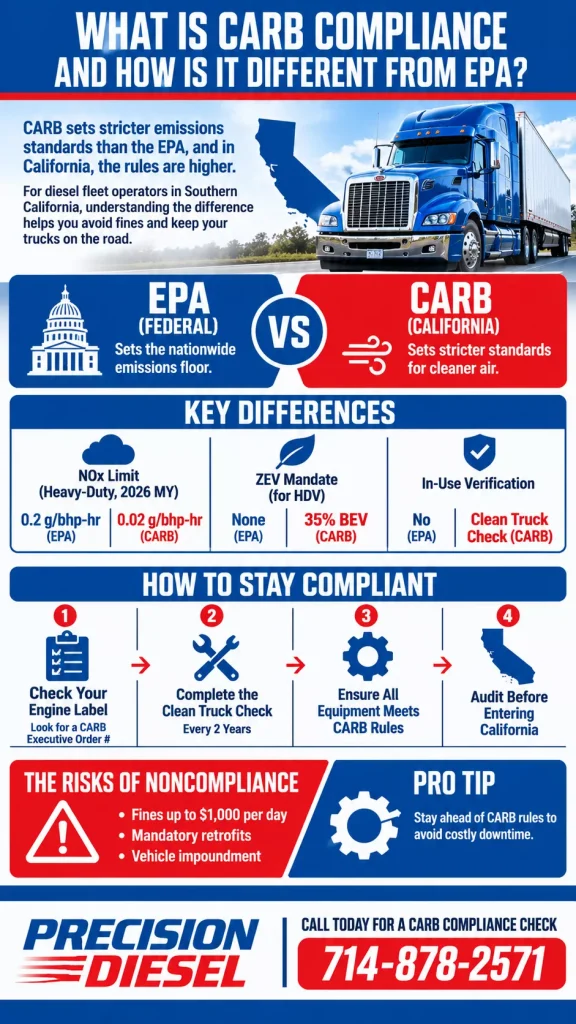
CARB compliance is confirmed through equipment labeling, engine Family Emission Labels (FELs), and in-use verification programs like the Clean Truck Check. If a vehicle’s label shows EPA certification only, without a CARB Executive Order number, it is not legally operable in California for commercial use. This is a point many out-of-state carriers miss entirely.
What usually trips people up here is the assumption that “EPA certified” and “street legal” mean the same thing nationwide. In California, they don’t. Treating California as your primary CARB compliance homeland means verifying every VIN in the state’s Clean Truck Check portal before your rig ever hits the scale house.
For a detailed breakdown of what California demands from your fleet units, the california truck emissions compliance resource covers current program requirements including the Clean Truck Check timelines.
California’s 35 Air Districts and Why They Complicate Things
CARB sets statewide minimums, but California’s 35 local air quality management districts can layer additional restrictions on top. The South Coast Air Quality Management District (SCAQMD), which covers Los Angeles, Orange, Riverside, and San Bernardino counties, is the most restrictive. If you’re running a fleet in Orange County or the LA Basin, you’re operating under the toughest combined regulatory environment in the country. A truck compliant at the CARB state level may still violate SCAQMD rules during a Spare the Air day or high-ozone advisory period.
The Actual Differences Between CARB and EPA Standards
The EPA derives its authority from the Clean Air Act of 1970 and sets baseline emissions standards that apply in all 50 states. CARB derives its authority from a standing federal waiver, also embedded in the Clean Air Act, that allows California to set its own, more stringent standards. Other states can adopt CARB standards in lieu of EPA standards, but they cannot write their own. As of 2026, roughly a dozen states and the District of Columbia have adopted CARB’s passenger vehicle standards; the picture for heavy-duty trucks is evolving quickly.
If you have ever wondered what is the difference between CARB compliant and EPA compliant hardware on the road, it comes down to stricter tailpipe limits and mandatory on-board diagnostic tracking that federal rules do not enforce.
The table below shows the most consequential differences between CARB and EPA frameworks for commercial diesel operators.
| Standard Area | EPA (Federal) | CARB (California) |
|---|---|---|
| NOx Limit (heavy-duty, 2026 MY) | 0.2 g/bhp-hr | 0.02 g/bhp-hr (Advanced Clean Trucks) |
| Zero-Emission Vehicle Mandate | None for HDV | 35% BEV market share required for 2026 MY (California New Car Dealers Association, 2025) |
| In-Use Verification Program | No federal equivalent | Clean Truck Check (biennial smog-style check) |
| Out-of-State Vehicle Exemption | N/A | Partial: EPA approved CARB HD I/M for in-state only (Federal Register, 2026) |
| Offset Compliance Allowance | N/A | 3.1% of instruments (CarbonPlan analysis of CARB data, 2023) |
The trade-off is real: California’s air quality has measurably improved under CARB pressure, but fleet operators pay the price in retrofit costs, compliance audits, and constrained equipment choices. A carrier running pre-2010 engine technology faces the most acute compliance burden.
For operators who want to stay current across multiple compliance areas, reviewing articles from mechanics working on California fleets provides practical field-level context that regulatory documents often omit.
What CARB Compliance Affects Beyond Tailpipe Emissions
Fuel Quality: California Reformulated Gasoline and ULSD
California Reformulated Gasoline (CaRFG) is formulated differently from fuel sold in other states. For diesel, California’s ultra-low sulfur diesel (ULSD) requirements are consistent with EPA, but additives, lubricity specs, and renewable content mandates under California’s Low Carbon Fuel Standard (LCFS) add compliance layers that don’t exist federally. Carriers fueling up in Nevada or Arizona before crossing into California should be aware that some additive packages approved by EPA are not CARB-approved for in-state use.
Small Off-Road Engines and Equipment
CARB’s reach extends well past semi trucks. Forklifts, yard trucks, refrigerated trailer units (TRUs), and portable generators all fall under CARB’s Off-Road Diesel regulation or the Airborne Toxic Control Measure (ATCM) for TRUs. On January 5, 2025, EPA authorized CARB’s small off-road engine (SORE) regulations (CARB, 2025), which means equipment like pressure washers and commercial landscaping machines sold or operated in California must meet CARB’s tighter HC+NOx standards. If your fleet yard uses non-CARB-compliant support equipment, you’re exposed.
The catch here is that many equipment rental companies operating across state lines don’t consistently verify CARB compliance for short-term California deployments. That is an enforcement gap closing fast.
You can find more practical context on equipment-level issues in diesel truck repair tips that cover both regulatory requirements and service intervals relevant to California operations.
Emergency Use and Public Safety Power Shutoffs
When PG&E or Southern California Edison issues a Public Safety Power Shutoff (PSPS), emergency generator use is common. CARB provides temporary exemptions for emergency operation of otherwise noncompliant equipment, but the process is not automatic. Operators must notify CARB within 24 hours of deploying noncompliant equipment and cannot extend emergency use beyond 12 months without seeking a formal variance. Businesses that assume a PSPS event creates blanket permission to run noncompliant generators are taking a legal risk.
Noncompliance Consequences and Real Enforcement Costs
CARB’s 2021 Annual Enforcement Report found a compliance rate of approximately 93.5% across regulated programs (CARB, 2022). That sounds high until you consider what the 6.5% noncompliance rate represents across California’s massive commercial fleet population.
Fines for CARB violations can reach $1,000 per day per violation for administrative penalties, with civil penalties going higher depending on the program. The Heavy-Duty Vehicle Inspection Program (HDVIP) can result in immediate out-of-service orders. For a trucking company running tight margins, a single day of fleet downtime from a compliance failure can cost more than the retrofit that would have prevented it. Does California require CARB compliance for out-of-state haulers just passing through? Yes, and CHP checkpoints enforce those exact rules on every commercial rig over 14,000 pounds crossing state lines.
Unexpected mechanical failures compound compliance risk. A truck sidelined for a semi truck radiator replacement cost issue that also happens to have an overdue Clean Truck Check registration is doubly exposed during any CARB roadside inspection. Drivers replacing exhaust parts often ask, “Do I need a CARB compliant catalytic converter?” and the answer is always yes for California operations because standard 49-state parts lack the stamped Executive Order number inspectors look for.
Proper the importance of semi truck fleet maintenance routines help avoid the chain-reaction effect where a mechanical failure reveals a compliance gap at the worst possible moment.
Which States Follow CARB Standards in 2026
As of 2026, states that have adopted CARB’s light-duty vehicle standards include Washington, Oregon, Colorado, Massachusetts, New York, and several others. For heavy-duty trucks specifically, the regulatory adoption map is narrower and shifting. Oregon’s Clean Trucks Rule mirrors key elements of CARB’s Advanced Clean Trucks regulation, but most other states have not yet moved to mandate zero-emission HDV percentages.
The table below summarizes the compliance category differences between a CARB-adopting state and a non-adopting state for commercial operators.
| Factor | CARB-Adopting State | Non-Adopting (EPA-Only) State |
|---|---|---|
| Engine Certification Required | CARB Executive Order | EPA certification sufficient |
| ZEV Fleet Mandate | Applies or phasing in | No mandate |
| In-Use Verification | State-level program likely | No equivalent program |
| Fuel Formulation Requirements | CARB fuel specs apply | EPA-baseline fuel acceptable |
| Penalty Exposure | State + CARB enforcement | Federal enforcement only |
The pattern we keep seeing is that fleet operators who run cross-country routes underestimate how quickly the compliance map is changing. A truck spec that worked in 2023 may require a retrofit or replacement to stay legal in California-adjacent markets by 2027.
For operators running routes through mountain terrain in Southern California, understanding physical road hazards is as important as regulatory ones. The runaway truck ramp southern california resource addresses one of those operational realities specific to this region.
California’s $73 billion carbon market has seen trading volume grow nearly 250% over the last five years (KraneShares, 2024), and the Cap-and-Invest program generated $3.13 billion in 2025 at an average auction price of $28.14 (CARB, 2025). These are not small numbers. They indicate a regulatory system with the financial momentum to sustain and expand enforcement, not retreat from it.
For further reading on how federal and state emissions authority is structured, the J.J. Keller Compliance Network overview of CARB vs. EPA differences provides a clear regulatory framework summary. The EPA’s December 2024 report on California’s motor vehicle emission standards offers the federal agency’s own analysis of where the two frameworks overlap and diverge. The Environmental Defense Fund’s analysis of Cap-and-Trade auction outcomes tracks how California’s compliance market is performing. And the Federal Register ruling from February 6, 2026 documents the partial disapproval of CARB’s Heavy-Duty Inspection and Maintenance program for out-of-state vehicles, which carries direct operational implications for interstate carriers.
Research Sources
The data and claims in this article were drawn from the following sources, verified 2026.
- Regulatory Outlook for Vehicle & Engine Emissions Standards Following the 2024 Presidential Election, Gibson Dunn
- CARB Compliance California: Clean Truck Check 2026 Guide, WhyLoyalty
- California State Motor Vehicle and Engine Pollution Control, EPA December 2024
- CARB States in 2026: US Emission Regulations, RouteMate
- EPA Vs CARB Catalytic Converter Requirements: Complete 2026 Guide, 3WayCatalyst
- Federal & State Regulations: Key Differences Between EPA and CARB, J.J. Keller Compliance Network
Let Precision Diesel Keep Your Southern California Fleet CARB-Ready
CARB enforcement in Southern California is not slowing down, and a single noncompliant unit can trigger fines, out-of-service orders, and costly downtime that ripples across your entire operation. Precision Diesel serves fleet operators across Los Angeles County, Orange County, Riverside County, and surrounding areas with mobile heavy-duty diesel repair and fleet maintenance that comes to your yard, not the other way around. Call Precision Diesel today at (714) 878-2571 and schedule a fleet compliance check before your next CARB inspection catches you off guard.
Frequently Asked Questions
Does CARB compliance apply to out-of-state trucks that only occasionally enter California?
Yes. Any commercial vehicle operating in California must meet CARB standards, regardless of where it is registered.
The February 6, 2026 Federal Register ruling did partially limit CARB’s Heavy-Duty Inspection and Maintenance program for out-of-state vehicles, but that partial carve-out is narrow and program-specific. It does not exempt out-of-state trucks from CARB’s core emissions requirements, engine certification rules, or Clean Truck Check obligations. If your unit crosses into California for a single load, it must still carry a valid CARB Executive Order number on its engine Family Emission Label.
What is the penalty for running a CARB-noncompliant diesel truck in California?
Administrative fines can reach $1,000 per day per violation, and enforcement officers can issue immediate out-of-service orders at roadside inspections.
Civil penalties under some CARB programs go higher, depending on the specific regulation violated and the number of prior offenses. Beyond the fine itself, an out-of-service order means lost revenue for every hour the truck sits. For a small carrier running two or three units, one compliance failure can cost more in a single week than a retrofit would have cost upfront. The math strongly favors proactive compliance auditing over reactive remediation.
Can a CARB-noncompliant generator be used legally in California during an emergency?
Temporarily yes, but only under CARB’s emergency use exemption, which requires notifying CARB within 24 hours and limits use to 12 months.
The exemption is not automatic or blanket. It applies during declared emergencies and Public Safety Power Shutoff events, but operators must follow CARB’s notification process or risk invalidating the exemption entirely. After 12 months, continued operation requires a formal variance application. Businesses that treat the exemption as an indefinite workaround routinely find themselves facing enforcement action when the initial emergency period expires and CARB follows up.
What is the difference between a CARB-compliant engine and an EPA-certified engine?
An EPA-certified engine meets federal emissions minimums; a CARB-compliant engine meets California’s stricter standards and carries a CARB Executive Order number in addition to EPA certification.
The two labels are not interchangeable. An engine manufacturer that wants to sell into the California market must apply separately to CARB and receive an Executive Order, which certifies that the engine meets CARB’s NOx, PM, and other limits. Those limits are meaningfully lower than EPA thresholds. For heavy-duty diesel, CARB’s Advanced Clean Trucks regulation is pushing NOx limits to 0.02 g/bhp-hr, compared to EPA’s 0.2 g/bhp-hr standard, a tenfold difference that requires fundamentally different aftertreatment technology.
How often do California fleet operators need to complete the Clean Truck Check?
The Clean Truck Check program requires heavy-duty diesel vehicles to complete a smog-style inspection on a biennial (every two years) cycle, with specific phase-in deadlines based on vehicle model year.
In practice, the program is rolling out in stages, so not every truck is on the same deadline schedule. Operators should verify their specific unit’s inspection due date through the CARB Clean Truck Check portal rather than assuming a universal date applies. Missing a scheduled inspection does not just result in a fine; it can also trigger a registration hold that prevents the vehicle from renewing its California registration until the inspection is completed and any required repairs are verified. For fleets with multiple units, staggered deadlines across the fleet can create an administrative burden if not tracked centrally.
The Bottom Line on What Is CARB Compliance and How Is It Different from EPA
Understanding what is CARB compliance and how is it different from EPA is not an academic exercise for California fleet operators. It is the difference between keeping your trucks moving and watching them sit at the side of the road under an out-of-service order while your load misses its window. CARB sets stricter limits, runs its own verification programs, enforces its own penalties, and is actively expanding its reach into zero-emission mandates that have no federal equivalent. The EPA sets the floor; CARB raises it significantly, and the gap between the two frameworks is widening in 2026, not closing.
Knowing what are the current regulations for CARB diesel trucks in California keeps you ahead of semi-annual Clean Truck Check testing, active TRUCRS reporting, and strict 2010-or-newer engine mandates.
The action step is straightforward: audit every unit in your fleet against current CARB requirements before its next California run. Check the engine Family Emission Label for a CARB Executive Order number, verify the Clean Truck Check status, and confirm any support equipment in your yard meets CARB’s off-road diesel and small engine regulations. If you operate in Los Angeles County, Orange County, or Riverside County, Precision Diesel’s mobile fleet maintenance team can come to your location and walk through compliance-related service items, from DPF cleaning to exhaust system repair, that directly affect your CARB inspection outcomes. Call (714) 878-2571 to schedule service today.
