

California’s Clean Truck Check certificate requires diesel trucks operating in the state to pass a roadside or referee emissions inspection and receive a certificate confirming the vehicle meets CARB’s current emissions standards. Without that certificate, your truck can be placed out of service, fined, and barred from California roads.
Who this is for: Fleet managers, owner-operators, and drivers running diesel Class 7 or Class 8 trucks in California who need to get their vehicles into compliance before an inspection or a CARB enforcement deadline.
Not for: Operators running gasoline-powered light-duty vehicles or fleets already exempted under specific agricultural or zero-emission pilot programs.
Key Takeaways
- The Clean Truck Check program is enforced by the California Air Resources Board (CARB) and applies to nearly all diesel trucks above 14,000 lbs GVWR operating in the state.
- You must register your vehicle in CARB’s online portal and schedule an inspection at an approved inspection station or referee location.
- Common failures include clogged DPF filters, malfunctioning EGR systems, and check engine codes related to emissions controls.
- Fixing deficiencies before the inspection, not after a failed test, saves you re-inspection fees, downtime, and potential civil penalties.
- Mobile diesel repair services can bring pre-inspection diagnostics to your yard, reducing the risk of a surprise failure.
- Deadlines for different model year groups are staggered, so checking your specific compliance window on CARB’s website is non-negotiable.
What the Clean Truck Check Program Actually Requires
The California Air Resources Board launched the Clean Truck Check program as the successor to the old Periodic Smoke Inspection Program (PSIP). It is a smog-check-style system for heavy-duty diesel vehicles, and it is significantly more rigorous than what most operators experienced under PSIP.
Under CTC, vehicles must pass an emissions functional inspection that tests onboard diagnostics (OBD), tailpipe opacity, and the proper operation of emissions control hardware, specifically the diesel particulate filter (DPF) and the exhaust gas recirculation (EGR) system. CARB has staggered enrollment deadlines by model year, so a 2010 through 2012 model year truck faces a different deadline than a 2013 and newer truck, as covered in the articles section. You can confirm your specific enrollment window using the CARB vehicle look-up tool.
The program applies to trucks with a gross vehicle weight rating (GVWR) above 14,000 lbs that operate on California public roads, regardless of whether they are registered in California or another state. Out-of-state operators are not exempt. That is a point that trips up a significant number of interstate carriers every inspection season.
What you get at the end of a successful inspection is a vehicle-specific compliance certificate linked to your license plate and VIN in CARB’s database. Enforcement officers can query that database in real time during a roadside stop. The certificate is not a physical sticker you tape to your windshield.
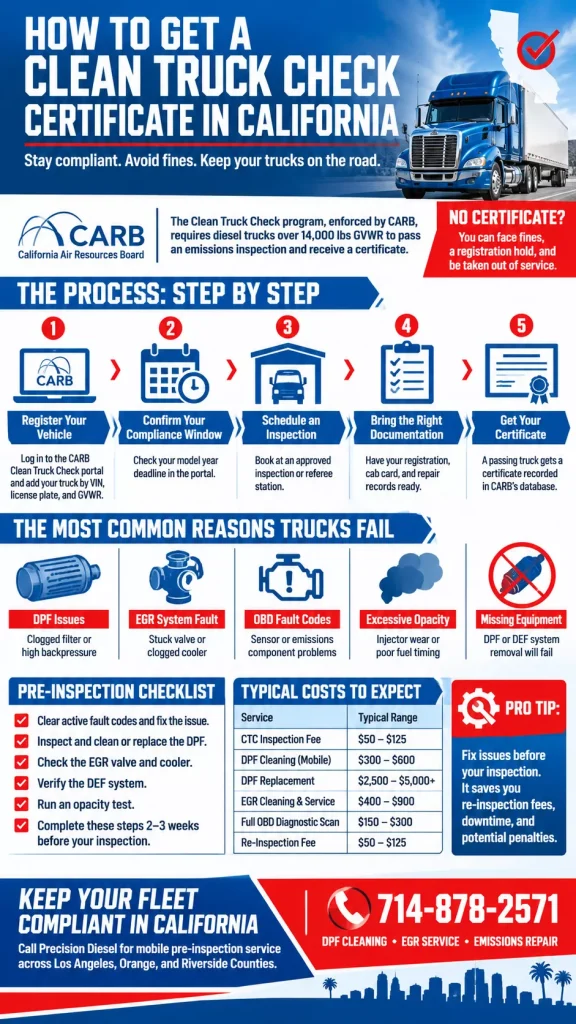
Steps to Register and Schedule Your Inspection
Before booking an inspection, you need to complete vehicle registration in CARB’s online Clean Truck Check portal. Here is the sequence:
- Register the vehicle: Log in to the CARB CTC portal, create a fleet or owner-operator account, and add each truck by VIN, license plate, and GVWR. This is required even for out-of-state trucks that operate in California regularly.
- Confirm your compliance window: The portal displays your enrollment deadline based on model year. Missing that date triggers a registration hold with the DMV and potential civil fines.
- Locate an approved inspection station: CARB maintains a searchable list of licensed inspection stations and referee stations. Referee stations are for vehicles that fail at a licensed station and want a second opinion, or for unusual configurations that standard stations cannot test.
- Show up with the right documentation: Bring your cab card, registration, and any recent repair records related to emissions components. Inspectors are more likely to flag a truck with a recently cleared check engine light if you have no accompanying repair documentation.
- Receive your result: A passing truck gets a certificate number recorded in CARB’s database. A failing truck gets a notice of the specific deficiencies, and you have a set window to make repairs and return for a re-inspection.
For detailed background on California’s emissions framework, the california truck emissions compliance page from Precision Diesel covers the regulatory landscape that sits behind the CTC program.
The Most Common Reasons Trucks Fail the Clean Truck Check
In practice, the failures that keep showing up are not random. They follow predictable patterns, and most of them are preventable with routine pre-inspection maintenance.
| Failure Category | Root Cause | Typical Fix |
|---|---|---|
| DPF backpressure fault | Clogged or damaged diesel particulate filter | DPF cleaning or replacement |
| EGR system fault | Stuck EGR valve or clogged EGR cooler | EGR cleaning, valve replacement |
| Active OBD fault codes | Sensor failure, wiring issue, or emissions component malfunction | Full diagnostic scan, repair per code |
| Excessive opacity | Injector wear or improper fuel timing | Injector service, timing adjustment |
| Missing or tampered emissions hardware | DEF system removal or DPF delete | Full system restoration (expensive) |
The DPF delete situation deserves a direct statement: if a truck has had its DPF or DEF system deleted, it will fail every Clean Truck Check inspection without exception. Restoring a deleted emissions system costs far more than keeping it maintained in the first place. CARB enforcement can also pursue civil penalties of up to $10,000 per day per violation for tampering, according to CARB’s enforcement policy.
A clogged DPF is by far the most common fixable failure. Precision Diesel offers DPF filter cleaning as a mobile service, meaning technicians come to your yard rather than you pulling a truck from service for a shop visit. That matters when you are managing a fleet of ten or more units and cannot afford extended downtime on multiple vehicles simultaneously.
For trucks that have suffered cooling system damage, possibly from running hot during heavy-duty operations, reviewing the semi truck radiator replacement cost breakdown can help you budget for repairs before they cascade into an emissions failure.
Pre-Inspection Checklist: What to Repair Before You Show Up
Knowing how to get a clean truck check certificate california starts well before the day of the inspection. Showing up with unresolved faults is the single most avoidable mistake fleet operators make.
Run through these steps at least two to three weeks before your scheduled inspection date:
- Clear and diagnose all active fault codes. Do not simply clear codes without fixing the underlying issue. Inspectors run OBD checks and can see if codes have been recently cleared without documented repairs.
- Inspect and clean or replace the DPF. A filter that is approaching its cleaning interval will likely trigger a backpressure fault under the inspection’s load cycle.
- Check the EGR valve and cooler. A partially stuck EGR valve will show up as a fault during the functional test.
- Verify the DEF system. Check the DEF fluid level, the quality sensor, and the dosing injector. A frozen or clogged dosing injector is a common winter and early spring issue in California’s mountain corridors.
- Run a full opacity test with a diesel smoke meter if your shop has one. If opacity is borderline, address injector wear before the inspection.
For operators who want broader pre-inspection guidance, the diesel truck repair tips resource from Precision Diesel covers maintenance practices that reduce emissions-related failures across model years.
Costs to Expect Across the Compliance Process
Budgeting realistically is part of a sound compliance strategy. Here is a reference breakdown of typical cost ranges across the CTC process. Note that actual prices vary by region and specific truck configuration.
| Cost Item | Typical Range | Notes |
|---|---|---|
| CTC inspection fee | $50 to $125 per vehicle | Varies by station and vehicle class |
| DPF cleaning (mobile) | $300 to $600 | Lower than full replacement |
| DPF replacement | $2,500 to $5,000+ | Needed if filter is damaged beyond cleaning |
| EGR cleaning and service | $400 to $900 | Higher if cooler replacement is required |
| Full OBD diagnostic scan | $150 to $300 | Recommended before any emissions repair |
| Re-inspection fee | $50 to $125 | Applies if vehicle fails first inspection |
These are not guaranteed price ceilings. Trucks with tampered emissions systems face dramatically higher restoration costs, sometimes exceeding $15,000 when DEF and DPF systems have been fully removed. The trade-off between skipping maintenance and absorbing a compliance failure is never favorable when you factor in downtime, fines, and re-inspection fees together.
Understanding the importance of the importance of semi truck fleet maintenance becomes very concrete when a single non-compliant truck can trigger a registration hold that sidelines a vehicle for weeks.
Why Southern California Fleets Face Extra Pressure
California’s South Coast Air Quality Management District (SCAQMD) covers Los Angeles, Orange, Riverside, and San Bernardino counties, an area that CARB treats as a high-priority enforcement zone because of persistent non-attainment of federal PM2.5 and ozone standards. That means inspection station density is higher here, roadside enforcement is more frequent, and the probability of an unannounced emissions check during a routine DOT stop is significantly greater than in most other states.
Fleets operating out of ports like the Port of Long Beach and Port of Los Angeles, two of the busiest freight hubs in North America, operate under additional scrutiny because drayage trucks are specifically identified in CARB’s heavy-duty vehicle regulations as a priority category.
Knowing runaway truck ramp southern california geography is part of operational safety, but knowing your emissions compliance status is what keeps your authority intact. One pulled certificate can cost a drayage operator their port access badge, which is a disruption that can take weeks to resolve.
For fleet managers who want to stay current on regulatory developments, the Precision Diesel articles section publishes updates on California-specific truck regulations as they are finalized.
The Federal Motor Carrier Safety Administration also tracks out-of-service orders tied to emissions non-compliance, and those records follow a carrier’s DOT number. A pattern of emissions violations can affect your SMS score and trigger a targeted investigation, separate from CARB’s own enforcement actions.
Precision Diesel: Mobile Pre-Inspection Service Across Southern California
Precision Diesel operates as a mobile heavy-duty diesel repair service across Los Angeles County, Orange County, Riverside County, and surrounding areas. With more than 20 years of experience, the team handles DPF cleaning, EGR system service, engine diagnostics, exhaust system repair, and Clean Truck Check Orange County preparation directly at your fleet yard or job site.
If your trucks operate out of Long Beach, Anaheim, Compton, Riverside, or any of the dozens of industrial cities across Southern California’s freight corridors, Precision Diesel can dispatch a technician to perform pre-inspection diagnostics before you commit to a formal inspection date.
Call (714) 878-2571 to schedule mobile service. Technicians are available across Southern California, and the mobile model means you do not pull a revenue-generating truck out of rotation for a shop visit that can happen on-site instead.
Get Your Trucks Cleared Before CARB Pulls Your Registration
Every day a non-compliant truck sits on a California road is a day closer to a registration hold, a civil fine, or a port access revocation. Precision Diesel brings mobile heavy-duty diesel repair directly to your fleet yard across Los Angeles County, Orange County, Riverside County, and surrounding Southern California areas. DPF cleaning, EGR service, full OBD diagnostics, and Clean Truck Check Los Angeles County preparation are all handled on-site, so your trucks stay in rotation instead of sitting in a shop queue. Call Precision Diesel at (714) 878-2571 right now and book a pre-inspection diagnostic before your compliance window closes.
Frequently Asked Questions
How long does it take to receive a Clean Truck Check certificate after passing the inspection?
The certificate is recorded in CARB’s database immediately upon a passing result, so enforcement officers can verify compliance during a roadside stop the same day.
The inspection station submits the result electronically, and there is no physical certificate mailed to you. Your truck’s VIN and license plate are linked to the passing record in real time. You can log into the CARB Clean Truck Check portal to confirm the status has updated before dispatching the vehicle.
Does the Clean Truck Check apply to out-of-state trucks that only occasionally operate in California?
Yes. Any diesel truck above 14,000 lbs GVWR that operates on California public roads, regardless of its registration state, must comply with the Clean Truck Check program.
CARB does not define a minimum number of trips before compliance applies. If your truck crosses into California and operates on public roads, it falls under CTC jurisdiction. Out-of-state operators should register in the CARB portal and confirm their compliance window the same way California-registered fleets do. Enforcement officers at weigh stations and port entry points have database access and will flag unregistered vehicles.
What happens if a truck fails the Clean Truck Check inspection?
A failing truck receives a written notice of deficiencies and is given a repair window, typically 45 days, before a mandatory re-inspection.
During that repair window, the vehicle may still operate in California, but only with the official failure notice in the cab. If the truck fails re-inspection or misses the re-inspection deadline, CARB can issue a registration hold through the DMV, prohibiting the vehicle from operating on California roads. Civil penalties can also apply, and for repeated violations, CARB has the authority to escalate to formal enforcement actions that follow the carrier’s DOT number.
Can I prepare my truck for the Clean Truck Check without taking it to a shop?
Yes, mobile diesel repair services like Precision Diesel can perform pre-inspection diagnostics, DPF cleaning, EGR service, and fault code repairs at your fleet yard, eliminating the need for a shop visit.
The advantage of mobile pre-inspection service is timing. You identify and fix deficiencies before the official inspection date rather than discovering them on the day of the test, which triggers re-inspection fees and downtime. For fleets with multiple trucks on staggered compliance deadlines, mobile service lets a technician work through each unit on-site without pulling vehicles from revenue service.
How often does a truck need to pass the Clean Truck Check after the initial inspection?
Under CARB’s current schedule, most trucks are required to pass a Clean Truck Check inspection every two years, though CARB retains the authority to adjust inspection intervals based on model year and emissions tier.
Newer model year trucks with more sophisticated OBD systems may qualify for longer intervals if they demonstrate consistent compliance. Older trucks, particularly those in the 2010 to 2012 model year range, face more frequent scrutiny because their emissions hardware is aging and more prone to degradation. Checking your specific interval in the CARB portal after each passing inspection is the only way to confirm your next required date, since CARB has updated intervals as the program has matured since its 2023 rollout.
The Bottom Line on How to Get a Clean Truck Check Certificate California
Knowing how to get a clean truck check certificate california is not just a regulatory checkbox. It is a direct factor in whether your trucks keep generating revenue or sit sidelined by a registration hold while your competitors keep moving freight. The process itself is straightforward: register in the CARB portal, fix every emissions deficiency before your inspection date, show up at an approved station, and pass. The trucks that fail are almost always the ones whose operators skipped the pre-inspection step.
Southern California fleets carry a heavier compliance burden than most, given the SCAQMD’s enforcement priority and the density of drayage operations around the ports. Mobile pre-inspection service removes the excuse of shop availability. Precision Diesel covers Los Angeles County, Orange County, Riverside County, and surrounding areas, and technicians can be at your yard before your compliance window expires. Call (714) 878-2571 to schedule your pre-inspection diagnostic today.
