
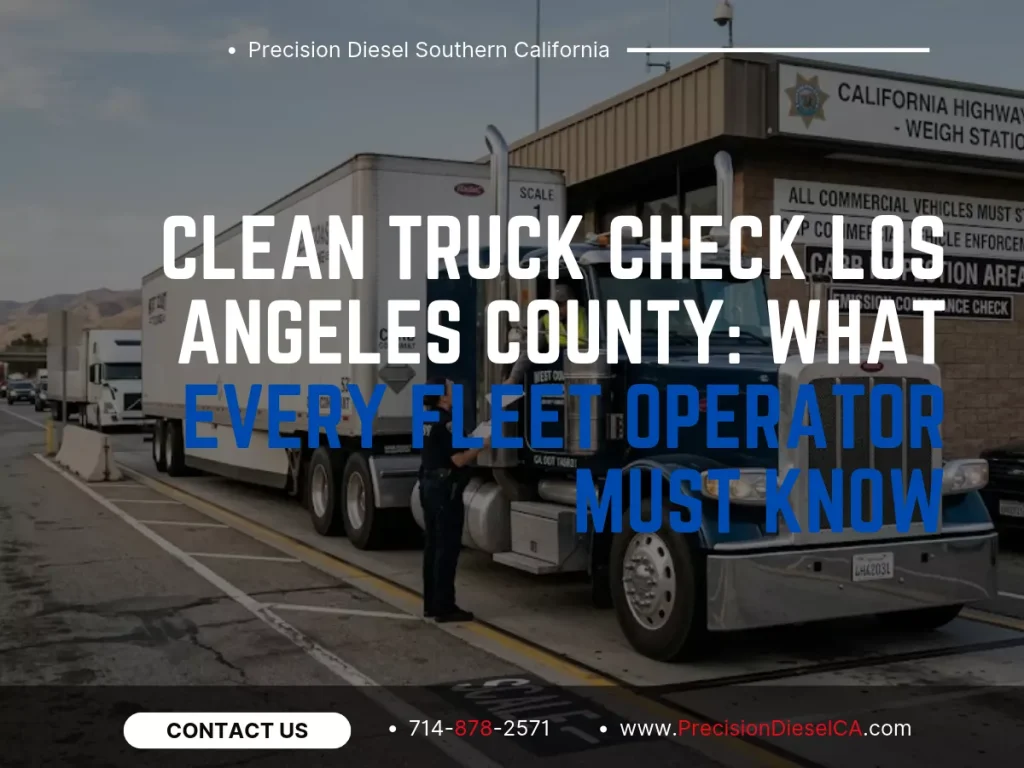
If you operate a diesel truck in Los Angeles County, the clean truck check Los Angeles County program is not optional. It is a California Air Resources Board (CARB) mandate that requires heavy-duty diesel vehicles to report smog and opacity inspection data through an online portal, with real consequences for fleets that miss deadlines.
That said, the specifics matter. The reporting cycles, engine model year thresholds, and enforcement timelines differ depending on your vehicle class and gross vehicle weight rating (GVWR). Getting the details wrong costs money and operating time.
Who this is for: Fleet managers, owner-operators, and logistics companies running heavy-duty diesel trucks (Class 4 through Class 8) in Los Angeles County who need to understand their current CARB reporting obligations.
Not for: Passenger car owners, gasoline-powered vehicle operators, or fleets running exclusively alternative-fuel or zero-emission vehicles, since the inspection requirements covered here do not apply to those groups.
Key Takeaways
- CARB’s Clean Truck Check program requires annual or biennial smog inspections for most heavy-duty diesel trucks registered or operated in California.
- Los Angeles County enforcement is active, and operating a non-compliant truck risks registration holds and civil penalties.
- Both opacity (tailpipe smoke) and OBD (on-board diagnostics) tests are required depending on engine model year.
- DPF and EGR system health are directly tied to passing inspection. Deferred maintenance on these components is the most common reason trucks fail.
- Mobile diesel mechanics can perform pre-inspection checks at your yard, reducing trip-to-shop downtime.
- Keeping thorough maintenance records is as important as the inspection itself.
What the CARB Clean Truck Check Program Actually Requires
CARB launched the Clean Truck Check program in phases starting in 2023, with ongoing enforcement ramp-ups through 2026. The program applies to virtually every heavy-duty diesel vehicle operating in California, including trucks that are based out of state but travel into California regularly.
Here is how the inspection structure breaks down. Trucks model year 2000 and newer with a GVWR above 14,000 lbs must pass an on-board diagnostics (OBD) smog check. Older trucks, pre-2000 model years, face an opacity (visible smoke) test instead. Both inspection types must be completed at a licensed Clean Truck Check station, and results are submitted directly to CARB’s database through the portal.
The reporting cycle runs on an annual basis for most fleets, though CARB has built in some phase-in flexibility for smaller operators. Missing your reporting window does not automatically result in a fine on day one, but it does trigger a registration hold through the California DMV, which grounds your truck legally until compliance is restored.
For california truck emissions compliance purposes, the OBD test reads every fault code and monitor status across your engine control module. A single unresolved fault in a monitored system, especially the diesel particulate filter (DPF), exhaust gas recirculation (EGR), or selective catalytic reduction (SCR) system, will cause a fail. This is not like a basic visual inspection. The system reads your truck’s computer directly.
The trade-off is worth flagging: the OBD-based testing is more thorough and catches issues that opacity tests miss, but it also penalizes trucks that have recently had a battery disconnect or ECM reset. After either event, you need enough drive cycles to complete all CARB monitors before testing. In practice, what trips up most owner-operators here is showing up for inspection within a day or two of shop work without running the truck through its full warm-up and drive cycle sequence first.

How DPF and EGR Condition Affect Your Inspection Result
This is where deferred maintenance becomes a liability rather than just an inconvenience. The DPF and EGR systems are the two components CARB’s OBD test scrutinizes most aggressively.
A clogged DPF will throw fault codes before it causes any visible smoke, meaning you can fail an OBD inspection with a truck that looks and drives fine. EGR systems that are partially blocked reduce combustion efficiency and generate fault codes tied to NOx emissions thresholds. Neither issue resolves on its own. Both require hands-on cleaning or component service.
| Inspection Failure Cause | Root System | Typical Fix | Estimated Cost Range |
|---|---|---|---|
| DPF restriction fault | Exhaust aftertreatment | DPF cleaning or replacement | $500 to $3,500 |
| EGR flow fault | Engine emission control | EGR cleaning or valve replacement | $400 to $1,800 |
| OBD monitor incomplete | ECM / drive cycle | Requires additional drive cycles | No parts cost |
| SCR/DEF system fault | Exhaust aftertreatment | DEF injector or SCR catalyst service | $600 to $4,000 |
For a broader set of diesel truck repair tips that address DPF and EGR maintenance schedules, it is worth having a maintenance calendar that flags cleaning intervals before fault codes appear. Reactively cleaning these systems after a failed inspection is significantly more expensive than proactive cleaning on a mileage-based schedule.
Also keep in mind that coolant system integrity connects to both EGR and overall engine health. A cracked EGR cooler, for example, can introduce coolant into the intake, which creates combustion issues that cascade into OBD faults. If you have recently dealt with elevated coolant temperatures or unexplained coolant loss, that is worth resolving before your inspection window. For trucks dealing with cooling system failures simultaneously, the semi truck radiator replacement cost should factor into your pre-inspection budget planning.
Los Angeles County Enforcement: What the Stakes Look Like
The California Air Resources Board does not rely solely on station inspections. CARB enforcement officers conduct roadside inspections throughout Southern California, and Los Angeles County is a priority enforcement area given the volume of freight moving through the region, particularly around the ports of Los Angeles and Long Beach.
A truck flagged at roadside that is out of compliance with the clean truck check Los Angeles County program faces an out-of-service order on the spot. That grounds your driver until compliance is verified. Beyond the immediate operational impact, civil penalties for violations can reach thousands of dollars per violation per day under California Health and Safety Code Section 43154.
Fleets operating under FMCSA compliance requirements face an additional layer of risk. A CARB violation that creates a roadside out-of-service event gets logged in the FMCSA’s Safety Measurement System (SMS), which affects your Compliance, Safety, and Accountability (CSA) score. A degraded CSA score can trigger FMCSA intervention and affect your ability to bid on certain contracts.
The pattern seen consistently among fleets that struggle with compliance is not ignorance of the rules. It is poor record-keeping. CARB’s portal requires you to link each truck’s VIN to its inspection record and maintain a verifiable maintenance history. Trucks with gaps in their documented service history are harder to defend at an enforcement proceeding, even if the truck itself is mechanically compliant.
Understanding the importance of semi truck fleet maintenance goes beyond avoiding breakdowns. It is a legal liability issue in California.
Pre-Inspection Checklist for LA County Operators
Before you book your Clean Truck Check station appointment, work through this list at your yard. Catching problems here is significantly cheaper than catching them at the station.
- OBD readiness monitors: Connect a scan tool and confirm all CARB-required monitors show “complete” status. If any show “not ready,” run the truck through its full warm-up and drive cycle before proceeding.
- DPF delta pressure: Check the differential pressure reading across the DPF. Elevated readings indicate restriction. Schedule cleaning if the reading is above your OEM threshold.
- EGR system check: Verify EGR valve operation and inspect for carbon buildup at the EGR cooler inlet. A visual clog that has not yet set a fault code will often throw one during the inspection’s OBD read.
- DEF quality and level: Contaminated or low-concentration DEF fluid causes SCR faults. Use only API-certified DEF and confirm your tank sensor reads accurately.
- Exhaust system integrity: Walk the entire exhaust path from turbo outlet to tailpipe. Any crack, missing gasket, or flex pipe leak will cause an opacity problem on older trucks and an exhaust leak fault on OBD-tested trucks.
| Pre-Inspection Item | Check Method | Pass Criterion | Consequence If Skipped |
|---|---|---|---|
| OBD monitors complete | Scan tool readout | All monitors “Ready” | Automatic inspection failure |
| DPF delta pressure | Telematics or gauge | Within OEM spec | Fail on DPF restriction fault |
| EGR valve operation | Visual + scan data | No flow faults | EGR fault code triggers fail |
| DEF concentration | DEF refractometer | 32.5% urea (plus or minus 1.5%) | SCR fault code triggers fail |
| Exhaust leak check | Visual walk-around | No visible damage or gaps | Opacity fail or exhaust fault |
Why Mobile Pre-Inspection Service Makes Financial Sense for LA County Fleets
Driving a truck from your yard to a shop for pre-inspection checks, then to the Clean Truck Check station, then back represents multiple hours of lost productive capacity. For a fleet operating in Commerce, Carson, Compton, or Long Beach, those miles and hours add up fast.
Precision Diesel operates as a mobile diesel mechanic service across Los Angeles County, Orange County, and Riverside County. The team comes to your yard and performs DPF cleaning, EGR service, OBD diagnostics, and exhaust system checks on-site, which means your trucks spend less time off the road and your drivers are not burning hours on shop runs.
With over 20 years of experience in heavy-duty diesel repair, Precision Diesel handles the full scope of pre-inspection prep: from DPF and EGR cleaning to coolant system checks and engine computer diagnostics. The service covers fleets running out of cities across LA County, including areas like Santa Fe Springs, Gardena, El Monte, and Pomona.
For fleets that run mountain routes or operate near grades, check out the runaway truck ramp southern california resource to understand downhill brake safety obligations that also tie into your FMCSA compliance picture.
For additional technical articles on diesel maintenance and regulatory compliance, Precision Diesel’s resource library covers common repair scenarios specific to Southern California fleets.
The National Institute for Automotive Service Excellence (ASE) sets the certification standards for diesel technicians performing this work. When selecting any mobile diesel service, confirming that technicians hold current ASE certifications for heavy-duty trucks is a reasonable due diligence step.
What 2026 Brings for Clean Truck Check Compliance in LA County
CARB has continued tightening enforcement timelines through 2026. Fleets that received compliance extensions in earlier phase-in periods are now subject to full enforcement. Additionally, CARB’s Advanced Clean Fleets regulation runs alongside the clean truck check Los Angeles County requirements, meaning some fleet categories now face both inspection mandates and zero-emission vehicle transition requirements simultaneously.
The California Air Resources Board’s Advanced Clean Fleets regulation overview outlines which fleet categories and vehicle model years fall under which requirements. High-priority and drayage fleets operating in LA County should cross-reference both programs.
The practical reality for 2026 is that compliance is a layered obligation. Meeting the Clean Truck Check inspection requirement is necessary but no longer sufficient on its own for fleets in certain size and use categories. Building a maintenance schedule that accounts for both programs, with documented records for each, is the operational standard that will hold up under CARB audit. For further technical guidance on emissions regulation timelines, the EPA’s heavy-duty vehicle emissions program page provides federal context that runs parallel to California’s state-level mandates.
Book Your Mobile Pre-Inspection Before Your Next Compliance Window Closes
Los Angeles County enforcement is active year-round, and a failed Clean Truck Check inspection or a missed reporting deadline can ground your truck, trigger a registration hold, and damage your CSA score in a single roadside stop. Precision Diesel’s mobile team comes directly to your yard across LA County, Orange County, and Riverside County to handle DPF cleaning, EGR service, OBD diagnostics, and full pre-inspection prep before you ever drive to a station.
Call Precision Diesel now at (714) 878-2571 and schedule your on-site pre-inspection service. Tell the team your truck’s model year, GVWR, and your upcoming compliance deadline, and they will put together a service plan that keeps your fleet moving and your records clean.
Frequently Asked Questions
How often do I need to complete a Clean Truck Check inspection in Los Angeles County?
Most heavy-duty diesel trucks in California are required to complete a Clean Truck Check inspection annually.
The exact cycle depends on your vehicle’s model year and GVWR. Some operators in earlier phase-in categories had biennial options, but by 2026 the majority of Class 4 through Class 8 diesel trucks fall under annual inspection requirements. Check your specific VIN’s compliance status through CARB’s online portal to confirm your next due date, since reporting windows are tied to registration renewal cycles.
What happens if my truck fails the OBD portion of the inspection?
A failed OBD result means your truck is out of compliance and cannot be registered until the underlying fault is corrected and a passing inspection is recorded.
You will need to diagnose and repair the specific fault code or codes that caused the failure, then return to a licensed Clean Truck Check station for a retest. Common causes include incomplete OBD monitors, DPF restriction faults, and EGR system faults. The retest itself carries a fee, so resolving all faults before your first appointment saves both money and time. A mobile pre-inspection diagnostic run before your station visit is the most cost-effective way to avoid a retest.
Does the Clean Truck Check program apply to out-of-state trucks that operate in Los Angeles County?
Yes. Any heavy-duty diesel vehicle that operates in California, regardless of where it is registered, is subject to CARB’s Clean Truck Check requirements.
Out-of-state trucks that make regular trips into California, including drayage trucks serving the ports of Los Angeles and Long Beach, must register in CARB’s trucking portal and complete inspections on the same schedule as California-registered vehicles. CARB enforcement officers conduct roadside checks at weigh stations and port entry points specifically targeting out-of-state vehicles. Operating without a compliant inspection record at a California port facility can result in an immediate out-of-service order.
Can I perform DPF and EGR cleaning myself to prepare for the inspection, or does it need to be done at a shop?
You can perform cleaning in-house if you have the right equipment, but most owner-operators and small fleets are better served by a certified diesel technician for this work.
DPF cleaning requires either a pneumatic cleaning machine or an oven-based thermal cleaning system to fully dislodge ash and soot from the filter substrate. Improper cleaning can damage the filter, which turns a maintenance expense into a full replacement cost. EGR cleaning involves chemical solvents and careful valve and cooler inspection that requires mechanical access and diagnostic confirmation. A mobile diesel service that brings the equipment and expertise to your yard removes the guesswork and ensures the cleaning meets the standard your truck’s OBD system will recognize.
What is the difference between the Clean Truck Check program and the Advanced Clean Fleets regulation?
The Clean Truck Check program is an inspection and testing mandate, while the Advanced Clean Fleets regulation is a vehicle procurement and transition mandate that pushes fleets toward zero-emission vehicles.
Both programs are administered by CARB and both apply to fleets operating in Los Angeles County, but they address different compliance obligations. Clean Truck Check requires you to test and report your existing diesel truck’s emissions performance on a recurring basis. Advanced Clean Fleets, depending on your fleet category and size, may require you to begin replacing older diesel trucks with zero-emission or near-zero-emission vehicles on a phased timeline. High-priority fleets and drayage fleets operating in LA County are subject to both simultaneously, which makes maintaining accurate fleet records and understanding each program’s specific triggers a critical operational priority for 2026.
The Bottom Line on Clean Truck Check Los Angeles County
The clean truck check Los Angeles County program is now a fully enforced, recurring compliance obligation, not a future concern or a phase-in grace period. By 2026, missing your inspection window, running a truck with unresolved DPF or EGR faults, or failing to maintain verifiable maintenance records all carry real financial and operational consequences: registration holds, roadside out-of-service orders, CSA score damage, and civil penalties.
The operators who stay out of trouble are the ones who treat compliance as a maintenance function rather than a last-minute administrative task. That means scheduling DPF cleaning on a mileage interval, keeping OBD monitor status current, documenting every service event with a dated record, and running a pre-inspection diagnostic check before every station visit. Precision Diesel’s mobile team serves fleets across Los Angeles County, from Long Beach and Carson to Santa Fe Springs and Pomona, bringing the diagnostic tools and repair capability directly to your yard. Call (714) 878-2571 today and get your fleet inspection-ready before your next compliance deadline arrives.
