
The EPA is revising key implementation requirements for its 2027 heavy-duty engine emissions program while keeping the core NOx emissions standard locked in place. Environmental Protection Agency (EPA) Proposes Changes to the 2027 Heavy-Duty NOx Rule that will reduce per-vehicle costs, eliminate DEF derates for new vehicles, and reshape compliance timelines, but the 0.035 g/hp-hr NOx limit for model year 2027 is not going anywhere.
Key Takeaways
- The 0.035 g/hp-hr NOx emissions standard for MY2027 remains unchanged, despite revisions to surrounding requirements.
- EPA estimates the proposed changes could save fleet operators and manufacturers up to $6,000 per diesel vehicle.
- DEF derates (SCR inducements) would be replaced with driver notification systems, reducing unplanned downtime.
- Useful-life durability requirements are delayed from MY2027 to MY2030, giving manufacturers more runway.
- Nonconformance penalties ranging from $1,000 to nearly $7,000 per unit would allow non-fully-compliant engines to enter the market under defined conditions.
- The public comment window closes August 29, 2026, meaning fleet operators have a narrow window to influence the final rule.
The 2027 NOx Standard That Is Not Moving
Before covering what is changing, you need to understand what is absolutely fixed. The MY2027 emissions threshold of 0.035 g/hp-hr represents roughly a 90% reduction in NOx output compared to the standard that was in place before this rulemaking. That figure is staying exactly where it is.
EPA Administrator Lee Zeldin made this clear during the June 10 announcement at the Great American Fair in Washington, D.C. The agency’s position is that the core standard protects human health and the environment, and no industry lobbying effort has succeeded in moving that number or pushing the start date back past 2027. Several trade groups had formally requested a delay, arguing that manufacturers needed more time to scale compliant engine production. The EPA rejected those delay requests and moved forward with the 2027 implementation date intact.
Industry Perspective & Historical Background: According to the American Trucking Associations (ATA), the trucking industry has already cut heavy-duty emissions by 99% since 1970. However, the initial 2023 rule demanded an additional 80% reduction in NOx emissions within just five years, pushing manufacturers toward complex, unproven technologies in real-world conditions.
While the EPA maintained the 0.035 g/hp-hr baseline, the Trump Administration and Administrator Zeldin incorporated key industry feedback to introduce commonsense flexibility. Industry groups emphasize that environmental rules must remain achievable, affordable, and reliable to support the 8.4 million workers keeping essential freight moving across the country.
For the guys spending long hours behind the wheel across Southern California freeways, this means the equipment hitting dealerships will be built to these exact environmental targets.
For fleet managers in California, this is especially significant. The California Air Resources Board (CARB) has historically adopted standards that meet or exceed federal EPA thresholds. With the 2027 federal NOx standard remaining firm, California’s regulatory environment will continue to reinforce compliance pressure, particularly in freight-heavy corridors across Los Angeles, Orange, and Riverside counties.
What the proposed rule does adjust is how manufacturers must support compliance over a vehicle’s lifetime, and what happens operationally when a truck’s emissions system is not performing optimally. Those changes matter a great deal to fleet economics.
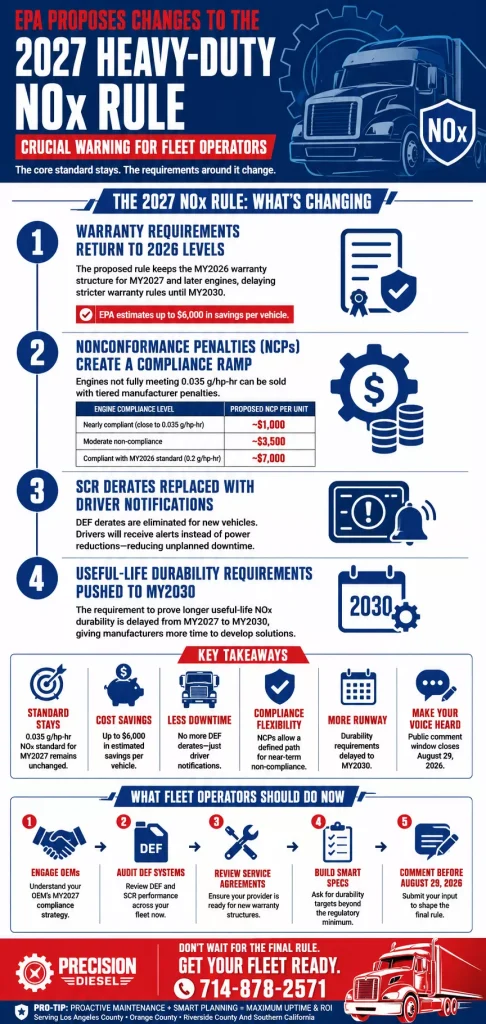
What Is Changing Under the EPA’s Proposed NOx Amendments
Emissions Warranty Requirements Would Return to 2026 Levels
One of the most financially significant shifts in the proposal involves rolling back the warranty requirements that were originally set for MY2027 engines. Under the original rule, manufacturers faced substantially extended emissions warranty obligations beginning with the 2027 model year. The proposed amendment would retain the MY2026 warranty structure for MY2027 and later engines, pushing the more demanding requirements out to MY2030.
From a fleet budget perspective, warranty length directly affects the residual value of a truck and the liability exposure for manufacturers. Shorter warranty obligations reduce manufacturer costs, and the EPA estimates that this change alone contributes to the projected savings of up to $6,000 per vehicle. For a fleet operating 50 or 100 units, that savings potential across a procurement cycle is significant.
You can read more about the financial realities of truck downtime and procurement costs in this commercial truck downtime cost analysis from Precision Diesel, which lays out how regulatory and mechanical factors compound across a fleet.
| Service Class | 2023 Rule Requirements (MY2027+) | Proposed Requirements (Today’s) |
|---|---|---|
| Spark-Ignition HDE | 160,000 miles / 10 years / 8,000 hours | 50,000 miles / 5 years |
| Light HDE | 210,000 miles / 10 years / 10,000 hours | 50,000 miles / 5 years |
| Medium HDE | 280,000 miles / 10 years / 14,000 hours | 100,000 miles / 5 years |
| Heavy HDE | 450,000 miles / 10 years / 22,000 hours | 100,000 miles / 5 years |
According to EPA estimates, reducing these warranty requirements could trim between $4,000 and over $6,000 off the price of a new diesel truck, varying by vehicle class. Here is a breakdown of the estimated savings:
| Regulatory Class | Diesel | Gasoline | Compressed Natural Gas |
|---|---|---|---|
| Light HDE | $6,152 | $2,783 | |
| Medium HDE | $4,130 | $2,838 | |
| Heavy HDE | $5,358 | $6,270 | |
| Urban Bus | $6,004 | $6,878 |
What are Nonconformance Penalties (NCPs)?
Nonconformance Penalties (NCPs) are a regulatory mechanism that allows heavy-duty vehicle and engine manufacturers to pay a monetary fine to sell products that fail to meet strict emission standards. Authorized under Section 206(g) of the Clean Air Act, NCPs act as a technological “safety valve”. They prevent supply chain disruptions by keeping essential vehicles on the market while giving manufacturers more time to catch up with new environmental laws
Nonconformance Penalties Would Create a Compliance Ramp
The proposed rule would introduce nonconformance penalties (NCPs) for MY2027 engines that do not fully meet the 0.035 g/hp-hr standard. These penalties are tiered based on how far a given engine falls from full compliance:
| Engine Compliance Level | Proposed NCP Per Unit |
|---|---|
| Nearly compliant (close to 0.035 g/hp-hr) | ~$1,000 |
| Moderate non-compliance | ~$3,500 |
| Compliant with MY2026 standard (0.2 g/hp-hr) | ~$7,000 |
This structure allows manufacturers who cannot achieve full compliance by 2027 to sell engines into the market, provided they pay the penalty. Critics from environmental groups argue this creates a financial loophole, since a $7,000 penalty on a $150,000+ truck is not a particularly strong deterrent. The EPA’s regulatory impact analysis resources provide the full penalty schedule and compliance methodology.
The counter-argument from industry is that NCPs give OEMs a defined path forward without halting new truck production entirely, which would be far more disruptive to freight capacity and fleet replacement cycles.
SCR Derates Would Be Replaced with Driver Notifications
This change will have the most immediate operational impact for fleet managers. Currently, selective catalytic reduction (SCR) systems can trigger progressive derates when diesel exhaust fluid (DEF) levels or system function fall below thresholds. In practice, this means a truck can be limited to significantly reduced power or speed until the DEF issue is resolved, sometimes stranding a driver mid-route.
The proposed rule would eliminate these derates for new vehicles and replace them with driver notification systems. Instead of the truck throttling itself down, the driver receives an alert that the emissions system requires attention.
From an uptime standpoint, this is genuinely good news for fleet operators. Current derate situations are a major source of unplanned downtime and emergency service calls. The Precision Diesel team’s guide on signs of engine trouble diesel mechanic socal outlines how early warning systems and regular maintenance catch these issues before they become roadside emergencies, which is exactly the operational model that driver-notification systems would support.
That said, the notification system only works if drivers and fleet managers respond promptly. Without the enforcement mechanism of a derate, compliance depends entirely on operational discipline and maintenance culture.
Eliminating sudden power derates gives truck drivers the peace of mind to finish a long haul without getting stranded on the shoulder over a minor sensor reading.
Useful-Life Durability Requirements Pushed to MY2030
Under the original 2027 rule, manufacturers were required to demonstrate that engines could maintain NOx compliance over a longer useful-life period. The proposed amendment delays this requirement until MY2030, giving OEMs three additional model years to develop the durability data and engineering solutions needed to meet the extended standard.
For fleets buying MY2027 through MY2029 trucks, this means engines purchased in that window will be held to the 2026-era useful-life standard, not the longer durability baseline originally planned. Whether this affects long-haul fleet operators who expect high mileage from their units depends on how manufacturers respond. Some OEMs may still engineer to the higher durability target voluntarily, while others will build to the regulatory minimum.
Fleet buyers should ask their OEM representatives directly what durability design targets their MY2027 engines are being built to, not just what regulatory floor they must meet.
| Primary Intended Service Class | Current Standard (MY2027-MY2029) | Proposed Extended Standard Beginning MY2030 |
|---|---|---|
| Spark-Ignition HDE | 110,000 miles / 10 years | 200,000 miles / 15 years |
| Light HDE | 110,000 miles / 10 years | 270,000 miles / 15 years |
| Medium HDE | 185,000 miles / 10 years | 350,000 miles / 12 years |
| Heavy HDE | 435,000 miles / 10 years / 22,000 hours | 650,000 miles / 11 years / 32,000 hours |
The Cost Impact and What It Means for Fleet Procurement
The EPA’s own estimate puts the per-vehicle savings from this package of amendments at up to $6,000. The bulk of that savings flows from reduced warranty requirements placed on manufacturers, which lowers production and liability costs that are typically passed through in sticker price.
For Southern California fleet operators navigating California’s already aggressive regulatory environment, lower truck acquisition costs are welcome relief. California’s Clean Truck Check program adds compliance costs at the state level regardless of federal rule changes, so any federal savings help offset the overall regulatory burden.
Operators managing commercial fleet repair california costs should factor these acquisition savings into total cost of ownership models, especially when planning MY2027 and later vehicle purchases. Lower upfront cost paired with consistent commercial fleet maintenance socal practices is the most straightforward path to maximizing fleet ROI under the new framework.
Environmental Trade-offs and the NCP Debate
Environmentally, the nonconformance penalty structure is the most contested element of this proposal. If manufacturers pay NCPs to sell engines operating at up to 0.2 g/hp-hr (the MY2026 standard), the aggregate NOx reduction in the 2027-2029 fleet could fall well short of the 90% reduction that the headline standard promises.
Research from the Health Effects Institute and other independent bodies consistently links NOx emissions to respiratory illness, particularly in communities near high-traffic freight corridors. Los Angeles County, where diesel freight activity is among the highest in the country, bears a disproportionate share of that health burden.
The EPA’s position is that the NCP structure is a temporary on-ramp, not a permanent alternative to full compliance. The core standard remains in force, and NCPs are designed to prevent market disruption while manufacturers scale compliant production. Whether that framing holds up depends on how many units enter service through the NCP path and for how long.
The public comment period, open until August 29, 2026, is the formal mechanism through which environmental advocates, industry groups, and individual fleet operators can shape the final rule. If you have operations in heavily affected airsheds, submitting a comment is a concrete action you can take before the window closes.
How Fleet Operators Should Prepare Right Now
Waiting until the final rule is published to start planning is a mistake. Here is what proactive fleet management looks like in this environment:
- Engage your OEM contacts to understand their MY2027 compliance strategy and whether they plan to use NCPs.
- Audit your current DEF system performance across your fleet now, since driver-notification-only systems will demand tighter operational discipline.
- Review your maintenance agreements to ensure your service provider is prepared for the shift in warranty structures.
- Build MY2027 truck specifications that ask for useful-life design targets beyond the regulatory minimum.
- Comment on the proposed rule before August 29, 2026 if fleet operational interests are not reflected in the current draft.
Staying informed is easier when you have access to current industry analysis. The Precision Diesel articles section regularly covers regulatory developments and maintenance best practices relevant to California fleet operators.
For day-to-day maintenance needs while these rules play out, mobile diesel repair southern california from Precision Diesel keeps your units running without the wait times and overhead of a fixed shop visit.
Things to Know
- The August 29, 2026 comment deadline is firm. The final rule publishes after that date and takes effect shortly thereafter, meaning MY2027 engine production decisions are being made right now by OEMs.
- DEF derate elimination applies to new vehicles only. Your existing fleet continues to operate under current SCR derate rules.
- Nonconformance penalties are paid by manufacturers, not fleet buyers directly, but they may influence which engine options are available and at what price.
- California’s CARB regulations operate independently from EPA federal rules. Meeting the federal 2027 standard does not automatically satisfy California’s state-level requirements.
- The useful-life delay to MY2030 affects durability demonstration requirements, not the emissions standard itself. Your MY2027 truck still must emit at 0.035 g/hp-hr from day one.
- The NIH’s research on diesel exhaust health effects provides independent context for understanding why the 90% NOx reduction target matters, even as implementation timelines shift.
- Public Hearing & Comment Deadlines: A formal EPA public hearing was held on July 29, 2026, ahead of the August 29, 2026 public comment deadline. Fleet operators and industry groups like the ATA are using this window to submit formal feedback before the rule is finalized.
How Precision Diesel Helps Fleets Prepare for MY2027
Precision Diesel works alongside fleet managers across Southern California to navigate changing EPA and CARB regulations, optimize preventative maintenance, and prevent costly downtime before the 2027 NOx standards take effect.
| Fleet Challenge | How Precision Diesel Can Help |
|---|---|
| Evaluating Fleet Maintenance & Replacement Timing | We analyze maintenance histories, computer diagnostic logs, and wear patterns to help you determine which trucks to prioritize for service, overhaul, or retirement. |
| Navigating CARB & Clean Truck Check Compliance | As certified emissions testing specialists, we keep your fleet fully compliant with California state standards and Clean Truck Check requirements to avoid operational penalties. |
| Adapting to MY2027 Driver Notification Systems | With SCR derates giving way to driver warning alerts, our diagnostic team helps you establish fast-response procedures to clear emissions fault codes before they cause severe engine issues. |
| Preventing Unplanned Roadside Downtime | Our scheduled preventative maintenance programs and 24/7 emergency roadside assistance keep your haulers running reliably across LA and Orange County freight corridors. |
| Maintaining Advanced Aftertreatment Systems | We provide specialized DPF filter cleaning, EGR servicing, and full aftertreatment diagnostics to maximize the lifespan of complex, low-emission engine components. |
| Mitigating Repair & Maintenance Risk | We offer structured fleet maintenance plans and BIT/DOT inspections to keep your operating costs predictable and your fleet safe. |
Schedule Your Fleet Compliance Review With Precision Diesel Before the Final Rule Drops
The window between now and the final rule publication is the best time to assess your fleet’s readiness for the MY2027 emissions landscape. Precision Diesel serves fleet operators across Los Angeles County, Orange County, Riverside County, and surrounding areas with mobile heavy-duty diesel repair, DOT inspections, DPF and EGR cleaning, and comprehensive commercial fleet repair california services, all without requiring you to take trucks off-route to a fixed shop.
Call Precision Diesel today at (714) 878-2571 or reach the team directly online to schedule a fleet compliance review. Tell them your current fleet size, model years, and service schedule so they can build a maintenance plan that keeps your units road-ready under current and upcoming regulations.
Frequently Asked Questions
What is the NOx rule for 2027?
The 2027 NOx rule requires new heavy-duty diesel engines to meet a NOx emissions standard of 0.035 g/hp-hr, approximately a 90% reduction from the previous standard.
This rule was finalized under the Biden administration and applies to model year 2027 and later heavy-duty engines. The EPA’s proposed amendments revise warranty, useful-life, and derate requirements around the standard but do not change the 0.035 g/hp-hr threshold itself.
Can I legally delete my diesel truck in 2026?
No, deleting emissions control systems from a diesel truck is illegal under federal law regardless of the model year or the calendar year.
The Clean Air Act prohibits tampering with or removing any emissions control device from a vehicle used on public roads. This applies to DPF, DEF, and EGR systems. Violations can result in significant fines from the EPA, and California’s CARB enforcement adds additional penalties for in-state violations.
Will 2027 diesel trucks have DEF?
Yes, MY2027 diesel trucks will still use diesel exhaust fluid as part of their selective catalytic reduction systems.
The proposed rule change eliminates DEF derates (the progressive power restrictions that engage when DEF levels or SCR performance drop below thresholds) but does not remove DEF requirements. Drivers will receive notifications instead of experiencing derates, but the underlying emissions control technology remains in place.
What EPA regulations did Trump remove?
The Trump administration has directed the EPA to revisit and revise several environmental regulations, including elements of heavy-duty vehicle emissions rules.
In the context of the 2027 NOx rule, the current EPA under Administrator Lee Zeldin is not eliminating the standard but is proposing to ease warranty, useful-life, and derate requirements around it. Broader regulatory rollbacks have targeted methane rules, power plant emissions standards, and certain vehicle fuel economy requirements, though many face ongoing legal challenges.
What will replace diesel trucks?
Battery-electric and hydrogen fuel cell trucks are the leading technologies positioned to replace diesel-powered heavy-duty vehicles over the next two to three decades.
California’s Advanced Clean Trucks regulation mandates increasing percentages of zero-emission truck sales from manufacturers operating in the state, with targets scaling through 2035. However, diesel trucks are expected to remain a large share of the working fleet well into the 2030s, and maintaining compliant diesel powertrains will require fleets to adapt to stricter emissions limits, elevated equipment costs, and shifting regulatory compliance standards.
What is the 2027 Heavy-Duty NOx Rule?
The 2027 Heavy-Duty NOx Rule represents the EPA’s regulatory framework designed to reduce nitrogen oxide emissions from heavy-duty vehicles beginning in model year 2027. This rule establishes increasingly stringent emission standards that manufacturers must meet through technological improvements and compliance strategies.
Why is the EPA proposing changes to this rule?
The EPA is proposing modifications to address stakeholder feedback, reflect technological feasibility assessments, and balance environmental protection objectives with industry implementation capabilities. These changes ensure the regulatory framework remains achievable while maintaining progress toward air quality improvement goals.
How will these changes affect heavy-duty vehicle manufacturers?
Manufacturers will experience adjusted compliance timelines and potentially modified emission standards, allowing more time for technology development and integration. The changes may reduce immediate capital expenditure pressures while maintaining long-term emission reduction commitments.
What vehicles are covered under this rule?
The rule applies to heavy-duty vehicles including Class 7 and Class 8 trucks, engines, and powertrains used in commercial transportation operations, including both diesel and alternative fuel configurations.
When do manufacturers need to comply with the new standards?
Compliance begins in model year 2027, with phased implementation allowing manufacturers to transition production to meet the established NOx reduction targets incrementally across subsequent model years.
How can stakeholders provide input on the proposed changes?
The EPA accepts public comments through the Federal Register: What is the 2027 Heavy-Duty NOx Rule?** The 2027 Heavy-Duty NOx Rule represents the EPA’s regulatory framework designed to reduce nitrogen oxide emissions from heavy-duty vehicles beginning in model year 2027. This rule establishes increasingly stringent emission standards that manufacturers must meet through technological improvements and compliance strategies.
How can stak: What is the 2027 Heavy-Duty NOx Rule?
The 2027 Heavy-Duty NOx Rule represents the EPA’s regulatory framework designed to reduce nitrogen oxide emissions from heavy-duty vehicles beginning in model year 2027. This rule establishes increasingly stringent emission standards that manufacturers must meet through technological improvements and compliance strategies.
When do manufacturers: What is the 2027 Heavy-Duty NOx Rule?
The 2027 Heavy-Duty NOx Rule represents the EPA’s regulatory framework designed to reduce nitrogen oxide emissions from heavy-duty vehicles beginning in model year 2027. This rule establishes increasingly stringent emission standards that manufacturers must meet through technological improvements and compliance strategies.
