

TL;DR
Low diesel fuel pressure can cause hard starting, rough idle, stalling, and poor acceleration, and it is typically caused by clogged filters, failing pumps, faulty sensors, or a bad fuel pressure regulator. Proper diagnosis involves fuel pressure testing under load (stall test), checking sensors and regulators, and verifying real-time scan data before replacing parts. Fixing the root cause restores stable fuel delivery and prevents unnecessary repairs and downtime.
Key Takeaways
- Professional diesel repair services like Precision Diesel Repair specialize in diagnosing and repairing these issues quickly to reduce downtime.
- Diesel engines require stable fuel pressure (often around 40–80 psi) for proper combustion and performance.
- A stall test and fuel pressure test under load are critical for accurately diagnosing fuel system problems.
- Common causes of low fuel pressure include clogged fuel filters, weak lift or high-pressure pumps, faulty fuel pressure regulators, and sensor issues.
- Symptoms of low fuel pressure include hard starting, engine hesitation, misfires, rough idle, stalling, and reduced acceleration.
- Fuel system diagnostics should include mechanical gauge readings, scan tool data, and inspection of filters, pumps, and regulators.
- Fuel pressure regulator failure is a frequent issue and can cause fluctuating or unstable pressure and poor engine response.
- After repairs, proper priming (such as on a 7.3 Powerstroke) is important to remove air and restore smooth operation.
- Safe and efficient diesel performance depends on maintaining correct fuel pressure and addressing issues early to avoid engine damage.
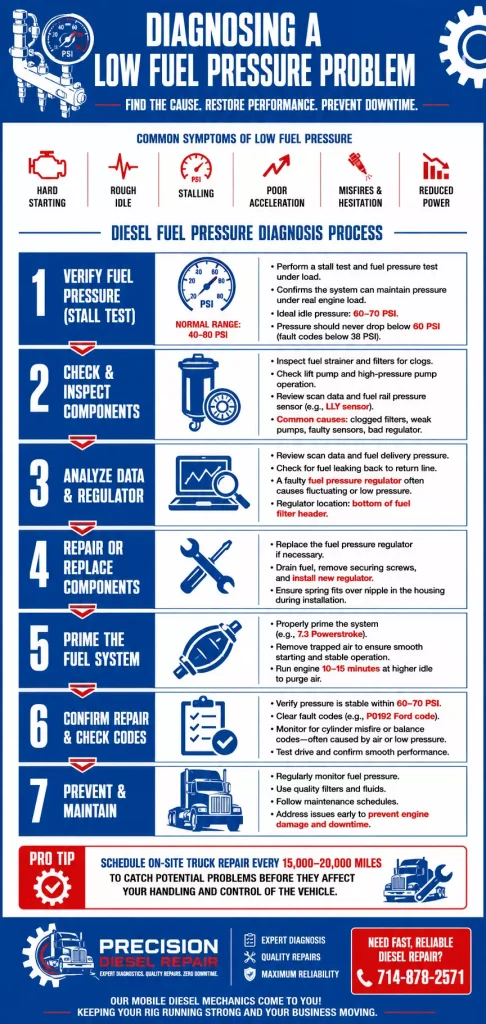
Our professionals often conduct a stall test to fix fuel pressure issues diesel engines. A combined diesel fuel pressure test / stall test helps verify system performance under real engine load conditions. This step is important for diagnosing a fuel system correctly; our mechanics strongly recommend it when working on diesel engines. Accurately diagnosing a low fuel pressure problem prevents unnecessary component replacement and reduces downtime. Monitoring diesel fuel pressure regularly helps ensure your engine receives the correct fuel flow for optimum performance.
Additionally, you can use a VIN decoder to find wiring diagrams for your vehicle model or check out specialized truck repair tools. Of course, you can reach out to us at Precision Diesel Repair to take a look and get your truck running right! Drivers searching for a trusted diesel repair shop near me often need fast diagnostics and dependable repairs to avoid costly downtime.
Stall Test
Generally, fuel pressure should be between 40 and 80 psi. Monitoring fuel pump pressure helps determine if the pump can maintain adequate diesel fuel flow under engine load. Comparing car fuel pump pressure to manufacturer specs helps detect early signs of pump wear. Knowing how much fuel pressure your engine requires helps prevent misdiagnosis of fuel system issues. This normal diesel fuel pressure range helps confirm that the fuel system is supplying enough fuel for proper combustion and engine stability. Monitoring diesel fuel pressure consistently ensures the engine runs efficiently and prevents long-term damage to injectors or the fuel pump.
It’s important to understand the fuel pressure range when diagnosing issues in diesel engines because a drop in pressure might indicate problems with the ECMs or the mechanical fuel pump. Persistent low fuel pressure can also result from clogged filters, failing lift pumps, or restrictions in the fuel supply line. Experiencing low fuel pressure can lead to engine hesitation, stalling, and reduced acceleration, which makes timely diagnosis critical.
The next step is to conduct a few more diagnostic tests to better understand the situation. A proper fuel delivery pressure test confirms whether the pump and regulator are supplying adequate fuel under load. Using a diesel fuel pressure test kit allows technicians to measure real-time pressure across the system safely and accurately. A diesel fuel pressure tester is essential for pinpointing pressure drops and verifying the performance of fuel pumps and regulators under load.
Understanding what does low fuel pressure mean in a diesel truck helps pinpoint if the issue stems from mechanical failure or electronic sensors.
Checks
Checking the fuel pressure using a mechanical gauge at the test port helps get accurate fuel pressure readings, similar to what scan data shows for fuel delivery pressure. The LLY fuel rail pressure sensor can provide real-time data to confirm whether the fuel rail is maintaining proper pressure. Next, inspect the fuel strainer. If it is clean, this suggests that someone has recently serviced it. Standard checks on the fuel filter are also important. Understanding what causes low fuel pressure in diesel engine systems helps technicians quickly identify restrictions, leaks, or failing components. Low fuel pressure can cause engine hesitation, misfires, or stalling, making it critical to address before serious engine damage occurs.
Causes of low fuel pressure include clogged filters, failing pumps, and faulty sensors. Common causes include clogged filters, failing fuel pumps, or faulty fuel pressure regulators. Recognizing 2KD fuel pump symptoms, such as engine hesitation or stalling, can prevent a total breakdown. Learning how to check diesel fuel pressure correctly prevents misdiagnosis and unnecessary parts replacement.
Review the scan data and fuel delivery pressure readings, as the fuel pressure regulator might be the problem. Data might just show that fuel was leaking back to the return line, which points to a failing regulator. A faulty fuel pressure regulator diesel system often causes fluctuating fuel pressure and rough engine idle. A fuel pressure regulator failure diesel issue commonly leads to unstable pressure and poor engine response. Your truck has a spring-style fuel pressure regulator at the bottom of the fuel filter header. Knowing the exact fuel pressure regulator location diesel truck owners rely on makes replacement faster and more accurate.
Replacing a regulator and making any other necessary repairs should make a positive change in fuel pressure and overall engine performance. Understanding how to fix low fuel pressure can save time and prevent unnecessary replacement of functional components.
Proper heavy-duty truck fuel system repair ensures consistent fuel delivery and prevents repeat engine performance issues.
Priming a 7.3 Powerstroke is essential after replacing fuel system components to ensure proper fuel delivery. Knowing how to prime a 7.3 Powerstroke prevents hard starting and maintains smooth engine operation.
Replacing the Fuel Pressure Regulator
To start replacing the fuel pressure regulator, first drain the fuel. Careful diesel fuel pressure regulator replacement ensures the spring and seals are installed correctly to restore pressure. Next, remove the securing screws. This step is important to reach the fuel pressure regulator, which is found under the fuel filter header. Once you reach the fuel filter header area, you should be able to see the new fuel pressure regulator and its part number.
If you’re not sure about maintenance schedules or need a professional diesel mechanic, give us a call today at (714) 878-2571! An experienced mechanic diesel mechanic can quickly diagnose complex fuel and performance problems.
Fuel Pressure Regulator Housing
Inside the fuel pressure regulator housing is a nipple that is very important when installing the spring. It’s essential that the spring fits over this nipple and stays in place during installation. Here’s the tricky part: you need to keep the spring over the nipple while the other end goes into a hole at the bottom of the fuel filter header.
Now, after repairing the fuel system and replacing the fuel pressure regulator, there should be an improved fuel delivery pressure. 60 to 70 psi at idle is ideal! This ideal diesel fuel pressure psi range supports smooth idle, proper injector operation, and stable combustion. Maintaining proper 7.3 fuel pressure ensures the Powerstroke engine runs efficiently and avoids injector damage. The pressure should no longer be fluctuating. Fixing pressure instability often resolves diesel truck hard starting / rough idle complaints reported by drivers. Even with a brake boost, it should never drop below 60 pounds. Pressures lower than 38 pounds will cause a fault code in diesel engines.
These fuel pressure fault codes diesel systems generate help pinpoint delivery problems before major engine damage occurs. The P0192 Ford code indicates an issue with the fuel rail pressure sensor circuit, often linked to low fuel delivery.
Cylinder Misfire
When you check the fuel system or inspect the ICP system, you might see a fault code for a cylinder balance issue or a cylinder misfire. At first, when you start the engine, it might seem like it’s misfiring, especially after fixing something in the fuel system. A temporary cylinder misfire after fuel system repair is often caused by trapped air that clears once the engine runs steadily.
Codes often show up because of airflow problems or low fuel pressure. A diesel engine misfire low fuel pressure condition can reduce power and trigger repeated diagnostic trouble codes. Low fuel pressure often leads to rough idle, poor acceleration, and hard starting in diesel engines. Don’t worry; this happens a lot. Many low fuel pressure diesel concerns are resolved after proper bleeding and regulator verification.
Many people immediately take off the valve cover to see if an injector is unplugged. But that’s not always needed. Instead, try running the engine for about 10 to 15 minutes at a higher idle. This helps get rid of any trapped air in the system. After a cylinder misfire code has cleared, the truck should run smoothly.
When a high-pressure pump isn’t working too hard, it will have plenty of life left. Overall, your truck shows great performance and reliability, especially when keeping up with regular diesel engine maintenance. You will help it run smoothly and prevent any future issues.
Recognizing early diesel engine fuel pressure symptoms can prevent breakdowns and costly injector damage. Common low fuel pressure symptoms include rough idle, reduced acceleration, hard starting, and intermittent engine stalling, which drivers should monitor closely. Measuring diesel injector pressure ensures the injectors are receiving adequate fuel for optimal combustion. Being aware of low fuel pressure symptoms allows technicians and drivers to address issues before they cause major engine damage.
Choose Precision Diesel Repair
When you need reliable service, choose Precision Diesel Repair for all your diesel repair needs. You’ll be glad you did! Simply swing by and we will give your truck our best care.
10 Pro Tips for Keeping Your Semi Truck Under Control
Keeping your semi truck under control is not just a matter of safety but also an art—a skill that, when mastered, makes driving an 80,000-pound rig look effortless and precise. As seasoned diesel mechanics, we have seen the difference proper truck control can make: from a close call to a disaster. Every day, semi-truck drivers face unique challenges such as unpredictable weather conditions, varying road surfaces, heavy traffic situations, complex vehicle dynamics, and tight time-to-delivery schedules.
It calls for more than just general skills in driving. You have to know the truck inside out with its strengths and weaknesses and be ahead in safety measures for control of what happens. That’s why we’ve put together these pro tips to help you stay in command of your rig. Whether you’re an experienced driver or new to the industry, these proven strategies will enhance your ability to handle your semi truck safely and efficiently in any condition.
Your semi truck’s dynamics are important to maintaining control on the road. Think of your truck as a complex system where each part needs to work together with others. Vehicle position and alignment require keeping your truck centered in the lane, watching for trailer drift in crosswinds, checking mirrors regularly for proper alignment, and maintaining a 3-4 second following distance.
A good set of steering axle tires is your first line of defense against hydroplaning and loss of control. Look for deep tread channels, water displacement, proper inflation pressure, even wear patterns, and regular rotation schedules. The handling characteristics of your truck change based on load weight, road conditions, and weather. Understanding the dynamics at play assists you in being able to anticipate and modify your driving accordingly before a situation develops.
Speed Control Techniques
Speed control is the first defense against road accidents. It is a thin line between skill and awareness to keep proper speed control. Speed management requires matching your speed to current road conditions while maintaining a 3-second following distance minimum. When conditions change, reducing speed by 2-3 mph is essential for safety.
Gear and RPM Management
Your engine’s sweet spot is usually between 1,100 and 1,500 RPM. It’s the range for maximum fuel efficiency and gives you total control over your rig. Stick to gears that keep you in this range, especially when climbing steep grades, hauling heavy loads, or driving in poor weather. When downshifting, let your engine speed drop to about 1,000 RPM before shifting down. This technique helps maintain smooth control and prevents unnecessary strain on your transmission. Remember – a loaded truck needs 40% more distance to stop compared to an empty one. Your speed choices directly impact your ability to respond to sudden changes in traffic or road conditions.
Effective Use of Brakes
Your semi truck’s braking system is your lifeline on the road. The vital braking systems available to you include service brakes (your primary braking system operated by the foot pedal), Jake brakes (engine brakes that assist in controlling speed on downgrades), and spring brakes (emergency and parking brake system).
Jake brakes shine on long descents. They minimize service brake wear and assist in steady speed. Apply them when going down steep grades, in dry conditions, and when signs don’t prohibit engine brakes. Service brakes should be conserved for emergency stops, wet or slippery roadways, final stops at intersections, and low-speed handling. Never apply Jake brakes on wet or icy roads, as this will make your trailer slide or jackknife. Instead, rely on gentle, steady pressure on your service brakes.
Tire Selection and Maintenance Tips for Truck Drivers
Your tires are your lifeline to the road. Wide channel traction lug tires provide superior grip through their deep treads and specialized design. These tires excel at dispelling water and slush, gripping on rough terrain, and providing safety in poor weather.
When facing icy or snowy conditions, gravel shoulders can provide better traction. To use the gravel shoulders effectively, pull on slowly and smoothly, keep your steering wheel straight, and maintain a constant speed.
For peak performance, tires should be maintained regularly. This includes daily tire pressure checks, weekly tread depth inspections, monitoring for uneven wear patterns, following manufacturer-recommended rotation schedules, and immediately replacing worn tires.
How to Use Your Power Dividers on Slippery Grades on Semi Trucks
Your power divider is your truck’s way of dividing its engine power in your drive axles, enabling you to tackle tough terrains better. That’s like an inbuilt feature inside your truck meant for harsh conditions during driving. To properly use your power divider, engage it early before you start climbing slippery hills – it’s too late when you notice you’re sliding down. Keep your speed below 25 mph when the power divider is on. Try to stay straight as much as possible when it is engaged to save your drivetrain from unnecessary stress.
Once you are back to level ground, you should turn off the power divider so that your tires do not wear out easily. Be observant of any spinning wheels or loss of traction- these are signals for you to engage the power divider before it gets worse.
Truck Driving Defensive Techniques
Be fully in control at all times and cognizant of your semi truck. Anticipate danger before it becomes dangerous in itself. Keep safe space in front of your vehicle at 7 seconds, check your mirrors every 8-10 seconds, and clear a way out of heavy traffic. Observe blind spots of oncoming vehicles into your lane and adjust your speed for weather, surface, traffic flow, time, and load. Remember: driving within conditions means adapting your speed to match the current situation. A dry road at 65 might require drops to 45 in the rain, or even 30 in the snow. Trust your judgment-it’s better to arrive late than risk losing control of your rig.
Handling Loss of Control Situations
Even the seasoned driver can expect an unexpected twist that leaves the vehicle out of control for just a few moments. Common loss of control situations include sudden tire blowout, crossing winds, black ice patches, breakdowns, and shifting cargo. For quick recovery tactics, keep calm and avoid panic overcompensation, lift off accelerator without slamming on the brakes, steer into skid as physics is your friend, keep wheels straight during recovery, and maintain a light touch on the steering wheel.
For prevention measures, be wary of mechanical failure indications, maintain constant surveillance of weather patterns, ensure cargo is held tightly in the truck with suitable weight, and inspect tire pressures prior to hitting the road. Most close calls happen within the fraction of seconds. Your quicker reaction can tell between a near incident and a potentially critical accident. Commit to mental exercise in these recontrols to develop more muscles in handling emergencies.
Maintenance Check for Semi Trucks Performance Guarantee
The upkeep of your semi-truck depends on maintenance checks. The more you take care of your truck, the lesser the chance of being stranded on the road and less chance of losing control while driving. Key areas of maintenance include brake system check, fluid level checks, tire pressure and wear monitoring, steering components examination, and suspension system check. Precision Diesel Repair brings professional diesel repair directly to you. Our mobile mechanics will do a complete inspection, along with any repairs, at your location, saving you time while keeping your truck in top condition. A professional mobile diesel mechanic California service allows truck owners to get expert help without towing or long shop delays.
From routine maintenance to complex diesel repair jobs, we have everything under one roof—guaranteed to keep your semi truck in peak performance form. Reliable semi-truck diesel repair is essential for maintaining power, fuel efficiency, and long-term engine durability.
Pro Tip: Regularly schedule on-site truck repair visits every 15,000-20,000 miles to catch potential problems before they affect your handling and control of the vehicle.
Diesel Fuel Pressure & Engine Performance Overview
Diesel fuel pressure plays a critical role in overall engine stability and combustion quality in heavy-duty systems. When diesel fuel pressure is not maintained correctly, diesel engine fuel pressure imbalances can cause drivability concerns and reduced efficiency. A fuel pressure low condition may also affect throttle response, especially when comparing high or low fuel pressure behavior during operation. Manufacturers like Ford closely monitor fuel pressure ford systems to ensure consistent delivery under load.
Accurate diesel injector pressure is essential for clean combustion and smooth acceleration. When diesel engine fuel pressure symptoms begin to appear, drivers may notice rough performance or inconsistent power delivery. In severe cases, diesel fuel pressure psi readings drop outside of normal operating range, and on platforms like the 7.3 fuel pressure system, this can trigger fuel pressure fault codes diesel. A common diagnostic indicator such as the P0192 Ford code may point directly to fuel system pressure inconsistencies.
Fuel System Diagnostics and Component Testing
Diagnosing fuel system issues often starts with identifying low fuel pressure causes and evaluating causes of low fuel pressure across the entire fuel delivery system. Conditions such as low fuel pump pressure can reduce efficiency and trigger performance issues under load. A proper fuel delivery pressure test helps confirm whether the system is operating within manufacturer specifications. Technicians may also rely on a diesel fuel pressure test kit or diesel fuel pressure tester for accurate readings.
Sensors and regulators play a major role in system performance, including the LLY fuel rail pressure sensor, which monitors real-time fuel delivery data. When issues persist, components such as the fuel pressure regulator diesel unit may need inspection, especially regarding fuel pressure regulator location diesel truck layouts. In some cases, diesel fuel pressure regulator replacement becomes necessary, particularly when combined with symptoms like 2KD fuel pump symptoms that indicate broader system wear.
What can cause low fuel pressure in a car
Symptoms of fuel system failure often begin with symptoms of low fuel pressure that affect drivability and acceleration. In diesel applications, low fuel pressure symptoms diesel can overlap with broader performance issues. When symptoms and causes of low fuel pressure appear together, they may lead to low fuel pressure problems that become more noticeable under load. One of the most common outcomes is a high speed misfire, and in more severe cases, engine misfires at high speed.
In many vehicles, unstable behavior linked to high or low fuel pressure can create inconsistent engine response during acceleration or cruising. These conditions often worsen if underlying fuel delivery issues are not addressed early. Proper diagnosis helps isolate whether the issue is related to airflow, fuel supply, or electronic control systems.
What causes low fuel pressure in a diesel
Understanding what causes low fuel pressure in a diesel system requires evaluating both mechanical and electronic components. A low fuel pressure diesel engine condition often begins with restrictions in fuel delivery or pump inefficiency. In some cases, a low pressure fuel pump diesel failure can directly reduce system output and overall engine performance.
When evaluating what causes low fuel pressure in a diesel setup, technicians look for fuel supply interruptions, clogged filters, or worn pumping components. These issues typically develop gradually and can affect cold starts, acceleration, and idle stability if not corrected in time.
What to do when there is no fuel pressure
Experiencing a complete no fuel pressure situation means fuel is not reaching the injection system, which prevents the engine from starting or causes an immediate stall. Unlike low pressure, a total loss of pressure usually points to a hard mechanical failure or an electrical disconnect.
Common causes of having no fuel pressure include a dead lift pump, a blown fuel pump fuse or relay, a severely clogged fuel line, or an empty fuel tank caused by a faulty gauge. A failed crankshaft or camshaft position sensor can also cause the engine control unit to shut down the fuel pump for safety. Diagnosing a no fuel pressure condition requires checking the electrical supply to the pump, testing for physical fuel flow before the high-pressure stage, and verifying that the fuel shut-off solenoid or control valves are operating correctly.
What does low fuel pressure mean in a diesel truck
Low fuel pressure in a diesel truck typically indicates that the engine is not receiving the correct fuel supply needed for efficient combustion. A sustained low fuel pressure condition can lead to reduced power output, poor throttle response, and inconsistent engine performance under load.
Monitoring diesel fuel pressure is essential for maintaining reliability in heavy-duty applications. When diesel fuel pressure psi drops below acceptable levels, it can trigger drivability issues and long-term wear on critical fuel system components.
Continuing Education Available to Truck Drivers
The industry of trucking evolves with new technologies and safety regulations. The resources for professional drivers to advance their skills and to keep them current are plentiful. Training opportunities include online platforms like J.J. Keller Online Training, Pro-TREAD, and FMCSA Educational Materials. Industry certifications encompass Advanced Driver Safety Courses, Hazmat Endorsement Instruction, and Defensive Driving certification. Local training centers offer Community College CDL Training, Truck Manufacturers training seminars, and State Safety Council Conferences. These locations will enable you to learn advanced vehicle control techniques, safety regulations and changing road conditions. Many trucking concerns pay for additional education – ask at work about education benefits available.
Choose Precision Diesel Repair
Safe trucking practices form the foundation of a successful career on the road. These pro tips on how to keep your semi truck in control can mean the difference between an ordinary haul and a dangerous situation. Your commitment to implementing these strategies will create safer roads for everyone. We know that challenges you are as a professional driver to master the art of vehicle dynamics, staying ahead of industry best practices, or taking that important step closer toward better control of your rig matters.
Precision Diesel Repair supports the safety journey through an experienced team offering professional onsite truck repair, emergency roadside assistance, DOT inspections, and regular maintenance services. Working with a qualified heavy duty diesel mechanic ensures accurate diagnostics, safe repairs, and long-term reliability.
Ready to increase the performance and safety of your truck? Call us at (714) 878-2571. Our mobile diesel mechanics will come to you, keeping your rig in prime condition for the miles ahead. Your safety is our priority. Let’s work together to maintain control and keep your semi truck running smoothly.
