

TL;DR
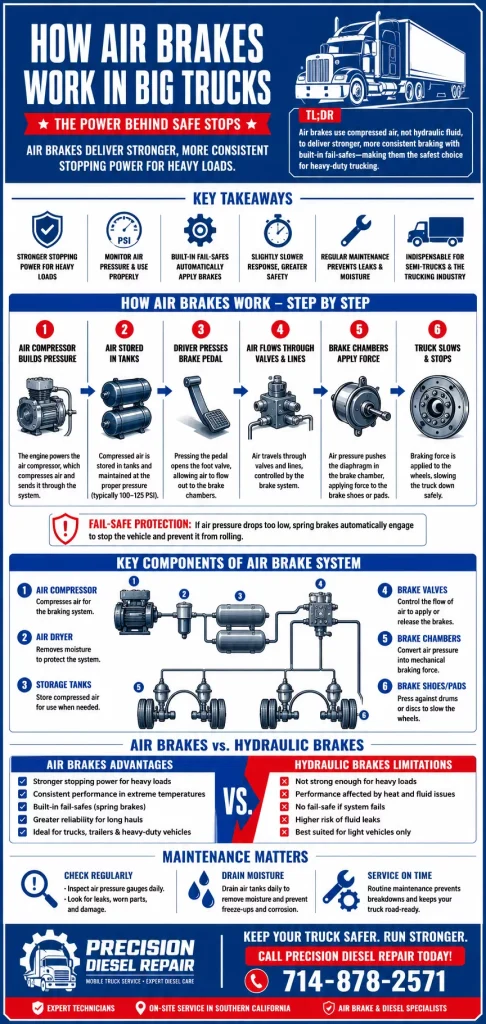
Air brakes are the standard braking system for semi-trucks because they use compressed air instead of hydraulic fluid, allowing them to deliver stronger, more consistent stopping power for heavy loads. Unlike car brakes, they include fail-safe features like spring brakes that automatically engage if air pressure drops. While they respond slightly slower than hydraulic systems, they are far safer and more reliable for long-haul trucking.
Key Takeaways
- Proper use includes monitoring air pressure and avoiding prolonged braking on steep declines.
- Semi-trucks use air brakes because hydraulic systems cannot handle extreme weight and heat.
- Air brakes use compressed air stored in tanks to apply braking force through brake chambers.
- Main components include an air compressor, storage tanks, valves, and brake chambers.
- They provide consistent braking performance even under heavy loads and long distances.
- Built-in fail-safes automatically apply brakes if air pressure is lost.
- Slightly slower response than hydraulic brakes, but much greater safety and stopping power.
- Regular maintenance is critical to prevent air leaks and moisture buildup.
Air brakes are an indispensable part of semi-trucks and are very significant for the trucking industry in general. Lorry brakes are specifically designed to handle the weight and demands of large commercial trucks. All American diesel vehicles rely heavily on air brakes for stopping power and safety on highways. Different from the braking systems installed in regular cars, these powerful systems were adapted to stand up to heavy load carriage and long-distance driving. Air brake systems are engineered to maintain consistent stopping power under extreme load conditions.
Understanding why semi-trucks use air brakes is pretty important. Many drivers ask, what are air brakes on trucks, and the answer lies in their use of compressed air to safely stop heavy vehicles. For beginners, learning what are air brakes is the first step to understanding heavy-duty truck operations. They are far better in performance compared to hydraulic brakes, and that’s why they’re really indispensable for a truck driver or a fleet owner. Each truck is equipped with an air brake system that ensures dependable stopping power under extreme conditions.
By understanding how the systems work, you will have an appreciation of their strengths and be able to operate a safer, more efficient fleet on the road. Proper maintenance by all American diesel and fleet services ensures trucks remain safe and reliable over long distances. Having a skilled mechanic diesel mechanic on hand ensures any issues with your air brakes or engine are addressed promptly.
Many tractor trailer trucks, including 18 wheelers and semi trucks, rely on these braking systems to manage heavy loads safely on highways. Diesel fleet services play a crucial role in keeping large trucks’ air brakes and engines properly maintained. A heavy duty diesel mechanic is essential for maintaining the complex systems of semi-trucks and tractor trailers.
Understanding Brake Systems
Many drivers wonder why do trucks use air brakes instead of hydraulic systems for heavy loads.
Brake systems are the unsung heroes when it comes to stopping power. Let’s briefly take a look at each of the two major types-hydraulic brake systems and air brake systems.
Many drivers refer to these systems simply as hyd brakes, and they’re common in everyday cars and smaller trucks.
Hydraulic Brake Systems
Hydraulic brake systems are by far the most common in passenger vehicles. In a hydraulic system, when a pedal is pushed, brake fluid is transmitted via lines at the wheels to apply brakes. These hydraulic brakes are ideal for light vehicles but not strong enough to handle the extreme demands of heavy trucks or trailers.
Important components include:
- Brake Pedal: Provides the initial input
- Master Cylinder: Transforms the pressure exerted on the pedal into hydraulic pressure
- Brake Lines: Medium for conducting brake fluid
- Calipers and Pads: Clamping components that press against the rotors and thus reduce the speed
Their dependence on fluid makes them suitable for smaller vehicles but raises questions about heat and potential leakage in the fluids.
Many drivers notice that air brakes take more time than hydraulic brakes because they use compressed air instead of direct hydraulic fluid pressure, which slightly delays the response time but increases overall braking power and safety. This explains why do trucks use air brakes instead of hydraulic systems, they provide consistent power and enhanced safety for heavy vehicles.
That’s why you won’t see hydraulic brakes on big rig trucks & trailers or tractor trailer models designed for long-distance hauling.
Air Braking Systems
Knowing why do big trucks use air brakes helps explain their superior stopping power under extreme weight conditions. Why do big trucks use air brakes helps fleet operators ensure safety and compliance with road regulations. Understanding why do semis use air brakes helps fleet owners plan safer operations for long hauls. Fleet managers consider why do semis use air brakes essential knowledge for training new drivers and maintaining safety standards.
In contrast, air braking systems are for larger vehicles such as semi-trucks. Semi air brakes are the standard choice for tractor trailers and other heavy-duty vehicles due to their reliability. These types of brakes do not use fluid but rely on compressed air to transfer pressure to the brakes.
This type of pneumatic brake system is specially designed for heavy-duty vehicles, including lorries and semi-trucks.
Components include the following:
- Air Compressor: compresses air for use in braking
- Storage Tanks: store compressed air for later use in braking
- Brake Chambers: These are for converting air pressure to mechanical force to apply the brakes
- Foot Valve (Brake Pedal): It controls the airflow either to apply or to release the brakes. The brake pedal in an air brake system allows the driver to modulate braking force precisely, preventing wheel lockup. The brake pedal in an air brake system allows drivers to regulate braking force accurately.
Unlike hydraulic systems, air brakes perform consistently under extreme variations in operating conditions and offer fail-safe features that will automatically apply the brakes should air pressure drop. Some heavy-duty vehicles also use a combined air hydraulic brake system, which merges the strength of air pressure with the smooth operation of hydraulic braking.
This means they become ideal for heavy-duty applications, both safe and reliable on long hauls.
Air brakes are standard on trucks with trailers, container trailer trucks, and even specialized cargo semi trailers because they provide the stopping force needed for large loads. Trucks with air brakes are easier to handle on long highways because the system ensures consistent braking power even under heavy loads. Trucks with air brakes are easier to operate safely over long distances, even when heavily loaded.
Understanding why do large trucks use air brakes is essential for fleet operators managing heavy cargo.
How Air Brakes Work
For anyone wondering how do air brakes on trucks work, the answer lies in their ability to use compressed air to generate powerful and consistent braking force.
Air brakes are an advanced system using compressed air to achieve and maintain effective braking performance. For beginners, learning what are air brakes is the first step in understanding heavy-duty truck operation. The main part of this system is the air compressor, an important component that converts engine power into compressed air. This air is stored in tanks, ready to be used when you need to slow down or stop your truck.
If you’ve ever wondered how do air brakes on trucks work, it comes down to a reliable chain of compressed air processes designed for safety and performance. Learning how do air brakes work is essential for anyone handling heavy-duty diesel vehicles.
How Do Truck Air Brakes Work?
Understanding how truck air brakes work is essential for anyone operating heavy-duty vehicles like semi-trucks or lorries. The air brake system on a truck uses compressed air rather than hydraulic fluid, making it more reliable under high pressure and temperature conditions. This system consists of air brake equipment such as compressors, brake chambers, and control valves that allow for strong and consistent braking force.
So, how does an air brake work exactly? When the driver presses the brake pedal, air pressure flows through the brake lines into the brake chambers, pushing the brake shoes against the drums or discs to slow the truck. This is how pneumatic brakes work in large vehicles like semi-trucks and lorries.
From single axle semi trucks with sleeper cabs to 10 wheeler trailers and 53 foot semi trailers, the same air brake principles apply.
Key Parts of Air Brakes
To understand how air brakes work, you should be aware of a few key parts:
- Air Compressor: Develops and saves compressed air so that, at all times, there is just enough pressure to brake
- Brake Actuators: The component that receives the compressed air to convert it to mechanical force, engaging the brake shoes to the drum or disc
- Brake Pedal: The device a driver uses to input control of airflow through to the actuating mechanisms
It’s important to remember that all vehicles equipped with air brakes have components like compressors, valves, and tanks that must be inspected regularly to maintain safe operation.
How Braking Engages and Releases
Understanding semi truck braking is key for safe driving, properly maintained air systems ensure smooth control and reduced stopping distances. Semi truck brakes require regular inspection to guarantee effective performance under high stress.
When the pedal is applied, the valve opens, admitting compressed air to the actuators. Air pressure then forces the components of the brakes to apply themselves and begin to retard the movements of your vehicle. Conversely, releasing the pedal reverses that the air is dumped out of the system, and the brakes release, making free movement of your truck possible. This complex interaction of the parts ensures that big rigs carrying heavy loads are able to navigate different terrains and conditions safely. Air brakes remain the standard choice for all long-haul trucks because of their reliability and consistent performance. Comprehension of this mechanism improves safety and enhances your driving experience in large vehicles.
Advantages of Air Brakes Over Hydraulic Brakes in Semi-Trucks
Some truck owners also explore installing an air brake conversion kit to upgrade from hydraulic to air systems for improved reliability and braking strength.
When it comes to the reliability of your semi-truck’s braking system, air brakes are superior for a number of reasons. Regular inspection of semi truck brakes ensures that the vehicle remains safe under heavy loads and long distances.
That’s why semi truck air brakes are trusted across the industry, particularly in harsh driving conditions. These semi truck air brakes provide dependable control even under heavy loads, making them the preferred system for long-haul and freight operations.
Consistent Braking Performance
For long hauls, when the weather is usually unpredictable, the consistency of their braking performance is invaluable. Whereas hydraulic systems may falter at extreme temperatures, air brakes will continue working as effectively as ever and keep your truck safe.
Greater Stopping Power
Other major advantages include the stopping power of air brakes. Since it was designed for heavy-duty vehicles like semi-trucks, it can supply the needed force to stop heavy loads safely and effectively. This greater ability to stop becomes crucial when driving through steep slopes or during cases of emergency stops due to their effect on reducing risks and improving safety in general.
Inherent Safety
Air brake systems have fail-safes, not part of hydraulic systems. These fail-safes explain why do big trucks use air brakes, providing backup in case of air pressure loss. Such mechanisms engage the brakes immediately in case of sudden air loss. In addition, spring brakes on trucks act as a safety backup that automatically engages if air pressure drops, preventing the truck from rolling unexpectedly. That inbuilt safety, a component fails, and your truck is not going to go barrel out of control, which is another comforting factor for driver and fleet owner alike.
So why do semi-trucks use air brakes? The answer lies in their unique combination of reliability, power, and safety. Knowing why do semi trucks use air brakes allows drivers to operate them more efficiently and reduces wear on the braking system. Knowing why do semi trucks use air brakes ensures drivers can operate them safely and efficiently. Knowing why do semi trucks use air brakes ensures drivers can operate them safely on long hauls. They are thus indispensable for any heavy-duty trucking operation.
That’s why names of 18 wheelers, new 18 wheeler models, and even classic best semi trucks of all time are all designed with air brake systems in mind. 18 wheeler air brakes are specifically engineered to stop these massive vehicles efficiently, even when fully loaded. 18 wheeler air brakes are crucial for ensuring safety in long-haul freight transport.
How to Use Airbrakes and Work Brakes on Semi-Trucks
Air brakes are more than just powerful stopping systems—they require a clear understanding of how to use airbrakes properly for safe operation. In semi-trucks, using air brakes effectively is all about managing air pressure, timing, and brake modulation.
Work brakes are the primary brakes you control with your foot pedal while driving. Unlike emergency or parking brakes, work brakes are designed for routine stopping and slowing down. When you press the pedal, compressed air flows from the storage tanks to the brake chambers, applying force to the brake shoes or pads. This process allows the truck to slow down smoothly, even when hauling heavy loads across Southern California highways or mountain passes.
To use air brakes safely:
- Press the pedal gently at first: Gradual pressure prevents wheel lockup and ensures even braking.
- Maintain adequate air pressure: Check gauges frequently to ensure your truck stays above the minimum safe pressure (usually around 60 psi).
- Use proper braking intervals: On long downhill stretches, apply the brakes in short bursts rather than holding the pedal down continuously to prevent overheating.
- Understand the spring brakes: These automatically engage if air pressure drops, acting as a backup for your work brakes.
For drivers operating on Southern California routes—from busy urban freeways to steep coastal roads—mastering air brakes and work brake usage is critical for safety and smooth vehicle handling. Proper usage not only protects your cargo but also extends the life of your braking system, reducing maintenance needs for diesel mechanics and fleet services.
How To Air Brakes Work
Air brakes use compressed air instead of hydraulic fluid to stop heavy vehicles. An air compressor builds pressure and stores it in tanks. When the driver presses the brake pedal, air is released through valves into the brake chambers. This pressure pushes a diaphragm that applies force to the brake shoes or pads, slowing the wheels down. In Southern California, this system is common in semi-trucks, buses, and heavy-duty diesel equipment because it performs well under high heat and heavy load conditions.
How To Use Air Brakes
Air brakes operate with steady control rather than quick pressure like a car brake pedal. The driver applies gradual pressure to slow the vehicle smoothly. For downhill driving, controlled braking helps maintain safe speed without overheating the system. Regular checks of air pressure levels are important before driving, since low pressure can reduce braking power. Proper use keeps stopping distances predictable on busy California highways and job sites.
Precision Diesel Services can inspect, repair, and maintain air brake systems to keep heavy vehicles operating safely and efficiently.
Air Brake Systems and Real-World Truck Performance
Out on Southern California roads, the way a truck air brake system performs isn’t just about theory, it’s about consistency day after day. A properly maintained air brake system on a truck keeps braking smooth even under heavy loads, especially when dealing with tractor trailer air brakes or full semi truck air brake systems. You’ll notice the difference in control, particularly when a truck with air brakes is hauling through traffic or long highway stretches where steady pressure matters more than sudden stops.
A lot of that reliability comes from how pneumatic braking systems are built. Unlike basic setups, a full truck and trailer air brake system works together with trailer air brake systems and semi trailer brake systems to balance braking across the entire rig. This is where heavy truck air brake systems stand out. They’re designed to handle weight, heat, and long-distance wear in ways a standard hydraulic brakes truck setup simply can’t match.
How do truck air brakes work
At a basic level, how do truck air brakes work comes down to controlled air pressure moving through a closed system. The air brake system truck uses compressed air stored in tanks, and when the pedal is pressed, that air travels through lines into chambers. This is how air brakes on trucks create force without relying on fluid. If you’ve ever wondered how air brakes work on trucks or even how does air brake work, it’s really about that steady conversion of air pressure into stopping power.
The process behind how truck air brakes work also explains why trucks use air brakes instead of fluid systems. With setups like semi truck air brake components and a primary and secondary air brake system, there’s built-in redundancy for safety. That’s also why questions like what are air brakes and how do they work or how does truck air brakes work come up so often. The system is simple in concept, but incredibly dependable when every part of the truck braking system is working the way it should.
Considerations of Maintenance and Repair for the Air Brakes in Semi-Trailers
The better one’s air brake systems are maintained, the safer your travels will be on the road. Regular all American diesel service helps prevent system failures and keeps trucks road-ready. This is a good but essential habit for best performance and safety. The best way to avoid getting stranded is to stay ahead with consistent diesel repair and semi-repair services.
Common Issues with Air Brakes
Leaks in the System
Leakages within the system can lead to air pressure loss that seriously impacts braking capacity. Regular checks enable the identification of such leaks, allowing their timely repair. Finding a reliable diesel mechanic near me in Southern California ensures your fleet stays road-ready.
Water Build-Up
Another common problem occurs due to condensation in the system, which causes water to accumulate. During cold weather, when this water freezes, it may block the airways and render braking less effective. Regular checks are especially important for trailers and trucks like 40 foot semi trailers, tri axle semi trucks, or smaller 16 ft utility trailer weights that also depend on air systems. It is considered wise to invest in maintenance services that include regular draining of air tanks.
Addressing all these potential problems with effective and regular maintenance practices will ensure that semi-truck drivers and fleet owners are more or less assured of their trucks’ safety when facing the demands of long-distance journeys.
Timely American diesel repair can resolve issues with air compressors, brake chambers, and other critical truck components. Experienced diesel mechanics near you in Southern California provide expert service for air brakes and semi-truck engines.
Professional Semi-Truck Air Brake Service
Our team also provides comprehensive diesel repair services to keep your truck’s engine, fuel systems, and brakes performing efficiently on the road. Visiting a trusted semi truck repair shop guarantees thorough maintenance of both brakes and engine systems.
When it comes to keeping your air brake systems at their optimum, it is important to leave the work to the professionals with expertise in this field. We at Precision Diesel Repair are a leading choice for mobile truck service. Being experts in the art of airbrake maintenance and repair, we provide on-site service throughout Southern California with technicians who have worked on air brakes for years, tending to each specific customer need. Semi truck mechanics near me in Southern California are crucial for fast, reliable service on busy routes.
For fleet owners and drivers, taking advantage of such specialized services makes sure your trucks are always road-ready, with minimum loss of time and maximum assurance of safety.
Choose Precision Diesel Repair
It is really important to understand how semi-trucks work with air brakes, both for fleet owners and drivers alike. It is clear that the systems meant for safety are essential ones, which rely on such components. No wonder semi-trucks rely on air brakes due to their mighty stopping capabilities and consistent performances at varied temperatures.
Whether it’s a heavy duty tractor trailer, a small camper trailer weight setup, or even specialized semi trailer towing, keeping the air brake system maintained is the key to safe driving.
To keep this important part in good shape, think about contacting Precision Diesel Repair. Our knowledge of mobile truck services guarantees that your truck’s air brakes stay in excellent condition. A semi mobile mechanic near me can arrive directly at your location for urgent air brake or engine repairs. For trustworthy maintenance services, contact us today at (714) 878-2571.
Precision Diesel Repair specializes in maintaining air, hydraulic, and hybrid braking systems, offering reliable service for semi truck braking and diesel repair services across Southern California.