

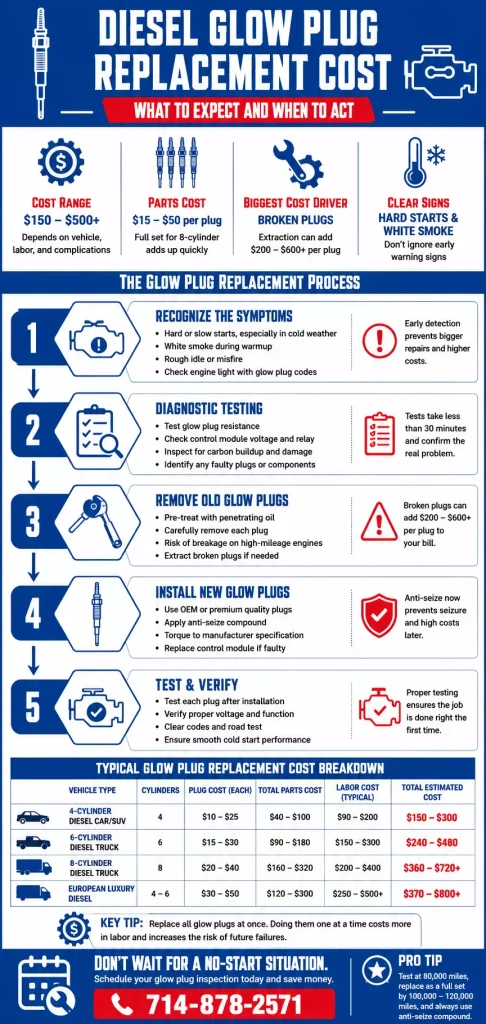
Diesel glow plug replacement cost typically falls between $150 and $500 for most vehicles. However, complex jobs on trucks like the 6.7 Powerstroke can push that figure significantly higher. The wide range reflects differences in vehicle type, the number of cylinders, labor rates, and whether any plugs break off during removal.
Key Takeaways
- Glow plug replacement cost ranges from $150 to $500+ depending on your vehicle and local labor rates
- Parts alone cost $15 to $50 per plug; a full set for an 8-cylinder diesel adds up quickly
- Broken glow plugs during removal are the single biggest cost driver, often doubling the repair bill
- Cold-start problems and white smoke at startup are the clearest signs of glow plug failure
- Replacing all plugs at once saves money compared to doing them one at a time
- Catching the problem early prevents harder cold starts that can stress the engine’s compression system
What Glow Plugs Do and Why They Fail
Diesel engines do not use spark plugs. Instead, they rely on compression heat to ignite fuel. In cold weather, that compression heat may not be enough to get combustion started reliably. That is where glow plugs come in.
These small heating elements sit inside each cylinder’s pre-chamber or combustion chamber. They warm the air and fuel mixture before and during startup. When you turn the key and wait a second or two before the engine cranks, you are waiting for the glow plugs to reach operating temperature.
Most glow plugs are designed to reach temperatures between 1,800°F and 2,500°F within a few seconds. According to Bosch’s technical documentation on diesel ignition systems, repeated heating and cooling cycles cause the heating element to degrade over time. Plugs typically last between 100,000 and 150,000 miles, but real-world conditions shorten that lifespan considerably.
Short trips, frequent cold starts, and poor fuel quality all reduce plug longevity. Additionally, normal wear on high-mileage vehicles accelerates the failure timeline.
Common causes of early glow plug failure include:
- Carbon buildup from incomplete combustion
- Poor fuel quality or contaminated diesel
- Overvoltage from a faulty glow plug control module
- Physical damage from engine overheating
- Normal wear from high cycle counts on high-mileage vehicles
Breaking Down Diesel Glow Plug Replacement Cost
The total bill for a glow plug job has two components: parts and labor. Understanding both helps you evaluate whether a shop’s quote is fair.
Parts Cost for Glow Plug Replacement
Glow plugs range from about $8 to $50 each depending on the brand and your vehicle’s make and model. Standard plugs for a common pickup truck like a Duramax-powered Chevy Silverado or a Ford Power Stroke run around $15 to $25 each. Premium plugs from brands like NGK or Bosch sit closer to the $25 to $50 range per plug.
A 6-cylinder diesel needs 6 plugs. An 8-cylinder diesel needs 8. Here is a typical parts cost breakdown:
| Vehicle Type | Cylinders | Plug Cost (Each) | Total Parts Cost |
|---|---|---|---|
| 4-cylinder diesel car/SUV | 4 | $10-$25 | $40-$100 |
| 6-cylinder diesel truck | 6 | $15-$30 | $90-$180 |
| 8-cylinder diesel truck | 8 | $20-$40 | $160-$320 |
| European luxury diesel | 4-6 | $30-$50 | $120-$300 |
Labor Cost for Diesel Glow Plug Replacement
Labor is where costs can vary dramatically. A straightforward glow plug job on an accessible engine takes a technician one to two hours. At shop rates of $90 to $150 per hour, labor falls between $90 and $300.
The biggest wildcard is broken plugs. On high-mileage diesel trucks, the plugs can seize in the head. When a technician applies torque to remove a seized plug, it can snap off. Extracting a broken glow plug from a cylinder head is labor-intensive work. Therefore, this task can add $200 to $600 per broken plug to the total bill. In serious cases, it requires removing the cylinder head entirely.
This is why many experienced diesel owners choose to have their glow plugs replaced proactively. They replace them before failure occurs and before seizure becomes an issue. If you want to read more helpful content like this, check out the articles section on Precision Diesel’s website for in-depth coverage of common diesel maintenance topics.
Glow Plug Problems and Related Diesel Issues
Glow plug failure rarely happens in isolation. When your diesel is struggling to start or running rough in cold weather, the glow plugs are a prime suspect. However, other fueling system components often share similar symptoms. Carbon deposits that foul glow plugs also accumulate on injectors, affecting spray patterns and combustion efficiency.
Understanding the diesel fuel injector cleaning cost can help you budget for a more complete service. If your injectors show similar wear patterns alongside the plugs, a comprehensive cleaning makes sense.
Similarly, degraded fuel injector parts truck engine performance can mimic the symptoms of glow plug failure. Rough idle, hard starts, and excessive white or black smoke can stem from either problem. A thorough diagnostic check before any repair work helps you avoid replacing glow plugs only to find the problem persists because of a separate injector issue.
The NIH’s National Library of Medicine research on diesel engine emissions shows a direct correlation between poor combustion efficiency and increased particulate output. Faulty glow plugs contribute to combustion problems. For diesel truck owners in states with strict emissions testing, that is another practical reason to keep glow plugs in good working order.
How a Diesel Technician Tests Glow Plugs
A professional diagnosis usually follows several steps:
1. Scan for Fault Codes
Modern diesel engines store glow plug-related codes that identify specific cylinders or control system problems.
2. Measure Glow Plug Resistance
A technician uses a multimeter to check resistance. A plug with an open circuit or abnormal reading is usually considered failed.
3. Check Voltage Supply
The technician verifies that the glow plug controller is delivering proper voltage.
4. Inspect Wiring and Connectors
Corrosion, damaged connectors, or wiring issues can create the same symptoms as a failed glow plug.
Proper testing prevents unnecessary replacement of expensive components.
DIY vs. Professional Diesel Glow Plug Replacement
Some diesel owners with mechanical experience do replace glow plugs themselves. On accessible engines, the job requires a glow plug socket set, a torque wrench, anti-seize compound, and patience. The risk is always the same: a broken plug.
If you are not experienced with extracting broken fasteners from aluminum or iron heads, a DIY job can turn into an expensive recovery mission. For most owners, a professional shop is the safer choice. When searching for a trusted diesel engine mechanic near you in southern California, look for shops that specialize specifically in diesel vehicles. Diesel-specific shops have the right tooling, including glow plug extractors and thread repair kits. They handle complications without turning a $300 job into a $900 ordeal.
Before you commit to any shop, ask these questions:
- Do you pre-treat the plugs with penetrating oil before removal?
- What is your process if a plug breaks?
- Do you replace the glow plug relay and control module if they test faulty?
- Will you test each plug after installation?
Things to Know About Glow Plug Replacement
- Glow plugs that work fine in summer can fail in winter because cold weather puts maximum demand on them; schedule a check before temperatures drop
- The glow plug control module, which regulates voltage to the plugs, can fail independently of the plugs themselves and will cause identical symptoms at a fraction of the cost to repair
- Anti-seize compound applied during installation significantly reduces the risk of seizure at the next service interval
- A single faulty plug on an 8-cylinder engine may not prevent starting but will cause misfires, rough idle, and increased diesel particulate output
- European diesel vehicles like Mercedes Sprinters and BMW diesels often use higher-cost plugs and have tighter access, pushing labor hours higher
- The Mayo Clinic’s guidance on air quality notes diesel particulates as a health concern, which reinforces the value of keeping combustion systems functioning cleanly
How to Make Glow Plugs Last Longer
You can extend glow plug life by maintaining the systems that affect combustion quality.
Helpful practices include:
- Use high-quality diesel fuel from reputable stations
- Replace fuel filters at manufacturer intervals
- Avoid excessive short trips when possible
- Fix injector problems quickly
- Maintain proper battery voltage
- Address check engine lights early
- Test glow plugs before winter weather arrives
A weak battery can also shorten glow plug life because the system requires significant electrical current during startup.
What to Do If Your Diesel Won’t Start in the Cold
If you are already stranded with a diesel that will not fire on a cold morning, it is worth knowing your options before you call a tow. Understanding emergency roadside assistance services designed for diesel vehicles can save you time and money. A diesel-specific roadside provider understands the difference between a dead battery, a failed glow plug relay, and seized plugs.
For a broader understanding of what you can realistically expect from professional help on the road, the resource on emergency roadside assistance what to expect from a professional diesel mechanic gives you a practical rundown. It covers services, response protocols, and realistic outcomes so you are not caught off guard.
The U.S. Department of Energy’s Alternative Fuels Data Center provides useful information on diesel vehicle maintenance requirements. This helps owners understand the full picture of diesel-specific upkeep costs.
Ready to Schedule Your Glow Plug Service?
The smartest move you can make right now is to book a diagnostic appointment with a qualified diesel technician before cold weather arrives. Ask specifically for a glow plug resistance test and a control module voltage check. These tests take less than 30 minutes and will tell you definitively whether your plugs are approaching failure.
If you are in Southern California, a diesel specialist can often perform this inspection the same day. They will give you a firm quote for replacement if needed or you can call Precision Diesel Southern California at 714-878-2571. Do not wait until a no-start situation forces your hand.
Frequently Asked Questions
Q: Can I drive my diesel with a bad glow plug?
You can technically drive with a bad glow plug once the engine is fully warmed up, but it is not advisable.
A faulty plug causes that cylinder to misfire or run inefficiently, increasing fuel consumption and emissions. In cold weather, a bad plug may prevent the engine from starting at all. Replacement should not be deferred beyond one or two weeks once a fault is confirmed.
Q: How often should you replace glow plugs on a diesel?
Most diesel manufacturers recommend inspecting glow plugs every 60,000 miles and replacing them by 100,000 to 150,000 miles.
Driving habits matter significantly. Vehicles used for short trips with frequent cold starts may need replacement sooner, around 60,000 to 80,000 miles. Always consult your owner’s manual and have plugs tested at each major service interval.
Q: How much does it cost to replace glow plugs on a 6.7 Powerstroke?
Replacing glow plugs on a Ford 6.7 Powerstroke typically costs between $400 and $900 at a professional shop.
The 6.7 Powerstroke has 8 cylinders, and accessing the plugs requires significant disassembly. OEM or premium aftermarket plugs run $25 to $45 each. Labor on this engine is generally 3 to 5 hours due to tight access. If any plugs break during removal, costs increase further.
Q: How long does it take a mechanic to change glow plugs?
On a straightforward job with accessible plugs that remove cleanly, a mechanic can replace a full set in 1.5 to 3 hours.
On trucks like the 6.7 Powerstroke or the 6.4 Power Stroke, factory access limitations push that to 4 to 6 hours. Broken plug extraction adds unpredictable time. Always ask your shop for a worst-case time estimate before authorizing the work so you are not surprised by the final invoice.
Q: How to tell if diesel glow plugs are bad?
The most common signs are hard or slow cold starts, white smoke from the exhaust during warmup, a rough idle in cold temperatures, and a check engine light with glow plug-related fault codes.
A technician can confirm failure using an ohmmeter to test each plug’s resistance. A reading outside the manufacturer’s specified range confirms a bad plug. Wikipedia’s overview of glow plug technology explains the resistance specifications and how these components work across different diesel engine designs.
The Bottom Line on Diesel Glow Plug Replacement Cost
Diesel glow plug replacement cost is one of those maintenance expenses that is far cheaper to handle proactively than reactively. A planned replacement on a healthy engine where the plugs come out cleanly can be done for $200 to $400 on most trucks. However, wait until a plug fails and seizes, and you are looking at a bill that can easily reach $800 to $1,500 or more.
Test your plugs at 80,000 miles, replace them as a full set by 100,000 to 120,000 miles, and make sure your technician uses anti-seize compound during installation. That single habit will save you from one of the most avoidable and costly repair scenarios diesel owners face.
