

California commercial truck emission testing is one of the most complex and frequently updated compliance areas for fleet operators in the state. If you run a diesel commercial truck or fleet in California, you face some of the strictest air quality regulations in the country. The California Air Resources Board (CARB) enforces these standards rigorously.
Key Takeaways
- California’s Truck and Bus Regulation requires most diesel trucks over 14,000 lbs. GVWR to meet specific engine model year or filter requirements.
- The Advanced Clean Trucks (ACT) rule adds zero-emission vehicle requirements starting in 2024 and ramping up through 2035.
- Failure to comply with CARB regulations results in fines exceeding $1,000 per day per vehicle.
- Smog checks for diesel commercial vehicles follow different rules than gasoline vehicles and depend on GVWR and registration weight.
- 2026 brings significant new reporting and compliance thresholds under the ACT rule and In-Use Off-Road Diesel regulation updates.
- Working with a qualified diesel mechanic familiar with CARB requirements is one of the most practical ways to stay road-ready and compliant.
Why California Commercial Truck Emission Testing Rules Hit Commercial Trucks Harder Than Passenger Vehicles
California does not treat commercial diesel trucks the same way it treats your personal car at a smog station. Furthermore, the California Air Resources Board (CARB) operates under authority granted by the federal Clean Air Act waiver. This allows the state to set standards stricter than federal EPA rules. You can review the CARB Truck and Bus Regulation overview on the CARB website for the full regulatory text.
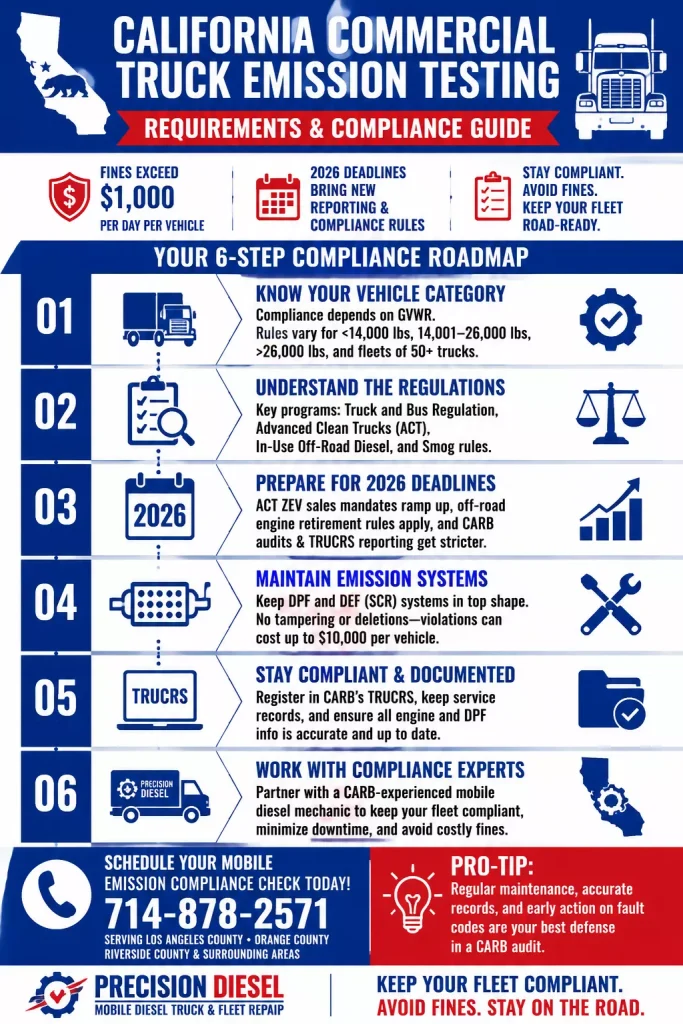
For commercial diesel trucks, the primary regulation is the Truck and Bus Regulation. This regulation appears in California Code of Regulations, Title 13, Section 2025. It applies to diesel-fueled vehicles with a gross vehicle weight rating (GVWR) over 14,000 lbs. The rule sets out requirements based on engine model year, diesel particulate filter (DPF) installation, and the phase-out of older, higher-polluting engines.
Here is what the compliance structure looks like at a high level:
| Vehicle GVWR | Regulation Focus | Key Requirement |
|---|---|---|
| Under 14,000 lbs | BAR Smog Check Program | Biennial smog inspection at licensed station |
| 14,001 – 26,000 lbs | Truck and Bus Reg + Smog | DPF or model year compliance + smog |
| Over 26,000 lbs | Truck and Bus Regulation | Engine upgrade or replacement milestones |
| All diesel fleets 50+ trucks | Advanced Clean Trucks | ZEV percentage targets starting 2024 |
Understanding which category your vehicles fall into is the first step. Moreover, if you operate a mixed fleet, you may be dealing with multiple regulatory programs simultaneously.
California Commercial Truck Emission Testing: The Smog Check Question for Diesel Vehicles
This is where a lot of operators get confused. The Bureau of Automotive Repair (BAR) Smog Check program covers gasoline vehicles and some lighter diesel vehicles. However, for heavier commercial diesel trucks, CARB’s Truck and Bus Regulation takes over as the primary compliance mechanism.
Diesel vehicles with a GVWR over 14,000 lbs. registered in California are generally exempt from the BAR smog check. Instead, they must comply with the Truck and Bus Regulation. This means proving your vehicle has the correct engine model year or an approved DPF installed. Additionally, diesel vehicles between 10,001 and 14,000 lbs. registered at a weight over 10,001 lbs. fall into a separate smog check requirement. This requirement uses a different test procedure than standard passenger cars.
One area that catches many operators off guard is engine maintenance. Therefore, understanding how to identify and fix common diesel fuel system problems is genuinely useful. An emissions-related failure, such as a clogged DPF or a malfunctioning EGR valve, can cause your vehicle to fail inspection. It can also trigger a CARB audit. Fuel system issues often cascade into emission system failures.
The NIH’s National Library of Medicine has published research confirming the health impact of diesel particulate matter on urban populations. This research is a key driver of why California continues to tighten these standards beyond federal minimums.
California Clean Truck Check (HD I/M) Requirements
In addition to CARB’s Truck and Bus Regulation, many diesel commercial vehicles operating in California must also comply with the California Clean Truck Check Program, formerly known as the Heavy-Duty Inspection and Maintenance (HD I/M) Program.
The program applies to most diesel and alternative-fuel vehicles with a GVWR greater than 14,000 pounds, including many out-of-state vehicles that operate in California.
Unlike traditional smog inspections, Clean Truck Check focuses on ongoing emissions monitoring through:
- OBD emissions testing
- Periodic emissions compliance reporting
- Roadside emissions inspections
- Remote sensing technology
- Smoke opacity inspections
Vehicle owners are responsible for ensuring that emissions systems remain functional throughout the year, not just during scheduled inspections.
Failure to comply can result in registration holds, citations, and significant CARB penalties.
What Is Actually Changing in 2026 for California Commercial Truck Emission Testing
The year 2026 is a critical compliance milestone for several CARB programs running simultaneously. Here is what you need to pay attention to:
Advanced Clean Trucks (ACT) Rule Ramp-Up
Under the ACT rule, manufacturers selling Class 2b through Class 8 trucks in California must hit increasing zero-emission vehicle (ZEV) sales percentages. By 2026, the percentages ramp up considerably for Class 7 and Class 8 trucks. In addition, if your fleet relies on purchasing new trucks, your options from dealers in California will increasingly include ZEV models. This affects your capital planning.
In-Use Locomotive and Off-Road Diesel Updates
The In-Use Off-Road Diesel-Fueled Fleets Regulation also has compliance checkpoints in 2026. These checkpoints require fleet operators above certain horsepower thresholds to retire or repower older Tier 0 and Tier 1 engines.
Truck and Bus Regulation Final Phase-Out
By January 1, 2023, most heavy-duty diesel trucks were already required to have 2010 model year engines or newer. Alternatively, they needed equivalent DPF-equipped engines. By 2026, compliance verification through CARB’s online reporting system (TRUCRS) becomes even more stringent. As a result, increased audit activity is expected for fleets that have not updated their registration records.
If you operate in Southern California and need help evaluating whether your trucks meet current standards, speaking with diesel mechanics near me southern california who understand CARB compliance is a smart move. This step helps before a roadside inspection catches you off guard.
California Commercial Truck Emission Compliance Checklist
Before operating your truck in California, verify the following:
- Confirm your truck’s GVWR
- Verify your engine model year
- Ensure your DPF is installed and functioning properly
- Check your DEF system for active faults
- Register your vehicle in CARB TRUCRS (if required)
- Complete Clean Truck Check reporting
- Resolve any active OBD emission fault codes
- Maintain maintenance and repair records
- Inspect your exhaust system for tampering
- Schedule preventive diagnostics before DOT or CARB inspections
Following this checklist greatly reduces the risk of costly roadside violations.
DPF, DEF, and Engine Technology Requirements for California Commercial Truck Emission Testing
Two emissions control systems come up constantly in compliance conversations: the Diesel Particulate Filter (DPF) and Diesel Exhaust Fluid (DEF) used in Selective Catalytic Reduction (SCR) systems.
DPF traps soot and particulate matter from exhaust. Furthermore, CARB requires approved DPFs on most heavy-duty diesel trucks. Tampering with or deleting a DPF is a serious violation that results in fines of up to $10,000 per vehicle plus potential criminal referral.
DEF is the urea-based fluid used in SCR systems on most 2010 and newer diesel engines. It reduces NOx emissions. Therefore, if you are purchasing a 2027 model year diesel truck, it will almost certainly include a DEF system. SCR technology is now standard across all major OEM platforms including Cummins, Detroit Diesel, and PACCAR. The EPA’s SmartWay program provides additional context on heavy-duty truck emission standards at the federal level.
For operators running older engines like the LML Duramax, understanding most common lml duramax problems helps you anticipate what to inspect before a roadside CARB check. A BIT inspection can trigger a violation, since staying on top of emissions-related components is especially critical. A failure in any emission system on an older engine can quickly create a compliance problem.
Minor components like glow plugs also matter more than most operators realize. Therefore, knowing your diesel glow plug replacement cost ahead of time makes budgeting for preventive maintenance much easier. A misfiring cylinder caused by a failed glow plug increases particulate output. It can also affect your DPF regeneration cycle.
Common Reasons Commercial Trucks Fail California Emission Inspections
Many emission violations are caused by maintenance issues rather than major engine failures.
Some of the most common include:
- Failed DPF regeneration
- Plugged diesel particulate filters
- DEF quality problems
- NOx sensor failures
- EGR valve malfunctions
- SCR catalyst efficiency faults
- Exhaust leaks
- Engine tuning modifications
- Deleted emissions equipment
- Active check engine lights
Addressing these issues early often prevents expensive repairs and avoids compliance penalties.
Things to Know
- CARB TRUCRS registration is mandatory. You must register your diesel trucks in CARB’s Truck Regulation Upload, Compliance, and Reporting System (TRUCRS) if they are subject to the Truck and Bus Regulation.
- Out-of-state trucks are not exempt. If you operate a truck in California for more than 60 days per year, CARB regulations apply regardless of where the vehicle is registered.
- Fines are per vehicle, per day. CARB enforcement actions accumulate quickly for large fleets. The California Attorney General’s office has pursued multi-million dollar settlements in past enforcement actions.
- Fleet size matters for ACT. The Advanced Clean Trucks rule applies to fleets with 50 or more vehicles. Smaller fleets have different timelines, but they are not permanently exempt.
- DPF deletion is illegal and detectable. Modern enforcement tools including roadside opacity meters and OBD scanning flag deleted trucks quickly.
- Maintenance records support compliance. Keeping detailed service records is your best defense in an audit or enforcement review.
What Happens During a California CARB Roadside Inspection?
During a roadside inspection, CARB inspectors may:
- Verify vehicle identification information
- Check engine model year documentation
- Inspect DPF installation
- Scan the vehicle’s OBD system
- Inspect DEF tanks and SCR components
- Measure smoke opacity
- Review maintenance records
- Verify TRUCRS reporting
If violations are discovered, the vehicle may receive citations requiring repairs before returning to compliance.
How Precision Diesel Helps Southern California Fleets Stay Compliant with California Commercial Truck Emission Testing
For fleet operators across Los Angeles County, Orange County, and Riverside County, staying ahead of California commercial truck emission testing requirements means having a reliable maintenance partner. This partner must understand both the mechanical and regulatory side of diesel operations.
Precision Diesel is a mobile diesel truck and semi truck repair provider serving Southern California fleets. Rather than pulling trucks out of service and sending them to a shop, they bring the repair to your yard or jobsite. Their team handles everything from DOT inspections and BIT inspections to DPF-related diagnostics. They also provide DEF system repairs and full fleet preventive maintenance programs.
You can reach them at (714) 878-2571, or (714) TRUCKS1, for emergency roadside assistance or to schedule fleet maintenance. For more technical reading on diesel systems and California compliance topics, their articles section covers a range of relevant subjects for commercial operators.
For operators who need a qualified technician on short notice anywhere in the Southern California region, searching for a diesel mechanic near me socal through Precision Diesel connects you with mobile technicians. These technicians understand the specific compliance environment California fleets operate in.
The Mayo Clinic has documented respiratory health effects linked to diesel exhaust exposure, which underscores why California’s regulators continue pushing compliance enforcement beyond what federal standards require.
What We See Most Often in Southern California Fleets
In our experience servicing commercial fleets across Los Angeles, Orange County, and Riverside County, the most common emission-related problems include:
- Plugged DPFs caused by excessive idling
- DEF contamination
- NOx sensor failures
- SCR efficiency faults
- Check engine lights ignored until inspection day
- Fleet records that haven’t been updated in TRUCRS
Many of these issues can be identified during routine preventive maintenance before they become compliance violations or result in expensive downtime.
How Much Does California Truck Emissions Compliance Cost?
Compliance costs vary depending on vehicle age and condition.
Typical expenses include:
- DPF cleaning
- DEF system repairs
- NOx sensor replacement
- OBD diagnostics
- Engine software updates
- Preventive maintenance
- Emission inspections
- Mobile diagnostics
Preventive maintenance is generally far less expensive than fines or extended vehicle downtime caused by compliance failures.
Ready to Audit Your Fleet’s Emission Compliance?
Pull your TRUCRS registration records today and cross-reference your vehicle list against the current CARB Truck and Bus Regulation compliance deadlines. If any of your vehicles are approaching a milestone engine year requirement or have open DPF-related fault codes, schedule a mobile diagnostic with Precision Diesel at (714) 878-2571. Do this before your next DOT inspection or CARB roadside check puts you in a difficult position.
Frequently Asked Questions
Q: Do I still have to smog my diesel truck in California?
Whether you need a smog check depends on your truck’s GVWR and registration weight.
Diesel trucks over 14,000 lbs. GVWR are generally exempt from the BAR smog check program but must comply with CARB’s Truck and Bus Regulation instead. However, lighter diesel vehicles between 10,001 and 14,000 lbs. registered at a higher weight class may face a separate diesel smog inspection procedure. Always verify your specific vehicle class with the BAR or CARB directly.
Q: What are the new trucking laws in California 2026?
The biggest 2026 changes involve Advanced Clean Trucks ZEV sales mandates and tightened CARB audit enforcement for TRUCRS compliance.
Fleet operators with 50 or more trucks will face higher ZEV purchase requirements when buying new Class 7 and Class 8 trucks from California dealers. Additionally, CARB is expected to increase its roadside enforcement activity targeting fleets that have not updated TRUCRS records to reflect current engine model years or DPF installations. Off-road diesel fleet operators also face updated horsepower-based retirement mandates in 2026.
Q: Do commercial vehicles need smog in California?
Commercial vehicles are subject to emissions compliance, but the specific program depends on vehicle weight and fuel type.
Gasoline-powered commercial vehicles generally go through the standard BAR smog check. However, diesel commercial vehicles over 14,000 lbs. are regulated under CARB’s Truck and Bus Regulation rather than the smog check program. Smaller diesel commercial vehicles may fall under a tailpipe opacity test or a hybrid of programs. Consulting CARB’s vehicle lookup tool or speaking with a compliance-experienced mechanic is the clearest path to confirming your obligations.
Q: What is the new California law for diesel trucks?
The most significant current law is the Advanced Clean Trucks rule combined with ongoing enforcement of the Truck and Bus Regulation.
The ACT rule requires truck manufacturers to sell increasing percentages of zero-emission vehicles in California, affecting new truck availability for fleet buyers. For trucks already in service, the Truck and Bus Regulation mandates 2010 model year or newer engines in most heavy-duty applications. DPF compliance is required, and DPF tampering carries steep financial penalties. CARB’s enforcement activity has grown substantially since 2022.
Q: Will 2027 diesel trucks have DEF?
Yes, all 2027 model year diesel trucks sold in the U.S. will include DEF systems as part of their standard Selective Catalytic Reduction (SCR) emissions setup.
DEF has been required on new heavy-duty diesel engines since the 2010 model year under EPA standards, and California aligns with or exceeds those requirements. Every major diesel OEM including Cummins, Detroit Diesel, and PACCAR will continue using SCR and DEF in their 2027 platforms. Managing your DEF system properly, including avoiding contamination and keeping sensors clean, is part of routine compliance maintenance.
The Bottom Line on California Commercial Truck Emission Testing
California commercial truck emission testing is not a single inspection event. It is an ongoing compliance obligation that touches your engine model year, your DPF system, your DEF maintenance, your TRUCRS registration, and increasingly your fleet purchasing decisions under the Advanced Clean Trucks rule. Missing a deadline or ignoring a DPF fault code does not just create a mechanical problem. It creates a regulatory and financial exposure that costs your operation far more than a timely repair would have.
The most practical step you can take right now is to schedule a mobile diagnostic for any truck in your fleet running emission-related fault codes. Do this if your truck is approaching a CARB compliance milestone. Precision Diesel’s mobile service covers Los Angeles County, Orange County, Riverside County, and surrounding areas. They bring shop-quality diagnostics and repairs directly to your yard. Call (714) 878-2571 to book a service appointment or get emergency roadside assistance before your next inspection becomes your next violation.
