

Mobile truck repair the right solution because it sends a certified diesel mechanic in Southern California directly to your disabled vehicle, eliminating the tow, the shop queue, and the lost revenue that follows. For fleets operating in high-traffic corridors like Southern California’s I-5, I-10, and SR-91, the math on downtime is brutal, and mobile service directly attacks the biggest cost centers.
This model works because a skilled technician can handle brake repairs, DPF cleaning, coolant system failures, engine diagnostics, and DOT inspections right at your yard or on the roadside, without you moving the truck at all.
Who this is for: Fleet managers, owner-operators, and logistics coordinators in Los Angeles County, Orange County, Riverside County, and surrounding areas who are evaluating whether a mobile repair contract makes financial sense.
Not for: Solo owner-operators who already have a trusted brick-and-mortar shop with guaranteed same-day bay availability and no meaningful towing costs.
Key Takeaways
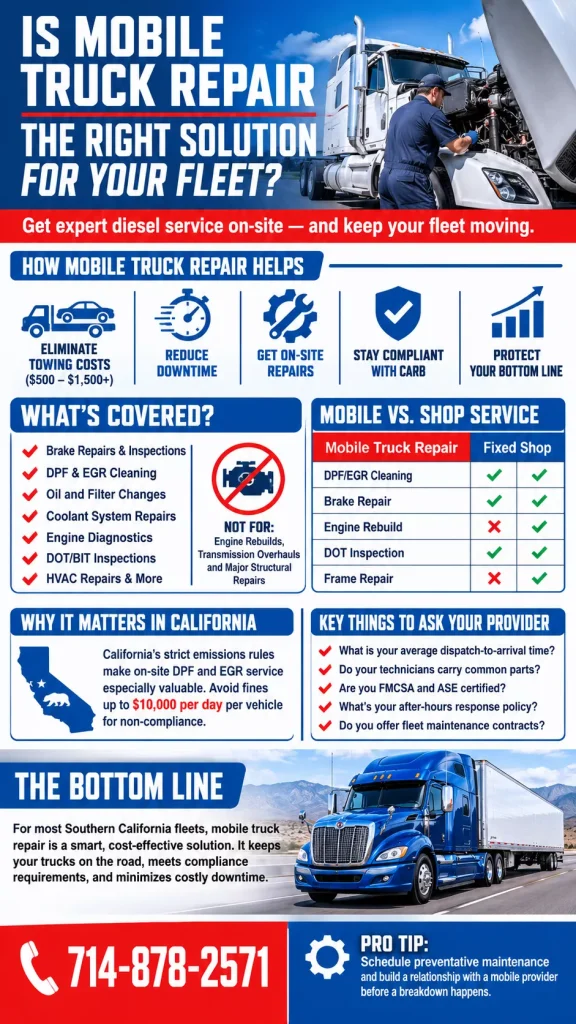
- Mobile repair eliminates towing fees that routinely run $500 to $1,500 or more per incident in Southern California.
- Response time is the critical variable: confirm your provider’s average dispatch-to-arrival window before you commit.
- Not every repair is mobile-friendly. Engine rebuilds and frame straightening still require a fixed shop.
- Preventative maintenance on-site is where mobile service delivers its best long-term ROI.
- California’s strict emissions regulations add a compliance dimension that makes on-site DPF and EGR service especially valuable.
- Precision Diesel covers Orange, Los Angeles, and Riverside counties with over 20 years of heavy-duty diesel experience.
What Mobile Truck Repair Actually Covers (and What It Doesn’t)
The list of repairs a qualified mobile technician can complete on-site is longer than most fleet managers assume. Brake inspections and repairs, oil and filter changes, EGR and DPF filter cleaning, exhaust system work, HVAC repairs, suspension diagnostics, engine computer diagnostics, coolant system repairs, and DOT/BIT inspections all translate well to a mobile context. Precision Diesel, for example, carries OEM and aftermarket parts ranging from Group 31 batteries to Glad Hands and airlines, so the technician arriving at your yard isn’t showing up empty-handed.
The honest trade-off is scope. Engine rebuilds, transmission overhauls, frame straightening after a collision, and major structural repairs require a fixed shop with overhead lifts and specialized tooling. No responsible mobile provider will tell you otherwise. If your fleet is running trucks with chronic, compounding mechanical failures, a mobile-only relationship isn’t the right answer.
For the importance of semi truck fleet maintenance on a routine basis, mobile service genuinely shines. Scheduled preventative maintenance visits to your yard cost you nothing in truck movement and guarantee that oil intervals, filter replacements, and inspection deadlines don’t slip because a driver “didn’t have time” to drop the truck off.
What usually trips up fleet managers here is underestimating how much revenue they lose while a truck sits waiting for a tow and a shop bay. A single day of downtime on a Class 8 truck running regional routes can cost $1,000 to $2,000 in lost revenue. Mobile service cuts that timeline dramatically.
| Repair Type | Mobile Truck Repair | Fixed Shop |
|---|---|---|
| DPF/EGR Cleaning | Yes, full service on-site | Yes |
| Brake Repair | Yes, including pads and drums | Yes |
| Engine Rebuild | No, requires shop equipment | Yes |
| DOT/BIT Inspection | Yes, certified on-site | Yes |
| Coolant System Repair | Yes | Yes |
| Frame/Structural Repair | No | Yes |
| Oil & Filter Service | Yes | Yes |
| Transmission Overhaul | No | Yes |
The Real Cost Comparison: Mobile vs. Shop-Based Service
Towing a Class 8 semi in Southern California is not cheap. Depending on distance and time of day, you’re looking at $500 to $1,500 or more for a standard tow, before the shop even opens the hood. Add storage fees if the truck sits overnight, plus the opportunity cost of the route that didn’t run. That number climbs fast.
Mobile service charges a service call fee plus labor and parts, but those towing and storage costs evaporate. For fleets running preventative maintenance programs, the per-visit cost is often lower than shop rates because you’re batching work at your yard during scheduled windows.
Understanding semi truck radiator replacement cost gives you a useful benchmark for Class 8 trucks. A radiator replacement on a Class 8 truck typically runs between $1,500 and $3,500 depending on the brand and labor involved. A mobile provider can handle that job on-site, saving you the tow and potentially negotiating a faster turnaround since there’s no shop queue.
The pattern that keeps repeating with Southern California fleets is this: shops are backed up. Walk-in availability at most commercial diesel shops in the LA metro runs three to five days for non-emergency work. Mobile service doesn’t have that queue problem in the same way.
California Compliance and Why Mobile Service Adds Specific Value Here
California runs the strictest commercial vehicle emissions rules in the country. The california truck emissions compliance requirements under CARB affect nearly every diesel fleet operating in the state, with DPF maintenance, EGR cleaning, and Clean Truck Check compliance all carrying real enforcement risk. CARB’s Clean Truck Check program requires periodic emissions inspections, and violations can mean fines, out-of-service orders, or registration holds.
A mobile provider that offers DPF filter cleaning, EGR filter cleaning, exhaust system repair, and Clean Truck Check services at your yard removes a significant logistics burden. You don’t have to coordinate driver time, shop drop-offs, and pickup schedules. The compliance work comes to you.
For fleet managers operating across Los Angeles, Orange, and Riverside counties, this matters specifically because CARB enforcement is active and consistent. Precision Diesel covers all three counties and handles FMCSA compliance and DOT inspection work as part of its mobile service portfolio, which means a single provider can address both mechanical and regulatory needs in one visit.
The runaway truck ramp southern california safety infrastructure across mountain passes in the region is a reminder that brake system integrity is a non-negotiable compliance issue, not just a maintenance item. Mobile brake inspection and repair access keeps that work from being deferred.
| California Compliance Service | Mobile Capable | Fixed Shop Only | CARB/FMCSA Relevance |
|---|---|---|---|
| DPF Filter Cleaning | Yes | No | High, emissions compliance |
| EGR Filter Cleaning | Yes | No | High, emissions compliance |
| Clean Truck Check | Yes | No | Mandatory for CA fleets |
| DOT Inspection | Yes | No | Federal FMCSA requirement |
| BIT Inspection | Yes | No | California-specific requirement |
| Brake System Repair | Yes | No | FMCSA and CHP enforcement |
According to the California Air Resources Board (CARB), fleets that fall out of compliance with the Truck and Bus Regulation face civil penalties that can reach $10,000 per day per vehicle. That’s not a hypothetical. Mobile service that keeps your emissions maintenance current is a direct risk management tool.
Evaluating a Mobile Repair Provider: What to Actually Ask
Choosing a mobile provider is not the same as signing up for a shop relationship. The variables that matter most are different. Response time, parts inventory on the truck, geographic coverage, and technician certification carry more weight than shop square footage or rack rates.
For fleets in Southern California, check whether the provider covers your specific corridors. Precision Diesel services cities across Los Angeles County, from Long Beach and Carson to Pasadena and Pomona, and extends into Orange County cities including Anaheim, Fullerton, Irvine, and Santa Ana, plus Riverside County routes. That coverage matters if you have trucks breaking down across different counties on the same day.
Ask these specific questions before signing any service agreement:
- What is your average dispatch-to-arrival time for Orange County versus eastern Riverside County?
- Do your technicians carry common OEM parts on the service vehicle, or do they order and return?
- Are your mechanics certified for FMCSA DOT inspections, and can you provide documentation?
- What is your after-hours or overnight response policy for roadside breakdowns?
- Do you offer fleet maintenance contracts with scheduled visit windows?
The diesel truck repair tips that separate a good mobile relationship from a reactive one almost always come down to scheduled preventative work. The fleets that get the most value from mobile service are the ones that use it proactively, not just when something breaks.
In practice, the providers worth committing to carry a meaningful parts inventory, employ technicians with 10-plus years of heavy-duty diesel experience, and can produce FMCSA compliance documentation without being asked twice. For more resources and service insights, the articles section at Precision Diesel covers common fleet issues with practical depth.
The Federal Motor Carrier Safety Administration (FMCSA) publishes its inspection and compliance standards publicly, and any mobile technician doing DOT work should be working from those standards, not approximating them.
The National Institute for Automotive Service Excellence (ASE) certification is one reliable credentialing signal to look for, though heavy-duty diesel experience and documented fleet references carry equal weight in the real world.
When Is Mobile Truck Repair the Right Call?
The clearest yes cases are: a truck disabled on the road with a repair that falls within mobile scope, scheduled preventative maintenance that your drivers can’t afford to lose time dropping off, and compliance work like DOT inspections or DPF cleaning that can batch efficiently at your yard.
The clearest no cases are: major structural damage requiring a lift, complex transmission rebuilds, and situations where a truck needs to be off the road for multiple days regardless of where the work happens.
For most Southern California fleets running regional freight, local distribution, or construction logistics, is mobile truck repair the right solution for your fleet? The answer is yes, with one qualification: it works best as your primary maintenance and roadside response layer, not as a replacement for every shop relationship you have.
Precision Diesel’s 20-plus years of mobile diesel experience across Orange, Los Angeles, and Riverside counties puts them in a position to handle the full range of day-to-day fleet needs. Reach them at (714) 878-2571 to discuss coverage, service contracts, and response times for your specific routes.
For fleet managers who want to understand the full scope of mobile diesel service before committing, the American Trucking Associations maintains industry resources on fleet maintenance standards and compliance that provide useful benchmarks.
Stop Losing Revenue to Avoidable Truck Downtime
Every hour a truck sits waiting for a tow or a shop bay is money your fleet will never recover. Precision Diesel brings certified mobile diesel mechanics directly to your yard or roadside location across Los Angeles County, Orange County, Riverside County, and surrounding Southern California areas, so your trucks get back on the road faster without the tow bill or the shop queue. Call Precision Diesel now at (714) 878-2571 and ask about fleet maintenance contracts, response times for your specific routes, and same-day roadside service availability.
Frequently Asked Questions
What types of repairs can a mobile diesel mechanic actually complete on-site?
A mobile technician can handle a wide range of repairs on-site, including brake repairs, DPF and EGR filter cleaning, oil and filter changes, coolant system repairs, engine diagnostics, DOT inspections, suspension work, and HVAC repairs.
The key limitation is scope. Jobs that require an overhead lift, heavy press equipment, or a controlled shop environment, such as engine rebuilds, transmission overhauls, and frame straightening, still require a fixed facility. For the majority of day-to-day fleet maintenance and roadside failures, though, a well-equipped mobile unit carries enough parts and tooling to resolve the issue without moving the truck.
How much does mobile truck repair cost compared to a traditional shop?
Mobile repair typically costs a service call fee plus labor and parts, but the elimination of towing fees ($500 to $1,500 or more in Southern California) and shop storage charges often makes the total cost lower than a shop visit for the same repair.
The comparison shifts even further in favor of mobile service when you factor in lost revenue from downtime. A Class 8 truck sitting in a shop queue for two to three days costs far more in missed routes than the difference in labor rates. Fleet maintenance contracts with a mobile provider can also lock in predictable per-visit pricing that makes budgeting easier quarter to quarter.
Is mobile truck repair a good fit for California’s emissions compliance requirements?
Yes. Mobile providers certified to perform DPF cleaning, EGR cleaning, Clean Truck Check inspections, and exhaust system repairs can handle the core of California’s CARB compliance work directly at your yard.
California’s truck emissions rules are among the strictest in the country, and the logistics of keeping trucks in compliance can be a significant burden when it requires shop drop-offs and driver coordination. A mobile provider that offers on-site compliance services removes that friction entirely. Precision Diesel covers FMCSA compliance, DOT inspections, BIT inspections, DPF cleaning, and EGR cleaning across its Southern California service area, making it possible to address both mechanical and regulatory needs in a single scheduled visit.
How fast can a mobile diesel mechanic reach a truck that breaks down on the freeway?
Response time depends on the provider’s coverage area, current dispatch load, and the specific location of the breakdown, so the most reliable answer comes from asking your provider directly for their average dispatch-to-arrival window for your routes.
In practice, the providers worth committing to operate dedicated service vehicles positioned across their coverage area rather than dispatching from a single fixed address. For Southern California fleets, this matters because a breakdown on the I-10 near Pomona and a breakdown near the Port of Long Beach are very different response scenarios. Precision Diesel covers routes across Los Angeles, Orange, and Riverside counties, and you can confirm specific response windows by calling (714) 878-2571 before signing any service agreement.
Should my fleet use mobile repair as its only maintenance solution, or do I still need a shop relationship?
For most fleets, mobile service works best as the primary layer for preventative maintenance, compliance work, and roadside response, with a fixed shop relationship held in reserve for major repairs that exceed mobile scope.
The honest trade-off is that no mobile provider, regardless of experience or parts inventory, can replicate everything a fully equipped shop offers. Engine rebuilds, major structural work, and complex transmission repairs require fixed tooling. What mobile service does exceptionally well is eliminate the downtime, towing costs, and scheduling friction that eat into fleet profitability on a daily basis. A smart fleet maintenance strategy uses both, with mobile handling the high-frequency, high-urgency work and a shop handling the low-frequency, high-complexity work.
The Bottom Line on Is Mobile Truck Repair the Right Solution for Your Fleet?
For most Southern California fleet operators, the answer is a clear yes, with an honest qualifier attached. Mobile truck repair covers the vast majority of day-to-day maintenance, compliance, and roadside repair needs more efficiently and at lower total cost than the traditional shop-and-tow model. The qualifier is that it works best when you treat it as a proactive system rather than a reactive emergency line.
Schedule preventative maintenance visits to your yard. Use mobile compliance services to stay ahead of CARB deadlines. Build a relationship with a provider before a truck breaks down at 2 a.m. on the 91 freeway, not after. Precision Diesel has served fleets across Orange County, Los Angeles County, and Riverside County for over 20 years with exactly that kind of full-service mobile capability. Call (714) 878-2571 today to get a service plan that fits your routes, your trucks, and your schedule.
