

ISUZU trucks are widely regarded as dependable workhorses in the light- and medium-duty commercial segment, but like any diesel platform, they develop predictable problems when maintenance lapses or mileage climbs. Staying ahead of routine isuzu medium duty truck repair keeps your rig out of the shop and prevents minor warnings from turning into roadside breakdowns. Knowing the most common failure points before they escalate into costly downtime is the single most effective thing a fleet operator or owner-operator can do to protect their investment.
Key Takeaways
- EGR valve clogging and DPF regeneration failures are the most frequent engine complaints on ISUZU diesel trucks, particularly in urban stop-and-go routes.
- Transmission wear accelerates significantly in overloaded fleets; monitoring fluid condition every 30,000 miles prevents most catastrophic failures.
- Electrical sensor faults and wiring harness degradation are the leading cause of persistent check engine lights on older ISUZU models.
- Brake fade on ISUZU NPR and NRR platforms is often tied to overloading rather than component defect; load management extends brake service life significantly.
- Average annual ISUZU truck maintenance costs run 15 to 25% lower than competitor platforms, according to TWL Autos (2025), but neglected issues close that gap fast.
- Mobile diesel repair services like Precision Diesel can diagnose and resolve most of these problems at your yard or jobsite, minimizing off-road time.
ISUZU Engine Problems You Need to Recognize Early
EGR Valve Clogging and DPF Regeneration Failures
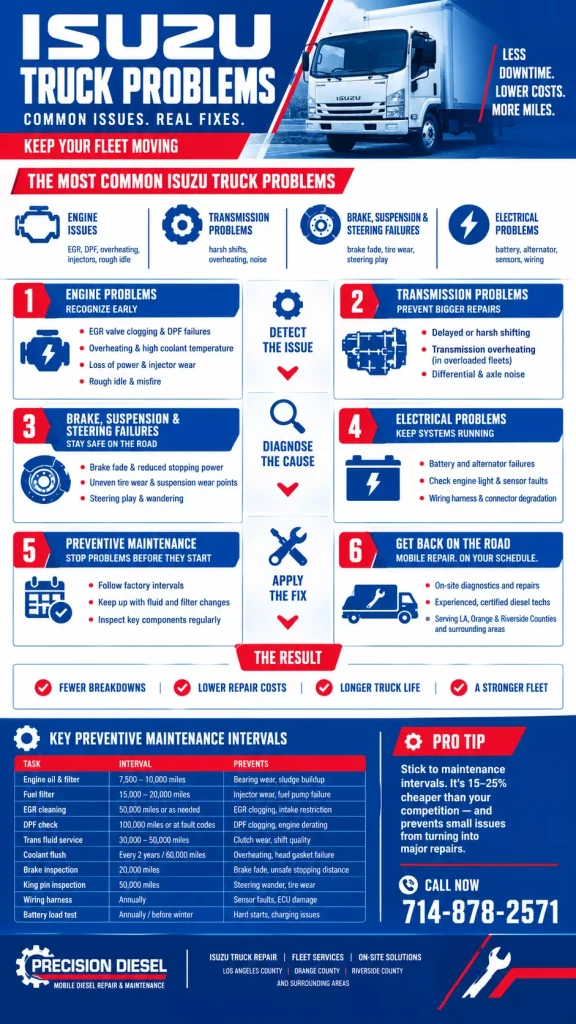
The 4HK1 and 6HK1 diesel engines found across the NPR, NQR, and NRR lineup are robust units, but their emissions control systems are a consistent pain point. EGR valve clogging is among the most commonly reported ISUZU truck problems in urban fleets. Carbon deposits accumulate inside the EGR passages at an accelerated rate on trucks running short-haul routes because the engine rarely reaches the sustained temperatures needed for passive DPF regeneration. The result is a restricted exhaust gas recirculation circuit that pushes soot into the intake manifold, raises combustion temperatures, and eventually triggers a forced regeneration warning or a hard fault code.
According to TWL Autos (2025), common ISUZU truck problems include EGR valve clogging, DPF regeneration issues, injector wear, electrical sensor failures, and transmission wear in overloaded fleets. Professional EGR cleaning, rather than full replacement, is often sufficient when caught at the early symptom stage, which typically presents as black smoke at idle and a slight drop in throttle response. The ISUZU recalls page is a useful starting point for checking whether your specific model year has an open recall related to emissions hardware.
For broader context on staying compliant with California’s strict diesel regulations, reviewing California truck emissions compliance requirements is essential for any operator running trucks in the state.
Overheating and High Coolant Temperature
Coolant system failures are another recurring engine concern. The most common culprits are a clogged radiator core, a failing water pump impeller, or a thermostat stuck in the closed position. When an ISUZU truck runs hot repeatedly, the cylinder head gasket becomes the next victim. Head gasket replacement on a 4HK1 or 6HK1 engine is one of the more labor-intensive repairs in this class of truck, and understanding semi truck radiator replacement cost figures will help you budget accurately if the radiator core is beyond cleaning.
Warning signs to watch for before a full overheat event: coolant level dropping without an obvious external leak, steam from the defroster vents, and the temperature gauge climbing steadily on highway grades.
Loss of Power and Injector Wear
Injector wear and fuel system degradation cause power loss that drivers often misattribute to transmission slip. On high-mileage ISUZU diesels, the common-rail injectors wear at the tip seat, allowing small fuel leaks back into the return circuit and reducing effective injection pressure. A professional diesel technician can perform an injector return flow test to quantify wear without pulling the injectors. Replacing a single injector typically runs between $400 and $700 including labor, while a full set of six on a 6HK1 can approach $2,500 to $3,800 depending on OEM versus quality aftermarket parts.
Rough Idle and Misfire
Rough idle on cold starts is frequently traced to a failing glow plug relay or individual glow plugs on trucks with higher mileage. Hard starting in temperatures below 40°F is the first symptom. An OBD-II scanner reading misfire codes P0300 through P0306 confirms which cylinder is affected. Glow plug replacement is straightforward on the 4HK1 and is a cost-effective preventive repair.
Transmission Problems That Signal Deeper Trouble
Delayed or Harsh Shifting
ISUZU’s Aisin-sourced automatic transmissions are generally durable, but harsh or delayed shifts develop when fluid service intervals are ignored. Used transmission fluid loses its friction modifier properties, leading to clutch pack slippage that generates heat and compounds wear. Fluid analysis is a low-cost diagnostic tool that reveals clutch debris, oxidation, and moisture contamination before a rebuild becomes necessary. The recommended interval for most ISUZU automatic transmissions is 30,000 to 50,000 miles under normal duty, less if the truck hauls near its gross vehicle weight rating regularly.
Transmission Overheating in Overloaded Fleets
According to TWL Autos (2025), transmission wear in overloaded fleets is a documented pattern with ISUZU trucks. When gross payload consistently exceeds the truck’s rated capacity, the torque converter lockup clutch cycles excessively and the transmission oil cooler cannot dissipate heat fast enough. Installing an auxiliary transmission cooler is a practical upgrade for fleets running heavy payloads in warm climates like Southern California. Transmission overhaul costs on ISUZU medium-duty platforms range from approximately $3,500 to $6,000, making prevention a clear financial priority.
For maintenance best practices that apply across the fleet, the resource on the importance of semi truck fleet maintenance covers systematic approaches that prevent these cascading failures.
Differential and Axle Noise
A whining or grinding noise from the rear axle under load is typically a sign of worn ring-and-pinion gears or failing wheel bearings. ISUZU rear differentials are robust, but they are sensitive to oil contamination from a leaking axle seal. Inspect the axle seals at every brake service interval and address any seepage immediately. Ignoring a slow axle seal leak leads to differential carrier damage that can push repair costs above $2,000.
Brake, Suspension, and Steering Failures
Brake Fade and Reduced Stopping Performance
Brake fade on ISUZU NPR and NRR trucks is almost always an operational issue before it becomes a component issue. Overloading and riding the brakes on grades generate heat that exceeds the thermal capacity of standard brake linings. If you operate in hilly terrain across Southern California, understanding brake system behavior on grades is critical. The runaway truck ramp southern california resource provides context on how quickly brake failure can escalate in mountainous driving conditions.
Drum brake linings should be measured at every PM interval. ISUZU specifies a minimum lining thickness before replacement; operating below that threshold dramatically reduces stopping distance and creates safety liability.
Uneven Tire Wear and Suspension Wear Points
Premature or uneven front tire wear is a strong indicator of worn front-end components, particularly the king pins and front leaf spring bushings on older ISUZU cab-over designs. King pin replacement is a specialized task that requires proper reaming tooling; an incorrectly installed king pin creates dangerous steering play. An alignment check after any front-end component replacement is mandatory.
Steering Play and Wandering on the Highway
Excessive steering play is a safety issue that develops from worn steering gear box internals or loose tie rod ends. ISUZU cab-over trucks are sensitive to steering geometry changes because the axle sits forward of the cab; small amounts of play feel amplified at highway speeds. The NHTSA complaint database is a reliable resource for checking whether your model and year has reported steering-related complaints from other owners. TheWeeklyDriver reports 1,554 NHTSA complaints across nine ISUZU models, updated April 2026, which illustrates that steering and brake complaints represent a consistent portion of owner-reported issues.
Electrical Problems That Affect ISUZU Trucks Most Frequently
Battery and Alternator Failures
Cold-start electrical strain accelerates battery degradation on ISUZU trucks used for refrigerated cargo or utility work, where parasitic loads run continuously. A failing alternator that puts out low voltage (below 13.5V at idle) causes the battery to discharge slowly, and the truck may show multiple fault codes from systems reacting to voltage instability. Testing the charging system with a quality multimeter or load tester is a five-minute diagnostic that prevents unnecessary parts replacement.
Persistent Check Engine Light and Sensor Failures
The check engine light on ISUZU trucks most frequently traces to upstream oxygen sensors, intake air temperature sensors, and MAP sensors. According to ForCar.org (updated September 2026), the ISUZU NPR shows 25 complaints, with one complaint per production run compared to a market average of 3.72, which reflects a relatively clean record, but electrical sensor faults remain the primary trigger for non-emergency warning lights. Clear fault codes after repair and complete a drive cycle to verify the fix before returning the truck to service.
For structured troubleshooting strategies, the collection of diesel truck repair tips covers diagnostic approaches applicable to ISUZU platforms.
Wiring Harness and Connector Degradation
Wiring harness issues are disproportionately common on ISUZU trucks operating in coastal environments or those frequently washed with high-pressure equipment. Connector corrosion on the ECU harness and injector sub-harnesses causes intermittent codes that are notoriously difficult to reproduce during a shop visit. A thorough inspection should include unplugging, cleaning with electrical contact cleaner, and applying dielectric grease to every accessible sensor connector on the engine harness. Inspect the area around the exhaust manifold where heat-induced insulation cracking occurs most often. More in-depth write-ups on ISUZU maintenance topics are available through the articles section on the Precision Diesel website.
Preventing ISUZU Truck Problems Before They Become Costly
Proactive maintenance is the most cost-effective strategy for any ISUZU truck operator. TWL Autos (2025) reports that average annual ISUZU truck maintenance costs run 15 to 25% lower than competitor platforms, but that advantage disappears quickly when deferred maintenance allows small issues to cascade. The ISUZU N-Series diesel brochure outlines factory maintenance intervals that serve as the baseline for any PM schedule.
The following table summarizes the most critical preventive maintenance tasks, their intervals, and their primary failure prevention targets:
| Maintenance Task | Recommended Interval | Primary Problem Prevented |
|---|---|---|
| Engine oil and filter change | Every 7,500 to 10,000 miles | Bearing wear, sludge buildup |
| Diesel fuel filter replacement | Every 15,000 to 20,000 miles | Injector wear, fuel pump failure |
| EGR system cleaning | Every 50,000 miles or as needed | EGR clogging, intake restriction |
| DPF forced regeneration check | Every 100,000 miles or at fault codes | DPF clogging, engine derating |
| Transmission fluid service | Every 30,000 to 50,000 miles | Clutch pack wear, shift quality |
| Coolant system flush | Every 2 years or 60,000 miles | Overheating, head gasket failure |
| Brake lining inspection | Every 20,000 miles or at each PM | Brake fade, unsafe stopping distance |
| Front-end king pin inspection | Every 50,000 miles | Steering wander, tire wear |
| Wiring harness inspection | Annually | Sensor faults, ECU damage |
| Battery load test | Annually or before winter | Hard starts, charging system strain |
According to autoline.com vehicle reviews, owner feedback on ISUZU trucks consistently highlights the importance of sticking to manufacturer intervals rather than extending them under heavy-duty operating conditions. Operators who treat PM intervals as a minimum rather than a target see significantly fewer unscheduled repair events.
A fleet-wide approach to scheduling, tracking, and executing preventive maintenance is especially important for Southern California operators who face both California Air Resources Board compliance requirements and the operational stress of dense urban routes. Isuzu recorded 44,000 trucks sold in North America in 2024, according to FleetMobility, which reflects an active ownership base that benefits from the kind of structured maintenance approach described above.
Stop ISUZU Truck Problems Before They Ground Your Fleet
Precision Diesel serves fleet operators across Los Angeles County, Orange County, and Riverside County with fully mobile diesel repair and maintenance, meaning a certified technician comes to your yard, jobsite, or roadside location rather than forcing you to haul a problem truck to a shop. With over 20 years of experience handling EGR cleaning, DPF service, brake repair, engine diagnostics, and full preventive maintenance programs, Precision Diesel keeps your ISUZU trucks earning revenue instead of sitting idle.
Call Precision Diesel now at (714) 878-2571 to schedule a mobile inspection or PM service for your ISUZU fleet anywhere in Southern California.
Schedule Mobile ISUZU Truck Repair Across Southern California Today
Your ISUZU truck is a revenue-generating asset, and every hour it sits unrepaired is money walking out the door. Precision Diesel brings certified mobile diesel mechanics directly to your location across Los Angeles County, Orange County, Riverside County, and surrounding areas, so you skip the tow bill and get back on the road faster. Whether you are dealing with an EGR fault, a transmission warning, a persistent check engine light, or a full preventive maintenance overhaul, the team at Precision Diesel has the tools and experience to handle it on-site.
Call Precision Diesel right now at (714) 878-2571 to book a mobile diagnostic or scheduled PM service for your ISUZU truck anywhere in Southern California.
Frequently Asked Questions
Q: What is the most expensive ISUZU truck repair problem?
Head gasket failure caused by repeated overheating is typically the most expensive repair on an ISUZU diesel truck, often running between $3,500 and $6,500 in parts and labor depending on the engine variant.
When a 4HK1 or 6HK1 engine runs hot repeatedly, the cylinder head warps and the gasket fails, allowing coolant to enter the combustion chamber. The repair requires a full head removal, resurfacing or replacement, and thorough cooling system inspection to address the root cause. Catching coolant loss and rising temperature gauge readings early is the most reliable way to avoid this level of expense.
Q: How often should the diesel fuel filter be replaced on an ISUZU truck?
The diesel fuel filter on most ISUZU trucks should be replaced every 15,000 to 20,000 miles under normal operating conditions, though heavily loaded trucks or those fueling from lower-quality sources may need more frequent service.
A clogged fuel filter starves the common-rail injection system of clean, pressurized fuel, accelerating wear on the high-pressure fuel pump and injectors. Both of those components are significantly more expensive to replace than a filter, making this one of the highest-return maintenance tasks on any ISUZU diesel platform. Always bleed the fuel system after filter replacement to prevent air lock on startup.
Q: Can electrical problems damage the ISUZU ECU?
Yes, voltage spikes, prolonged low-voltage conditions from a failing alternator, and water intrusion into the wiring harness can all cause permanent damage to the ISUZU engine control unit.
The ECU is sensitive to voltage irregularities outside the 12 to 14.5-volt operating window. A failing alternator that delivers inconsistent voltage, or a corroded ground strap that creates resistance in the return circuit, can send damaging spikes through the control module. ECU replacement on ISUZU medium-duty trucks typically costs between $800 and $1,800 for the unit alone, and the module must be programmed to the specific vehicle, adding additional labor charges. Inspecting the charging system and all major ground connections annually is far less expensive than ECU replacement.
Q: Why does my ISUZU truck lose power while driving?
Power loss while driving on an ISUZU truck most commonly points to a clogged DPF triggering an engine derate, worn fuel injectors reducing combustion efficiency, or a restricted EGR system elevating intake manifold temperatures.
The engine management system is programmed to reduce power output when it detects conditions outside normal parameters, which protects the engine but can leave drivers stranded or unable to maintain highway speed. An OBD-II scanner with ISUZU-specific data stream capability will reveal whether the derate is emissions-related, fuel-pressure-related, or tied to a boost leak in the turbocharger system. Addressing the root fault code rather than simply clearing it is critical, because a derate that recurs without resolution typically escalates to a more severe restriction.
Q: How can I extend the life of my ISUZU truck brakes?
The most effective ways to extend ISUZU truck brake life are managing payload within the truck’s rated gross vehicle weight, using engine braking on grades rather than riding the service brakes, and inspecting lining thickness at every preventive maintenance interval.
Heat is the primary enemy of brake lining material, and it accumulates fastest when a heavily loaded truck descends grades with the brakes applied continuously. Drivers who downshift and use the engine and exhaust brake to manage speed on long descents preserve lining material and reduce rotor or drum wear significantly. On the maintenance side, catching a worn lining before it reaches the backing plate prevents scoring damage to the drum or rotor, which doubles or triples the repair cost compared to a simple lining replacement.
The Bottom Line on ISUZU Truck Problems
ISUZU trucks earn their reputation for reliability through smart engineering and a lower-cost maintenance profile compared to many competitor platforms, but that reputation only holds when operators stay ahead of the predictable failure points. EGR and DPF issues, injector wear, transmission fluid neglect, brake fade from overloading, and electrical harness degradation are all manageable when caught early and addressed with the right tools and technical knowledge. Waiting until a warning light becomes a breakdown is always the more expensive choice.
If you operate an ISUZU truck or a mixed fleet in Southern California, the smartest next step is scheduling a comprehensive mobile inspection with Precision Diesel. Call (714) 878-2571 today, and a certified diesel mechanic will come to your location across Los Angeles County, Orange County, Riverside County, or any surrounding area to assess your truck’s condition and build a maintenance plan that keeps it earning.
