

Fixing diesel engine issues quickly is one of the most important decisions you can make to protect your vehicle and your bottom line. Properly fixing diesel engine faults early prevents small mechanical hiccups from turning into major breakdowns. Diesel engines are built tough, but they have specific failure points that, when ignored, can turn a minor repair into a five-figure rebuild.
Key Takeaways
- Diesel engines often fail due to fuel system problems, cooling issues, and EGR cooler failures, all of which are preventable with regular maintenance.
- Early diagnosis typically costs far less than $1,000, while delayed repairs can push into $10,000 or more.
- Oil quality monitoring is one of the simplest and most effective ways to catch internal engine wear before it escalates.
- Mobile diesel mechanics in Southern California can come directly to your yard or jobsite, reducing costly downtime.
- The average diesel engine can last 500,000 to 1,000,000 miles with proper maintenance, making routine care a smart long-term investment.
- Air brake and EGR cooler failures are two of the most overlooked issues that compound engine damage when left unaddressed.
Why Diesel Engine Failures Cost More Than Most Drivers Expect
Diesel engines power the trucks that keep American commerce moving. From the ports of Long Beach to the distribution centers of the Inland Empire, diesel-powered semi trucks and heavy-duty vehicles are on the road around the clock. That constant use comes with a cost: these engines operate under extreme compression ratios, high temperatures, and heavy loads that accelerate wear on critical components. Because of these operational stresses, fixing diesel engine damage quickly is critical to preventing compound mechanical failures.
What makes diesel repair particularly expensive compared to gasoline engines is the complexity and precision of the fuel delivery systems. A diesel injector operates at pressures exceeding 30,000 PSI in modern common rail systems, according to engineering resources from the U.S. Department of Energy. Any contamination, wear, or mechanical failure in that system can damage multiple downstream components rapidly.
Fleets that skip routine oil analysis, neglect coolant system maintenance, or defer EGR cooler inspections are essentially gambling with equipment worth $100,000 or more. The good news is that most catastrophic diesel failures do not happen overnight, and they send warning signs that you can act upon before a breakdown strands your truck on I-5 or the 91 freeway by consulting articles on diesel maintenance best practices.
The Most Common Failure Points in Diesel Engines
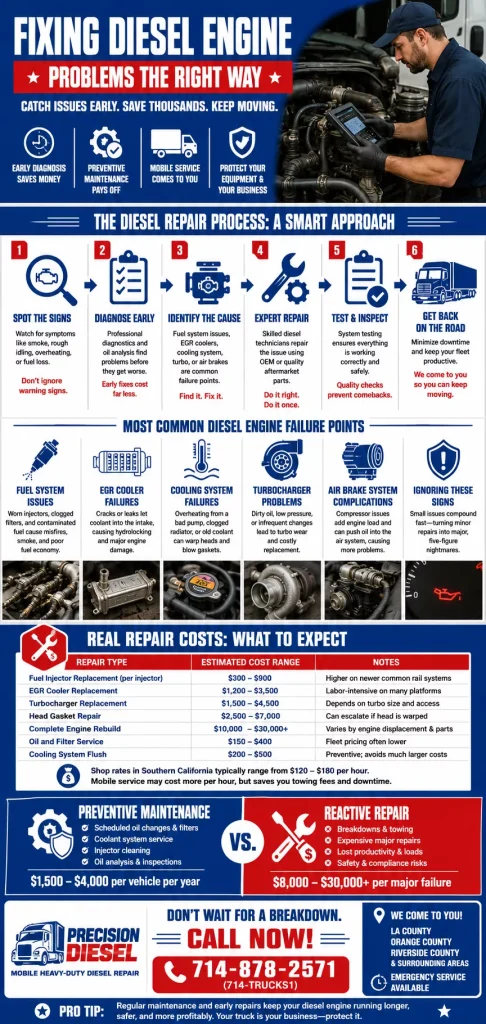
Understanding the specific weak points in diesel engines helps you monitor them proactively. When fixing diesel engine failure points, catching symptoms early is the single most effective way to protect your investment. Here are the components most frequently involved in diesel engine failures:
Fuel System Issues
Diesel fuel injectors are precision instruments that wear down over time, especially when fuel quality is poor or filters are not changed on schedule. Clogged or worn injectors cause misfires, excessive smoke, and reduced fuel economy. Contaminated fuel, which is a real problem in high-usage fleet environments, can score injector bores and destroy high-pressure pumps.
EGR Cooler Failures
The exhaust gas recirculation (EGR) cooler is one of the most notorious failure points on heavy-duty diesel trucks. When an EGR cooler develops a crack or leak, coolant enters the intake system and can cause catastrophic damage including hydrolocking. If you want to understand exactly what this looks like and how to catch it early, the breakdown on bad egr cooler for heavy duty trucks covers the symptoms in real detail. This is a component that should be on every fleet manager’s inspection checklist.
Cooling System Failures
Diesel engines generate tremendous heat. A failing water pump, clogged radiator, or neglected coolant can push engine temperatures beyond safe limits within minutes. Overheating is one of the leading causes of head gasket failure and warped cylinder heads, both of which are expensive repairs.
Turbocharger Problems
Turbos on diesel engines work hard and depend entirely on clean, properly pressurized oil for lubrication. Low oil pressure, dirty oil, or infrequent oil changes are the primary causes of premature turbo failure. A replacement turbo on a Class 8 truck can cost between $1,500 and $4,000 in parts alone, before labor.
Air Brake System Complications
While air brakes are not part of the engine itself, brake system failures affect the entire drivetrain and can force an emergency shutdown, and understanding semi truck air brake system failure is critical for fleet operators because brake-related issues can mask or compound engine stress during hard stops and heavy hauling.
Oil Quality: The Single Most Telling Engine Health Indicator
If you want to catch engine problems before they become expensive, oil analysis is your most reliable tool. The condition of your diesel engine oil tells a detailed story about what is happening inside the engine. Metal particles in the oil can indicate bearing wear. Coolant contamination points to a failing head gasket or EGR cooler. Excessive fuel dilution suggests injector problems. Regular oil checks give mechanics a clear blueprint when fixing diesel engine issues before severe internal wear occurs.
Knowing how to check diesel engine oil quality is something every driver and fleet manager should understand at a basic level, and sending oil samples to a laboratory for spectrometric analysis provides even more precise data. Many fleets do this every 10,000 to 15,000 miles as a standard part of their preventive maintenance program.
The American Petroleum Institute sets the classification standards for diesel engine oils in the United States, and using the correct API-rated oil for your specific engine model is non-negotiable. Running the wrong viscosity or specification in a modern common rail diesel engine can void your warranty and accelerate wear.
Real Repair Costs: What to Budget for Common Diesel Fixes
One of the most frequent questions fleet operators and owner-operators ask is how much a specific repair will cost. The overall cost of fixing diesel engine damage depends heavily on the make, model, year, and severity of the issue. When it comes to fixing diesel engine damage, total costs depend heavily on the make, model, year, and severity of the issue. The honest answer is that it depends heavily on the make, model, year, and severity of the damage. That said, here are realistic cost ranges based on common diesel repair scenarios in the U.S. market.
| Repair Type | Estimated Cost Range | Notes |
|---|---|---|
| Fuel Injector Replacement (per injector) | $300 – $900 | Higher on newer common rail systems |
| EGR Cooler Replacement | $1,200 – $3,500 | Labor-intensive on many platforms |
| Turbocharger Replacement | $1,500 – $4,500 | Depends on turbo size and access |
| Head Gasket Repair | $2,500 – $7,000 | Can escalate if head is warped |
| Complete Engine Rebuild | $10,000 – $30,000+ | Varies by engine displacement and parts |
| Oil and Filter Service | $150 – $400 | Fleet pricing often lower |
| Cooling System Flush | $200 – $500 | Preventive; avoids much larger costs |
These figures assume standard U.S. shop rates between $120 and $180 per hour, which is typical for diesel specialists in Southern California. Mobile service providers may charge a slightly higher hourly rate in exchange for the significant time savings of on-site repair.
How Air Brakes and Engine Health Are Connected
Many fleet operators think of engine maintenance and brake maintenance as entirely separate concerns, but they are closely linked in practice. Understanding how air brakes work in big trucks helps you see why: the air compressor that powers the brake system is driven by the engine, and if the compressor is failing or leaking, it puts additional load on the engine and can allow oil to pass into the air system.
Drivers who notice excessive air compressor cycling, oily moisture in the air dryer purge, or slow brake pressure buildup should treat these as engine-adjacent warning signs, not just brake system problems. A comprehensive vehicle inspection that covers both systems simultaneously is the most efficient approach.
Things to Know
- Diesel engines do not fail suddenly in most cases. Symptoms like excessive black smoke, rough idling, increased fuel consumption, and unusual noises are early indicators you should never ignore.
- The most damaging thing you can do to a diesel engine is run it with low oil pressure or overheated coolant, even for a few minutes. Internal damage can be permanent.
- Extended idle periods without load can cause injector fouling and cylinder glazing on diesel engines, particularly in cold weather.
- Not all diesel mechanics are equipped to handle Class 8 trucks, and you want commercial truck mechanics with specific experience in heavy-duty applications, not a general automotive shop.
- Using biodiesel blends above B20 in engines not rated for them can cause injector and fuel pump failures, particularly in older trucks.
- Skipping a DOT inspection does not just create a compliance risk. It means potential engine and brake issues go undetected until they become emergencies.
- Fixing diesel engine issues on-site through mobile mechanics is often the fastest way to minimize fleet downtime and avoid expensive towing fees.
Preventive Maintenance vs. Reactive Repair: The Numbers Make It Clear
The Federal Motor Carrier Safety Administration (FMCSA) reports that vehicle maintenance violations are consistently among the top causes of commercial vehicle out-of-service orders during roadside inspections. Trucks pulled out of service cost fleets between $750 and $1,500 per day in lost productivity, not counting the repair itself.
Preventive maintenance programs, which include scheduled oil changes, filter replacements, coolant system service, and injector cleaning, typically cost between $1,500 and $4,000 per year per vehicle for a well-managed fleet. Investing in routine upkeep saves thousands compared to fixing diesel engine breakdowns on the side of the road. Compare that to a single EGR cooler failure that leads to a head gasket breach, which can run $8,000 to $15,000 in parts and labor.
The Mayo Clinic comparison may seem unusual here, but the principle applies: treating problems early, before they compound, is always less expensive and less disruptive than emergency intervention. The same logic that applies to human health applies directly to diesel engine maintenance.
Call Precision Diesel Before the Breakdown Happens
If your truck or fleet is showing any of the warning signs covered in this article, the time to act is now, not after you are stranded on the shoulder of the 405. Precision Diesel provides mobile heavy-duty diesel truck and semi truck repair across Los Angeles County, Orange County, Riverside County, and surrounding areas in Southern California. Their team specializes in fixing diesel engine breakdowns directly at your yard or jobsite, so you avoid the cost and hassle of towing. Their technicians come directly to your yard or jobsite, so you avoid the cost and hassle of towing.
For emergencies, Precision Diesel is available now at (714) 878-2571 (also dialed as 714-TRUCKS1). When it comes to fixing diesel engine components on-site, their mobile team handles everything from diagnostics and EGR cooler replacement to complete engine evaluations using OEM and quality aftermarket parts. Whether you need diagnostics, EGR cooler replacement, oil service, brake system inspection, DOT compliance support, or a complete engine evaluation, their mobile team handles it on-site with OEM and quality aftermarket parts.
Call (714) 878-2571 right now or request service online to get a mobile diesel mechanic dispatched to your location today.
Frequently Asked Questions
Are diesel engines expensive to fix?
Yes, diesel engine repairs are generally more expensive than gasoline engine repairs due to the complexity and precision of diesel fuel systems and components.
Injectors, turbochargers, EGR coolers, and high-pressure fuel pumps all carry significant parts and labor costs. However, regular preventive maintenance dramatically reduces the likelihood of major repairs and keeps total ownership costs manageable over the long run.
What is the most common problem in the diesel engine?
Fuel system issues, particularly clogged or worn injectors and contaminated fuel, are among the most frequently reported diesel engine problems in commercial truck applications.
EGR cooler failures and cooling system problems are also extremely common, especially in high-mileage fleets. These issues are detectable early through routine inspection and oil analysis before they cause serious damage.
What is the average cost of diesel repair?
The average cost of a diesel repair varies widely, ranging from around $300 for a single injector replacement to $30,000 or more for a complete engine rebuild on a Class 8 truck.
Most common repairs, such as EGR cooler replacement or turbo work, fall in the $1,500 to $5,000 range. Mobile repair services in Southern California typically charge $120 to $180 per hour for labor, with on-site service saving significant towing and downtime costs.
What’s the worst thing for a diesel engine?
Running a diesel engine with low oil pressure or overheated coolant causes the most severe and often irreversible internal damage in the shortest amount of time.
Continued operation under either of these conditions can score bearings, warp cylinder heads, and destroy turbochargers within minutes. Fuel contamination and extended periods without proper lubrication service are close behind as the most destructive factors.
What’s the average lifespan of a diesel engine?
A well-maintained diesel engine in a commercial truck application can last between 500,000 and 1,000,000 miles, which is significantly longer than a comparable gasoline engine.
Some Cummins, Detroit Diesel, and CAT engines are known to exceed 1,000,000 miles with proper oil changes, coolant maintenance, and timely repair of minor issues. The key word in that sentence is “well-maintained.”
The Bottom Line on Fixing Diesel Engine Problems
Fixing diesel engine problems the right way means catching them early, using qualified technicians with heavy-duty experience, and investing in consistent preventive maintenance rather than waiting for a breakdown to force your hand. Every mile you put off a known issue is a mile closer to a much larger repair bill, or worse, a truck out of service during your most critical haul.
The NIH’s research on occupational health in transportation underscores that equipment reliability directly impacts driver stress and safety outcomes, making mechanical upkeep a workforce health issue as much as a business one. If your truck is showing symptoms, or if you simply want to build a smarter maintenance plan for your Southern California fleet, contact Precision Diesel at (714) 878-2571 and get a mobile mechanic working for you today.
