
A failing EGR cooler in a heavy duty diesel truck is one of the most serious mechanical problems you can face, and catching it early can save your engine from catastrophic damage. The symptoms of bad EGR cooler for heavy duty applications include white or sweet-smelling exhaust smoke, coolant loss without visible leaks, overheating, and white milky deposits in your engine oil.
Key Takeaways
- White smoke from the exhaust and unexplained coolant loss are the two most urgent warning signs of a failing EGR cooler.
- Coolant mixing with engine oil causes rapid bearing and seal damage, turning a $1,500 repair into a $20,000+ engine replacement.
- Heavy duty trucks operating in high-load conditions, such as long-haul routes or construction sites, are at significantly higher risk.
- Ignoring an overheating trend on your temperature gauge is one of the most common and costly mistakes fleet operators make.
- Mobile diesel mechanics, like the team at Precision Diesel, can diagnose and address EGR cooler issues at your yard or jobsite.
- Early detection combined with consistent preventative maintenance is the most effective way to protect your fleet investment.
What the EGR Cooler Actually Does in a Heavy Duty Diesel
The Exhaust Gas Recirculation (EGR) system is a federally mandated emissions control component on virtually every modern heavy duty diesel truck sold in the United States. According to the U.S. Environmental Protection Agency, EGR technology reduces nitrogen oxide (NOx) emissions by recirculating a portion of exhaust gases back into the intake manifold, lowering combustion temperatures and reducing harmful output.
The EGR cooler is the component that cools those recirculated exhaust gases before they re-enter the engine. Without effective cooling, intake temperatures spike, combustion efficiency drops, and the engine suffers. In heavy duty applications, whether you’re running a Peterbilt 389, a Kenworth T680, or a Freightliner Cascadia, the EGR cooler works under extreme thermal stress every day.
The cooler uses engine coolant to absorb heat from exhaust gases. That relationship between the cooling system and the exhaust system is precisely why a failing EGR cooler creates such wide-ranging, dangerous symptoms. When the internal tubes or the housing of the cooler crack or corrode, coolant and exhaust gases can mix, setting off a chain of failures across multiple engine systems.
The Primary Symptoms of Bad EGR Cooler for Heavy Duty Trucks
Recognizing the warning signs early is the difference between a manageable repair and a totaled engine. Here is what you need to watch for on any Class 6, 7, or 8 diesel truck.
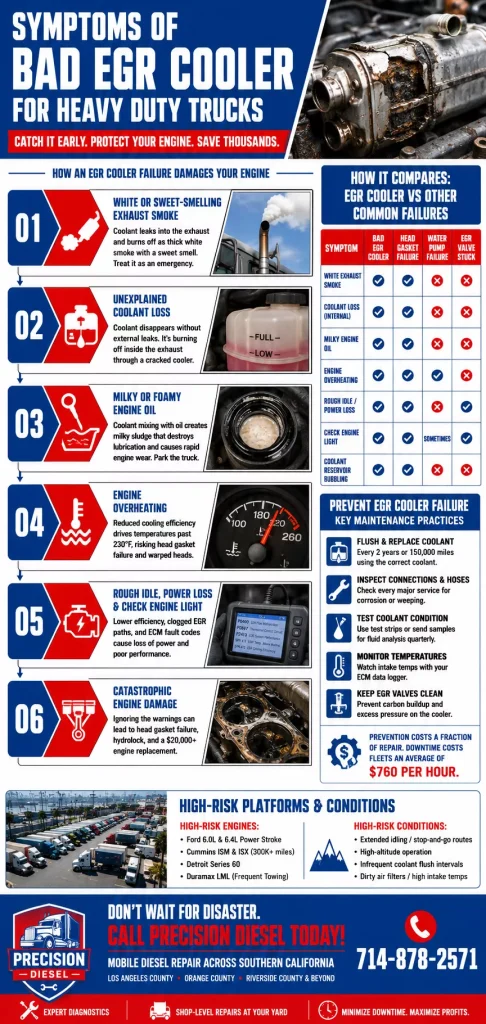
White or Sweet-Smelling Exhaust Smoke
This is usually the first visible symptom. When coolant leaks internally into the exhaust stream, it vaporizes and exits through the exhaust stack as thick, white or grayish smoke. Unlike the brief white puff you see on a cold morning startup, this smoke persists after the engine is fully warmed up.
The sweet smell associated with this smoke comes from burning ethylene glycol, the primary compound in most diesel engine coolants. If your drivers report this smell on the road, treat it as an emergency. Continued operation risks hydrolocking the engine if coolant accumulates in the cylinders.
Unexplained Coolant Loss
If your coolant reservoir keeps dropping but you cannot find an external leak anywhere, a cracked EGR cooler is a prime suspect. The coolant is leaking internally into the exhaust system, so it burns off without leaving a puddle under the truck.
Fleet managers often chase this symptom for weeks, topping off the coolant and assuming a slow external leak. That delay is dangerous. Learning how to check diesel engine oil quality is a critical skill here because coolant contamination in the oil is the next stage of this problem.
Milky or Foamy Engine Oil
When the EGR cooler fails badly enough, coolant migrates into the engine oil. You will see a milky, caramel-colored sludge on your dipstick or under the oil filler cap. This is one of the most destructive combinations possible in a diesel engine. Coolant dilutes the oil’s viscosity and destroys its lubricating film, leading to accelerated wear on bearings, crankshafts, and camshafts.
Understanding 5 ways proper lubrication can save your diesel engine makes it clear just how quickly contaminated oil can accelerate wear across every moving surface inside the engine. If you spot milky oil, park the truck immediately.
Engine Overheating
A compromised EGR cooler reduces the efficiency of the entire cooling circuit. The coolant that is leaking internally is no longer available to manage engine temperatures. At highway speeds under load, this can push coolant temperatures past 230°F, triggering the overheating condition that causes head gasket failures and warped cylinder heads.
The Mayo Clinic analogy holds here: catching a fever early and treating it prevents the serious complications. Engine overheating works the same way. Addressing the root cause, a failed EGR cooler, before temperatures climb out of control is the only responsible choice.
Rough Idle, Power Loss, and Check Engine Light
As coolant reduces combustion efficiency and clogs EGR passages, you will notice rough idle, hesitation under throttle, and a noticeable drop in pulling power. For a truck hauling a loaded 53-foot trailer across the I-10 through the Inland Empire, that power loss is more than inconvenient. It is a safety issue.
The engine control module (ECM) will log fault codes related to EGR flow, coolant temperatures, and intake manifold conditions. Common codes on Cummins ISX and Detroit DD15 engines include P0400 (EGR flow malfunction), P0597 (thermostat control circuit), and P2413 (EGR system performance). A proper diagnostic scan is essential before assuming the root cause.
How a Bad EGR Cooler Compares to Similar Failures
Not every overheating or white smoke event means a bad EGR cooler. It is important to know what else could cause similar symptoms.
| Symptom | Bad EGR Cooler | Head Gasket Failure | Water Pump Failure | EGR Valve Stuck |
| White exhaust smoke | Yes | Yes | No | No |
| Coolant loss (internal) | Yes | Yes | No | No |
| Milky engine oil | Yes | Yes | No | No |
| Engine overheating | Yes | Yes | Yes | No |
| Rough idle / power loss | Yes | Yes | No | Yes |
| Check engine light | Yes | Yes | Sometimes | Yes |
| Coolant reservoir bubbling | Yes | Yes | No | No |
The overlap between EGR cooler failure and head gasket failure is significant. In many cases, a neglected EGR cooler failure actually causes the head gasket to fail as a secondary consequence. That is why the decision around repair vs replace diesel engine becomes very real when these two failures compound each other.Regenerate section
Risk Factors: Which Heavy Duty Trucks Fail EGR Coolers Most Often
Certain platforms and operating conditions accelerate EGR cooler wear significantly. Based on industry data and research from diesel engineering publications, high EGR failure rates cluster around several specific factors.
High-risk platforms include:
- Ford 6.0L and 6.4L Power Stroke engines (medium and heavy duty applications)
- Cummins ISM and ISX engines with high mileage over 300,000 miles
- Detroit Series 60 engines in severe-duty fleet cycles
- Duramax LML engines in work trucks with frequent towing cycles
Operating conditions that accelerate failure:
- Extended idling in stop-and-go urban freight routes
- High-altitude operation in mountain passes where engines run hotter
- Infrequent coolant flush intervals, allowing silicate depletion and acid buildup
- Neglected air filter maintenance, which increases combustion temperatures
Fleet operators in Southern California running distribution routes between the ports of Los Angeles and Long Beach face particularly aggressive EGR cooler wear cycles due to the combination of urban idling and heavy-load freeway operation.
Maintenance Practices That Reduce EGR Cooler Failure Risk
Prevention is significantly cheaper than repair. EGR cooler replacement on a Class 8 truck typically runs between $1,200 and $3,500 in parts alone, with labor pushing total costs to $2,500 to $6,000 depending on engine access and configuration. If the failure triggers a head gasket job or engine rebuild, costs can exceed $15,000 to $25,000.
The NIH National Library of Medicine consistently documents the principle that preventative care costs a fraction of reactive treatment. The same principle applies directly to diesel engine maintenance.
Key preventative steps include:
- Flush and replace engine coolant on schedule, typically every two years or 150,000 miles on heavy duty applications, using the manufacturer-specified coolant type.
- Inspect EGR cooler connections and hoses during every major service interval for early signs of external weeping or corrosion.
- Run a coolant test strip or send a sample to a fluid analysis lab quarterly on high-mileage units.
- Monitor intake manifold temperatures using your ECM data logger, flagging any sustained increase above normal baseline.
- Keep EGR valves clean to prevent carbon buildup that forces higher differential pressures through the cooler.
For deeper insights into protecting your trucks over the long haul, the resource on diesel truck engine longevity covers the full spectrum of practices that keep engines running past 700,000 miles. You can also browse more technical articles on diesel engine maintenance through Precision Diesel’s resource library.
The American Trucking Associations estimates that unplanned downtime costs fleets an average of $760 per hour in lost productivity. A single EGR cooler failure that takes a truck off the road for two days at that rate equals roughly $18,240 in lost revenue, far beyond any repair cost.
Ready to Protect Your Fleet Before Failure Strikes?
If any of the symptoms described here sound familiar, do not wait for the situation to get worse. Call Precision Diesel right now at (714) 878-2571 and speak directly with a mobile diesel mechanic who covers Los Angeles County, Orange County, Riverside County, and surrounding areas. Precision Diesel brings shop-level diagnostics and repair capability straight to your yard or roadside location, meaning your trucks spend less time parked and more time generating revenue. For fleets across Southern California, heavy duty mobile truck repair in southern california from Precision Diesel is the fastest path from a suspected EGR cooler failure back to full operation.
Frequently Asked Questions
Q: Can a truck still run with a bad EGR cooler?
Yes, but continued operation causes rapid escalating damage that often leads to complete engine failure.
When coolant enters the combustion chamber or mixes with oil, bearing surfaces and seals deteriorate at an accelerated rate. Even a few hundred miles of operation after symptoms appear can turn a $3,000 repair into an engine replacement that costs $20,000 or more.
Q: How long does an EGR cooler replacement take on a Class 8 truck?
Depending on the engine platform, EGR cooler replacement typically takes between 4 and 10 hours of labor.
Engines with restricted access to the EGR assembly, such as some Cummins ISX configurations, require more disassembly time. A mobile mechanic with the right tooling can complete this job at your yard, avoiding the additional downtime of towing to a shop.
Q: Is it worth replacing an EGR cooler on a high-mileage truck?
In most cases, yes, provided the engine core is otherwise sound and the chassis has remaining service life.
A truck with 500,000 miles and good maintenance records is often worth a $3,000 to $6,000 EGR cooler repair. However, if multiple systems are failing simultaneously, a full cost-benefit analysis comparing repair versus replacement is warranted.
Q: What fault codes are associated with EGR cooler failure?
Common codes include P0400, P0401, P0402, P2413, and various manufacturer-specific EGR efficiency and temperature codes.
On Cummins engines, SPN 411 and SPN 412 fault codes specifically reference EGR system parameters. A professional diagnostic scan is the only reliable way to confirm the root cause before committing to a repair.
Q: How often should the EGR cooler be inspected on a fleet truck?
EGR cooler inspection should occur at every major service interval, typically every 50,000 miles or annually for high-cycle fleets.
Trucks operating in urban stop-and-go conditions or running extended idle hours should be inspected more frequently. Coolant analysis every 25,000 miles is a low-cost way to catch internal leaks before they become catastrophic.
The Bottom Line on Symptoms of Bad EGR Cooler for Heavy Duty Trucks
The symptoms of bad EGR cooler for heavy duty trucks, white exhaust smoke, internal coolant loss, milky engine oil, overheating, and power loss, are never minor warnings. Each one points to a failure mode that accelerates into much larger, much more expensive problems if you allow the truck to keep running. The cost difference between catching an EGR cooler failure at the first symptom versus discovering it after the engine is destroyed can easily be $15,000 to $20,000.
Your next step is straightforward: if any truck in your fleet is showing even one of these symptoms, schedule a diagnostic inspection immediately. Precision Diesel serves fleets across Southern California with mobile mechanics who come to you, whether you are parked at a distribution yard, stuck on the 91, or sitting at a jobsite. Call (714) 878-2571 to get a Precision Diesel tech dispatched to your location today.
