
TL;DR
When heavy-duty trucks suffer major powertrain distress in Southern California, choosing whether to repair vs replace diesel engine assets comes down to 7 core data metrics, including fluid analysis, compression loss, and emissions compliance. While minor diesel repairs fix isolated issues, structural block failures or compounding aftertreatment costs make full engine installation more financially predictable for long-term fleet operations.
Key Takeaways
- Fluid Tell-Tales: Microscopic metal bearing debris in oil filtration systems or fluctuating coolant levels usually signal advanced engine wear that points toward a complete engine replacement.
- The Downtime Equation: A full engine replacement or drop-in unit can often be executed faster than a highly complex custom overhaul, significantly cutting down on costly shipping and logistics operational downtime.
- Environmental Pressures: Stop-and-go congestion on the I-710/I-405 and punishing high-temperature climbs over the Cajon Pass accelerate internal engine wear and elevate emissions levels.
- Regulatory Compliance: In Southern California, an un-repaired, aging engine that causes ongoing DPF or SCR fouling will rapidly destroy your maintenance budget allocation due to strict regional clean-air mandates.
Heavy duty truck drivers, fleet managers, and owner operators across Southern California face a critical crossroads when a major powertrain failure occurs on the I-5 or near the Port of Los Angeles. The central dilemma always comes down to a clear financial and operational calculation: repair vs replace diesel engine assets to protect the bottom line. Making the wrong choice can lead to cascading mechanical issues, unexpected capital expenditures, and catastrophic operational downtime.
When a commercial vehicle suffers a catastrophic failure while hauling a heavy load over the Cajon Pass, understanding the exact health of the diesel engine determines whether a business stays profitable. Evaluating repair vs replace diesel engine options requires a deep look at performance metrics, maintenance history, and long term financial implications. Precision Diesel technicians regularly guide vehicle owners through this exact scenario, providing detailed diagnostic insight to prevent costly mistakes.
The True Cost of Engine Downtime in Southern California Logistics
For any transport operation or logistics operation centered around the Gateway Cities or the Inland Empire, a truck sitting on the shoulder of the SR-91 represents immediate revenue loss. The operational impact of a downed vehicle ripples through the entire supply chain, resulting in missed delivery windows at air cargo terminals like Ontario International or LAX.
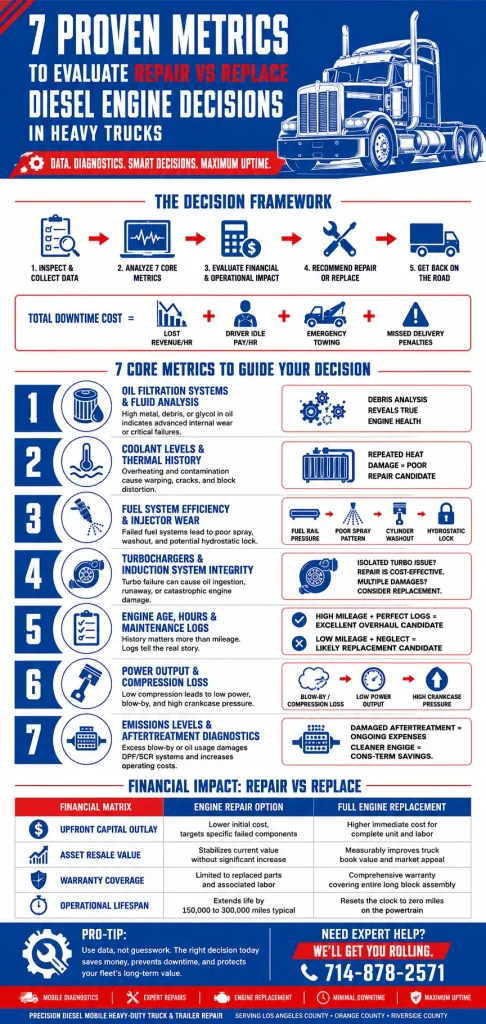
Total Downtime Cost = Lost Revenue/Hour + Driver Idle Pay/Hour + Emergency Towing + Missed Delivery Penalties
When considering whether to repair vs replace diesel engine components, fleet management teams must factor in the total cost of engine downtime, not just the raw shop invoice. A complex overhaul might keep a vehicle off the road for two to three weeks, whereas an engine installation using a complete drop-in unit might get the truck back into service much faster. Balancing the repair timeline against a replacement timeline is often the deciding factor for high-utilization commercial vehicles.
7 Core Metrics to Guide Your Decision
Deciding whether to repair vs replace diesel engine components depends on precise data rather than guesswork. Our technicians utilize advanced diagnostic tools to analyze seven specific performance metrics and history points before making a formal recommendation to vehicle owners.
1. Oil Filtration Systems and Fluid Analysis Results
The condition of the lubricating fluid provides an unfiltered look into internal engine health. Regular diesel engine maintenance involves monitoring what the oil filtration systems trap over operating hours.
If a microscopic debris analysis reveals heavy concentrations of bearing material, chromium from piston rings, or iron from the crankshaft, internal engine wear is advanced. Discovering high levels of glycol in the oil points to internal casting fractures or head gasket failures, which significantly increases standard diesel engine repair costs.
2. Coolant Levels and Thermal History
Repeated overheating episodes permanently alter the structural integrity of heavy duty components. When checking coolant levels during a routine diesel engine inspection, our team looks for signs of oil migration or exhaust gas leakage into the cooling system.
Severe thermal stress causes cylinder head warping and block distortion. An engine that has been cooked repeatedly during hot Inland Empire summers while climbing steep grades like the Grapevine is often a poor candidate for minor diesel repairs.
3. Fuel System Efficiency and Injector Wear
Modern high pressure common rail injector systems operate under extreme pressures. If the fuel system fails, poor spray patterns can quickly wash out cylinders or melt pistons.
Fuel Rail Pressure Issues -> Poor Spray Pattern -> Cylinder Washout -> Hydrostatic Lock
Evaluating the overall cost of replacing complete injector systems and high pressure pumps is a major factor in the repair vs replace diesel engine calculation. If the underlying block is sound but the fuel system is spent, a fuel system overhaul makes perfect financial sense.
4. Turbochargers and Induction System Integrity
Turbochargers are highly sensitive to oil quality and foreign object damage. A failing turbocharger can dump oil directly into the induction system, leading to dangerous engine runaway conditions or catastrophic internal damage.
When performance metrics show a severe loss of power accompanied by unusual turbocharger noise, our technicians inspect the compressor and turbine wheels. If the failure is isolated to the turbo, replacing it is a fraction of the cost of a full diesel engine replacement.
5. Engine Age, Operating Hours, and Maintenance Logs
A diesel engine with 800,000 miles that has meticulous maintenance logs is often a better candidate for a selective overhaul than an engine with 400,000 miles that missed frequent oil changes.
High Mileage + Perfect Logs = Excellent Overhaul Candidate
Low Mileage + Sludge/Neglect = Likely Replacement Candidate
Operating hours tell a more accurate story than odometer miles, especially for local delivery trucks operating in stop and go traffic near Anaheim or the South Bay. High idling hours accelerate component fatigue and oil degradation without registering significant mileage on the dashboard.
6. Power Output and Compression Loss
A noticeable loss of power under heavy loads or constant engine misfires usually signals a loss of mechanical compression.
Blow-by / Compression Loss -> Low Power Output -> High Crankcase Pressure
When compression drops below the factory specified performance metrics across multiple cylinders, simple parts replacement will not fix the problem. Severe compression loss due to worn liner walls or broken rings indicates that the diesel engine condition has deteriorated past the point of simple external fixes.
7. Emissions Levels and Aftertreatment Diagnostics
In Southern California, compliance with strict emissions levels is mandatory for legal operation. Issues like heavy blow-by or oil consumption quickly foul expensive Diesel Particulate Filters (DPF) and Selective Catalytic Reduction (SCR) systems.
If an aging power plant keeps damaging the aftertreatment system, the ongoing diesel repairs will quickly drain your budget allocation, making a cleaner replacement engine the more viable choice.
Analyzing Financial and Operational Impact
The choice to repair vs replace diesel engine blocks always involves long term financial implications for a business. Fleet managers must evaluate upfront repair costs vs replacement costs alongside the expected resale value and depreciation of the truck itself.
| Financial Matrix | Engine Repair Option | Full Engine Replacement |
| Upfront Capital Outlay | Lower initial cost, targets specific failed components | Higher immediate cost for complete unit and labor |
| Asset Resale Value | Stabilizes current value without significant increase | Measurably improves truck book value and market appeal |
| Warranty Coverage | Limited to replaced parts and associated labor | Comprehensive warranty covering the entire long block assembly |
| Operational Lifespan | Extends life by 150,000 to 300,000 miles typical | Resets the clock to zero miles on the powertrain |
While temporary solutions might solve an immediate breakdown on the road, they often lead to ongoing repairs that disrupt business operations over time. Investing in a used diesel engine or a remanufactured option provides structural financial predictability that simple patch jobs cannot match.
Actionable Roadside Inspections for Operators
When a truck displays early warning signs of mechanical distress, drivers can perform a quick inspection before calling for mobile service. This step ensures clear communication with our incoming technicians.
- Secure the Vehicle Safely
- Safety First: Pull completely off the active lanes of the freeway, preferably into an industrial micro-zone or well-lit rest area. Set the parking brakes and deploy your emergency reflective triangles to protect yourself and other motorists.
- Perform a Visual Fluid Check
- Look for Leaks: Open the hood and check for active puddles, spraying fluids, or heavy smoke. Look closely at the radiator connections, heater core hoses, and underneath the oil pan without touching hot components.
- Monitor the Instrument Cluster
- Note Fault Codes: Write down any active diagnostic trouble codes or warning lights displayed on the dashboard. Pay close attention to oil pressure gauges, coolant temperature readings, and voltage metrics.
- Inspect the Exhaust Output
- Check Smoke Color: Observe the exhaust pipe while the engine is running if safe to do so. Heavy blue smoke indicates burning oil, thick black smoke indicates unburnt fuel or turbo issues, and white sweet-smelling smoke points to internal coolant consumption.
Regional Logistics and Fleet Challenges
Operating commercial vehicles in Southern California introduces distinct environmental and operational stressors that accelerate diesel engine wear. The constant stop and go traffic along the I-710 and I-405 freeways puts immense stress on cooling systems and torque converters. Heavy port-related haulage out of Long Beach and San Pedro requires maximum power output under high thermal loads, which can worsen existing common engine issues.
Furthermore, climbing steep mountain grades like the Ortega Highway or moving heavy freight through the distribution center queuing corridors in Fontana forces engines to run at maximum operating temperatures for extended periods. During summer heatwaves in the Inland Empire, these demands test the limits of diesel engine durability.
Preventive maintenance routines must be tightened to account for these local conditions, ensuring that oil filtration systems and cooling components are checked frequently.
Comprehensive Diagnostic Solutions for Modern Fleets
When your truck requires immediate professional attention, having a reliable team handle your mobile diesel repair ensures minimal disruption to your schedule. Our technicians travel with advanced diagnostic tools right to your location, whether you are stranded on a freeway shoulder or parked at a distribution facility. We handle everything from basic engine adjustments to complex component swap outs.
Our specialized services ensure your equipment remains compliant and efficient:
- Extensive diesel engine maintenance including detailed overhead valve adjustments and system flushes.
- Precision diesel engine repair targeting high pressure fuel systems, turbochargers, and electrical control modules.
- Certified diesel engine replacement and professional engine installation for long-term fleet renewal.
- Comprehensive truck and trailer alignment, brake overhauls, and advanced computer diagnostics.
We serve owner operators and large corporate operations with the same level of technical precision, ensuring every truck meets local performance and environmental standards.
Frequently Asked Questions
What are the most common signs that an engine needs to be replaced instead of repaired?
Major structural failures are the primary indicators that you should replace rather than repair. These include a cracked engine block casting, severe crankshaft breakage, or deep metal scoring inside the engine block cylinders that cannot be machined out. When our technicians find excessive metal debris throughout the oil filtration systems along with a complete loss of oil pressure, a full engine replacement is usually the safest and most economical path forward.
How do local emissions laws affect the choice to repair vs replace diesel engine blocks?
Southern California enforces strict regulations regarding smoke opacity and diesel emissions levels. An older diesel engine with excessive internal wear will create heavy blow-by gases that quickly plug up the diesel particulate filter. If ongoing repairs to an aging fuel system or internal pistons cannot permanently clean up the exhaust, installing a newer, certified clean-idle engine is required to keep the truck legally operating through the ports and local shipping lanes.
What is the typical duration for an emergency roadside diesel engine repair?
The exact timeline depends completely on the specific breakdown details. Minor diesel repairs like replacing a ruptured cooling hose, swapping a faulty fuel sensor, or installing a mobile turbocharger component can often be completed on-site within two to six hours. However, if a thorough diesel engine inspection reveals internal mechanical damage that requires heavy machining, our team will help coordinate a safe transport plan to one of our regional service shops for an intensive rebuild or engine installation.
Does replacing an engine preserve the overall resale value of a heavy truck?
Yes, documenting a fresh engine installation using a high quality unit with solid warranties and guarantees helps protect the long term value of your commercial asset. While the truck chassis will still show its original mileage, resetting the operating hours on the powertrain provides excellent financial predictability for future buyers. It shows that the vehicle reliability has been restored to factory benchmarks, minimizing the immediate risk of costly engine downtime for the next operator.
Reliable Support on Southern California Highways
When you are facing critical truck issues or trying to decide if it is time to repair vs replace diesel engine assets, having an expert partner makes all the difference. The dedicated technicians at Precision Diesel Mobile Heavy-Duty Truck and Trailer Repair bring professional shop capabilities directly to the field. Our team regularly supports logistics operations throughout Los Angeles County, Orange County, and Riverside County, ensuring that local trucks maintain peak operational efficiency.
Whether you need a rapid roadside response near the ports or structured diesel services at one of our established regional diesel shops in La Palma, Huntington Beach, El Segundo, or Newport Beach, we are ready to assist. You can reach our dispatch line directly at 714-878-2571 to get an experienced technician headed toward your location. From basic diesel engine maintenance to complete emergency engine changes, we focus on minimizing your downtime and keeping your wheels rolling safely across Southern California.