
Staying compliant with Los Angeles fleet maintenance compliance requirements means keeping your vehicles inspection-ready, your CSA scores clean, and your drivers legally operating on some of the most regulated roads in the country. California combines federal FMCSA rules with state-specific emissions mandates, creating a compliance environment that demands consistent, proactive maintenance from every fleet operator running trucks in the region.
Key Takeaways
- Los Angeles fleets face both federal FMCSA regulations and California-specific emissions requirements, making compliance more complex than in most other states.
- Your CSA score directly affects your operating authority and insurance rates, so maintenance recordkeeping is just as important as the physical work done.
- Mobile diesel services allow you to complete DOT inspections, preventative maintenance, and BIT inspections without pulling trucks off their routes.
- California’s CARB regulations require diesel fleets to meet strict particulate and NOx emission standards, with significant fines for violations.
- Keeping up with small issues like oil filters, batteries, and glad hands prevents larger violations during roadside inspections.
- Precision Diesel provides on-site mobile fleet maintenance across Los Angeles County, Orange County, and Riverside County, covering the full compliance picture.
Why Los Angeles Fleet Maintenance Compliance Is Particularly Demanding
Running a commercial fleet in Los Angeles differs significantly from operating in most other American cities. The region sits at the intersection of federal Department of Transportation (DOT) rules and California’s aggressive regulatory framework. Additionally, the California Air Resources Board (CARB) enforces these standards actively. Together, these create a layered compliance environment that can catch operators off guard if they are not actively managing their maintenance schedules.
The Federal Motor Carrier Safety Administration sets the national baseline through its CSA (Compliance, Safety, Accountability) program. This program scores carriers across seven Behavior Analysis and Safety Improvement Categories, known as BASICs. Furthermore, any out-of-service violation found during a roadside inspection in California goes directly into your CSA score. As a result, these violations can affect your operating authority, insurance premiums, and ability to win freight contracts.
California layers its own requirements on top of that. The California Air Resources Board’s Truck and Bus Regulation requires that diesel trucks operating in California meet specific particulate matter filter and engine model year standards. Moreover, fleets operating older model year engines that do not meet current thresholds can face fines starting at $1,000 per day, per vehicle. For a mid-size fleet running 20 trucks, non-compliance can turn into a six-figure liability fast.
On top of emissions, Los Angeles County experiences heavy patrol by the California Highway Patrol (CHP). The CHP conducts BIT (Biennial Inspection of Terminals) inspections and Level I-VI roadside inspections. Therefore, if your trucks are not maintained to a documentable standard, these stops become costly.
The CSA Score and What Los Angeles Fleet Maintenance Compliance Costs You
Your CSA score is the single most visible measure of your fleet’s compliance health. The FMCSA updates it monthly based on roadside inspection results and crash data. Additionally, carriers whose scores breach intervention thresholds in categories like Vehicle Maintenance or Hazardous Materials Compliance can receive warning letters. Furthermore, targeted inspections or even operations investigations may follow.
Here is a breakdown of what the Vehicle Maintenance BASIC tracks and why it matters for your Los Angeles operation:
| Violation Type | CSA Severity Weight | Common Examples |
|---|---|---|
| Brake system violations | 8 | Worn brake linings, air leaks |
| Lighting violations | 6 | Inoperable marker lights, brake lights |
| Tire violations | 8 | Low tread depth, improper inflation |
| Oil and fluid leaks | 4 | Engine oil, coolant, transmission fluid |
| Coupling device issues | 6 | Defective glad hands, broken airlines |
| Exhaust system defects | 4 | Cracked manifolds, missing stack guards |
Each violation carries weight and time-decays over 24 months. However, a cluster of violations in a short window can push your score above the intervention threshold quickly. Keeping up with scheduled preventative maintenance and documenting it properly is the single most effective way to protect your score.
To understand how experienced diesel technicians identify and address these issues before they become violations, you can read about diesel technician jobs key duties and skills and what qualifications to look for when choosing a maintenance partner.
Preventative Maintenance: The Foundation of Los Angeles Fleet Maintenance Compliance
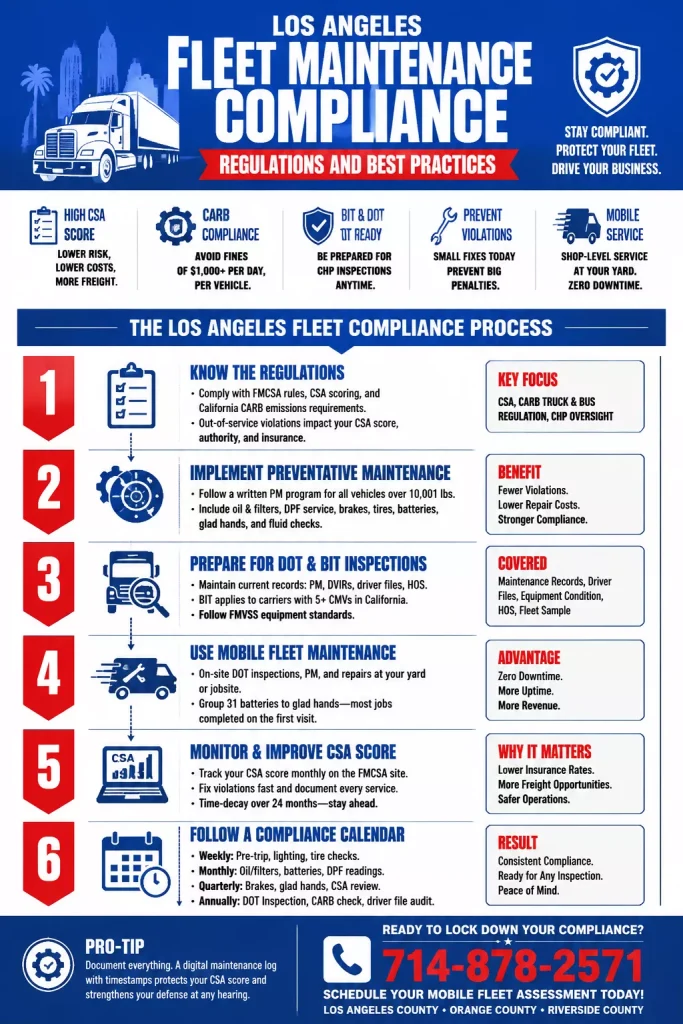
Preventative maintenance (PM) is not just about keeping trucks running. In California, it is a legal and financial risk management strategy. Additionally, every commercial motor vehicle operating over 10,001 lbs in California must have a written preventative maintenance program. The CHP reviews these programs during BIT inspections. As a result, carriers that cannot produce documented PM schedules are subject to immediate out-of-service orders.
A solid PM program for Los Angeles fleet maintenance compliance should include:
- Oil and filter changes at manufacturer-specified intervals
- DPF (Diesel Particulate Filter) cleaning and inspection cycles
- Brake adjustment and lining inspection every 25,000 miles or per manufacturer spec
- Tire rotation, inflation checks, and tread depth documentation
- Battery load testing, especially for vehicles operating in high-heat Southern California conditions
- Glad hand and airline inspection before every dispatch
Small components often become the source of big compliance failures. Something as straightforward as an oil filter in poor condition can trigger an out-of-service finding. Additionally, it may indicate broader engine stress. Check out 4 signs your semi trucks oil filter needs immediate attention so your drivers and shop staff can catch early warning signs during pre-trip inspections.
DOT Inspections and Los Angeles Fleet Maintenance Compliance for BIT Standards
California Highway Patrol officers conduct DOT inspections and BIT terminal inspections for any carrier that operates five or more commercial motor vehicles from a California location. Additionally, if your fleet is based in or regularly operates through Los Angeles, you are almost certainly subject to BIT oversight.
A BIT inspection covers:
- Vehicle maintenance records and PM documentation
- Driver qualification files
- Hours of Service logs
- Equipment condition across your full fleet sample
The National Highway Traffic Safety Administration publishes Federal Motor Vehicle Safety Standards (FMVSS) that establish the minimum equipment condition requirements a truck must meet. Furthermore, inspectors cross-reference your truck conditions against these standards during every BIT visit.
Knowing what inspectors look for gives you a clear checklist to work from. The article on how to handle your next d o t inspection with confidence and ease walks through the specific items your trucks need to have in order before the inspector arrives. For example, you will need lighting checks and coupling device conditions verified.
Precision Diesel’s mobile BIT inspection service means you do not have to send your trucks to a shop and lose hours of uptime. Their technicians come to your yard, perform the inspection, and handle any corrective work on the spot.
How Mobile Fleet Maintenance Changes the Los Angeles Fleet Maintenance Compliance Picture
Traditional fleet maintenance requires pulling trucks out of rotation, driving them to a shop, waiting for service, and driving them back. For a Los Angeles operator running tight delivery windows on the 710 or the 60, every hour off the road is lost revenue.
Mobile diesel mechanics change that equation entirely. Precision Diesel operates across Los Angeles County, Orange County, and Riverside County, bringing shop-level service to your yard or jobsite. Additionally, from Group 31 battery replacements to glad hands, airlines, and trailer repairs, their technicians carry OEM and aftermarket parts to handle most service calls on the first visit.
When looking for a reliable partner for your fleet, choosing a top semi truck repair shop that can also mobilize to your location gives you the best of both worlds. You gain professional shop expertise without the downtime of physically visiting one.
For breakdowns that happen during operations, Precision Diesel also provides 24/7 emergency roadside assistance across Southern California’s freeway network. Additionally, their mobile mechanic fixes page covers the range of roadside repairs they handle. For example, they address engine diagnostics to air system failures.
Fleet operators should know that driver fatigue enforcement has intensified under California’s HOS rules. Therefore, making it even more important that your vehicles are mechanically ready when drivers are legally permitted to operate them. Every mechanical breakdown that delays a restart costs you HOS compliance headroom.
Key Things to Know About Los Angeles Fleet Maintenance Compliance
- California’s CARB Truck and Bus Regulation applies to any diesel truck over 14,001 lbs GVWR that operates in California, even if it is registered out of state.
- A single out-of-service violation found during a roadside stop in Los Angeles will be visible to shippers and brokers who check your FMCSA safety profile.
- BIT inspections are unannounced for terminal operators, so your maintenance records must always be current, not just before a scheduled audit.
- Glad hands and air lines are among the most frequently cited defects during California CHP inspections and are cheap to fix proactively.
- Keeping a digital maintenance log that timestamps each service event strengthens your defense if a violation is disputed at an FMCSA hearing.
- Precision Diesel can help you maintain a high CSA score through its FMCSA compliance support services, which is a differentiator not all mobile providers offer.
For deeper reading on regulatory updates, compliance case studies, and maintenance tips specific to Southern California fleets, the Precision Diesel articles section is a useful resource to bookmark.
Building a Los Angeles Fleet Maintenance Compliance Calendar Your Fleet Can Actually Follow
Most compliance failures in Los Angeles fleets are not caused by ignorance of the rules. Rather, they happen because PM schedules exist on paper but are not systematically followed. Here is a practical structure for a monthly compliance calendar:
Weekly:
- Driver-conducted pre-trip and post-trip inspections with signed DVIRs
- Visual tire and lighting checks at dispatch
Monthly:
- Oil and filter checks against mileage thresholds
- Battery load testing for any vehicle over 18 months old
- DPF pressure drop readings logged
Quarterly:
- Full brake inspection and adjustment
- Trailer coupling and glad hand service
- Review of CSA score online through the FMCSA Safety Measurement System
Annually:
- Full DOT Annual Inspection completed and sticker affixed
- CARB compliance verification for emission system integrity
- Driver qualification file audit
Ready to Lock Down Your Fleet’s Compliance Standing?
Call Precision Diesel now at (714) 878-2571, or (714) TRUCKS1, and schedule a mobile fleet assessment for your Los Angeles-area operation. Their team will come to your yard, evaluate your current PM documentation, identify any immediate compliance risks, and set you up with a scheduled maintenance program that keeps your CSA score protected and your trucks legal on California roads.
Frequently Asked Questions About Los Angeles Fleet Maintenance Compliance
How often do Los Angeles fleets need a DOT Annual Inspection?
Every commercial motor vehicle must pass a DOT Annual Inspection once every 12 months.
The inspection must be conducted by a qualified inspector and the resulting report must be retained for 14 months. Furthermore, in California, the CHP also cross-references annual inspection records during BIT terminal audits. As a result, documentation gaps can trigger additional scrutiny.
What is a BIT inspection and does it apply to my LA fleet?
A BIT (Biennial Inspection of Terminals) is a California Highway Patrol program that audits carriers operating five or more CMVs from a California terminal.
Inspectors review your full maintenance program, driver files, and a sample of vehicles. Additionally, fleets operating regularly through Los Angeles are almost always subject to BIT oversight, even if their terminal is in an adjacent county.
Can a mobile diesel mechanic legally perform a DOT Annual Inspection?
Yes, a mobile mechanic can perform a DOT Annual Inspection if they meet the federal qualification criteria under 49 CFR Part 396.
Precision Diesel employs technicians qualified to complete DOT Annual Inspections and BIT-related maintenance on-site at your yard. Therefore, you eliminate the need to drive trucks to a fixed shop location.
What CARB regulations affect diesel fleets in Los Angeles specifically?
California’s Truck and Bus Regulation requires diesel trucks over 14,001 lbs GVWR to meet specific engine model year and particulate filter standards.
Fleets that have not upgraded to compliant engine years or installed approved DPF systems face fines and potential registration holds. Additionally, out-of-state trucks operating in California more than 30 days per year must also comply.
How does a mobile maintenance provider help my CSA score?
A mobile provider improves your CSA score by enabling more frequent, documented maintenance without the logistical friction of shop visits.
When trucks are serviced regularly and all work is timestamped and documented, you build a defensible maintenance record. Furthermore, this record can offset or dispute inspection findings at the FMCSA level. Precision Diesel’s FMCSA compliance support specifically focuses on keeping carrier CSA scores within safe operating thresholds.
The Bottom Line on Los Angeles Fleet Maintenance Compliance
Los Angeles fleet maintenance compliance ranks among the most demanding regulatory environments commercial operators face anywhere in the United States. Between FMCSA CSA scoring, California CARB emissions requirements, and CHP BIT inspections, the consequences of deferred maintenance extend well beyond a single out-of-service notice. Furthermore, they affect your operating authority, your insurance costs, your relationships with shippers, and ultimately your ability to keep trucks on the road.
The most practical step you can take right now is to audit your current PM documentation against your actual service intervals and identify where the gaps are. Then call Precision Diesel at (714) 878-2571 to schedule a mobile fleet assessment. They cover Los Angeles County, Orange County, Riverside County, and surrounding areas, and they bring the tools, parts, and compliance knowledge directly to your location. Therefore, your trucks stay working while your compliance standing stays strong.