
TL;DR
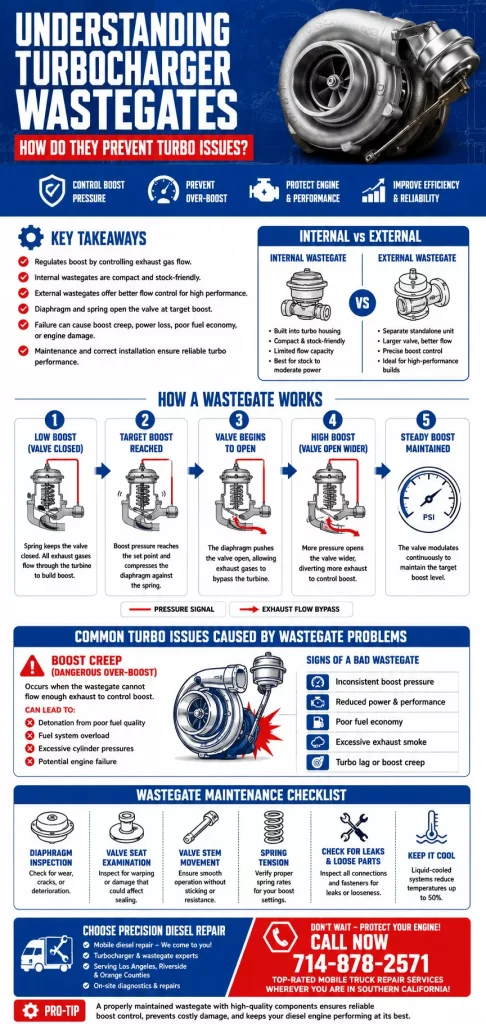
A Turbocharger Wastegates controls boost pressure by diverting excess exhaust gas away from the turbine, preventing over-boost and protecting the engine. Internal wastegates are compact and common in stock setups, while external wastegates offer better flow control for high-performance builds. Proper function is critical for engine safety, efficiency, and preventing issues like boost creep or engine damage.
Key Takeaways
- Wastegates regulate turbo boost by controlling exhaust gas flow.
- Internal wastegates are stock-friendly but limited in high power applications.
- External wastegates provide stronger, more precise boost control for performance builds.
- A diaphragm and spring system opens the valve when target boost is reached.
- Failure can cause boost creep, power loss, poor fuel economy, or engine damage.
- Maintenance and correct installation are essential for reliable turbo performance.
Your truck’s performance relies heavily on proper boost control – it’s a delicate balance that can make or break your engine’s health. A turbocharger works by using exhaust gases to spin a turbine, forcing more air into your engine’s combustion chamber.
Understanding how a wastegate turbo works is essential for managing boost pressure and preventing engine damage.
This process creates the boost that gives your engine extra power.
Getting this boost level right is critical. Too little boost results in reduced power output, while too much boost can lead to potential engine damage.
This is where wastegates come in as your engine’s boost control guardians. These vital components are pressure relief valves, controlling exhaust gas flow through your turbocharger system. By regulating the amount of exhaust gas that drives the turbine, wastegates supply reliable boost pressures and safeguard your engine against deadly over-boost conditions. A properly functioning waste gate ensures that excess exhaust gases are routed efficiently, preventing any unnecessary strain on your turbocharger and engine components.
At Precision Diesel Repair, we’ve seen firsthand the difference that a functioning wastegate can make between optimal performance and costly engine repair. With an understanding of how these units work, you’ll know how to identify potential problems before they become serious.
Learning Turbocharger Wastegates
A wastegate is your pressure relief valve for your turbocharger – it’s a very critical piece of gear that regulates exhaust gas flow by offering a bypass path around your turbo turbine. A safety valve keeps your engine from being fed too much boost pressure. If you’re still curious about what does a wastegate do, it primarily regulates the flow of exhaust gases to maintain optimal boost pressure and protect your engine from over-boosting.
If you’re wondering, what does a wastegate do on a turbo, it primarily controls the exhaust flow to regulate boost pressure and protect your engine.
Internal Wastegates
Internal wastegates are literally attached directly to the turbocharger housing and utilize a compact flapper valve design that makes them a typical factory standby on turbocharged trucks. They are perfectly suited to stock power due to the space-friendly nature of their design. However, their flow capacity is inherently limited due to size constraints within the turbo housing.
However, many truck owners ask, what do wastegates do in performance scenarios, as internal wastegates sometimes struggle to keep up with higher boost demands.
External Wastegates
External wastegates are separate standalone units that offer larger valve designs for improved exhaust flow control. These units excel in high-performance applications where precise boost regulation is crucial. Their independent design allows for customizable boost control, and multiple units can be installed when additional flow capacity is needed. This flexibility makes them the preferred choice for serious performance builds where boost management is critical.
The main difference between internal and external wastegates is how well they control boost. Internal wastegates work fine for stock setups but can have trouble with “boost creep” – when the small valve can’t let enough air flow to keep the boost at the desired level. Thanks to their separate design, external wastegates are great for performance builds, with bigger valves and better control.
Your decision on whether to use internal or external wastegates depends on how much power you want. If you’re seeking power gains in stock or light form, internal wastegates will do just fine. However, if you’re going to be gaining heavy power, you’ll find external wastegates with greater air flow and boost control provide improved performance. External wastegates also serve to lower turbulence in the turbine, so the turbo acts quicker and decreases back pressure.
The Mechanics Behind Wastegate Operation
The heart of wastegate operation lies in its diaphragm mechanism – a sophisticated system that responds to real-time pressure changes. The diaphragm works against a calibrated spring, creating a precise balance that controls boost levels.
The Diaphragm System Function
The diaphragm system is linked to a system of complex configuration where a spring of predetermined capacity, usually expressed in values in terms of pressures, keeps the wastegate valve shut. The diaphragm is pressurized into your intake manifold by a line of pressure, and when the boost pressure outweighs the spring resistance, it drives the diaphragm. The pressure that has developed opens the valve, permitting exhaust gases to bypass the turbine.
How Does a Wastegate Work?
To explain simply, a wastegate on turbo works by opening a valve to bypass excess exhaust gases, preventing the turbocharger from producing too much boost pressure. This helps maintain optimal engine performance and avoids over-boost issues.
What Is a Wastegate on a Diesel and How Does It Work?
A wastegate diesel system is designed specifically to handle the higher compression and exhaust energy found in diesel engines. In simple terms, what is a wastegate on a diesel—it’s a boost control valve that regulates how much exhaust gas reaches the turbocharger, helping maintain consistent power without overloading the engine.
To better understand how a diesel turbo wastegate works, it helps to look at the actuator. The actuator uses boost pressure to move a diaphragm and spring mechanism, which opens or closes the valve. This process explains how a wastegate actuator works in real-world driving—once the preset boost level is reached, the actuator signals the valve to open and divert exhaust flow away from the turbine.
For those wondering how internal wastegate works, it operates from inside the turbo housing using a flapper valve. This design is common in factory setups and works efficiently for daily driving conditions across Southern California, especially in stop-and-go traffic or when hauling moderate loads.
A properly functioning wastegate on turbo systems ensures smooth acceleration, better fuel efficiency, and protection against excessive boost pressure in demanding environments like highway towing or steep grades.
Boost Level Impact on Performance
The relationship between boost levels and valve operation creates a dynamic control system. During low boost pressure, the valve remains closed, directing all exhaust flow through the turbine. Once the target boost is reached, the valve begins to open, maintaining steady boost pressure. In high-boost scenarios, the valve opens wider to prevent excessive pressure buildup.
Modern wastegates use advanced materials to enhance this operation. These provide consistent pressure regulation independent of extreme temperatures.
The liquid-cooled diaphragm housing lowers operating temperatures by as much as 50%. The cooling system pipes circulate engine coolant through the wastegate housing, enhancing durability and boosting control stability in high-load driving applications.
Ensuring appropriate boost control requires a valve-to-diaphragm size ratio. An adequately sized system responds to pressure changes quickly, delivering smooth boost levels and safeguarding your engine against perilous pressure surges.
Common Turbo Issues Related to Wastegates
A critical issue with turbocharger wastegate systems is boost creep – a dangerous condition where the wastegate valve can’t flow enough exhaust gas to maintain the desired boost level.
Diesel Turbo Wastegate Problems and Blow Off Valve Differences
Understanding diesel turbo wastegate problems is key to avoiding performance loss and costly repairs. A bad wastegate can cause several noticeable issues, including inconsistent boost pressure, reduced engine power, poor fuel economy, and even excessive exhaust smoke.
When a wastegate on turbo systems fails or becomes stuck, it can either stay open—causing low boost—or remain closed, leading to dangerous over-boost conditions. These wastegate diesel issues are especially common in high-mileage work trucks operating in hot Southern California climates, where heat and carbon buildup can affect valve movement.
It’s also important to distinguish between a blow off valve for turbo setups and a wastegate. While both are related to turbo systems, they serve different purposes. A blow off valve releases excess pressure from the intake side when the throttle closes, preventing compressor surge. In contrast, a waste gate turbo system controls exhaust flow before it reaches the turbine.
For diesel engines, blow-off valves are less common because throttle plates function differently than in gasoline engines. Instead, precise boost regulation is handled almost entirely by the diesel turbo wastegate system.
Working with a trusted provider like Precision Diesel Services ensures your precision diesel turbo system is properly diagnosed and maintained, helping prevent these common issues and keeping your truck running reliably under load.
The Internal Wastegate Design Limitations
This typically occurs when the internal wastegate valve becomes undersized for the engine’s power output. Performance modifications often increase power beyond the wastegate’s designed capacity, leading to operational issues. Additionally, mechanical problems can arise when the valve becomes stuck or damaged, further compromising the wastegate’s ability to regulate boost pressure effectively.
When boost creep happens, your turbo creates excessive pressure that can trigger a chain of serious problems:
Engine Damage Risks:
- Detonation from inadequate fuel quality
- Fuel system overload
- Excessive cylinder pressures
- Potential engine failure
The positioning of wastegates also plays a vital role in preventing issues. Incorrect mounting can reduce flow capacity by up to 50%. Key mounting considerations include:
- Placement close to the turbo
- 45-degree orientation in flow direction
- Discharge point at least 18 inches from turbine
- Proper merge angle into the exhaust flow
Internal wastegates face unique challenges when pushed beyond stock power levels. The exhaust gas blast across the turbine face creates:
- Increased back pressure
- Reduced turbine efficiency
- More turbo lag
- Power loss
These issues highlight why high-performance applications often switch to external wastegates with appropriately sized valves for precise boost control and enhanced reliability.
Maintenance Considerations for Wastegates
Regular maintenance of your wastegate system plays a vital role in preserving your turbocharger’s performance. A well-maintained wastegate helps prevent boost control issues and extends the life of your engine.
Key Maintenance Areas
Diaphragm Inspection requires carefully checking for any signs of wear, cracking, or deterioration that could compromise its function.
Valve Seat Examination thoroughly examines warping or damage that could affect proper sealing performance. Valve Stem Movement should be tested to ensure smooth operation without any sticking or resistance.
Spring Tension must be verified to maintain proper spring rates for your specific boost settings. This ensures optimal wastegate performance and reliable boost control.
External wastegates showcase the gold standard in serviceability. Every component is available individually as a service part, allowing for targeted replacement of worn items between racing seasons or heavy use periods.
A properly maintained wastegate system with high-quality components helps ensure reliable boost control and protects your engine investment.
Choose Precision Diesel Repair
Your turbocharger’s operation directly affects your diesel engine’s efficiency and well-being. Though knowing wastegate mechanics enables you to make intelligent choices, maintaining it properly calls for professional skills and specialized equipment.
We deliver our professional diesel repair to your doorstep. Our certified technicians specialize in turbocharger diagnosis, wastegate repairs, and extensive diesel engine repair in Southern California.
Don’t wait for minor turbo issues to escalate into major engine problems. Get expert help today:
Our mobile service covers Los Angeles County, Riverside County, and Orange County, delivering professional turbocharger and wastegate maintenance right to your location. We provide complete diesel engine repair solutions along with thorough on-site diagnostics and repairs to keep your engine running optimally.
Ready for top-rated mobile truck repair services? Call us at (714) 878-2571!
We’ll get your diesel engine running at peak performance – wherever you are in Southern California.
