

TL;DR
The article says the EPA’s review of Heavy-Duty Vehicle Greenhouse Gas Phase 3 rules could significantly reshape emissions standards for trucking, potentially affecting costs, technology adoption, and fleet operations. While aimed at reducing emissions, the regulations may impose high compliance costs and operational challenges, especially for small carriers. Industry groups and stakeholders are actively pushing for more flexible, realistic implementation.
Key Takeaways
- EPA is reviewing GHG Phase 3 emissions standards for heavy-duty trucks, signaling possible regulatory changes
- Proposed rules include stricter NOx and particulate limits, EV adoption targets, and new testing requirements
- Compliance could cost the industry hundreds of billions and $30,000–$50,000 per truck for small operators
- Small trucking businesses may face financial strain, higher maintenance costs, and potential downsizing or closures
- Industry groups like ATA, TCA, and OOIDA are advocating for realistic timelines and cost-effective compliance options
- Technology solutions include improved diesel systems, hybrid powertrains, and expanding electric truck adoption
- The rulemaking process involves proposals, public comment, technical review, and interagency coordination over 12–24 months
Are you aware of some recent and pivotal news from the trucking sector? Recent developments by the EPA on the Greenhouse Gas Emissions Standards for Heavy-Duty Vehicles – Phase 3 (GHG3) have been creating a buzz, and we’re here to inform you about it.
Under the guidance of EPA Administrator Lee Zeldin, we are witnessing a root change in regulatory policy in action. The agency is reassessing these emissions regulations with their practical application in trucking operations in mind. This examination can be a lifesaver to fleet operators and owners like yourselves.
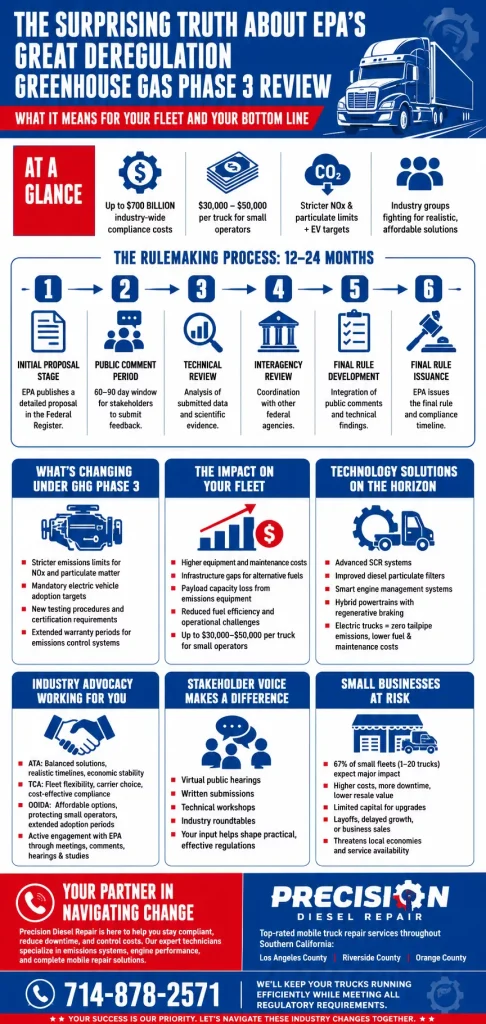
What is actually at stake here?
The game here has monumental stakes higher than policy. Your cost of operation is at the forefront of these changes since implementing new standards means a huge investment. Conformity levels for vehicles will redefine your maintenance and operation practices within your fleet, and your future decisions regarding fleet planning will need to be carefully weighed in an attempt to harmonize with future regulations. These changes are initiating technological changes across the industry that will revolutionize the way in which the trucking industry will be conducted over the next few years.
Continue reading to explore in depth what these changes will mean for your business. You’ll see how the GHG3 review will impact large fleets and small operators, learn about the complex rulemaking process, and hear about practical solutions to keep your trucks on the road and still comply with emissions standards.
Your go-to diesel repair and maintenance pros, we’re here to guide you through these changes and keep your fleet in motion.
The GHG Phase 3 Review and What It Means
Let’s get into the nitty-gritty of what GHG Phase 3 means to your fleet and how it will impact you. These regulations are the most extensive overhaul of heavy-duty emissions regulations ever, with compliance costs estimated to swell over $700 billion industry-wide.
Key Changes Under GHG Phase 3:
- Stricter emissions limits for nitrogen oxides (NOx) and particulate matter
- Mandatory electric vehicle adoption targets
- New testing procedures and certification requirements
- Extended warranty periods for emissions control systems
The trucking industry faces unprecedented challenges adapting to these regulations. Several fleet operators cite severe issues with rising equipment expenses in their operations. The lack of alternative fuel vehicle infrastructure poses a major roadblock to those intending to switch to cleaner technology. Moreover, payload capacity loss due to the weight of emissions equipment has become a pressing issue for operational efficiency. Fleet operators have also noted decreased fuel efficiency resulting from current compliance technologies, further straining their bottom line.
Technology Solutions on the Horizon
The diesel engine industry hasn’t stood still. Recent technological breakthroughs include:
- Advanced selective catalytic reduction (SCR) systems
- Improved diesel particulate filters
- Smart engine management systems
- Hybrid powertrains with regenerative braking
Electric trucks are picking up momentum as a cost-effective solution, with Volvo and Freightliner offering highly lucrative models. Zero tailpipe emissions themselves are a monumental environmental advantage, and reduced maintenance is utilized to counteract front-end investment. Electric trucks provide quieter operation, enabling late-evening delivery schedules in noise-deterrent markets. And lower fuel costs throughout the life of the truck make electric trucks even more appealing on a total cost of ownership basis.
These changes will require intentional planning and purposeful investments for small to medium fleets. You’ll be balancing short-term operating needs with long-term regulatory requirements. As these systems become increasingly complex, working with experienced diesel repair technicians becomes essential.
The bright spot? These technologies are not just compliance-driven—if serviced and operated properly, they can lead to greater efficiency and reduced operating costs.
The Role of Important Stakeholders and Their Advocacy Work
Industry groups are speaking with one voice to advance pragmatic solutions for emissions that serve environmental interests as well as the trucking business. The American Trucking Associations (ATA) has been a vocal advocate of GHG Phase 3, calling for a balanced solution that takes into account technology readiness and market conditions.
The ATA’s position emphasizes:
- Support for emissions reductions through proven technologies
- Need for realistic implementation timelines
- Protection of industry economic stability
The Truckload Carriers Association (TCA) brings additional perspectives to the table, highlighting the importance of:
- Maintaining fleet flexibility
- Preserving carrier choice in vehicle procurement
- Ensuring cost-effective compliance pathways
The Owner-Operator Independent Drivers Association (OOIDA) represents small business truckers’ interests with targeted advocacy efforts:
- Pushing for affordable compliance options
- Protecting independent operators from excessive costs
- Requesting extended adoption periods for new standards
These organizations actively engage with EPA policymakers through various channels. They regularly participate in direct meetings with regulatory officials to present their concerns and suggestions. Submission of detailed technical comments is a critical component of their outreach strategy, providing detailed comments on rule proposals. They also remain actively involved at public hearings, raising industry viewpoints and concerns. The groups also often provide evidence-based studies to support their cause and shape policy considerations.
Together, their work is to help guide regulations to safeguard environmental interests without eroding the trucking industry’s ability to operate. Each of the associations brings varied perspectives from throughout the industry to generate a valuable conversation with regulators.
The Rulemaking Process Ahead: Challenges and Opportunities
The process to amend the EPA regulations is a complicated series of steps that will require 12-24 months. Here’s what the process looks like:
- Initial Proposal Stage: The EPA must publish a detailed proposal in the Federal Register
- Public Comment Period: A 60-90 day window where stakeholders submit feedback
- Technical Review: Analysis of submitted data and scientific evidence
- Interagency Review: Coordination with other federal agencies
- Final Rule Development: Integration of public comments and technical findings
The success of these regulatory changes depends on active participation from industry experts, environmental groups, and the public. We’re seeing unprecedented engagement from trucking companies sharing real-world operational data and suggesting practical alternatives to current standards.
Stakeholder Input and Engagement
The EPA has created several dedicated channels to gather stakeholder feedback and ensure comprehensive industry participation. Virtual public hearings are the major tool for direct input, and written submissions provide detailed technical and operational evaluation. Technical workshops provide a platform for experts and practitioners to debate the issues of solution and implementation. Roundtables with industry leaders provide open-house discussions between industry leaders and regulators, enabling joint problem-solving and policy refinement.
The collective process assists in generating well-balanced regulations that are protective of the environment and feasible for business. Your voice matters in shaping these policies – whether you’re a fleet owner, independent operator, or service provider.
Impact on Small Trucking Businesses: Operational Viability at Stake?
Small-business truckers face mounting pressure from the GHG Phase 3 regulations. The cost of upgrading equipment to meet these standards can reach $30,000-$50,000 per truck – a significant burden for companies operating with thin profit margins.
Here’s what small fleet owners are dealing with:
- Higher maintenance costs for advanced emission control systems
- Increased downtime due to complex repairs
- Reduced vehicle resale value
- Limited access to capital for fleet upgrades
A recent industry survey revealed that 67% of small trucking companies (1-20 trucks) report these regulations could significantly impact their operations. Many operators indicate they will need to delay their fleet expansion plans due to financial constraints. In addition, layoffs have become a real concern as businesses balance compliance cost and cost of doing business. Most notably, perhaps, are owners now considering selling their businesses outright, unable to envision a sustainable future under the new regulatory regime.
These challenges struck family businesses especially hard. While larger carriers can absorb compliance costs across hundreds of vehicles, small-business truckers often lack this financial flexibility. Many face the difficult choice between taking on substantial debt or scaling back their operations.
The ripple effects extend beyond individual businesses – local economies depending on these small carriers for goods transportation could see increased shipping costs and reduced service availability.
Looking Ahead: Your Partner in Navigating Change
The EPA’s deregulatory action on greenhouse gas emissions regulations is a watershed moment for the trucking industry. The changes bring challenges along with opportunities, refocusing the fleet operators on the way they approach vehicle maintenance and compliance.
Choose Precision Diesel Repair
We recognize these changing needs and are dedicated to assisting you in making the changes. Our expertly trained technicians have expertise in emissions system diagnosis, engine performance calibration, and overall maintenance options. We offer mobile repair capacity to keep your fleet compliant and on the road, taking our skills to you where and when you require them.
Need expert guidance for your fleet? We provide top-rated mobile truck repair services throughout Southern California, including Los Angeles County, Riverside County, and Orange County.
Call us at (714) 878-2571 – We’ll keep your trucks running efficiently while meeting all regulatory requirements.
Your success is our priority. Let’s navigate these industry changes together.
