
TL;DR
Diesel mechanic repairs significantly improve commercial truck fuel efficiency by fixing issues in fuel delivery, turbochargers, emissions systems, and drivetrain components. In Southern California’s demanding driving conditions, small mechanical problems can quickly reduce MPG and increase costs. Preventive maintenance and advanced diagnostics help catch inefficiencies early, restore engine performance, and lower long-term fuel expenses.
Key Takeaways
- Diesel mechanic repairs directly influence fuel efficiency in commercial trucks
- Fuel system, turbocharger, and emissions repairs offer the largest MPG gains
- Diesel diagnostics identify hidden fuel losses early
- Transmission, tire, and drivetrain maintenance reduce rolling resistance
- Preventive diesel maintenance delivers long-term fuel savings
- Professional repairs help fleets meet California emissions standards while improving efficiency
Diesel mechanic repairs play a critical role in how efficiently a commercial truck uses fuel, especially in Southern California where traffic congestion, mountainous routes, port operations, and emissions regulations put added strain on diesel engines. Fuel costs remain one of the largest operating expenses for owner operators and fleet managers, and even minor inefficiencies in a diesel engine can translate into thousands of dollars lost every year.
Fuel efficiency in commercial trucks is not determined by driving habits alone. Mechanical condition, diagnostic accuracy, emissions system health, drivetrain performance, and preventive maintenance all directly affect how much fuel a truck consumes per mile. When diesel systems fall out of calibration or components wear unevenly, engines work harder than necessary, leading to increased fuel consumption and reduced diesel engine efficiency.
This article explains how diesel mechanic repairs improve fuel efficiency in commercial trucks, which systems matter most, and why consistent diesel heavy truck maintenance remains one of the most reliable ways to control fuel costs across Los Angeles, Orange County, Riverside County, and the rest of Southern California.
Why Fuel Efficiency Matters More in Southern California
Southern California presents unique challenges for commercial truck fuel economy. Stop-and-go freeway traffic, long idle times at ports and warehouses, steep grades, and extreme heat all increase fuel burn. Diesel engines operating under these conditions rely heavily on proper airflow, accurate fuel delivery, and optimized exhaust aftertreatment systems.
When diesel engine repairs are delayed, even small problems such as a partially clogged injector or restricted DPF can create excess exhaust backpressure. That backpressure forces the engine to burn more fuel to maintain power, lowering overall diesel fuel efficiency and increasing emissions output.
Experienced diesel technicians frequently see trucks losing one to three miles per gallon due to issues that could have been corrected during routine diesel mechanic maintenance. Over the course of a year, that loss adds up quickly for commercial fleets.
Diesel Engine Repairs That Improve Fuel Economy
Fuel System Repairs and Injector Performance
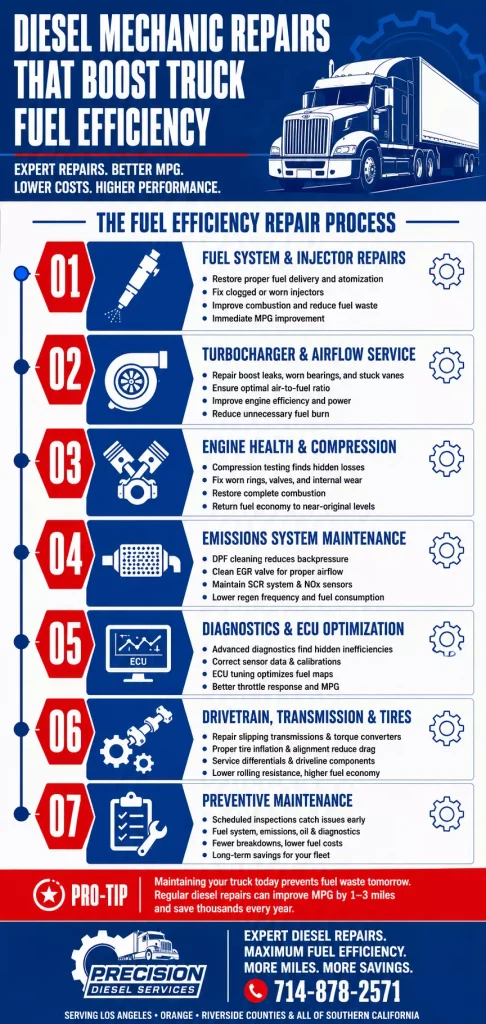
Fuel delivery accuracy is one of the most important factors affecting diesel truck MPG improvement. Diesel fuel system repair addresses issues such as clogged injectors, worn injector tips, low rail pressure, and uneven fuel atomization.
Injectors that do not spray fuel evenly cause incomplete combustion. This wastes fuel, increases soot production, and accelerates DPF loading. Injector cleaning and replacement restores proper spray patterns, improving diesel engine performance and reducing fuel consumption.
In real-world fleet scenarios, injector flow testing often reveals imbalances between cylinders that drivers never notice until fuel costs spike. Correcting these issues through diesel mechanic repairs leads to immediate fuel savings for truck fleets.
Turbocharger Efficiency and Airflow Balance
Turbocharger repair for diesel trucks has a direct impact on fuel efficiency in commercial trucks. Turbochargers increase airflow, allowing diesel engines to burn fuel more completely. When turbo vanes stick, boost leaks develop, or bearings wear out, the engine compensates by injecting more fuel to maintain power.
A properly functioning turbocharger improves diesel engine efficiency by ensuring optimal air-to-fuel ratios under load. Diesel engine tuning following turbocharger repair further refines boost pressure and throttle response, reducing unnecessary fuel burn during acceleration and hill climbs.
Compression and Internal Engine Health
Compression testing diesel engines provides valuable insight into fuel efficiency losses. Low compression from worn piston rings, valve issues, or cylinder damage causes incomplete combustion and higher truck fuel consumption.
Heavy-duty truck maintenance that addresses internal wear early can prevent severe efficiency losses. While compression-related repairs are more involved, they often restore fuel economy to near-original levels when performed before catastrophic damage occurs.
Fuel Contamination Response and Repair Costs in Diesel Engines
Unexpected fuel contamination events can lead to complex mechanical damage that requires immediate attention in commercial diesel systems. In severe cases, gas in diesel engine repair cost is influenced by how quickly the issue is identified, the extent of fuel system contamination, and whether components such as injectors, pumps, or fuel lines require full replacement.
Southern California fleets often face higher repair variability due to operating demands and stop-heavy routes that intensify engine strain during contamination events. Proper fuel system flushing and contamination isolation help limit secondary damage, protecting long-term engine reliability and preventing extended downtime.
Preventive Maintenance and Diesel Performance Optimization
Routine service plays a key role in maintaining consistent engine responsiveness and fuel stability across commercial fleets. A scheduled diesel truck tune up focuses on restoring baseline engine performance by checking timing balance, airflow consistency, and overall combustion efficiency under load conditions.
Regular tune-up intervals help reduce uneven wear patterns and support smoother operation during heavy hauling or urban delivery cycles. When performed consistently, these services improve drivability and help maintain stable operating costs across Southern California routes.
How Diesel Diagnostics Reduce Fuel Consumption
Advanced Diesel Engine Diagnostics
Modern diesel engine diagnostics identify inefficiencies that are impossible to detect without specialized tools. Diesel scan tool diagnostics monitor injector timing, fuel pressure, exhaust temperatures, and sensor feedback in real time.
Accurate diagnostics allow diesel technicians to pinpoint issues such as faulty NOx sensors, incorrect ECU calibration, or EGR system malfunctions. These problems often trigger the engine to run in a less efficient mode, increasing fuel consumption without obvious warning signs.
Diesel mechanic repairs guided by precise diagnostics reduce guesswork and ensure that fuel-saving corrections are made quickly.
ECU Calibration and Engine Tuning
ECU calibration diesel trucks rely on must match real-world operating conditions. Trucks operating in Southern California may require adjustments for elevation changes, heat load, and stop-and-go driving.
Diesel engine tuning improves throttle response, reduces excessive fueling, and optimizes torque curves for better commercial truck fuel economy. Proper tuning is especially important after major repairs such as injector replacement, turbocharger repair, or emissions system service.
Telematics and Fuel Monitoring
Telematics fuel monitoring helps fleet managers track real-time fuel efficiency trends. When combined with diesel diagnostics services, telematics data reveals how mechanical issues affect fleet fuel efficiency over time.
Consistent monitoring allows maintenance teams to schedule preventive diesel maintenance before fuel losses escalate.
Emissions System Maintenance and Fuel Efficiency
DPF Cleaning and Regeneration
Diesel particulate filter maintenance is one of the most overlooked contributors to diesel fuel efficiency. As soot accumulates, the DPF restricts exhaust flow and increases diesel exhaust backpressure.
DPF regeneration and cleaning restore airflow and reduce the amount of fuel required for active regeneration cycles. Trucks with neglected DPF systems often experience significant MPG loss due to frequent regen events.
Professional DPF cleaning service improves fuel efficiency while helping trucks remain compliant with California diesel emissions system maintenance requirements.
EGR System Impact on Fuel Economy
The EGR valve plays a critical role in emissions control but also affects fuel efficiency. Carbon buildup in the EGR system disrupts airflow and combustion temperatures.
EGR valve cleaning restores proper exhaust gas recirculation, improving diesel engine efficiency and reducing excessive fuel burn. This is particularly important for trucks operating under heavy loads in warm climates.
SCR System Efficiency and NOx Sensors
SCR system maintenance ensures that DEF dosing, NOx sensor calibration, and catalyst performance remain within optimal ranges. When NOx sensors fail or drift out of calibration, the engine may enter derate modes or alter fueling strategies that reduce fuel economy.
Diesel aftertreatment maintenance keeps emissions systems functioning efficiently without compromising performance.
Transmission, Drivetrain, and Tire Maintenance for Better MPG
Transmission and Torque Converter Health
Transmission maintenance fuel economy improvements are often overlooked. Slipping clutches, delayed shifts, or failing torque converters force engines to operate at higher RPMs, consuming more fuel.
Diesel transmission repair restores proper gear engagement and torque transfer. In heavy-duty applications, torque converter repair alone can recover measurable MPG losses.
Wheel Alignment and Rolling Resistance
Tire maintenance fuel efficiency depends on correct inflation, tread condition, and alignment. Misaligned wheels increase rolling resistance and cause uneven tire wear.
Wheel alignment fuel efficiency improvements reduce drag and allow trucks to maintain speed with less throttle input. Truck tire inflation fuel savings are particularly noticeable on long highway routes.
Differential and Drivetrain Maintenance
Drivetrain components that are improperly lubricated or worn increase parasitic losses. Heavy-duty truck maintenance that includes differential service helps reduce resistance and improve commercial truck fuel economy.
Preventive Diesel Maintenance and Long-Term Fuel Savings
Preventive diesel maintenance consistently delivers the highest return on investment for fuel efficiency. Scheduled inspections catch issues early before they escalate into fuel-draining failures.
A diesel maintenance schedule for fuel savings typically includes fuel system inspections, emissions system checks, oil analysis, and diagnostic scans. Fleets that follow structured maintenance plans often experience fewer breakdowns and lower overall fuel costs.
In practice, fleets across Southern California that prioritize diesel mechanic repairs as part of preventive strategies report improved fleet fuel efficiency and reduced operating costs year over year.
Real-World Fuel Savings From Professional Diesel Repairs
Diesel technicians regularly see trucks regain lost fuel economy after targeted repairs. For example, a regional delivery fleet operating between Los Angeles and Riverside experienced a two MPG improvement after injector replacement and DPF cleaning.
Another long-haul operator hauling freight through Orange County ports reduced fuel costs significantly after addressing turbocharger inefficiencies and correcting ECU calibration issues discovered through diagnostics.
These examples highlight how professional diesel mechanic repairs directly impact fuel savings for commercial fleets.
About Precision Diesel Services
Precision Diesel Services supports commercial truck drivers and fleets throughout Los Angeles, Orange, and Riverside counties, serving all of Southern California. With extensive real-world experience handling complex diesel engine repairs, diagnostics, and emissions system maintenance, the team helps trucks operate efficiently under demanding regional conditions.
For service inquiries, Precision Diesel Services can be reached at 714-878-2571.
Frequently Asked Questions About Diesel Mechanic Repairs and Fuel Efficiency
What diesel repairs improve fuel efficiency the most?
Fuel system repairs, injector cleaning, turbocharger service, DPF cleaning, and ECU calibration typically provide the biggest improvements in diesel fuel efficiency.
How do mechanics improve diesel fuel economy?
Mechanics use diagnostics to identify inefficiencies, restore airflow and fuel delivery, correct sensor data, and ensure all systems operate within optimal parameters.
How often should diesel trucks be serviced for fuel efficiency?
Preventive diesel maintenance should be performed at regular intervals based on mileage, engine hours, and operating conditions to maintain consistent fuel economy.
Can emissions system problems reduce fuel efficiency?
Yes. DPF restrictions, EGR valve buildup, and SCR system faults all increase fuel consumption by forcing engines to work harder.
Does tire maintenance really affect fuel economy?
Proper tire inflation, alignment, and tread condition significantly reduce rolling resistance and improve commercial truck fuel economy.
How do I find reliable semi truck repair shops near me?
Finding reliable semi truck repair shops near me starts with choosing a facility that provides diesel diagnostics, emissions system maintenance, and preventive diesel repairs designed to improve fuel efficiency. In Southern California, experience with heavy-duty trucks, compliance with California emissions regulations, and access to advanced diagnostic tools are key factors that separate dependable repair shops from general service centers.
