

If you manage a commercial fleet in Southern California, your best option for diesel engine service is a provider that combines mobile repair capability with DOT compliance support and fleet maintenance programs. Fixed shops work for planned downtime, but mobile mechanics can reach a truck on the road, in a yard, or at a job site without pulling the whole vehicle out of service.
That distinction matters more than most fleet managers realize until a truck goes down on the 710 during peak hours.
Who this is for: Fleet managers, owner-operators, and logistics coordinators in Los Angeles County, Orange County, Riverside County, and surrounding Southern California areas who need to decide between fixed-shop diesel service and a mobile provider.
Not for: Individual passenger car owners or fleet managers outside California looking for general repair advice.
Key Takeaways
- Mobile diesel mechanics eliminate the tow cost and reduce downtime compared to fixed-shop repairs.
- DOT compliance, FMCSA inspections, and California’s Clean Truck Check requirements are non-negotiable for commercial fleets operating in this state.
- Preventative maintenance programs save significantly more per truck annually than reactive repairs.
- Not every mobile provider carries OEM-grade parts. Confirm parts sourcing before you sign a service agreement.
- Diesel engine service quality varies sharply by technician certification. Ask for ASE Heavy-Duty Truck credentials.
- A provider covering multiple counties gives you consistent service regardless of where your trucks are running that day.
Mobile vs. Fixed Shop: The Core Decision Every Fleet Manager Faces
Fixed diesel shops have been the default for decades. You schedule the truck, haul it in, wait for the bay to open, and collect it a day or two later. For major engine rebuilds or frame-level work, that model still makes sense. The trade-off is time and logistics cost, particularly when your truck is 40 miles from the nearest authorized shop.
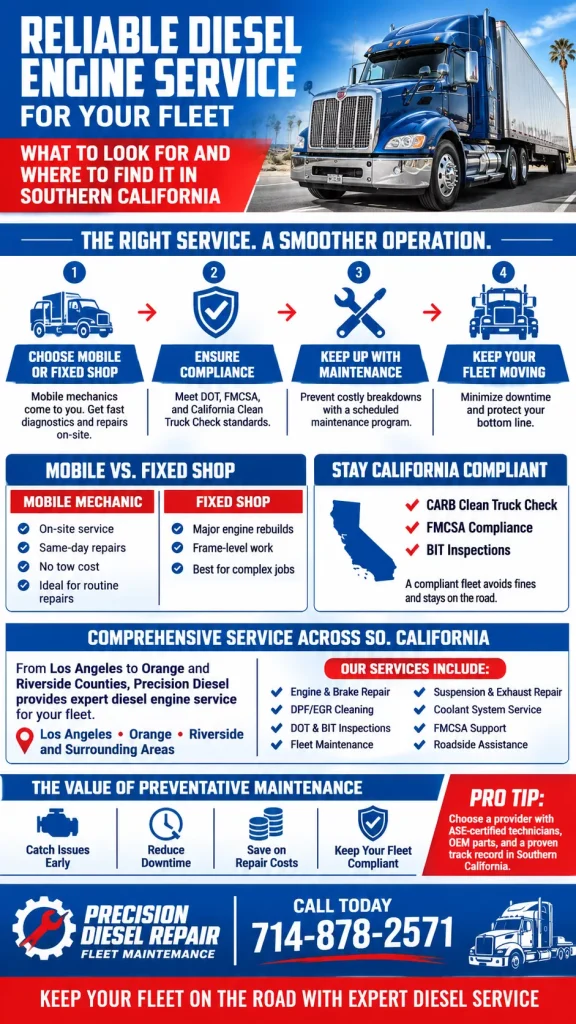
Mobile diesel service inverts that model. The mechanic drives to the truck. That means same-day diagnostics, oil and filter changes, brake repairs, DPF filter cleaning, EGR filter cleaning, and coolant system repairs can all happen in your yard or at a job site without a tow.
Here is where most fleet managers underestimate the math: a single tow for a Class 8 truck in the Los Angeles metro area can run $500 to $1,200 depending on distance. Add the shop labor rate markup and overnight vehicle storage, and a reactive fixed-shop repair for something like a coolant system issue can cost two to three times what a mobile call-out would have.
The catch with mobile service is capability ceiling. A mobile unit cannot resurface a crankshaft or perform a complete transmission overhaul roadside. For everything below that threshold, though, a well-equipped mobile diesel truck covers the full range of day-to-day fleet needs.
| Service Type | Mobile Mechanic | Fixed Diesel Shop |
|---|---|---|
| Oil & filter change | Yes, at your location | Yes, requires appointment |
| DPF/EGR cleaning | Yes | Yes |
| Engine diagnostics | Yes, with computer diagnostics tools | Yes |
| Brake repair | Yes | Yes |
| Major engine rebuild | No | Yes |
| DOT/BIT inspection | Yes (certified providers) | Yes |
| Response time | 1 to 4 hours typically | Next available bay (often 1 to 3 days) |
| Tow cost | None | $500 to $1,200+ per incident |
California Compliance: What Your Diesel Service Provider Must Cover
Operating commercial trucks in California means dealing with a regulatory environment that is significantly stricter than federal baselines. The California Air Resources Board (CARB) administers the california truck emissions compliance requirements that apply to diesel fleets, and failing an inspection does not just mean a citation. It can ground your trucks.
The Clean Truck Check program requires periodic Portable Emissions Measurement System (PEMS) testing for heavy-duty trucks operating in California. Your diesel service provider needs to understand these requirements well enough to flag potential compliance risks during routine maintenance, not just during a formal inspection.
FMCSA compliance is a separate layer. Federal Motor Carrier Safety Administration rules govern hours of service, vehicle inspection intervals, and recordkeeping. A provider who offers FMCSA compliance support as part of their service package removes that administrative burden from your internal team.
BIT (Biennial Inspection of Terminals) inspections apply to California-based motor carriers. Your trucks and your terminal both need to pass. If your diesel service provider can perform BIT inspections on-site at your facility, that is a material operational advantage.
The NIH National Library of Medicine publishes research connecting diesel particulate exposure to respiratory outcomes in workers, which is part of why California’s emissions regulations are aggressive by design. The state is not going to ease those requirements.
What Precision Diesel Covers Across Southern California
Precision Diesel operates as a mobile diesel mechanic service based in El Segundo (840 Apollo St #300, El Segundo, CA 90245) and serves fleets across Los Angeles County, Orange County, Riverside County, and surrounding areas. With over 20 years of experience in heavy-duty diesel truck, semi truck, and trailer repair, the company’s model is built specifically around keeping commercial vehicles out of fixed shops whenever possible.
The service list covers the full range of routine and reactive fleet needs: engine repair, brake repair, suspension repair, exhaust system repair, HVAC systems repair, coolant system repair, EGR and DPF filter cleaning, chassis repair, DOT inspections, BIT inspections, FMCSA compliance support, and roadside assistance. Parts sourcing includes both OEM and quality aftermarket components, from Group 31 batteries to Glad Hands and airlines.
For fleet managers asking where can i get diesel engine service for my fleet in Southern California, Precision Diesel’s coverage area is one of the widest in the region. Cities served in Los Angeles County alone include Long Beach, Compton, Carson, Torrance, Downey, Pomona, and Pasadena, among dozens of others. Orange County coverage includes Anaheim, Irvine, Fullerton, Santa Ana, and Huntington Beach. Riverside County coverage extends the network further inland.
You can reach their team directly at (714) 878-2571.
Preventative Maintenance: The Argument for a Scheduled Program
Reactive repair is expensive. The pattern that keeps recurring across commercial fleets is that managers underinvest in scheduled maintenance until a catastrophic failure makes the math undeniable. A blown engine on a revenue-generating truck does not just cost the repair bill. It costs the missed loads, the driver downtime, and the potential contract penalty.
A structured preventative maintenance program catches failure indicators early: coolant contamination before it reaches the head gasket, brake wear before it becomes a DOT violation, DPF loading before it triggers a regeneration failure.
Precision Diesel’s fleet maintenance model is built around scheduled preventative visits, which means your trucks get checked on a cadence, not just when something breaks. For a detailed breakdown of why this matters financially, the the importance of semi truck fleet maintenance resource covers the specific cost arguments worth walking through with your operations team.
The Federal Motor Carrier Safety Administration (FMCSA) publishes vehicle inspection and maintenance standards that give you a baseline for what a compliant preventative program needs to include. Your service provider should be familiar with every line of it.
| Maintenance Task | Recommended Interval | Consequence of Skipping |
|---|---|---|
| Oil & filter change | Every 15,000 to 25,000 miles | Engine wear, oil contamination |
| DPF filter cleaning | Every 100,000 to 150,000 miles | Regen failures, power loss, DEF issues |
| Brake inspection | Every 25,000 miles or per DOT schedule | Safety violation, CSA score impact |
| Coolant system check | Every 6 months | Overheating, head gasket damage |
| EGR filter cleaning | Every 50,000 miles | Emissions failure, engine performance loss |
| DOT annual inspection | Annually (required) | Out-of-service order |
Specific Cost Considerations to Know Before You Shop Providers
One number fleet managers frequently underestimate: radiator replacement on a semi truck. Depending on the truck make and the extent of the damage, semi truck radiator replacement cost can range from roughly $1,500 to over $4,000 when you include parts and labor. Mobile service does not always eliminate that cost, but it can eliminate the tow and the shop markup.
Engine computer diagnostics are another area where costs vary wildly between providers. Some fixed shops charge a flat diagnostic fee of $200 to $400 before they touch anything. Mobile providers who include diagnostics in the service call structure give you better cost predictability.
What usually trips fleet managers up here is the hidden cost of downtime, not the repair invoice itself. A truck generating $2,000 in revenue per day that sits in a shop bay for three days costs $6,000 in lost revenue on top of the repair bill. When you frame mobile diesel service that way, the per-call cost looks very different.
For practical diesel truck repair tips that help you spot early warning signs before they become major failures, your drivers are your best early-warning system. Train them to report coolant smell, unusual exhaust color, and brake pedal feel changes. Early reports mean earlier intervention.
Terrain and Regional Factors That Affect Fleet Maintenance in Southern California
Southern California’s geography adds specific stressors to commercial truck fleets that providers elsewhere do not deal with. Stop-and-go traffic on the I-5, I-10, and I-710 corridors causes disproportionate brake wear and engine temperature fluctuations. The inland areas of Riverside County involve elevation changes and grades that stress cooling systems and exhaust brakes.
If you route trucks through mountainous stretches in San Bernardino or Riverside counties, knowing where emergency infrastructure sits matters. The runaway truck ramp southern california resource covers grade-specific infrastructure that every driver operating in those corridors should know. Brake system integrity on those routes is not optional, and it circles back directly to your maintenance schedule.
The California Department of Transportation (Caltrans) publishes route-specific information for commercial vehicles, including designated truck routes and weight restrictions, that your operations team should reference when routing new loads.
Vetting a Diesel Service Provider: The Questions That Matter
Finding the right provider means asking pointed questions, not just comparing hourly rates. The articles published by Precision Diesel cover several of the technical and operational topics that help fleet managers ask better questions of any provider they are evaluating.
Here is what actually separates a capable diesel service provider from one that will cost you more over time:
- ASE certification for heavy-duty trucks: Ask specifically for the H series (H1 through H8) credentials. General automotive certification does not transfer to Class 7 or Class 8 vehicles.
- Parts accountability: Does the provider document part numbers and sourcing? Can they source OEM parts when required, not just aftermarket?
- Response time guarantee: A provider without a committed response window is not suitable for fleet contracts. Get it in writing.
- Compliance support: Can they perform DOT annual inspections, BIT inspections, and document the results in a format FMCSA auditors accept?
- Service area confirmation: Confirm coverage for every county and major city where your trucks run, not just the city closest to their base.
The U.S. Department of Transportation provides carrier and mechanic licensing verification resources you can use to confirm a provider’s compliance credentials before you commit.
For fleet managers across Southern California still asking where can i get diesel engine service for my fleet, the combination of mobile capability, compliance coverage, and regional reach is what narrows the field fastest. Most providers do one or two of those things well. Very few do all three.
Book Mobile Diesel Service That Keeps Your Fleet Moving
Every day a truck sits idle, it costs you money. Precision Diesel sends certified mobile mechanics directly to your location across Los Angeles County, Orange County, Riverside County, and surrounding Southern California areas, so your vehicles get serviced where they are, not where a shop happens to have an open bay. With over 20 years of experience in heavy-duty diesel truck and semi truck repair, fleet maintenance, and DOT compliance support, Precision Diesel is built for fleet managers who cannot afford unplanned downtime.
Call Precision Diesel now at (714) 878-2571 and schedule your fleet’s next service appointment or get immediate roadside assistance dispatched to your location today.
Frequently Asked Questions
What types of diesel engines and trucks does a mobile fleet service provider typically work on?
Most mobile diesel providers work on Class 6, 7, and 8 trucks, including semi trucks, day cabs, sleepers, and heavy-duty work trucks.
Precision Diesel specifically services diesel trucks, semi trucks, trailers, and heavy equipment across Southern California. Engine brands commonly covered include Cummins, Detroit, PACCAR, and Volvo D-series engines, though you should confirm compatibility for your specific fleet makes before booking. If you run a mixed fleet, ask the provider to verify technician experience across each platform you operate.
How quickly can a mobile diesel mechanic reach my truck if it breaks down on a Southern California freeway?
Response times for mobile diesel roadside assistance in Southern California typically range from one to four hours depending on traffic conditions and the mechanic’s current location.
The Los Angeles and Orange County freeway corridors can add significant response time during peak hours on routes like the I-710 or the 91. Precision Diesel offers roadside assistance across its Southern California service area, and the best way to get an accurate arrival estimate is to call directly at (714) 878-2571 with your truck’s exact location. Having the cross street or milepost marker ready speeds dispatch considerably.
Does mobile diesel fleet service cost more than taking trucks to a fixed shop?
Mobile diesel service often costs less in total once you factor in towing fees, shop storage charges, and lost revenue from downtime, even if the per-hour labor rate appears similar.
A tow for a Class 8 truck in the Los Angeles metro area can run $500 to $1,200 before the shop even opens the hood. Add one to three days in a shop bay, and the total cost of a reactive repair climbs fast. Mobile service eliminates the tow and reduces downtime to hours in many cases. The trade-off is that mobile units cannot handle major engine rebuilds or frame-level structural work, so very large repairs still require a fixed facility.
What should I look for in a fleet maintenance contract with a mobile diesel provider?
A solid fleet maintenance contract should specify response time guarantees, inspection intervals, parts sourcing standards, compliance documentation, and a clear scope of covered services in writing.
Watch for contracts that are vague about which services are included versus billed separately. DOT annual inspections, BIT inspections, and FMCSA compliance documentation are often add-ons that catch fleet managers off guard at renewal. Precision Diesel’s fleet maintenance model covers preventative maintenance, compliance inspections, and roadside response as an integrated service rather than a disconnected set of add-ons. Ask any provider to walk you through a sample service record so you understand what documentation you will receive after each visit.
How does California’s Clean Truck Check program affect what I need from my diesel service provider?
California’s Clean Truck Check program requires periodic PEMS emissions testing for heavy-duty diesel trucks, and your service provider needs to maintain your vehicles to a standard that passes those tests consistently.
CARB has steadily expanded the program’s scope since its initial rollout, and the enforcement calendar through 2026 covers a broad range of model years. A diesel service provider who is not familiar with CARB’s current requirements can inadvertently leave your trucks in a configuration that fails testing, which risks out-of-service orders and fines. Your provider should flag potential emissions-related issues during every routine maintenance visit, not just when you schedule a compliance check. This is one area where working with a Southern California-based provider who deals with CARB regulations daily gives you a clear advantage over a national chain unfamiliar with California’s specific requirements.
The Bottom Line on Where to Get Diesel Engine Service for Your Fleet
For Southern California fleet operators, the answer to where can i get diesel engine service for my fleet comes down to three things: mobile capability that reduces downtime, compliance expertise that keeps you legal under California and federal rules, and a service area wide enough to cover your trucks wherever they are running on any given day.
Precision Diesel delivers all three across Los Angeles County, Orange County, Riverside County, and surrounding areas, backed by over 20 years of hands-on experience with heavy-duty diesel trucks, semi trucks, trailers, and heavy equipment. The mobile-first model means your trucks stay on the road instead of sitting in a shop bay waiting for an available technician.
Your next step is straightforward: call (714) 878-2571, give Precision Diesel your fleet size and service area, and get a maintenance plan that fits your operation.
