
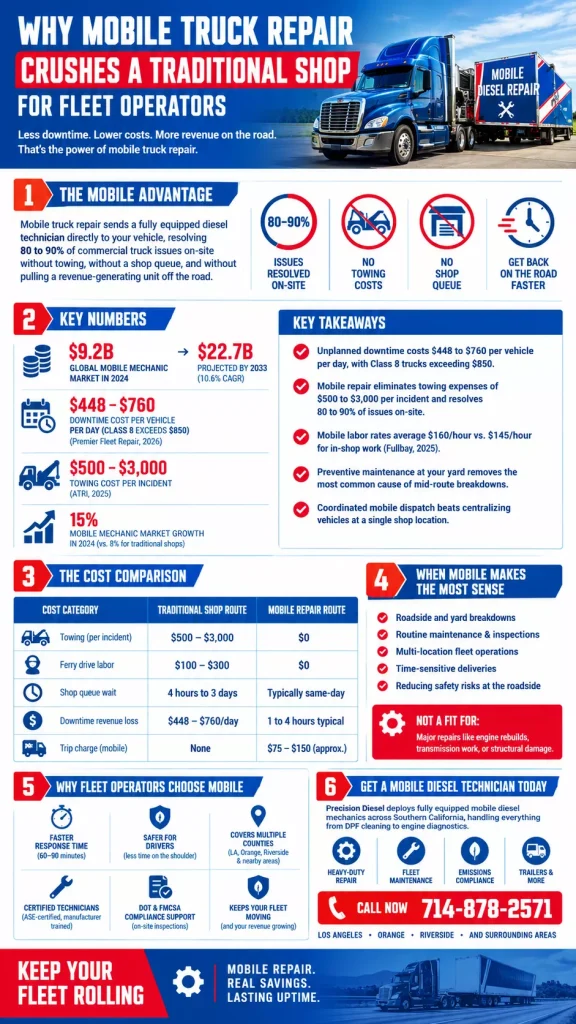
Mobile truck repair sends a fully equipped diesel technician directly to your vehicle, resolving 80 to 90% of commercial truck issues on-site without towing, without a shop queue, and without pulling a revenue-generating unit off the road for hours. For fleet operators running Class 8 equipment across Southern California’s freight corridors, that single operational difference translates into thousands of dollars in recovered uptime every month.
The global mobile mechanic services market reached $9.2 billion in 2024 and is projected to hit $22.7 billion by 2033, growing at a compound annual rate of 10.6% according to industry analysts. That trajectory is not accidental. Fleet managers have done the math, and the advantages of keeping repairs at the vehicle rather than driving to a shop are hard to argue against.
Who this is for: This article is written for owner-operators, fleet managers, and dispatchers running commercial diesel trucks or semi trucks in Los Angeles County, Orange County, Riverside County, and surrounding Southern California regions who are actively evaluating whether mobile repair fits their operation.
Not for: Owner-passenger-car drivers or light-duty vehicle operators looking for standard auto repair options.
Key Takeaways
- Unplanned downtime costs between $448 and $760 per vehicle per day, with Class 8 trucks exceeding $850 per day (Premier Fleet Repair, 2026).
- Mobile repair eliminates towing expenses of $500 to $3,000 per incident and resolves 80 to 90% of issues on-site.
- The mobile mechanic segment grew 15% in 2024, nearly double the 8% growth rate of traditional repair shops.
- Mobile labor rates average $160/hour versus $145/hour for in-shop work, a modest premium offset by eliminated towing, ferry time, and lost revenue.
- Preventive maintenance performed at your yard or job site removes the most common cause of mid-route breakdowns before they become roadside emergencies.
- For fleets operating across multiple Southern California counties, coordinated mobile dispatch beats centralizing vehicles at a single shop location.
Downtime Is the Metric That Makes or Breaks Fleet Profitability
A single Class 8 truck sitting idle costs your operation more than $850 per day, according to Premier Fleet Repair (2026). Across a 100-vehicle fleet, unplanned downtime can drain $175,000 to $300,000 annually from utilization gaps alone. Traditional shops compound this problem by adding scheduling delays, physical relocation of the broken unit, and a shop queue that can stretch days during peak periods.
Mobile repair attacks downtime at its source. When a technician rolls to your yard, truck stop, or job site with diagnostic equipment, DPF cleaning tools, and a parts inventory stocked with common components, the idle clock stops faster. The pattern Precision Diesel sees repeatedly across Orange County and Los Angeles County routes: a truck that would have waited two days for a shop appointment is back in service within four hours of a mobile call.
The trade-off is real, though. Mobile repair cannot handle every job. A cracked engine block, a transmission rebuild, or major frame work still requires a stationary lift and a bay environment. Knowing where the line sits matters, and any honest mobile provider should tell you upfront rather than attempt a repair the road cannot support.
For resources on keeping track of related maintenance decisions, the articles section at Precision Diesel covers a range of fleet topics worth bookmarking.
Skip the Tow Truck: What That Actually Saves Per Incident
Towing a semi truck in California runs $500 to $3,000 per incident, per ATRI research (2025). For a fleet that experiences even a dozen roadside events per year, that line item alone reaches $36,000 before a single part is purchased. Mobile repair eliminates that cost entirely for the 80 to 90% of repairs that can be completed at the breakdown location.
There is a second, less-discussed cost hiding inside every tow: the ferry drive. Once a truck reaches the shop, someone must drive it back to the yard or the delivery route afterward. That ferry trip burns driver hours and fuel on a non-revenue move.
| Cost Category | Traditional Shop Route | Mobile Repair Route |
|---|---|---|
| Towing (per incident) | $500 to $3,000 | $0 |
| Ferry drive labor | $100 to $300 | $0 |
| Shop queue wait | 4 hours to 3 days | Typically same-day |
| Downtime revenue loss | $448 to $760/day | 1 to 4 hours typical |
| Trip charge (mobile) | None | $75 to $150 (approx.) |
The numbers favor mobile for most roadside and yard breakdowns. The catch is parts availability. A shop with a large parts room can sometimes complete a complex repair faster if the required component is not on the mobile unit. Confirming parts availability before dispatching a mobile technician saves a wasted visit.
Fleet Coordination Without Centralizing Your Trucks
Traditional shops require every vehicle to come to one physical location. For a fleet spread across Long Beach, Compton, and Ontario, that centralization creates a logistics puzzle on top of the mechanical problem. Drivers deadhead to the shop, schedules shift, and dispatch scrambles.
Mobile repair inverts that model. A dispatcher calls one number and a technician routes to whichever truck needs attention, whether it sits at a customer’s dock in Carson or at a fuel stop on the 91 corridor. Precision Diesel covers Los Angeles County, Orange County, Riverside County, and surrounding areas, which means a single point of contact can coordinate repairs across multiple simultaneous incidents without relocating vehicles.
Understanding the importance of semi truck fleet maintenance becomes even clearer when you realize how much mobile scheduling simplifies multi-location operations.
Response Time in Emergencies: Benchmarks That Matter
Mobile mechanics average a 60 to 90-minute response window, according to Premier Fleet Repair (2026). A traditional shop, by contrast, may not even schedule a look until the next business day. In freight operations, the difference between a 90-minute response and a next-morning appointment is often the difference between making a delivery window and losing a client.
For Southern California operators running time-sensitive loads through the ports of Los Angeles and Long Beach, that response gap carries real financial weight. A missed port appointment can mean chassis fees, detention charges, and re-booking costs that dwarf a mobile repair invoice.
If you want to understand how specific repair events like coolant system failures affect your budget, the semi truck radiator replacement cost breakdown is a good reference before negotiating quotes.
On-Site Preventive Maintenance Catches Failures Before the Road Does
What usually trips fleet managers up here is treating preventive maintenance as a shop-only activity. Scheduling PMs requires pulling a truck from service, which dispatchers resist until it becomes urgent. The result: deferred maintenance, premature failures, and emergency repairs that cost three times what a scheduled PM would have.
Mobile preventive maintenance eliminates that hesitation. A technician performs oil and filter changes, brake inspections, EGR cleaning, DPF servicing, and coolant system checks at your yard during overnight hours or between routes. The truck never misses a shift. Precision Diesel’s mobile services include the full PM scope: lubrication, exhaust system checks, HVAC inspection, and california truck emissions compliance work, which matters considerably given the state’s Clean Truck Check program administered by the California Air Resources Board.
The mobile PM model does have a ceiling. Shops with alignment racks, brake lathes, and chassis lifts can handle suspension and alignment work that a mobile unit cannot perform roadside. A hybrid maintenance strategy, mobile for routine PMs and shop visits for structural repairs, typically produces the best outcome for larger fleets.
Cost Structure: Where Mobile Saves and Where It Costs More
The median mobile labor rate is $160/hour versus $145/hour for in-shop work, according to Fullbay’s 2025 State of Heavy-Duty Repair. Mobile work carries a modest premium, reflecting the cost of a fully equipped service vehicle, diagnostic tools, and travel logistics.
Almost half of repair shops also implement a trip charge for every mobile call-out, typically in the $75 to $150 range. Factor that into your per-incident budget.
| Repair Type | Mobile Viable? | Typical Mobile Cost Advantage |
|---|---|---|
| Oil and filter change | Yes | High (no tow, no ferry) |
| DPF/EGR cleaning | Yes | High |
| Brake adjustment | Yes | High |
| Electrical diagnostics | Yes | Moderate |
| Radiator replacement | Often yes | Moderate |
| Transmission rebuild | No | N/A (shop required) |
| Frame/structural repair | No | N/A (shop required) |
Total heavy-duty shop revenue reached $5.04 billion in 2025, up 68% since 2023, according to Fullbay’s fifth annual State of Heavy-Duty Repair report. Mobile repair contributed meaningfully to that expansion, which explains why 80% of shops offered mobile services in 2025, according to the same data set.
For practical diesel truck repair tips that help you communicate repair needs clearly to a technician, Precision Diesel’s resource library is worth reviewing before your next call.
Safety at Roadside Breakdowns: Specifics, Not Generalities
A broken-down semi on a freeway shoulder creates measurable risk. FMCSA data shows that struck-by incidents during roadside events are a leading cause of commercial vehicle fatalities. Every minute a driver stands outside a disabled truck on the 405 or the 15 increases that exposure. Mobile repair reduces that window.
A technician arriving within 60 to 90 minutes means the driver can stay in the cab with hazard lights active rather than waiting hours for a tow that then requires further waiting at a shop. The faster the repair unit arrives, the shorter the hazard exposure window.
If you have ever noticed the runaway truck ramp southern california infrastructure along Interstate 15, you understand that Southern California’s terrain creates its own category of breakdown risk. Brake and suspension failures on mountain grades are precisely the emergencies where a rapid mobile response, combined with a prior preventive maintenance schedule, prevents catastrophic outcomes.
Technician Qualifications and the Limits of Mobile Diagnostics
Mobile technicians serving commercial fleets are not light-duty mechanics with a van full of basic tools. Legitimate providers employ ASE-certified diesel specialists with manufacturer-specific training on Cummins, Detroit Diesel, PACCAR, and Volvo powertrains. Precision Diesel brings over 20 years of experience across heavy-duty trucks, trailers, and heavy equipment.
That said, mobile diagnostics do have a ceiling. Engine computer diagnostics via laptop-based tools can read fault codes and actuator data on-site, but a shop’s stationary dyno or specialized lifting equipment provides capabilities a mobile unit cannot replicate. For emissions testing under California’s Clean Truck Check program and formal DOT inspection compliance, understanding the scope of what can be certified on-site versus in a fixed facility matters. The Federal Motor Carrier Safety Administration publishes vehicle inspection standards that govern what qualifies for DOT compliance regardless of where the inspection occurs.
Benefits of Choosing Mobile Truck Repair When Your Fleet Runs Multiple Counties
The benefits of choosing mobile truck repair over a traditional shop become sharpest when your operation spans geography. A fleet running Riverside to the Port of Long Beach and back cannot afford to funnel every breakdown through a single shop in one zip code. Mobile dispatch allows a single maintenance coordinator to manage simultaneous incidents across counties, routing technicians to each truck’s location rather than rerouting trucks to a central point.
For operators in Southern California, the American Trucking Associations estimates that freight demand through the LA Basin and Inland Empire will continue growing through 2026, putting more pressure on fleet uptime metrics. Choosing a mobile-first maintenance strategy positions your fleet to absorb that volume without the bottleneck a traditional shop creates during peak demand periods.
The mobile mechanic segment grew 15% in 2024, more than double the 8% growth rate of traditional repair shops, according to Fullbay industry data. That gap reflects a real market signal: fleet operators are voting with their maintenance dollars for repair services that come to them.
For anyone researching the broader landscape of heavy-duty repair economics, Fullbay’s State of Heavy-Duty Repair and Fleet Equipment Magazine’s 2026 heavy-duty repair trends analysis provide the most current data available on where shop revenue, labor rates, and mobile adoption are heading.
Book a Mobile Diesel Technician for Your Southern California Fleet Today
Unplanned breakdowns do not wait for a convenient moment, and neither should your repair response. Precision Diesel deploys fully equipped mobile diesel mechanics across Los Angeles County, Orange County, Riverside County, and surrounding areas, getting your trucks back in service faster than any shop queue can match. With over 20 years of experience in heavy-duty diesel repair, fleet maintenance, and DOT compliance work, the team handles everything from DPF cleaning to engine diagnostics at your location.
Call Precision Diesel right now at (714) 878-2571 and get a mobile technician dispatched to your truck, your yard, or your job site today.
Frequently Asked Questions
What types of repairs can a mobile diesel technician realistically handle on-site?
Mobile technicians can resolve the majority of commercial truck issues at the breakdown location, including brake adjustments, DPF and EGR cleaning, oil and filter changes, electrical diagnostics, coolant system repairs, and exhaust work.
According to Premier Fleet Repair (2026), 80 to 90% of common commercial vehicle issues are resolved on-site by mobile mechanics. The repairs that fall outside mobile scope are structural jobs requiring a lift bay, such as transmission rebuilds, frame straightening, or alignment correction. If you describe the fault code or symptom before dispatch, a qualified mobile provider can confirm whether the repair is field-viable before rolling a truck, saving everyone time.
Is mobile truck repair more expensive than taking a truck to a traditional shop?
Mobile labor rates average $160 per hour compared to $145 per hour for in-shop work, per Fullbay’s 2025 State of Heavy-Duty Repair, but that modest hourly premium is typically erased by the elimination of towing costs and downtime losses.
Towing a Class 8 truck in California runs $500 to $3,000 per incident, per ATRI research (2025). Add a day or more of downtime at $448 to $760 per vehicle, and the in-shop route often costs significantly more in total. Most mobile providers also charge a trip fee in the $75 to $150 range per call-out, so factor that into your per-incident math. For routine maintenance and common roadside repairs, mobile is the more cost-effective path for the majority of fleet operators.
How quickly will a mobile diesel mechanic arrive after I call?
Mobile mechanics average a 60 to 90-minute response window, according to Premier Fleet Repair (2026), compared to the hours or days a truck might wait for a shop appointment.
Response time does vary by location, time of day, and technician availability in your area. Precision Diesel serves a wide corridor across Southern California, including the LA Basin, Orange County, and Riverside County, which allows for faster routing across the region’s major freight arteries. For the fastest response, call directly at (714) 878-2571 rather than submitting a web form, especially during a live roadside event.
Can a mobile truck repair service handle DOT inspections and FMCSA compliance work?
Yes, qualified mobile providers can perform DOT inspections, BIT inspections, and FMCSA compliance checks at your yard or fleet staging area, provided the technician holds the required certifications.
Precision Diesel offers DOT inspections and BIT inspections as part of its mobile service roster, which means you do not need to relocate your fleet to a fixed inspection station for routine compliance. The Federal Motor Carrier Safety Administration sets the inspection standards that apply regardless of where the inspection is conducted. The one area where on-site compliance work has a ceiling is emissions certification under California’s Clean Truck Check program, which in some cases requires verified fixed-facility equipment. Confirm the specific requirements with your technician before scheduling.
How do I decide whether to call a mobile mechanic or tow a truck to a shop?
Call a mobile mechanic first for any breakdown that does not involve structural damage, a seized drivetrain, or a repair that requires a lift bay. Tow to a shop only when the mobile technician confirms on the phone that the repair exceeds field capability.
The practical decision tree is straightforward. Brake issues, electrical faults, DPF problems, coolant leaks, air system failures, and most engine diagnostic work are all strong mobile candidates. A cracked block, a complete transmission failure, or a bent frame needs a bay. What usually trips fleet managers up here is defaulting to a tow out of habit rather than making a quick call first. A 5-minute phone conversation with a qualified mobile provider can save $1,500 in towing costs and a full day of downtime on repairs that are perfectly manageable roadside.
The Bottom Line on Benefits of Choosing Mobile Truck Repair Over a Traditional Shop
The core value proposition is not complicated. Mobile repair keeps your trucks where they belong: on the road generating revenue, not sitting in a shop queue. With downtime costs exceeding $850 per day for Class 8 units, every hour saved by dispatching a technician to the truck rather than routing the truck to a shop has a measurable dollar value attached to it.
For Southern California fleet operators running routes through LA, Orange, and Riverside counties, Precision Diesel provides the mobile diesel expertise and geographic coverage to make that model work at scale. Call (714) 878-2571 to schedule a mobile technician or discuss a fleet maintenance plan that keeps your trucks earning.
Research Sources
The data and claims in this article were drawn from the following sources, verified 2026.
- Fleet Owner, Report: The 2024-2025 State Of Heavy-Duty Repair
- Fleet Equipment Magazine, 2026 Heavy-Duty Repair Trends Show Rising Costs, Labor Strain
- Fullbay, State Of Heavy Duty Repair 2025
- Trucking Info, Heavy-Duty Shop Revenue Up Amid Tech Shortage
- American Trucking Associations, Fullbay Unveils Fifth Annual State of Heavy-Duty Repair Report
- NTTRD, Truck Repair Industry Trends 2025
