
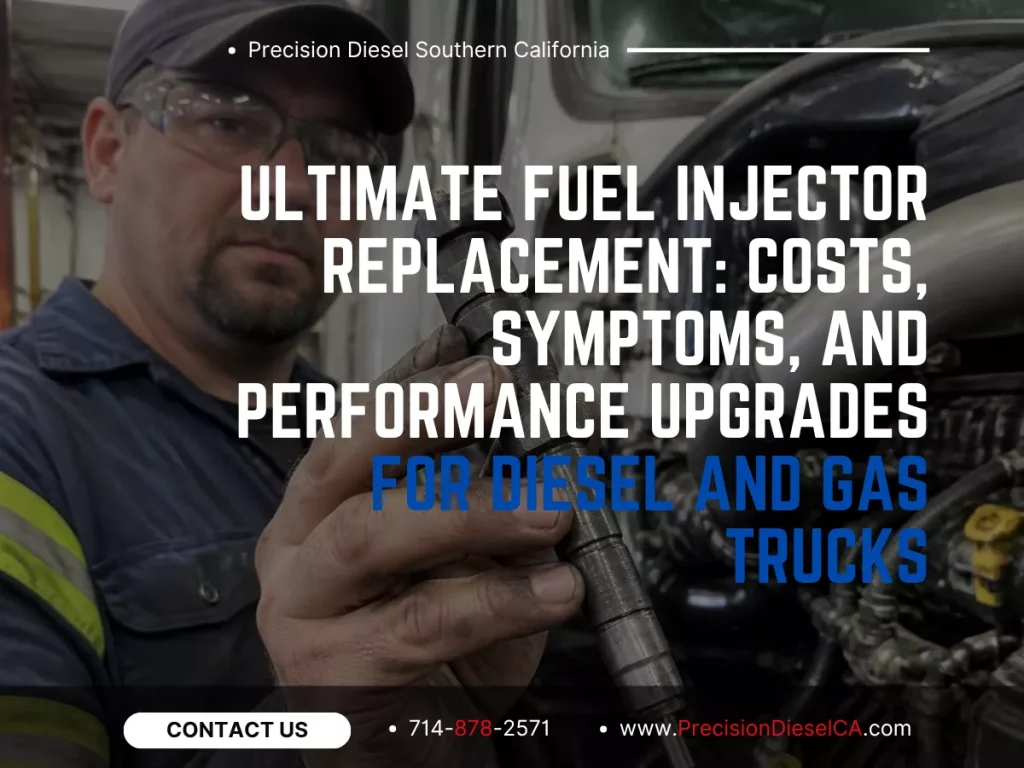
Fuel injector replacement is the process of removing worn or failed fuel injectors and installing new, remanufactured, or performance-grade units to restore proper fuel delivery and engine efficiency. When injectors fail, your engine loses power, burns more fuel, and can produce emissions that push your truck out of compliance.
Key Takeaways
- Fuel injector replacement typically costs between $1,500 and $2,500 for a full set, including labor, though the range shifts significantly by vehicle make and injector type.
- Common warning signs include rough idling, misfires, poor fuel economy, and a check engine light linked to injector-related fault codes.
- OEM, aftermarket, and remanufactured injectors each offer different trade-offs in price, longevity, and warranty coverage.
- Diesel trucks like the 5.9 and 6.7 Cummins benefit measurably from performance injector upgrades when paired with tuning software.
- Fuel quality and preventative maintenance habits directly affect how long your injectors last.
- Fleet operators in Southern California face both mechanical and regulatory pressure when injectors start failing, making early diagnosis critical.
Fuel Injector Replacement Cost: What to Expect by Vehicle Type
The cost of replacing fuel injectors varies widely depending on whether you drive a light-duty gas pickup, a heavy-duty diesel, or a commercial semi truck. Individual injectors typically run between $150 and $500 per unit for standard OEM or quality aftermarket parts. Labor adds significantly to the bill, especially on diesel engines where injectors are harder to access.
For a common gasoline-powered truck like a Chevrolet Silverado 1500, RepairPal estimates the total cost for fuel injector replacement at roughly $353 to $421 per injector, including parts and labor. For a larger SUV like a GMC Yukon, RepairPal’s cost estimate for fuel injector replacement lands in a similar range, typically between $370 and $445 per injector.
A full set replacement on an eight-cylinder engine, once you factor in all injectors plus shop time, can land between $1,500 and $2,500 at a standard repair shop. High-pressure common rail diesel systems, found in commercial trucks and semi trucks, push that number higher, sometimes well past $3,000 depending on injector brand and engine configuration.
| Vehicle Type | Injector Cost (Each) | Typical Full Replacement (8-cyl) |
|---|---|---|
| Gas Pickup (e.g., Silverado 1500) | $150 – $300 | $1,500 – $2,000 |
| Diesel Pickup (e.g., Ram 2500 Cummins) | $250 – $500 | $2,000 – $3,500 |
| Semi Truck / Heavy-Duty Diesel | $400 – $900 | $3,000 – $6,000+ |
| Performance Injectors (upgraded) | $300 – $800 | $2,500 – $5,000+ |
If you manage a fleet in Southern California, you already know that unexpected repair costs compound fast. Understanding semi truck radiator replacement cost alongside injector pricing helps you budget more accurately across your preventative maintenance calendar.

How Fuel Injectors Work and Why They Fail
Fuel injectors are precision solenoid or piezoelectric valves that spray atomized fuel directly into the combustion chamber or intake port at exact intervals and pressures. According to IMARC Group’s Diesel Common Rail Injection System Market report (2025), solenoid injectors held a 63.4% share of the injector type segment in 2025, while piezoelectric variants are gaining traction in high-performance and ultra-low-emission engine configurations.
The direct injection segment held 55% of market share in 2024, driven by its proven ability to enhance fuel efficiency and reduce emissions in gasoline engines, according to GM Insights (November 2024).
Injectors fail for several reasons:
- Carbon buildup: Deposits accumulate on the injector tip over time, especially in direct injection gasoline engines where the tip is exposed to combustion gases.
- Wear on the solenoid or needle valve: High-pressure cycling degrades internal components, causing injectors to drip fuel instead of delivering a precise spray.
- Contaminated fuel: Dirt, water, or low-quality diesel introduces abrasive particles that score internal surfaces.
- Clogged filters: A neglected fuel filter starves injectors of clean fuel flow, accelerating internal wear.
For diesel fleets, reviewing diesel truck repair tips before a problem escalates can prevent a single bad injector from damaging neighboring cylinders or your high-pressure fuel pump.
Recognizing the Symptoms of a Failing Fuel Injector
Catching injector problems early saves significant repair costs. The symptoms are often subtle at first and escalate quickly once one injector fails to the point where combustion is disrupted.
Primary warning signs to watch for:
- Rough idle or engine misfires: If the engine stumbles at idle or shakes under load, an injector may be delivering too much or too little fuel.
- Poor fuel economy: A leaking injector dumps excess fuel into the cylinder. A clogged one forces the ECU to compensate by enriching other cylinders.
- Hard starts or long crank times: Injectors that lose their seal allow fuel pressure to bleed down overnight, making cold starts difficult.
- Black smoke from the exhaust: Common in diesel trucks when injectors are dumping unburned fuel into the combustion chamber.
- Check engine light with specific fault codes: Codes like P0201 through P0208 pinpoint individual injector circuit failures.
- Fuel smell inside the cab or engine bay: A cracked injector body or failed O-ring can leak raw fuel onto hot engine surfaces.
Fleet operators managing multiple vehicles across Los Angeles, Orange County, and Riverside County should treat any check engine light tied to injector codes as an immediate diagnostic priority. Precision Diesel’s mobile diagnostic service can pull fault codes on-site, so your truck stays on the road longer rather than sitting in a shop bay.
OEM vs. Aftermarket vs. Remanufactured Injectors: Which Should You Choose?
One area where many truck owners get tripped up is choosing between injector types. Each option carries different trade-offs in cost, reliability, and warranty.
OEM Injectors come directly from your engine’s original manufacturer or an approved supplier. They match the exact specs your engine was designed around, carry a manufacturer warranty, and require no calibration. The downside is cost: OEM injectors are the most expensive option per unit.
Aftermarket Injectors are manufactured by third parties to match OEM specs. Quality varies significantly by brand. Reputable names in the heavy-duty diesel space include Bosch, Denso, and Delphi (now Phinia). According to GM Insights (November 2024), Bosch, Denso Corporation, and Phinia collectively held 21% of the automotive fuel injector market in 2024, which reflects their dominant position in both OEM supply and aftermarket replacement.
Remanufactured Injectors are used cores that have been cleaned, rebuilt to spec, and tested. They typically cost 30 to 50 percent less than new OEM units and carry a limited warranty. For cost-sensitive fleet operators, reman injectors from a reputable supplier are often the practical choice.
| Injector Type | Cost Level | Warranty | Best For |
|---|---|---|---|
| OEM | High | Full manufacturer | Reliability-critical applications |
| Aftermarket (Bosch, Denso) | Medium | Varies by brand | Balanced cost and quality |
| Remanufactured | Low to Medium | Limited (90 days to 1 yr) | Budget-conscious fleets |
| Performance Upgrade | High | Varies | Power and efficiency gains |
For fleets operating under strict timelines, reading up on the importance of semi truck fleet maintenance provides a broader context for why injector type selection matters long-term.
Performance Fuel Injectors: Real Gains for Diesel Trucks
Beyond replacement, some truck owners choose to upgrade their injectors for measurable performance improvements. This segment has real merit for diesel pickups used for towing, competitive events, or high-load commercial hauling.
5.9 Cummins Performance Injectors: More Torque Without Compromise
The 5.9-liter Cummins, found in Ram 2500 and 3500 trucks from 1998 to 2007, responds exceptionally well to injector upgrades. Performance injectors designed for the 5.9 Cummins increase nozzle flow rate, improve atomization, and work best when paired with a tuner and upgraded lift pump. Common upgrades include 100% over injectors for street/strip builds and stage 2 nozzles for heavy towing applications.
6.7 Cummins Performance Injectors: Maximizing Modern Diesel Output
The 6.7 Cummins, used in post-2007 Ram HD trucks, operates with a more complex high-pressure common rail system. Performance injectors for this engine must be calibrated to the truck’s ECM and typically require a Smarty Touch or EFI Live tune to avoid fuel trim faults. Gains of 50 to 100 horsepower are achievable depending on the injector size, fueling strategy, and supporting modifications.
Why Performance Injectors Make Sense for Working Trucks
The performance injector market is expanding for practical reasons, not just racing applications. The aftermarket replacement segment is gaining relative share as the global diesel vehicle fleet ages and replacement injection demand intensifies, according to IMARC Group’s 2025 report. Better atomization from a high-flow injector reduces unburned fuel, which directly lowers particulate matter output. For fleets in California, that matters.
California truck emissions compliance is not optional for commercial operators, and upgraded injectors that improve combustion efficiency can contribute to cleaner burn cycles alongside DPF cleaning and EGR maintenance.
DIY Fuel Injector Replacement vs. Professional Service
The competitor article skips this entirely. Here is what you actually need to know before deciding whether to tackle injector replacement yourself.
Gasoline engines (port injection): Replacing port fuel injectors is within reach for a mechanically experienced DIYer. The fuel rail is accessible, and the injectors typically unplug and slide out once the rail is removed. The job requires depressurizing the fuel system safely, using new O-rings, and confirming no vacuum leaks post-installation.
Gasoline engines (direct injection): More complex. High-pressure lines require a line disconnect set, and improper removal can damage the high-pressure fuel pump or injector seat.
Diesel and common rail systems: Professional service is strongly recommended. Common rail systems operate at pressures exceeding 20,000 PSI. Injectors must be torqued precisely, and return lines must be reassembled correctly. Many diesel engines also require injector coding, where each injector’s calibration data is entered into the ECM after installation.
For Southern California fleet operators, Precision Diesel offers mobile diesel repair across Los Angeles County, Orange County, and Riverside County. Their technicians carry diagnostic equipment to identify injector-specific fault codes on-site, saving you the cost and downtime of a shop visit. Call (714) 878-2571 to schedule a mobile inspection.
Preventing Injector Failure: Maintenance Habits That Matter
Replacement is expensive. Prevention is cheaper. The automotive fuel injector market surpassed $13.3 billion in 2024, according to GM Insights, largely because injector failures are common. Many of those failures are preventable.
Maintenance practices that extend injector life:
- Use high-quality fuel: Diesel from reputable truck stops with a high Cetane rating reduces injector deposit buildup.
- Change your fuel filter on schedule: For most diesel trucks, this means every 15,000 miles. A clogged filter damages injector internals by forcing debris past precision components.
- Run a fuel system cleaner periodically: Products like Stanadyne Performance Formula or Power Service Diesel Kleen dissolve deposits before they cause flow restriction.
- Address small leaks quickly: A cracked fuel line or failing lift pump puts additional stress on injectors.
- Avoid running the tank to empty: The bottom of a tank collects sediment and water. Frequent low-fuel operation pulls that contamination straight into your injectors.
For additional guidance on keeping heavy-duty trucks running longer, the articles section at Precision Diesel covers a range of fleet maintenance topics relevant to Southern California operators.
Drivers who frequently navigate mountain grades in Southern California should also be aware that high-load descents create unique engine stress. Understanding the role of a runaway truck ramp southern california puts the broader picture of truck safety and drivetrain stress into perspective for long-haul drivers managing heavily loaded rigs.
The Bottom Line on Fuel Injector Replacement
Fuel injector replacement is one of the higher-cost repairs a truck owner or fleet manager will face, but it is also one of the most consequential. Bad injectors do not just hurt performance; they increase emissions, stress surrounding components, and accelerate fuel system wear across the board.
Whether you are replacing a single failed injector on a gas pickup or upgrading to performance units on a 6.7 Cummins for a demanding haul route, the decision requires accurate diagnosis, the right injector type for your application, and proper installation. For commercial operators in Southern California, Precision Diesel’s mobile service eliminates the shop visit entirely. Contact their team at (714) 878-2571 or visit their location at 840 Apollo St #300, El Segundo, CA 90245 to schedule an on-site diagnostic and discuss your injector replacement options.
Frequently Asked Questions
How much does it cost to replace fuel injectors?
The total cost for fuel injector replacement typically ranges from $1,500 to $2,500 for a full set on a standard eight-cylinder engine, including parts and labor.
On a vehicle like a Chevrolet Silverado 1500, individual injector replacement runs roughly $353 to $421 per unit according to RepairPal. Heavy-duty diesel trucks and semi trucks push total costs higher, sometimes exceeding $5,000 for a full set using OEM or performance-grade injectors.
How do I know if a fuel injector is bad?
A bad fuel injector typically shows up as rough idling, misfires, poor fuel economy, black exhaust smoke, or a check engine light with fault codes in the P0201 to P0208 range.
A leaking injector may also produce a raw fuel smell near the engine bay. The most reliable diagnosis involves a professional scan tool and a fuel injector balance test, which measures each injector’s contribution to combustion relative to the others.
Is it worth replacing fuel injectors?
Yes, replacing failed or degraded fuel injectors is worth the cost in most cases, as running an engine on bad injectors accelerates damage to pistons, catalytic converters, and the DPF system.
For diesel trucks still in good mechanical condition, a quality injector replacement restores fuel economy, reduces emissions, and often extends the engine’s service life by eliminating the downstream damage caused by misfires and rich-running conditions.
Can I drive with bad fuel injectors?
You can drive short distances with a mildly failing injector, but it is not advisable, as continued operation risks catalytic converter damage, cylinder wash-down, and engine misfires that worsen quickly.
On diesel trucks, a stuck-open injector can cause hydrolocking if raw fuel floods a cylinder. The safest approach is to treat injector fault codes as a priority repair rather than a deferred maintenance item.
What is the lifespan of a fuel injector?
Well-maintained fuel injectors in a gasoline engine typically last 80,000 to 100,000 miles, while diesel injectors in a properly maintained heavy-duty truck can reach 150,000 miles or more before replacement is needed.
That range shifts significantly based on fuel quality, filter maintenance habits, and operating conditions. Trucks that frequently run near empty, use low-grade diesel, or go extended intervals without fuel filter changes tend to see injector failure well before those benchmarks. The aging global vehicle fleet is one reason the aftermarket replacement segment is growing, as more vehicles accumulate high mileage without the preventative service needed to protect precision fuel system components. Treating injector maintenance as part of a regular service schedule rather than a reactive repair is the most reliable way to reach or exceed the top end of that lifespan range.
Where to Go From Here With Fuel Injector Replacement
Fuel injector replacement is not a repair to delay or diagnose casually. Whether you are dealing with a single misfiring cylinder on a gas pickup or a full set of worn common rail injectors on a commercial semi truck, the cost of inaction compounds fast across your fuel system, emissions equipment, and engine internals. Knowing the symptoms early, choosing the right injector type for your application, and working with a technician who can properly calibrate and code the new units makes the difference between a clean repair and a recurring problem.
For fleet operators and owner-operators across Los Angeles County, Orange County, and Riverside County, Precision Diesel brings the diagnostic equipment and diesel expertise directly to your location. With over 20 years of experience in heavy-duty mobile diesel repair, their team handles injector diagnostics, replacement, and fuel system service without requiring you to pull your truck off a run or sit in a shop waiting room. Call (714) 878-2571 or visit 840 Apollo St #300, El Segundo, CA 90245 to schedule your mobile service appointment today.
