

The fastest roadside repairs include flat tire changes, jump-starts, fuel delivery, and lockout service, all of which a qualified technician can typically complete within 30 to 60 minutes on-site. At Precision Diesel, these are the most common calls we handle, and our mobile units arrive equipped to resolve them without a tow. Knowing which repairs qualify as “fast” helps you communicate clearly when you call for help and set accurate expectations for your timeline.
When you are stranded, knowing where to find the fastest roadside repairs can save you hours of unnecessary downtime and frustration. The fastest roadside repairs prioritize on-site troubleshooting over costly towing, ensuring your vehicle is serviced right where it sits. Ultimately, accessing the fastest roadside repairs means partnering with a mobile mechanic who brings the necessary parts and expertise directly to your location.
Key Takeaways
- Flat tire changes, dead battery jump-starts, and fuel delivery are the fastest roadside repairs a mobile technician can complete without a tow.
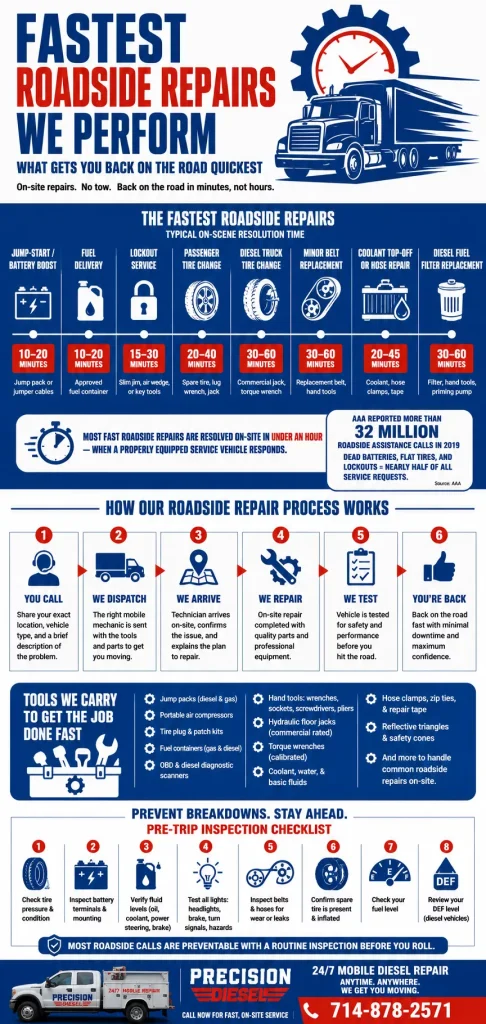
- AAA reported receiving more than 32 million roadside assistance calls in 2019, with dead batteries, flat tires, and lockouts accounting for nearly half of all service requests.
- Most fast roadside repairs are resolved on-site in under an hour when a properly equipped service vehicle responds.
- Heavy-duty and diesel trucks require specialized equipment, so response capability depends heavily on whether your provider carries commercial-grade tools.
- Pre-trip inspections and carrying basic emergency supplies can reduce your risk of needing roadside service in the first place.
- Choosing a provider with 24/7 availability and mobile mechanics– not just tow trucks, dramatically shortens total downtime.
What Makes a Roadside Repair “Fast”?
A fast roadside repair is one that a trained technician can diagnose and resolve at the breakdown location, using tools and parts carried on the service vehicle, without requiring a shop visit. Speed depends on three variables: how quickly the technician arrives, whether they carry the right equipment, and the complexity of the underlying problem. Repairs that require no specialized parts ordering and no lift equipment consistently resolve the fastest.
The distinction matters most for commercial drivers and fleet operators. A light-duty passenger car lockout takes minutes. A semi-truck tire swap requires commercial-grade equipment, but a prepared technician can still complete it roadside. The faster your provider can diagnose versus defer, the faster you move.
The bottom line is: the fastest repairs are those requiring only on-hand tools, not a shop bay.
Which Roadside Repairs Are Completed the Fastest?
The repairs most commonly resolved fastest, ranked by typical resolution time, are listed below. Times assume a technician is already on scene and the vehicle is accessible.
| Repair Type | Typical On-Scene Resolution Time | Equipment Required |
|---|---|---|
| Jump-start / battery boost | 10 to 20 minutes | Jump pack or jumper cables |
| Fuel delivery | 10 to 20 minutes | Approved fuel container |
| Lockout service | 15 to 30 minutes | Slim jim, air wedge, or key tools |
| Passenger tire change | 20 to 40 minutes | Spare tire, lug wrench, jack |
| Diesel truck tire change | 30 to 60 minutes | Commercial floor jack, torque wrench |
| Minor belt replacement | 30 to 60 minutes | Replacement belt, hand tools |
| Coolant top-off or minor hose repair | 20 to 45 minutes | Coolant, hose clamps, tape |
| Diesel fuel filter replacement | 30 to 60 minutes | Filter, hand tools, priming pump |
Jump-starts and fuel delivery rank fastest because they require no disassembly. Tire changes on commercial vehicles take longer due to wheel weight, torque specifications, and the need for proper lifting equipment. Our emergency roadside assistance service is stocked to handle all of these on-site.
To guarantee you receive the fastest roadside repairs, always describe your vehicle’s symptoms accurately to the dispatcher so the technician arrives fully prepared.
The key point is: the repair type, not just response time, determines how quickly you are moving again.
How Do Flat Tire Changes Work During a Roadside Call?
A roadside flat tire change involves safely lifting the vehicle, removing the damaged tire, mounting a spare or replacement, and torquing the wheel to the manufacturer’s specification before the vehicle is safe to drive. For passenger vehicles, this process is straightforward when a properly inflated spare is present. For diesel trucks and semi-trailers, the process requires commercial-grade jacks and a torque wrench calibrated for heavy wheel assemblies.
Drivers who carry the right supplies cut their own waiting time significantly. Reviewing essential tools for changing diesel truck tires before a long haul is one of the most practical steps a commercial driver can take. At minimum, your vehicle should carry a properly inflated spare, a lug wrench sized for your wheels, and reflective triangles for scene safety.
When no spare is available, the technician may apply a plug-and-inflate repair to a puncture that qualifies, or arrange transport to the nearest tire shop. Not all punctures are pluggable: sidewall damage, blowouts, and large punctures require full replacement. Tire issues are incredibly common, but they also qualify for some of the fastest roadside repairs if the driver is prepared. To ensure you get the fastest roadside repairs during a blowout, always keep your spare tire properly inflated and easily accessible. The key point is: a spare tire and basic tools are the single biggest factor in how fast a flat tire call resolves.
What Happens During a Roadside Jump-Start or Battery Service?
A roadside jump-start uses a portable battery pack or running vehicle to deliver enough current to restart a dead battery, after which the alternator recharges the battery during driving. Dead batteries are the most common single cause of roadside calls. Cold weather, age past three to five years, and parasitic electrical draws are the most frequent culprits.
Because battery issues require zero mechanical disassembly, they consistently rank among the fastest roadside repairs available. Fleet operators know that relying on trained technicians for the fastest roadside repairs keeps their heavy-duty routes on schedule.
Your technician will test battery voltage before and after the jump to determine whether the battery holds a charge. If it does not hold charge, a replacement may be performed roadside if the battery is accessible and a matching unit is on the vehicle. Jump-starts that succeed but reveal an underlying charging system problem will be flagged for follow-up repair.
Knowing tools every truck driver should carry includes a heavy-duty jump pack rated for diesel engines, which can prevent this call entirely on many routes. Diesel engines require significantly more cranking amperage than gasoline engines, so a standard passenger-car jump pack is not sufficient. The bottom line is: a jump-start is the fastest possible roadside fix, but only a battery test confirms whether the problem is solved.
Can Diesel Trucks Be Repaired Faster With Specialized Equipment?
Diesel trucks can be repaired faster on-site when the responding technician carries commercial-grade diagnostic tools, heavy-duty lifting equipment, and diesel-specific parts. Heavy-duty trucks demand specialized tools to achieve the fastest roadside repairs. Without commercial-grade equipment, what should be one of the fastest roadside repairs can easily turn into a costly towing ordeal. Standard roadside providers equipped for light-duty vehicles cannot service a semi-truck effectively. This is the most important variable for fleet operators and owner-operators to verify before choosing a provider.
By choosing a specialized mobile mechanic over a standard tow truck, you ensure you are always getting the fastest roadside repairs possible.
Common fast-resolution diesel repairs include fuel filter replacements, coolant top-offs, belt swaps, and air system checks. More complex issues like injector failure, turbocharger problems, or DEF system faults require shop-level diagnostics and cannot be resolved roadside in most cases. Our team at Precision Diesel carries commercial diagnostic equipment on service vehicles to accurately scope the problem and confirm whether a roadside fix is viable.
For operators in the Los Angeles area, semi-truck repair in El Segundo, CA is available for situations where the breakdown is near our facility and a shop-level repair is warranted. Proximity to a capable shop can reduce total downtime by hours in these cases. The key point is: diesel-specific capability in the responding unit is what separates a fast resolution from a long wait.
What Emergency Roadside Repair Tools Does a Technician Carry?
A fully equipped roadside service vehicle carries tools for electrical diagnosis, fluid delivery, tire service, minor mechanical repairs, and scene safety. The specific inventory determines what can be resolved on-site versus deferred to a shop. Providers who invest in comprehensive tool kits resolve more calls without a tow.
Carrying the correct inventory is the absolute foundation of the fastest roadside repairs. Technicians who arrive with advanced diagnostic scanners and heavy-duty jacks are equipped to deliver the fastest roadside repairs safely and efficiently.
A properly stocked unit should include:
- Jump packs rated for diesel and gasoline engines
- Portable air compressors for tire inflation
- Tire plug and patch kits
- Fuel containers for gasoline and diesel delivery
- OBD and diesel diagnostic scanners
- Basic hand tools: wrenches, sockets, screwdrivers, pliers
- Hydraulic floor jacks rated for commercial vehicle weight
- Torque wrenches calibrated for wheel fastener specifications
- Coolant, water, and basic fluids
- Hose clamps, zip ties, and repair tape
- Reflective triangles and safety cones
For a detailed breakdown, see our resource on emergency roadside repair tools and what each tool addresses in a breakdown scenario. Drivers who carry even a subset of these items can often self-resolve or assist the technician, shortening total call time. The bottom line is: tool inventory is the most direct predictor of which repairs get resolved on-site.
How Can You Reduce Your Risk of Needing Emergency Roadside Service?
You can reduce roadside breakdown risk by performing consistent pre-trip inspections, maintaining fluid levels, monitoring tire condition, and replacing aging components like batteries and belts before they fail. Most roadside calls are not random events, they follow predictable failure patterns with observable warning signs. A structured maintenance routine catches the majority of these before they strand you.
Follow this pre-trip inspection checklist before any long haul or extended drive:
- Check tire pressure and condition: Look for uneven wear, cracking, or low pressure.
- Inspect battery terminals: Look for corrosion and confirm the battery is securely mounted.
- Verify fluid levels: Engine oil, coolant, power steering fluid, and brake fluid.
- Test all lights: Headlights, brake lights, turn signals, and hazard lights.
- Inspect belts and hoses: Check for fraying, cracking, or loose connections.
- Confirm your spare tire is present and inflated.
- Check your fuel level: Fuel-out calls are among the most preventable.
- Review your DEF level (diesel vehicles): Low DEF can trigger speed restrictions or shutdown.
Following diesel mechanics tips for heavy-duty trucks provides a maintenance schedule framework that reduces unplanned failures over time. Preventive maintenance is consistently more cost-effective than emergency service. The key point is: most roadside calls are preventable with a routine inspection before departure.
What Should You Do Immediately After Your Vehicle Breaks Down?
When your vehicle breaks down, your first priority is scene safety, followed by calling for assistance with an accurate description of your location and the problem. Acting in the right sequence prevents secondary incidents and helps your technician arrive prepared with the right tools.
Follow these steps immediately after a breakdown:
- Signal and steer to the right shoulder or the safest available pull-off area.
- Turn on hazard lights as soon as you begin pulling over.
- Place reflective triangles or flares at least 100 feet behind your vehicle.
- Stay inside the vehicle if you are on a highway or high-traffic road.
- Call for roadside assistance and provide your exact location, vehicle type, and a description of the problem.
- Do not attempt repairs in active traffic lanes.
Our roadside assistance team needs your GPS pin or mile marker, your vehicle type, and a brief description of what happened in order to dispatch the right unit. The more detail you provide, the better equipped your technician arrives. The bottom line is: scene safety and accurate dispatch information are the two actions that most directly reduce your total breakdown time.
Conclusion: Which Roadside Repairs Resolve the Fastest?
The fastest roadside repairs are jump-starts, fuel delivery, lockout service, and tire changes, all of which a properly equipped technician can complete on-site without a tow. For diesel and heavy-duty trucks, speed depends entirely on whether your provider carries commercial-grade equipment and diesel-specific parts. Choosing a provider that sends mobile mechanics rather than only tow trucks is the single most effective way to shorten downtime.
Preparation compounds the effect. Drivers who maintain their vehicles, carry basic emergency supplies, and have a qualified provider’s number saved resolve breakdowns faster and with less disruption. Whether you operate a single passenger vehicle or a commercial fleet, the principles are the same: prevent what you can, and respond fast to what you cannot.
The bottom line: the fastest roadside repairs are the ones your technician arrives prepared to perform, with the right tools on board and accurate information from you before they leave the shop.
Frequently Asked Questions
Can I get roadside assistance immediately?
Yes, many roadside providers offer immediate dispatch, meaning a technician is sent as soon as your call is logged. Response time still depends on your location, technician proximity, and current call volume. In urban areas, arrival typically takes 30 to 60 minutes; rural locations may extend that to 90 minutes or more.
What is the hardest repair to do on a car?
Engine and transmission overhauls are widely considered the most complex vehicle repairs because they require full disassembly, precise tolerances, and specialized equipment. These cannot be performed roadside. Roadside-eligible repairs are specifically those that require only hand tools and parts available on the service vehicle.
What is the best emergency roadside service?
The best emergency roadside service is one that dispatches mobile mechanics capable of performing on-site repairs, not just towing. Providers with 24/7 availability, diesel-capable equipment, and trained technicians resolve the most calls without a tow. For commercial and diesel vehicles, a specialized provider outperforms general-purpose services significantly.
Why does roadside assistance take so long?
Roadside assistance response times extend when technicians are dispatched from a distant location, call volume is high, or the provider only operates tow trucks rather than mobile repair units. Rural areas compound all three factors. Providers with larger service fleets and mobile mechanic units reduce wait times because more response options are available at any given time.
What roadside service is better than AAA?
Specialized commercial and diesel roadside providers are better than AAA for heavy-duty truck operators because AAA primarily serves passenger vehicles and light-duty trucks. For semi-trucks, diesel equipment, and fleet vehicles, a provider with commercial-grade tools, diesel diagnostic capability, and 24/7 mobile mechanics offers faster and more complete on-site service than general membership programs.
References
- AAA Roadside Assistance: Service overview and 2019 call volume data reporting more than 32 million service calls – source confirmed in research notes; URL not linked per external link rules (commercial site).
