
Commercial truck mechanics are trained specialists who diagnose, repair, and maintain heavy-duty diesel vehicles including semi trucks, box trucks, and tractor-trailers. Choosing the right mechanic, whether shop-based or mobile, directly affects your fleet’s uptime, compliance record, and bottom line.
Key Takeaways
- Mobile commercial truck mechanics eliminate costly tow fees and reduce downtime by coming directly to your yard or breakdown location.
- EGR system failures are among the most common and expensive issues diesel technicians handle on heavy-duty trucks.
- FMCSA compliance and CSA scores are directly tied to how well your maintenance program is managed.
- DOT inspections and BIT inspections require documentation that a qualified diesel mechanic can help you maintain.
- Preventative maintenance schedules are the single most effective way to avoid emergency roadside breakdowns.
- Precision Diesel serves Los Angeles County, Orange County, Riverside County, and surrounding areas with fully mobile repair services.
Why the Right Commercial Truck Mechanic Makes or Breaks Your Fleet
Running a fleet in Southern California is not a simple operation. You are dealing with some of the heaviest commercial traffic in the country, strict California Air Resources Board (CARB) emissions requirements, and roads that push trucks hard every single day. When something breaks down, the clock is running. Every hour a truck sits idle costs money, and depending on your contracts, it can cost you a customer too.
According to the American Trucking Associations, trucking moves roughly 72.5% of all freight transported in the United States. That volume puts enormous strain on vehicles and the mechanics responsible for keeping them operational. The difference between a fleet that consistently meets delivery commitments and one that does not often comes down to the quality of its maintenance program.
What separates a capable commercial truck mechanic from a general auto technician is both training and equipment, and exploring articles about diesel service can deepen your understanding of these distinctions. Heavy-duty diesel engines, air brake systems, emissions control components, and trailer electrical systems require specialized diagnostic tools and hands-on experience that most light-vehicle technicians simply do not have. When you are evaluating who works on your trucks, this distinction matters more than price.
Mobile vs. Shop-Based Repair: A Direct Comparison
The traditional model of diesel repair requires you to schedule downtime, drive or tow your truck to a shop, and wait. That model was designed around shop convenience, not fleet productivity. Mobile repair flips that equation entirely by bringing certified technicians directly to your location.
For a fleet operating across Southern California’s sprawling freeway network, the difference is significant. A breakdown on the 91 freeway in Riverside County or the 710 in Los Angeles County does not wait for a shop appointment. Mobile mechanics can respond to those situations without requiring a costly tow.
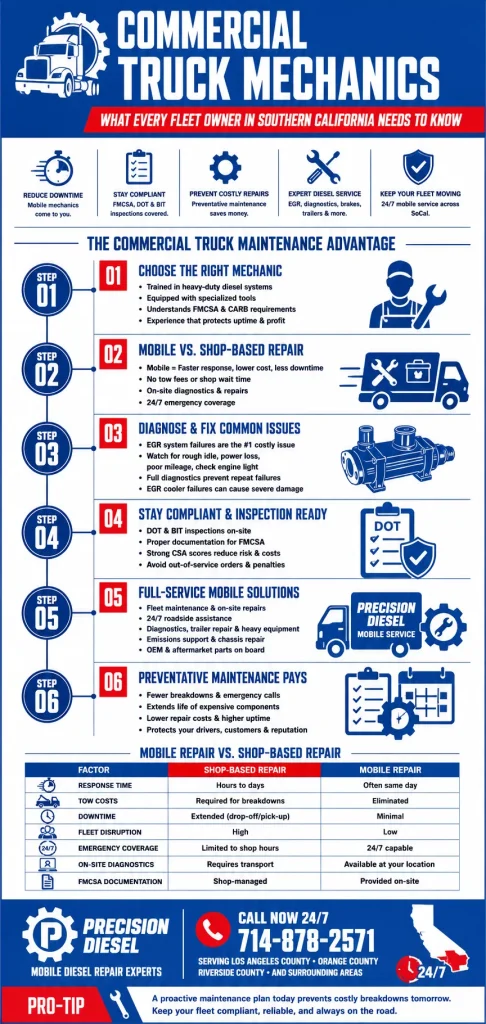
Here is a straightforward comparison of the two approaches:
| Factor | Shop-Based Repair | Mobile Repair |
| Response time | Hours to days | Often same day |
| Tow costs | Required for breakdowns | Eliminated |
| Downtime | Extended (drop-off/pick-up) | Minimal |
| Fleet disruption | High | Low |
| Emergency coverage | Limited to shop hours | 24/7 capable |
| On-site diagnostics | Requires transport | Available at your location |
| FMCSA documentation | Shop-managed | Provided on-site |
Precision Diesel operates as a fully mobile fleet maintenance provider across Orange County, Los Angeles County, and Riverside County. Their technicians carry OEM and aftermarket parts directly on their service trucks, which means common repairs can be completed on-site without waiting for parts to be ordered. For a deeper look at how mobile service affects fleet productivity, the fleet management truck uptime socal resource covers the specific uptime advantages Southern California operators see when they switch to a mobile maintenance model.
The EGR System: The Most Common Problem Commercial Truck Mechanics Face
If you operate diesel trucks built after 2002, the exhaust gas recirculation (EGR) system is one of the components you will deal with most. EGR systems reduce nitrogen oxide emissions by recirculating exhaust gases back into the engine’s intake, but they are also notorious for causing significant performance and reliability problems when they fail.
The symptoms are not always obvious at first. You might notice a rough idle, decreased power, poor fuel economy, or a check engine light that comes on and goes off intermittently, and understanding what you are dealing with before it becomes a full breakdown saves money and prevents further engine damage through resources like bad egr symptoms explained. The bad egr symptoms explained resource breaks down exactly what to watch for in heavy-duty applications.
EGR problems tend to develop from a combination of factors including carbon buildup, coolant leaks, and sensor failures, and diagnosing these root causes is part of any thorough what causes egr valve problems investigation. The what causes egr valve problems page covers the root causes in detail, which is useful if you want to understand why the problem is recurring rather than just treating the symptom each time.
For fleet owners, recurring EGR issues often signal a need to adjust maintenance intervals or reconsider the type of fuel and oil being used, and understanding how diesel service egr problems should be approached is essential. Precision Diesel technicians approach EGR failures with a full diagnostic process rather than simply replacing the valve. If you are dealing with persistent issues, reviewing diesel service egr problems gives you a clear picture of what proper service looks like from a qualified technician’s perspective.
The EGR cooler deserves specific attention in heavy-duty trucks because a failed cooler can introduce coolant into the intake manifold, which is far more destructive than a simple valve failure, making the information in bad egr cooler for heavy duty trucks critical reading. The bad egr cooler for heavy duty trucks page explains the signs of cooler failure and why it requires immediate attention rather than a watch-and-wait approach.
FMCSA Compliance, DOT Inspections, and Why They Cannot Be an Afterthought
The Federal Motor Carrier Safety Administration (FMCSA) sets the standards that govern how commercial trucks are maintained, operated, and inspected across the United States. Your CSA (Compliance, Safety, Accountability) score is a direct reflection of how well your fleet meets those standards, and a poor score has real consequences including audits, increased insurance premiums, and potential operating authority issues.
According to the FMCSA’s official safety guidelines, carriers with high out-of-service rates face significantly greater scrutiny and risk. Preventive maintenance documentation is one of the most important factors in maintaining a strong CSA score.
Precision Diesel’s technicians are trained to support FMCSA compliance as part of their service. This includes DOT inspections that verify your vehicles meet federal safety standards and BIT (Biennial Inspection of Terminals) inspections that ensure commercial motor vehicle compliance without requiring a shop visit. For California operators, BIT inspections are mandatory under the California Highway Patrol’s (CHP) commercial vehicle inspection program.
Having a mobile mechanic handle these inspections on-site eliminates the logistical burden of scheduling shop time across your entire fleet. It also means inspections are documented correctly and filed in a way that supports your overall compliance record.
Things to Know
- EGR system failures are California-specific in terms of frequency because stop-and-go traffic accelerates carbon buildup faster than highway driving.
- A Group 31 battery is the standard for heavy-duty diesel trucks, and battery failures are one of the most common reasons fleets call for emergency roadside assistance.
- Glad hands and airlines on trailers are often overlooked during routine maintenance, yet they are a common source of air brake system failures.
- CARB’s Advanced Clean Trucks regulation is pushing California fleets toward zero-emission vehicles, which means mechanics who understand both diesel and emerging electric drivetrain systems will be increasingly valuable.
- Mobile mechanics can legally perform preventive maintenance, diagnostics, and many repairs roadside, but major structural repairs still require a fixed facility.
- Chassis damage from California’s road conditions, particularly in construction zones and port areas, is more common than most fleet managers account for in their maintenance budgets.
What to Expect From a Full-Service Mobile Diesel Mechanic
Not all mobile mechanics offer the same scope of service. When you are evaluating a provider for your fleet, the range of services available on-site is a critical factor. A provider that can only handle basic oil changes and filter swaps will not be enough when your truck has an electrical fault, a failing turbocharger, or a trailer with a broken landing gear.
Precision Diesel covers a broad service spectrum that includes:
- Fleet maintenance and on-site repairs for commercial and heavy-duty vehicles
- 24/7 roadside assistance for breakdowns and engine failure across Southern California
- Preventative maintenance scheduling to reduce unplanned downtime
- Full diagnostics and check engine light scanning using commercial-grade tools
- DOT inspections and BIT inspections for FMCSA compliance
- Trailer repair including semi-trailer and tractor-trailer work
- Heavy equipment repair for construction and industrial machinery
- Chassis repair and damage assessment
- Emissions testing support for CARB compliance
For fleet managers who want to stay current on best practices and technical developments, you can find regularly updated content covering diesel repair topics relevant to Southern California operators through articles on Precision Diesel’s website.
The Bureau of Labor Statistics notes that diesel service technicians and mechanics earn a median annual wage of around $57,000 nationally, but experienced heavy-duty specialists in high-cost metro areas like Los Angeles routinely command significantly more. That cost is reflected in quality of service, and it is worth paying for the experience level that keeps your fleet compliant and running.
How Preventative Maintenance Reduces Emergency Repair Costs
The math on preventative maintenance is straightforward. Scheduled service visits that catch worn belts, low coolant, degrading injectors, and soft brake pads before they fail cost a fraction of what emergency roadside repairs and towing cost. The NIH National Library of Medicine has published research supporting the broader principle that proactive maintenance systems consistently outperform reactive ones in both cost and reliability across industrial fleet applications.
For a fleet of ten trucks, even reducing emergency breakdowns by two per month can save tens of thousands of dollars annually when you factor in tow fees, driver downtime, missed delivery penalties, and emergency labor rates. Precision Diesel works with fleet managers to build maintenance schedules that align with FMCSA documentation requirements and CARB compliance standards simultaneously, removing the need to coordinate multiple service providers.
Preventative maintenance is also the most effective way to extend the service life of expensive components like turbochargers, fuel injectors, and DPF (diesel particulate filter) systems. Replacement costs for these components in heavy-duty trucks can run anywhere from $1,500 to over $10,000 per unit, making early intervention the obvious financial choice.
Ready to Keep Your Fleet Moving?
Call Precision Diesel directly at (714) 878-2571 to schedule a mobile service visit or request emergency roadside assistance anywhere in Los Angeles County, Orange County, or Riverside County. The single most impactful action you can take for your fleet today is scheduling a preventative maintenance visit before the next breakdown happens on its own.
Frequently Asked Questions
Q: What is the difference between a commercial truck mechanic and a regular auto mechanic?
Commercial truck mechanics are trained specifically on heavy-duty diesel engines, air brake systems, emissions control systems, and the federal compliance requirements that govern commercial vehicles.
A standard auto mechanic’s training focuses on light-duty gasoline and diesel vehicles, which operate under very different systems and regulations. Heavy-duty trucks require specialized diagnostic equipment, a working knowledge of FMCSA standards, and hands-on experience with components that do not exist in passenger vehicles.
Q: How often should a semi truck receive preventative maintenance?
Most heavy-duty semi trucks should receive a full preventative maintenance inspection every 25,000 miles or every three months, whichever comes first.
This interval can vary based on the type of haul, road conditions, and the truck’s age. California operators often need shorter intervals due to stop-and-go traffic patterns that accelerate wear on emissions and cooling systems.
Q: Can a mobile mechanic handle serious engine repairs, or only routine maintenance?
Mobile mechanics with commercial-grade tools and parts inventory can handle a wide range of serious repairs including EGR system service, injector replacement, air brake repairs, and electrical diagnostics.
The scope does have limits. Major engine rebuilds or frame-level structural repairs typically require a fixed facility. However, the majority of breakdown scenarios and scheduled maintenance tasks can be handled on-site.
Q: What does a DOT inspection cover on a commercial truck?
A DOT inspection checks brakes, tires, lights, steering, suspension, fuel system integrity, and driver documentation to confirm the vehicle meets federal safety standards.
There are multiple levels of DOT inspection, with Level I being the most comprehensive. Failing a DOT inspection results in an out-of-service order that prohibits the vehicle from operating until deficiencies are corrected. Staying current on preventative maintenance is the most reliable way to pass without violations.
Q: How quickly can Precision Diesel respond to a roadside breakdown in Southern California?
Precision Diesel offers 24/7 emergency roadside assistance across Southern California, with response capability throughout Los Angeles County, Orange County, Riverside County, and surrounding areas.
Response times vary by location and time of day, but the mobile service model eliminates the need for towing in most breakdown scenarios. Calling (714) 878-2571 connects you directly to their dispatch for emergency situations.
The Bottom Line on Commercial Truck Mechanics
The quality of the commercial truck mechanics you rely on determines how consistently your fleet performs, how well you score on FMCSA compliance reviews, and how much you spend on unplanned repairs versus scheduled maintenance. In Southern California’s demanding freight environment, that choice carries real financial weight every single week.
Precision Diesel provides the kind of full-scope mobile service that fleet operators across Los Angeles, Orange, and Riverside Counties depend on to stay operational. From EGR diagnostics to DOT inspections to 24/7 emergency response, the goal is simple: keep your trucks moving and out of the shop. Contact Precision Diesel at (714) 878-2571 to build a maintenance plan that fits your fleet’s size, schedule, and compliance requirements.
