

A diesel mechanic is a trained technician who diagnoses, repairs, and maintains diesel-powered engines and the heavy-duty vehicles built around them. For fleet operators and truck drivers across Southern California, having fast access to a qualified diesel mechanic is the difference between staying on schedule and losing thousands of dollars in downtime.Regenerate section
Key Takeaways
- Diesel mechanics handle far more than basic engine repairs, covering electrical systems, brakes, ABS modules, emissions compliance, and trailer systems.
- Mobile diesel repair services eliminate the need to tow a vehicle to a shop, saving time and reducing operational costs.
- Preventative maintenance is the most cost-effective strategy for extending the life of any commercial diesel vehicle.
- Knowing whether to repair or replace a diesel engine is a critical financial decision that requires expert assessment.
- FMCSA compliance and DOT inspections are non-negotiable for commercial fleets operating in California.
- Precision Diesel serves Los Angeles County, Orange County, Riverside County, and surrounding areas with mobile repair and fleet maintenance.
The Scope of a Diesel Mechanic’s Work
When most people picture a general diesel mechanic, they think of someone changing oil under a big rig. The reality is considerably broader. A qualified technician working on commercial diesel vehicles deals with complex systems that include turbocharged engines, high-pressure fuel injection, advanced emissions controls, multi-axle braking systems, and onboard computer diagnostics.
According to the U.S. Bureau of Labor Statistics, there were over 290,000 diesel service technicians and mechanics employed in the United States as of the most recent data, with demand projected to remain steady as freight transportation continues to expand. In California alone, the trucking industry moves the vast majority of goods through ports like Long Beach and Los Angeles, which means commercial vehicles here log serious mileage under demanding conditions.
A skilled diesel mechanic in a mobile operation handles:
- Engine diagnostics and check engine light scanning
- Fuel system inspection and injector cleaning or replacement
- Brake system repairs, including ABS module troubleshooting
- Electrical system diagnostics and battery replacement
- DOT inspections and FMCSA compliance checks
- Trailer repair, including glad hands, airlines, and lighting
- Preventative maintenance scheduling and execution
- Emissions system repair to meet California’s strict CARB standards
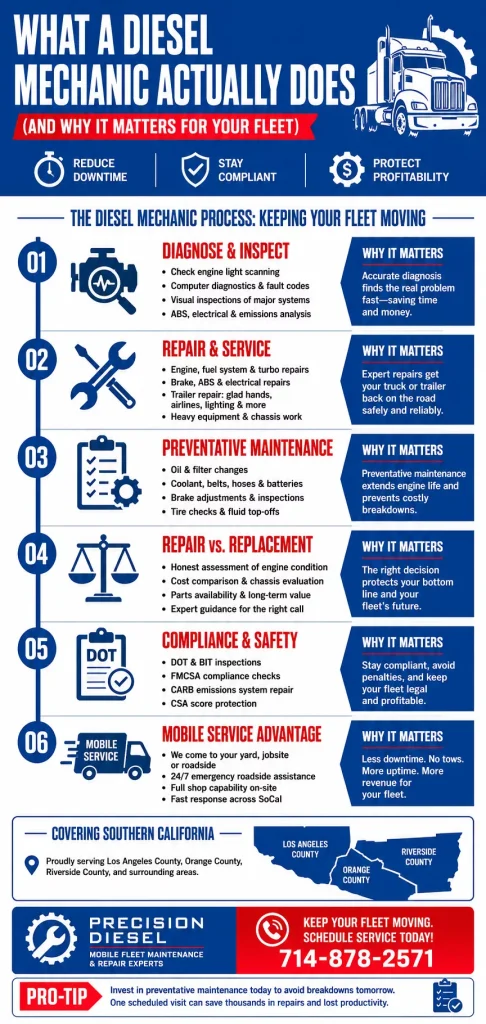
Why Mobile Diesel Repair Changes the Math for Fleet Operators
Traditional repair shops require you to tow or drive a broken vehicle to their location, which is costly, time-consuming, and operationally disruptive. A mobile diesel operation eliminates that friction entirely. The shop comes to your yard, your jobsite, or your roadside location.
Precision Diesel is built around exactly this model. Serving Los Angeles County, Orange County, Riverside County, and surrounding areas, the team functions as a mobile fleet maintenance provider that delivers repairs and scheduled services without requiring drivers to leave the road or yard managers to arrange tows.
For fleet operators managing multiple trucks across Southern California’s busy freeway network, that kind of convenience translates directly into revenue protection. One truck sitting idle in a shop waiting bay can cost a fleet operator anywhere from $500 to $1,500 per day in lost productivity, according to data from the American Trucking Associations.
Precision Diesel covers services including:
- Emergency roadside assistance, available 24/7
- Scheduled preventative maintenance at your location
- Fleet-wide repair and maintenance programs
- DOT inspection and BIT inspection compliance
- Heavy equipment and chassis repair
- Trailer repair for all trailer types
For drivers who want to stay informed between service visits, the articles section on Precision Diesel’s website covers a wide range of practical topics about diesel maintenance and repair.
Preventative Maintenance: The Most Cost-Effective Service Any Diesel Mechanic Provides
Fleet operators who invest in scheduled preventative maintenance consistently spend less on emergency repairs than those who run vehicles until something breaks. This is not a theory; it is a well-documented pattern across commercial trucking operations.
The Federal Motor Carrier Safety Administration (FMCSA) mandates that commercial motor vehicles be systematically inspected, repaired, and maintained. Falling short of these requirements directly affects your CSA score, which has real consequences for insurance premiums, shipper contracts, and your ability to operate legally.
When it comes to routine maintenance decisions, one of the most debated topics is engine oil selection. The choice between conventional diesel engine oils vs the synthetics which is better is something every fleet operator should understand, as the decision affects both engine longevity and maintenance intervals.
Precision Diesel’s preventative maintenance services are designed to keep fleets compliant and operational, addressing:
- Oil and filter changes on schedule
- Coolant system inspections
- Belt and hose condition checks
- Battery testing and Group 31 battery replacement
- Brake adjustment and lining inspection
- Tire pressure and tread depth verification
For fleet managers who want a longer-term strategy, the topic of maximizing diesel engine life covers specific practices that extend engine longevity well beyond industry averages.
Repair vs. Replacement: One of the Hardest Calls in Diesel Maintenance
At some point, every diesel engine reaches a crossroads. A major failure occurs, and the question becomes whether to repair the existing engine or replace it entirely. This decision carries serious financial weight, and it requires honest, experience-based input from a qualified technician.
| Scenario | Repair Recommended | Replace Recommended |
| Engine age under 500,000 miles | Often yes | Rarely |
| Major block damage or cracking | No | Yes |
| Repair cost under 50% of replacement | Yes | Consider carefully |
| Multiple systems failing simultaneously | No | Yes |
| Vehicle has strong remaining chassis life | Yes | Situation-dependent |
| Parts availability is limited | No | Yes |
The decision is rarely simple, and the right answer depends on variables specific to each truck and each fleet’s financial situation. Precision Diesel’s technicians work through this assessment with clients directly, and the detailed breakdown on repair vs replace diesel engine provides a solid framework for thinking through the options before committing.
When a rebuild is the right call, the process involves a structured sequence of teardown, inspection, part replacement, and reassembly. Understanding the diesel engine restoration steps how we do it helps fleet managers set accurate expectations for timeline and cost before work begins.
ABS Modules, Electrical Systems, and the Diagnostics That Modern Fleets Require
Modern commercial trucks are not just mechanical machines. They carry sophisticated electronic control systems that govern braking performance, fuel delivery, emissions compliance, and powertrain operation. Diagnosing faults in these systems requires both computer-based tools and the expertise to interpret what the data means.
One of the more common and frustrating electrical problems fleet operators encounter involves ABS (Anti-lock Braking System) modules on trailers. These failures often show up as persistent warning lights or brake performance inconsistencies that do not resolve with standard brake servicing. The breakdown of 3 common issues with semi trailer abs modules and how we fix them is a useful reference for understanding what causes these failures and what the repair process involves.
According to research published by the National Highway Traffic Safety Administration (NHTSA), brake system failures are among the leading mechanical causes of commercial vehicle accidents in the United States. Keeping ABS systems properly maintained is not just a compliance issue; it is a critical safety matter.
Precision Diesel’s diagnostic services cover:
- Check engine light scanning and fault code interpretation
- ABS module testing and replacement
- Electrical wiring inspection and repair
- Fuel system pressure diagnostics
- Emissions system analysis and repair
Things to Know
- California’s CARB (California Air Resources Board) emissions standards are stricter than federal EPA standards, meaning diesel vehicles operating in the state must meet additional compliance requirements.
- DOT inspections and BIT (Biennial Inspection of Terminals) inspections are two separate compliance requirements for California commercial fleets, and failing either carries significant penalties.
- Mobile repair services typically carry OEM and quality aftermarket parts, so most repairs can be completed on-site without waiting for parts to be ordered.
- A high CSA score (above 65) significantly increases the risk of roadside inspections and can affect your insurance premiums and shipper relationships.
- Not all diesel shops are equipped to handle trailer repair, heavy equipment, and chassis work. Choosing a provider that covers all of these reduces the number of vendor relationships you need to manage.
- The Mayo Clinic notes that diesel exhaust exposure is a recognized occupational health risk, which is one reason proper emissions system maintenance matters beyond regulatory compliance.
Ready to Keep Your Fleet Moving Without the Downtime?
Take one concrete action today: contact Precision Diesel and schedule a preventative maintenance visit for your highest-mileage truck. You do not need to wait for a breakdown to make the call. A single scheduled visit can identify developing issues before they turn into expensive emergencies. Precision Diesel operates across Southern California, covers your yard or jobsite, and brings shop-level capability directly to your fleet.
Frequently Asked Questions
Q: What is the difference between a diesel mechanic and a regular auto mechanic?
A diesel mechanic specializes in compression-ignition engines and the heavy-duty commercial vehicles built around them, which require different training and tools than gasoline-powered vehicles.
Diesel engines operate at higher compression ratios, use high-pressure fuel injection systems, and are subject to emissions regulations that do not apply to most consumer vehicles. Technicians working on commercial trucks also need to understand DOT compliance, fleet maintenance scheduling, and systems like ABS modules and fifth wheels that do not exist on passenger cars.
Q: How much does mobile diesel truck repair cost compared to taking a truck to a shop?
Mobile diesel repair typically costs more per hour than in-shop labor, but the total cost is usually lower once you factor in towing fees, lost operational time, and driver downtime.
For fleet operators, the ability to have a repair completed at the yard means trucks return to service faster, drivers stay on schedule, and there is no towing bill. For emergency roadside situations, mobile service is often the only practical option.
Q: How often should a commercial diesel truck have preventative maintenance?
Most commercial diesel trucks require scheduled maintenance every 15,000 to 25,000 miles, depending on the manufacturer’s specifications, the type of operation, and California emissions requirements.
Heavy-duty applications like dump trucks or concrete mixers may require shorter intervals due to the intensity of their duty cycles. Fleet managers should work with their diesel technician to create a maintenance schedule based on actual operational data rather than a one-size-fits-all calendar.
Q: What should I do if my semi-truck breaks down on a Southern California freeway?
Pull safely to the shoulder, activate your hazard lights, and contact a mobile diesel repair service with 24/7 emergency coverage immediately.
Do not attempt to diagnose or repair the vehicle yourself on a busy freeway. A mobile diesel repair provider like Precision Diesel can dispatch a technician to your location across Los Angeles County, Orange County, and Riverside County without requiring a tow to a shop.
Q: Does Precision Diesel handle trailer repair as well as truck repair?
Yes, Precision Diesel provides mobile trailer repair services covering all trailer types, including semi-trailers, ramp trailers, and specialty equipment.
Services include glad hands, airlines, lighting systems, ABS modules, and structural trailer repairs. Having a single provider handle both truck and trailer work simplifies fleet maintenance logistics considerably.
The Bottom Line on Diesel Mechanic Services in Southern California
Finding a qualified diesel mechanic who can respond quickly, bring the right parts, and handle the full range of commercial diesel systems is genuinely difficult in a market as busy and spread out as Southern California. Precision Diesel is built specifically to solve that problem, operating as a mobile fleet maintenance provider across Los Angeles County, Orange County, Riverside County, and beyond.
Whether you need emergency roadside assistance at 2 a.m. on the I-5, a scheduled preventative maintenance program for your entire fleet, or expert guidance on whether to rebuild or replace a failing engine, the right technician makes all the difference. Review your current maintenance schedule, identify the gaps, and reach out to a provider who can cover your trucks wherever they operate.
