
TL;DR
An 18-speed transmission gives truck drivers precise control over power, torque, and fuel efficiency using an H-pattern, range selector, and splitter. It looks complex but is manageable with practice and rarely requires all 18 gears in normal driving. Mastery comes from smooth clutch use, proper shifting timing, and consistent practice under light loads. Regular maintenance and early issue detection are critical to avoid costly repairs. Mobile diesel mechanics like Precision Diesel Services in Southern California can help with inspections, repairs, and drivetrain issues.
Key Takeaways
- Professional mobile diesel repair services can diagnose shifting or clutch problems quickly
- The 18-speed transmission is built for flexibility, not constant use of all 18 gears
- Core controls include an H-pattern, range selector, and splitter system
- Smooth clutch control and RPM matching are essential for clean shifting
- Most learning comes from practice in low-stress environments with light loads
- You don’t need to use all gears in everyday driving
- Poor shifting habits can cause long-term transmission damage
- Regular maintenance (fluid, clutch adjustment, inspections) prevents breakdowns
Eighteen-speed truck driving may look somewhat overwhelming at first glance. That number “18” alone makes even experienced drivers pause. But here’s the honest truth: it’s most likely not as complicated as you might think. The 18 speed transmission is among the most prevalent manual transmissions in the trucking industry, designed to give you complete control over the performance of your truck. A skilled mechanic diesel mechanic understands how proper gear control directly affects engine strain, fuel efficiency, and long-term drivetrain reliability.
Just think of it as a reliable companion while driving, where you can tackle the different conditions of driving with complete confidence.
We understand the challenges you face as a truck driver. Whether you are a novice or an experienced driver looking to sharpen your skills, mastering the basic H-pattern shifting technique, effective gear-changing techniques, smooth shifting on any road type, and correct transmission maintenance are essential skills. When you learn the proper techniques and practice, those 18 gears change without a second thought. A heavy duty diesel mechanic often sees transmission damage caused by incorrect shifting habits that develop early in a driver’s career.
Understanding the 18-Speed Transmission
The 18-speed transmission may sound like an overly complicated device at first glance, but in essence, it’s actually a pretty simple design. An 18 speed semi transmission is built to handle changing road conditions without making the driver constantly fight for control. Based around a simple H-pattern shifting system at its core, it’s no different than what would be found on most manual transmissions.
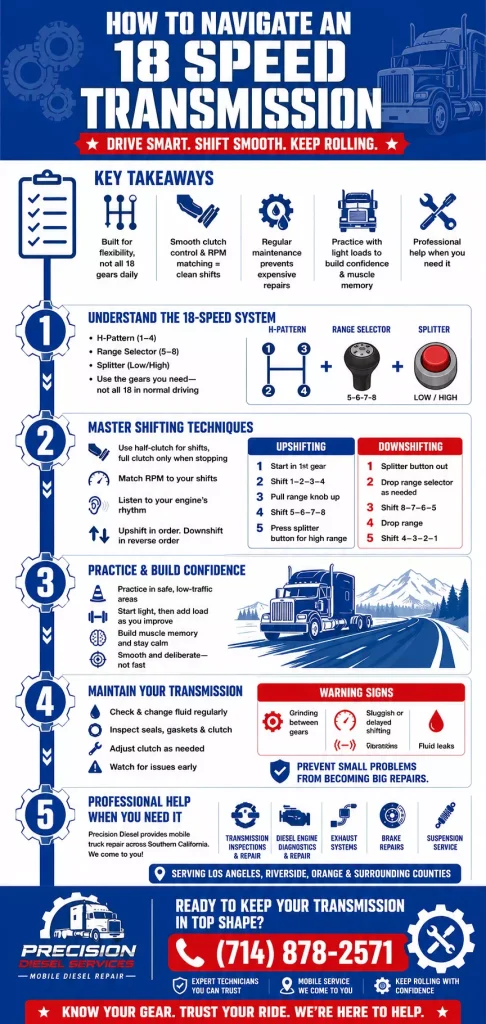
The 18-speed truck transmission shift pattern may look intimidating at first, but learning it step by step ensures smooth and efficient gear changes in any situation. The gear system consists of the main H-Pattern containing the basic 1-2-3-4 gear positions, a Range Knob (black knob) that moves gears 5-6-7-8, and a Splitter Button (grey or red on 13 speeds) that opens up top gear.
Many drivers new to 18-speeds worry about handling all these gears. Just the number “18” can create unnecessary stress and anxiety about the complexity of shifting. Honestly, you’ll rarely need to use all 18 gears in normal driving conditions. Experienced diesel mechanics near you in Southern California can confirm whether unusual shifting patterns are caused by driving technique or internal transmission wear.
The additional gears are meant for special situations, such as negotiating steep grades or dealing with heavy loads. Drivers dealing with performance issues under load often look for a trusted diesel mechanic near me in Southern California to inspect gear wear and clutch response.
What Is an 18 Speed Gearbox and How the Shift Pattern Works
An 18 speed gearbox is a type of manual transmission designed to give drivers maximum control over power, torque, and speed in a heavy-duty 18 speed truck. In simple terms, it allows you to adjust how your truck performs in different driving conditions, whether you’re hauling heavy loads through Southern California freeways or navigating steep grades inland. Drivers operating an 18 speed semi around busy routes like I-710 near the Port of Long Beach or the I-5 freight corridors often rely on those extra gear options to keep power delivery smooth.
The semi truck 18 speed transmission works using a combination of a basic H-pattern, a range selector, and a splitter. Together, these components create the full 18 speed transmission system, giving you more flexibility than standard manual gearboxes. While it may sound complex, the system is built to be logical and predictable once you understand the layout.
The 18 speed shift pattern is based on a familiar H-pattern for gears 1 through 4. The 18 speed shift pattern is essential for quickly building muscle memory and confidence when operating your truck. After that, the range selector allows you to move into higher gears (5 through 8), and the splitter lets you divide those gears further for smoother transitions. This design is what makes the 18 speed truck transmission ideal for handling varying terrain, traffic, and load conditions across Southern California.
For drivers who speak Spanish, the term “trailer de 18 velocidades navegar” generally refers to navigating or operating a truck with an 18-speed transmission. Regardless of language, the goal is the same—smooth shifting, better control, and reduced wear on your drivetrain.
Understanding how the 18 speed shift pattern works visually and mechanically can make a big difference in how quickly you build confidence behind the wheel. A clear 18 speed shift diagram can help you visualize each gear’s position, making it easier to anticipate shifts and reduce errors while driving. Once you get familiar with the pattern, shifting becomes second nature, even in stop-and-go traffic or long highway stretches.
Mastering Shifting Techniques
The clutch pedal mastery involves the half-clutch technique, where halfway down is the clutch pedal when executing normal gear changes. The full-clutch rule applies only when coming to a complete stop. Clutch brake awareness is important, as a full pedal press engages the clutch brake—save this for situations when coming to a stop. A professional semi truck repair shop can quickly identify clutch brake damage that leads to grinding or hard gear engagement.
For upshifting, start in first gear with a smooth clutch release. When ready to shift, press the clutch halfway down, execute the H-pattern to the next gear, and release the clutch smoothly. Proceed with the H-pattern sequence for gears 1–4. At gear 4, pull the range knob up and continue H-pattern for gears 5–8. For top gear, press the splitter button in.
For downshifting, move the splitter button back to normal, drop the range selector as required, and proceed in the reverse order of the H-pattern, maintaining steady clutch control during each gear transition.
Remember to learn clutch coordination at a slow speed! Notice where you can ‘feel’ catch or normal resistance points in your shifter, and make all shifting movements with finesse. Listen to your engine’s rhythm as it guides your timing. When shifting feels inconsistent, many drivers consult semi truck mechanics near me in Southern California for adjustment and calibration of linkage or clutch components.
Your shifting technique will improve with practice, so start with lighter loads while learning, as this transmission design offers plenty of flexibility for various driving conditions.
Understanding how to shift an 18 speed truck transmission is crucial for new drivers, and practicing how to shift a 18 speed truck transmission with light loads helps build confidence before hitting heavy traffic or steep grades.
Practical Tips for Confidently Mastering Your 18-Speed Transmission
Just as with learning to ride a bike, there is a learning curve and an investment of practice time in completely mastering an 18-speed transmission. We recommend you commence practicing in a controlled environment, such as empty parking lots, industrial areas during off-hours, less-traveled highways, and rural roads with sufficiently little traffic.
Start simple by practicing the fundamental H-pattern unloaded, then progress to increasing the weight given the load as experience builds. Practice holding constant speeds while shifting gears and learn downshifting in a safe area. Don’t get frazzled! A calm attitude results in smoother gear shifts. Most drivers are intimidated by the number 18, but you will find you don’t need half of those gears under normal driving circumstances.
Get a feel for the gears through the shift lever – every transmission has its “personality.” Take your time in learning the pattern; speed will come with practice, naturally. Understanding the 18 speed shift pattern visually can speed up muscle-memory development for new drivers.
Start with very light loads so that the shifting becomes second nature. That extra practice matters because an 18 speed semi can feel very different in stop-and-go traffic around Anaheim corridors compared with long highway stretches through the Inland Empire. Consistent practice with your truck 18 speed transmission in different conditions will make the shifting process second nature and reduce stress on long hauls. Routine inspections at semi truck repair shops near me in Southern California help prevent unexpected breakdowns during extended highway operation.
Concentrate on doing it smoothly and deliberately rather than quickly. The sound of your engine will tell you when to shift. Your transmission responds best to calm, methodical shifting. Every semi truck 18 speed transmission responds slightly differently depending on load weight, terrain, and maintenance history. An 18 speed semi moving through areas like Fontana and the Ontario logistics corridor may also react differently during long periods of heavy distribution traffic and frequent gear changes.
When you’re learning, tune out distractions and focus on your gear changes. In time and with practice, you’ll build up muscle memory that makes shifting as natural as walking.
How to Keep Your Truck’s Transmission in Good Shape
The 18-speed transmission of your truck requires periodic maintenance to be able to continue operating well without necessitating major repairs. Essential maintenance practices include regular fluid checks and changes, seal and gasket checks, clutch adjustments and maintenance, and early identification of strange noises or shifting problems. Proper servicing keeps an 18 speed transmission operating smoothly across high-mileage commercial use.
Before purchasing a new truck, check 18 speed manual dump truck transmission reviews to understand performance, reliability, and driver experiences.
Watch for warning signs such as grinding between gears during shifting, sluggish or delayed shifting, excessive vibrations, and fluid leaks. A properly maintained transmission system directly affects your truck’s performance and lifespan. Diesel repair services with a professional will assist you in finding any possible problems before they become major concerns.
How To Shift 18 Speed Peterbilt
Shifting an 18 speed Peterbilt takes control and timing. Start in low gear, use the splitter switch, and shift through each range smoothly while keeping engine RPM steady. Split gears are used for heavier loads and uphill driving, while higher ranges help on open roads. Precision Diesel Services supports drivers across Southern California with guidance on proper shifting techniques for heavy-duty trucks.
How To Shift 18 Speed Transmission Shift Pattern
The 18 speed transmission shift pattern uses an “H” style layout with a range selector and splitter. Low and high ranges double the available gears, allowing fine control over torque and speed. Move through each gear without rushing, and always match engine speed before shifting to avoid grinding. Understanding this pattern improves control on both city streets and highways in Southern California.
How To Drive 18 Speed Truck
Driving an 18 speed truck requires smooth coordination between clutch, throttle, and gear selection. Start slow in lower gears, then shift up as speed increases. Downshift early when approaching stops or steep grades to maintain control. Keep a steady rhythm and avoid skipping gears until fully comfortable with the transmission. Many local drivers improve their skills by practicing on open roads before taking on heavy traffic routes.
How To Race A Manual Car
Racing a manual car focuses on fast, precise gear changes and maintaining high engine power. Launch smoothly, shift quickly at the right RPM, and keep both hands and feet coordinated. Rev matching helps maintain balance during downshifts and prevents loss of speed. Control and timing matter more than force, especially on performance roads where consistency makes the biggest difference.
Professional Help When You Need It
Precision Diesel provides mobile truck repair to Southern California. Our trained technicians travel to Los Angeles County, Riverside County, Orange County, and the surrounding areas. Our services include full-service transmission inspections, diesel engine repair, exhaust systems maintenance, diagnosis, repair, and enhancement, brake repairs, and suspension service. Reach our team for mobile truck repairs for direct service with a mobile truck mechanic, whether you have a diesel or any kind of truck breakdown in your engine. Also, our team can provide guidance on selecting the best truck with 18 speed transmission for your needs.
Mastering Your 18-Speed Transmission
Mastering an 18-speed transmission may seem like a tough job at first, but don’t worry—with practice and the right mindset, you’ll be shifting like a pro. Remember, it’s just like learning to ride a bike. Just relax, feel the gears through the shifter, and use your clutch wisely. The key is treating your transmission with care and maintaining it properly.
Ready to keep your truck’s transmission in top shape? Our professional team at Precision Diesel is ready to help. We bring professional mobile truck repair services right to your location throughout Southern California.
Need professional transmission service or maintenance? Call Precision Diesel today at (714) 878-2571! Your journey toward becoming a professional truck driver starts with knowing your equipment. We’re here to help you every step of the way.
