

TL;DR
FMSCA compliance helps trucking companies operate safely, avoid fines, and maintain a strong reputation through proper vehicle maintenance, driver qualifications, and regulatory adherence. Professional diesel repair and preventative maintenance services play a critical role in keeping fleets roadworthy, reducing downtime, and meeting FMCSA safety standards.
Key Takeaways
- FMCSA compliance sets safety and operational standards for trucking companies.
- Compliance reduces accidents, legal risks, fines, and operational disruptions.
- A USDOT number is required for legal commercial trucking operations.
- New carriers must complete an 18-month monitoring and safety audit process.
- Operating Authority is required for interstate commerce and certain cargo types.
- Preventative vehicle maintenance is essential for FMCSA compliance and road safety.
- Professional diesel repair services help fleets stay compliant and avoid costly breakdowns.
- Certified diesel mechanics can identify and repair issues before they become serious violations.
- Strong compliance practices improve customer trust and business reputation.
- Proactive maintenance keeps trucks on the road longer and improves operational efficiency.
Knowing your way around the trucking industry requires a keen understanding of FMCSA compliance. The Federal Motor Carrier Safety Administration determines that commercial motor vehicles observe the set safety standards. These regulations are crucial in ensuring that our roads remain safe for everyone.
Why FMCSA Compliance Matters
FMCSA compliance is important because it sets a systematic framework that all trucking companies have to follow. This includes guidelines relating to vehicle maintenance, driver qualification, and operational standards. If followed, companies can reduce the rate of accidents, improve road safety, and avoid costly penalties or legal complications.
Benefits of FMCSA Compliance
The big takeaway with FMCSA compliance is that it does this dual duty: safety on the highways and protection of the reputation of trucking companies. Customers and stakeholders alike look upon and treat companies that can repeatedly show their ability to meet FMCSA standards as dependable, responsible, and reliable. That kind of good reputation builds trust, leading to long-term business viability and, in turn, standing out in a competitive market where safety is not just some regulatory imperative but is actually an active business asset. Understanding FMCSA compliance, in essence, places priority on safe truck operations that balance the interests of the company with those of the general public.
Understanding the FMCSA Compliance Regulations
The Federal Motor Carrier Safety Administration, under the guidance of the Department of Transportation, plays a very salient role in the regulation of driving for interstate commerce. The vast regulation includes driver qualification and goes all the way to vehicle maintenance, among others, with the sole aim of preventing accidents or moving goods safely across state lines.
The Need for a USDOT Number
Perhaps the most basic requirement for FMCSA is obtaining a USDOT number. This number serves as a kind of unique identifier for the motor carrier. It is very important for legal operation and serves a variety of purposes:
The USDOT number helps the regulatory body monitor the safety records of a specific carrier and their compliance with federal regulations. In case of an accident or inspection, the number simplifies the process for authorities to access information about the carrier. The agency has ensured that vehicles are easily identified and tracked whenever they operate on the road.
Beyond Legal Compliance: The Broader Impact of FMCSA Regulations
These are not the only regulations; their importance goes beyond legality. Obeying FMCSA guidelines keeps trucking companies safe from facing expensive fines and contributes significantly to road safety. These measures prevent any traffic accidents that may happen because a vehicle breaks down or if a driver lacks the qualities to handle situations effectively. As a result, it secures not just drivers’ lives but also those of other highway users.
The Continuing Effort at Education and Implementation
Understanding these regulations extends far beyond merely filling out paperwork. It involves constant learning about new standards as they change and adherence to them. Trucking companies must stay up-to-date and proactive on-site with current regulations in their daily practices to keep drivers and fleets compliant and safe on the roads.
This commitment to compliance lays the best grounds for exploring further aspects of FMCSA requirements, driver qualification, and vehicle maintenance standards essential for operating a successful trucking business.
Main Elements of FMCSA Compliance
The road to FMCSA compliance has several major components, each designed to ensure that the motor carrier will safely operate its business legally. Detailing these steps provides not only a roadmap for new entrants but also reinforces the critical areas to maintain compliance.
Steps in Registering as a Motor Carrier with FMCSA
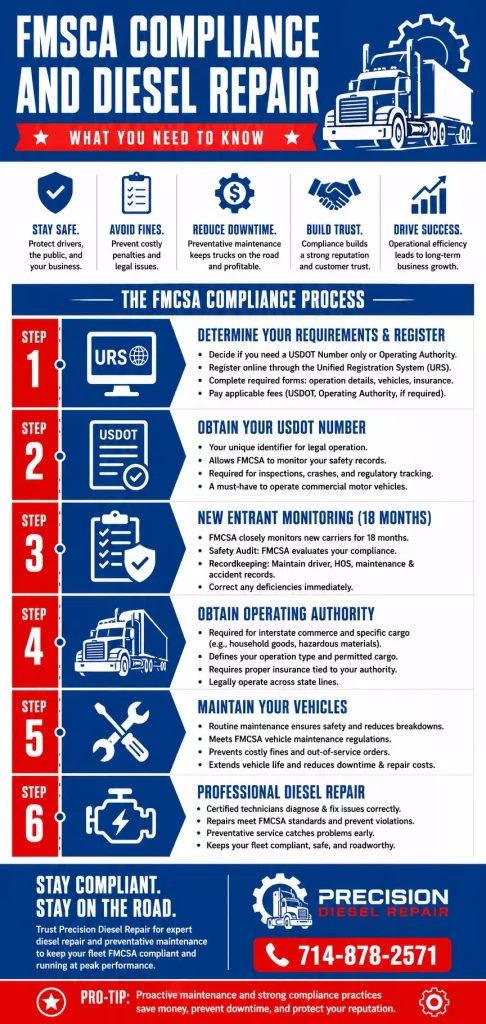
On the road to the world of trucking, the journey into registration via the Unified Registration System—URS, for short—begins online. This online system is your key to the credentials needed to operate as a motor carrier.
- Determine Your Requirements: Before the actual registration process, you have to decide if you will need an Operating Authority or just a USDOT number. This would be based on the type of cargo you will be handling and where you will operate.
- Register with URS: The Unified Registration System streamlines things because you can submit all new carrier registration requirements from one online location.
- Fill out forms: You will be required to fill out the necessary forms in URS, covering your operation description, vehicle information, and insurance information.
- Payment of relevant fees: Registration does not come free, so you need to be prepared to pay the fees, which include but are not limited to the acquisition of the USDOT Number Acquisition and Operating Authorities where applicable.
Overview of the New Entrant Registration Process
Once registered, new motor carriers become subject to the New Entrant Registration program. This is similar to a probationary period of 18 months wherein safety performance will be closely monitored. Requirements include:
- Safety Audit: During this period, FMCSA will conduct an audit to assess compliance with the safety requirements.
- Recordkeeping: Maintain detailed records regarding driver qualification, hours of service, maintenance logs, and accident reports.
- Corrective Actions: Any deficiencies identified from audits must be corrected immediately in order to sustain your registration.
Understanding Operating Authority Under FMCSA Regulations
Operating Authorities are necessary for carriers that engage in interstate commerce or carry particular commodities, such as household goods or hazardous materials. This is the basic operating privilege that defines your operation type and what cargo you would be permitted to carry.
Why is this important?
Once you have obtained Operating Authority, you are legally recognized to operate across states. Due to the nature of requirements, carriers are required to obtain relevant insurance linked to their specific needs for the Operating Authority. There are forms of Operating Authorities corresponding with freight transportation services or passenger transit among others.
The Role of Vehicle Maintenance in FMCSA Compliance
While paperwork and driver qualification play their role in ensuring that your fleet meets the standards for FMCSA compliance, it is also closely interwoven with the physical aspect of your trucks. Routine maintenance is important for several reasons:
- Safety Assurance: Well-maintained vehicles are less likely to experience mechanical failures that may lead to accidents. This, in turn, directly impacts road safety, not just for the drivers but also for other users on the road.
- Regulatory Compliance: Even FMCSA has specific regulations regarding vehicle maintenance that should be met consistently. Non-compliance could attract heavy fines or even out-of-service orders that could truly hurt your business operations.
- Cost Efficiency: With regular preventive maintenance, repairs that are costly and time-wasting can be prevented by detecting the problem when it is still in its infancy. This approach saves not only money but also reduces downtime, allowing your trucks to stay on the road and work productively.
For any trucking company in southern California, access to valuable mobile truck repair services makes all the difference in their success. Their expertise allows for the assurance that vehicles are in conformance with FMCSA standards without wasted time.
How Diesel Repair Services Contribute to FMCSA Compliance
As the tedious nature of FMCSA compliance controls can be overwhelming, professional diesel repair services grant trucking companies the ability to meet even the most extreme standards. You will have the confidence to protect your compliance status and the ability to prolong the life expectancy of your fleet when you hire knowledgeable technicians like ours here at Precision Diesel Repair.
Benefits of Professional Diesel Repair Services
Professional diesel repair services are irreplaceable and indispensable in maintaining compliance with FMCSA regulations. These professionals will ensure that every part of your truck is in great condition, from the engine to the exhaust system. The attention to detail will be instrumental in preventing you from very costly violations that take your trucks off the road and into the shop due to unscheduled repairs.
Certified diesel mechanics have the knowledge to diagnose any problem correctly and conduct the repair in the most efficient way. Knowledge of FMCSA regulations ensures any repair they make is to the letter concerning compliance.
Regular maintenance schedules can help diesel repair services identify potential problems before they become serious, hence minimizing the chances of a fleet being out of compliance due to malfunctioning vehicles. Professional diesel repair services mean investing in the assurance that your fleet will meet all the needed safety standards. In a proactive way, you are avoiding fines and enhancing your company’s reputation as a reliable service provider.
Choose Precision Diesel Repair
Diesel repair services play a leading role in maintaining compliance with FMCSA. Motor carriers that disregard these aspects will most likely suffer from significant fines, disrupted operations, and loss of reputation. Professional diesel repair services have an essential role in maintaining FMCSA compliance since they prepare the vehicle to achieve the minimum requirements necessary to be safe on the highway.
As professionals, we take proactive steps to maintain your truck’s safety from unexpected downtimes and help keep the wheels running with ease. If you’re looking for reliable diesel repair services that have a proper sense of FMCSA regulations, look no further than our team of experts here at Precision Diesel Repair. Our knowledge of both diesel repairs and regulatory requirements will make sure your fleet is compliant and roadworthy.
Ready to take your company’s compliance strategy to the next level? Contact us at Precision Diesel today for expert guidance and top-rated mobile truck repair services throughout Southern California. 714-878-2571
