

TL;DR
Global conflicts and oil supply disruptions are driving up diesel prices and increasing operational pressure for businesses across Southern California. As fuel costs rise, delaying maintenance may seem like a way to save money, but it often leads to reduced fuel efficiency, accelerated engine wear, costly repairs, and unexpected downtime. Preventative diesel service helps fleets and work trucks maintain reliability, control long-term costs, and perform efficiently under demanding local conditions.
Key Takeaways
- Global conflict affects diesel service by increasing fuel costs and operational pressure
- Delayed maintenance often leads to higher long-term repair expenses
- Fuel system efficiency becomes more critical as diesel prices rise
- Preventative diesel service reduces downtime and protects engine performance
- Southern California operating conditions require specialized maintenance strategies
- Consistent service improves reliability for fleets, work trucks, and towing vehicles
Rising global tensions and disruptions in oil supply chains are directly affecting diesel service across Southern California. When conflict impacts fuel production and transportation routes, diesel prices increase, supply chains tighten, and operating costs rise for businesses that rely on trucks, heavy equipment, and fleet vehicles. For companies depending on consistent performance, diesel service becomes a critical factor in maintaining efficiency, controlling costs, and preventing downtime.
In regions like Los Angeles County, Orange County, and Riverside County, where logistics, construction, and transportation drive the local economy, these global shifts are felt quickly. Precision Diesel Services regularly sees how external pressures translate into real mechanical issues, delayed maintenance, and increased strain on diesel engines operating under already demanding conditions.
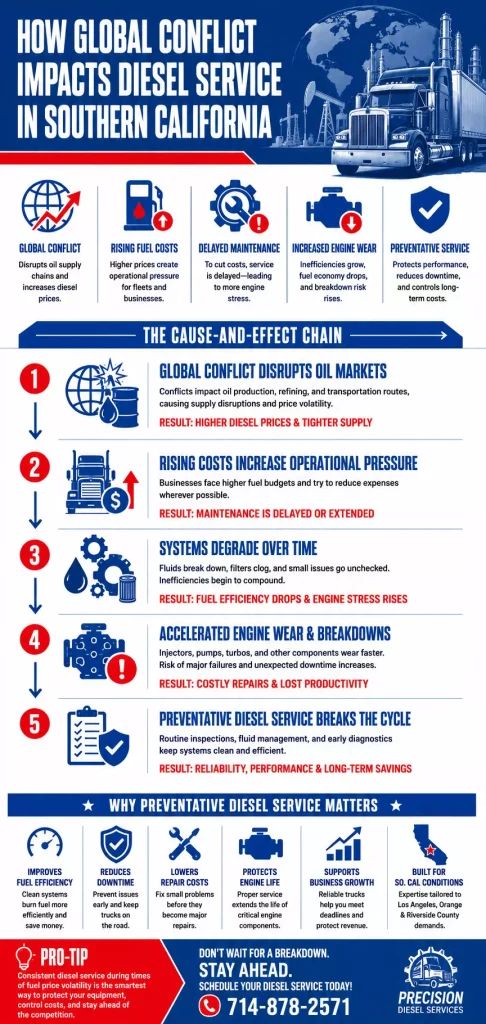
The Cause-and-Effect Chain: From Global Conflict to Engine Wear
Global conflict often disrupts key oil transportation routes and refining operations. This creates immediate instability in fuel pricing and availability. As diesel costs rise, businesses attempt to manage expenses by adjusting operations, which unintentionally places additional stress on vehicles.
This chain reaction typically follows a predictable pattern. Fuel prices increase, forcing fleet operators to extend service intervals or delay maintenance. Trucks stay on the road longer without inspection, fluids degrade beyond optimal limits, and small inefficiencies begin to compound. Over time, this leads to measurable engine wear, reduced fuel efficiency, and a higher likelihood of breakdowns.
In real-world scenarios, a delivery fleet operating across Southern California may begin skipping routine oil analysis or delaying fuel filter replacements to offset fuel expenses. Within weeks, injectors can begin to lose efficiency, combustion becomes less consistent, and fuel consumption increases further. What started as a cost-saving decision ends up increasing total operating expenses.
How Oil Losses and Market Volatility Add Pressure to Diesel Operations
In the week of March 18 to March 20, 2026, Brent crude moved sharply as the market reacted to escalating conflict in the Middle East. Prices settled at $107.38 per barrel on March 18, rose to an intraday high of about $119.13 on March 19, and then eased back toward the $107 range on March 20. For diesel-dependent businesses in Southern California, that kind of volatility creates immediate pressure on fuel budgets, operating costs, and maintenance decisions. Oil losses are not only financial through price spikes and supply disruption. They also happen physically through evaporation, leakage, poor storage conditions, and transport-system issues that reduce usable oil and increase waste.
That matters because when fuel markets tighten, many truck owners and fleet operators delay service or extend maintenance intervals to control short-term costs. In reality, that often creates bigger expenses later. Work trucks, towing vehicles, and jobsite diesel equipment already operate under heavy loads, high heat, and repeated stop-and-go use across Los Angeles County, Orange County, and Riverside County. When degraded lubricants, overlooked leaks, or fluid contamination are left unchecked during a volatile market, efficiency drops and the risk of downtime rises. A more practical response is consistent diesel service that helps catch fluid loss, contamination, and system strain early before those issues turn into larger repairs.
Why Diesel Service Becomes More Important During Fuel Price Spikes
When diesel prices climb, every inefficiency inside an engine becomes more expensive. A minor issue that might have gone unnoticed under stable conditions can now significantly impact operating costs.
Fuel system performance is one of the first areas affected. Dirty injectors, worn pumps, or restricted filters can reduce combustion efficiency, forcing the engine to burn more fuel to produce the same power. This is especially noticeable in work trucks used for towing or hauling, where consistent torque output is critical.
Oil quality also plays a larger role during these periods. Contaminated or degraded oil increases internal friction, causing components to work harder and generate more heat. Over time, this accelerates wear on bearings, pistons, and turbochargers.
Precision Diesel Services often encounters engines where extended oil intervals have led to sludge buildup or contamination. In high-demand environments such as construction sites or long-haul routes, this can quickly escalate into major mechanical failures.
Real-World Impact on Fleets and Work Trucks
In Southern California, diesel trucks are rarely used under light conditions. They are constantly navigating traffic, hauling loads, idling at job sites, and operating in high-temperature environments. These factors already place stress on engine components, and rising fuel costs only amplify the consequences of poor maintenance.
Consider a contractor running multiple diesel trucks across job sites in Riverside County. As fuel expenses rise, the business may try to reduce overhead by postponing service appointments. Over time, one truck develops a clogged EGR system and reduced airflow. The engine begins to lose power, fuel economy drops, and the truck struggles under load. Eventually, it requires a more extensive repair that takes the vehicle out of service entirely.
Downtime in this situation is more damaging than the initial cost of maintenance. Missed deadlines, delayed projects, and lost revenue quickly outweigh any short-term savings.
The Hidden Cost of Delayed Diesel Service
Delaying diesel service rarely results in actual savings. Instead, it shifts costs into the future where they become larger and less predictable.
Engines rely on precise timing, clean fuel delivery, and proper lubrication. When any of these systems are compromised, the entire engine must compensate. This leads to increased strain across multiple components, not just the original problem area.
For example, a neglected fuel filter does not just affect fuel flow. It can cause injectors to work harder, reduce spray efficiency, and alter combustion patterns. This creates additional carbon buildup, which then affects exhaust systems and emissions components. The result is a cascading effect that increases both repair complexity and cost.
Diesel service acts as a preventative measure against this chain reaction. By addressing issues early, businesses can maintain consistent performance and avoid unexpected failures.
Diesel Service Strategies During Uncertain Economic Conditions
When fuel markets are unstable, a proactive approach to diesel service becomes essential. This does not mean increasing costs, but rather optimizing maintenance to protect long-term performance.
Routine inspections should focus on identifying early warning signs. Changes in fuel efficiency, unusual engine noise, or reduced power output are often indicators of underlying issues. Addressing these symptoms early prevents them from developing into more serious problems.
Fluid management is another key factor. Oil, coolant, and transmission fluids must be monitored closely, especially in high-mileage or high-load vehicles. Contamination or degradation in any of these systems can lead to significant mechanical damage if left unaddressed.
Fleet operators in Los Angeles County often benefit from establishing consistent service schedules rather than reacting to problems as they arise. This approach reduces downtime and allows for better planning of maintenance costs.
The Role of Local Diesel Expertise in Southern California
Operating conditions in Southern California are unique. Heavy traffic, long idle times, and high ambient temperatures create an environment where diesel engines must work harder than in many other regions.
Local diesel service providers understand these challenges and can tailor maintenance strategies accordingly. Precision Diesel Services works with trucks that experience stop-and-go traffic in urban areas, extended highway driving between counties, and demanding job site conditions. Each of these scenarios requires a different approach to maintenance and diagnostics.
Having access to experienced technicians who understand regional operating conditions helps ensure that issues are identified accurately and resolved efficiently. This level of expertise becomes especially valuable when external factors such as fuel price volatility are already placing pressure on businesses.
Maintaining Reliability When Every Mile Counts
Reliability is one of the most important factors for any diesel-dependent operation. When fuel costs are high, unexpected breakdowns become even more disruptive.
Consistent diesel service helps maintain engine efficiency, reduce wear, and extend the lifespan of critical components. It also provides an opportunity to identify potential issues before they lead to failure.
For example, early detection of oil contamination can prevent damage to internal engine components. Identifying injector issues can restore fuel efficiency and improve overall performance. Addressing cooling system problems can prevent overheating and costly repairs.
These preventative measures are not just about maintaining equipment. They are about protecting the business operations that depend on that equipment.
FAQ: Diesel Service and Fuel Cost Challenges
How does rising fuel cost affect diesel engines?
Higher fuel costs increase the financial impact of any inefficiency within the engine. Poor combustion, clogged filters, or injector issues lead to more fuel being consumed, raising overall operating expenses.
Should diesel service intervals change when fuel prices rise?
Service intervals should remain consistent or become more proactive. Delaying maintenance during high fuel costs often leads to larger repairs and increased long-term expenses.
What are the most common diesel service issues during economic pressure?
Common issues include fuel system inefficiency, oil contamination, clogged filters, and neglected diagnostics. These problems often result from extended service intervals.
How can fleet operators reduce costs without delaying diesel service?
Focusing on preventative maintenance, monitoring performance changes, and addressing minor issues early can reduce overall costs without increasing risk.
Why is diesel service important for work trucks and towing vehicles?
Work trucks and towing vehicles operate under heavy loads, which increases engine stress. Regular diesel service ensures consistent power, efficiency, and reliability under demanding conditions.