
TL;DR
A kill switch is a vehicle security and safety device that disables a car or truck by interrupting ignition, fuel, or electrical systems. It’s commonly used to prevent theft, protect fleets, and support safe maintenance. Proper installation ensures reliability, while removal or bypassing should be handled carefully to avoid electrical issues.
Key Takeaways
- Kill switches interrupt critical vehicle systems to prevent operation when engaged, offering both safety and security.
- Understanding what is a kill switch helps owners make informed decisions on installation.
- How a kill switch works varies by type, electrical, ignition, or fuel interruption.
- Different types of kill switches range from manual toggles to GPS‑integrated remote systems.
- Knowing where are kill switches located ensures proper accessibility and concealment.
- A kill switch is different from a battery disconnect switch, serving security over simple battery isolation.
- Ignition and fuel cutoff systems are closely tied to how kill switches integrate with modern vehicles.
- Bypassing or removing a kill switch should be done carefully with professional guidance.
From jobsite fleets in Riverside County to heavy‑haul diesel trucks in Los Angeles or Orange County, understanding kill switches for cars and trucks is more than just technical knowledge, it’s about protecting your vehicle, cargo, and business continuity. Regular checks of your kill switch for car systems ensure they remain fully functional and provide consistent protection against theft or accidental startups. Owners often rely on semi truck repair shops near me in Southern California to maintain these critical safety systems and ensure reliable performance.
Whether you operate a single work truck or manage dozens of diesel vehicles, knowing how kill switches function and why they matter can help reduce theft, prevent damage, and ensure a safer, more reliable fleet. A trusted diesel truck shop near me in Southern California can assist with installation and troubleshooting of engine kill switches.
This complete guide dives into what kill switches are, how they work, common types, where they’re located, their differences from battery disconnect systems, and how they integrate with diesel engine ignition and fuel systems. Understanding kill switches for cars helps prevent theft and ensures proper safety integration across both personal and commercial vehicles. Modern kill switch cars come in multiple designs, including manual, automatic, and remote systems for varied applications.
We’ve also included practical examples, frequently asked questions, and insights that only experienced diesel technicians, like the team at Precision Diesel Services in Southern California can provide. Finding a good diesel mechanic near me in Southern California ensures that kill switch installation and maintenance meet professional standards.
What Is a Kill Switch in a Car or Truck?
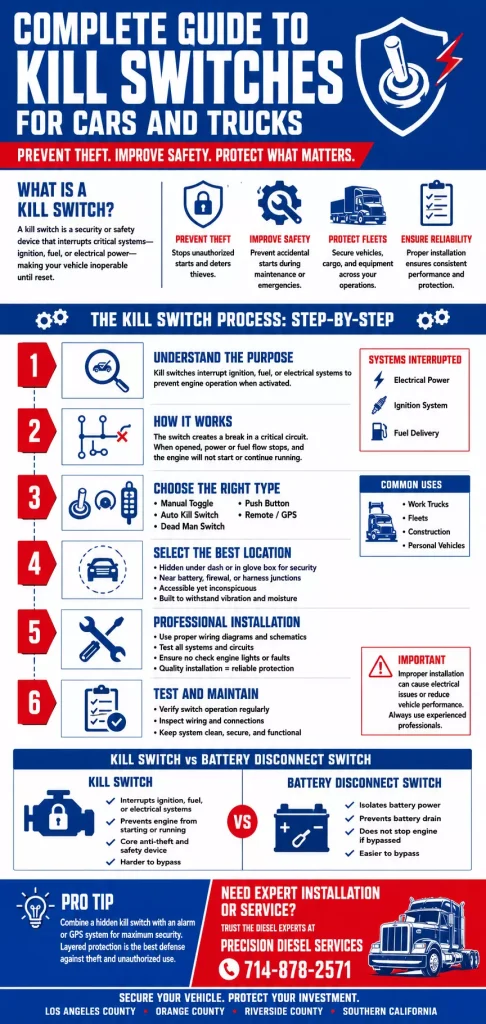
A kill switch is a physical or digital security and safety device that disables a vehicle by interrupting essential systems such as ignition, fuel delivery, or electrical power, making it impossible to start or run without authorization.
When people first hear about kill switches for cars and trucks, they often ask what is a kill switch and whether it’s something only racers or custom builders use. Knowing what is a kill switch is the first step toward enhancing vehicle security and operational safety. Simply put, a kill switch is a device designed to interrupt power or fuel flow to the engine, making the vehicle inoperable unless reset. An automotive kill switch can be customized for different vehicles, from personal cars to diesel work trucks moving through Long Beach port routes or the Inland Empire freight corridors.
A properly installed kill switch for car models can deter theft and provide an emergency shutoff when needed. Choosing the right kill switch for car applications ensures maximum security and reliable operation, especially for vehicles parked in high-risk areas. A killswitch car configuration can be tailored for stealth, ease of use, or integration with existing alarm systems. Selecting the right killswitch for car setups ensures both reliability and minimal visibility to potential thieves. Choosing the right killswitch for car applications depends on whether it’s for security, safety, or both.
Technically, what’s a killswitch in automotive terms is a safety or anti‑theft component that stops critical systems, usually electrical power, ignition, or fuel, from operating. Many vehicle owners ask what is a kill switch in a car; it is essentially a device that prevents engine operation unless intentionally reset. Many people wonder what is a kill switch in a car and how it differs from simple battery disconnect switches.
Essentially, what is a kill switch in a car is a security device designed to prevent unauthorized engine operation by cutting off power, fuel, or ignition. Many vehicle owners ask what does a kill switch do on a car, and the answer is it prevents operation by interrupting essential engine systems. Simply put, it acts as a security and safety measure to stop unauthorized starts or accidental engine operation.
Some truck owners define a kill switch as a hidden shut‑off that keeps thieves from starting the vehicle. Drivers often ask what’s a kill switch and how it functions to protect both personal and commercial vehicles. Many first-time vehicle owners wonder whats a killswitch; it is a simple device that stops the engine or fuel systems when activated. For those new to vehicle security, understanding whats a killswitch clarifies its role as an anti‑theft or safety device.
Knowing whats a killswitch helps drivers recognize its function as a critical safeguard for both personal and commercial vehicles. The kill switch car clarifies that it is primarily a safety and security device designed to stop unauthorized vehicle operation. Others think of it as an emergency safety feature that technicians use to protect equipment during maintenance or after an accident.
The kill switch meaning becomes clearer when you understand that it’s essentially a control point. It acts as a gatekeeper for circuits or systems that are essential to running a vehicle. When the switch is activated, current flow stops, fuel delivery halts, or essential ignition functions disengage.
So what are kill switches? In automotive use, they range from simple toggle switches to advanced remote‑controlled devices integrated with GPS and alarm systems. Kill switches for cars are increasingly popular among fleet owners and daily drivers to prevent theft and accidental engine starts. Interest in kill switch for cars systems has also grown around high traffic areas where stop-and-go driving along the I-5, I-405, and SR-91 can keep vehicles parked for long periods at jobsites and commercial properties. Understanding the variety of kill switches allows vehicle owners to select the system that best fits their security and operational needs.
In the context of diesel service, kill switches are especially valuable because diesel engines, unlike gasoline engines, are often high‑torque, high‑value assets used extensively in commercial work. Installing a kill switch for truck models ensures that heavy-duty engines cannot be started without authorization, protecting expensive equipment. A kill switch for truck applications ensures that heavy-duty engines cannot be started without authorization. A kill switch for a truck becomes even more practical when vehicles regularly handle cargo runs through Fontana, Anaheim, Santa Ana, and busy Ontario logistics routes.
What Is a Car Kill Switch?
Installing a kill switch on a car is one of the most effective and affordable ways to stop vehicle theft before it starts. While modern vehicles come with electronic key fobs and factory alarms, a hidden kill switch on a car physically blocks electrical power or fuel from reaching the engine. Unless someone knows the secret location of the switch, the car simply will not start, leaving potential thieves stranded and unable to hotwire or drive the vehicle away.
Learning exactly how to install a kill switch correctly is the best way to ensure your rig remains fully secure when parked overnight at busy truck stops or supply yards.
A car kill switch is a security and safety device designed to prevent a vehicle from starting or continuing to run by interrupting critical systems such as ignition, fuel delivery, or electrical power. For drivers across Southern California from daily commuters in Los Angeles to fleet operators in Riverside and Orange County, understanding what is a car kill switch helps protect vehicles from theft, unauthorized use, and unexpected engine operation.
In simple terms, a kill switch car setup works by creating a controlled break in one of the vehicle’s essential circuits. When activated, the system disables the engine, making the vehicle inoperable until the switch is reset. This added layer of protection is especially valuable in high-traffic urban areas and job sites where vehicle theft and tampering can occur.
A car kill switch can be installed in different ways depending on the vehicle and use case:
- Hidden toggle or push buttons placed under the dashboard or kick panels.
- Integrated remote systems tied into advanced alarm networks.
- Customized configurations tailored to commercial workloads, environments, and security requirements across Southern California.
A car kill switch can be installed in different ways depending on the vehicle and use case. A kill switch car installation can be a hidden toggle, push button, or remote system depending on the vehicle’s security needs. Some are hidden manual switches placed under the dashboard, while others are integrated into advanced alarm or GPS tracking systems. Choosing a kill switch for car applications depends on whether the priority is security, safety, or convenience. In Southern California’s commercial trucking and construction industries, kill switch car systems are often customized to match the vehicle’s workload, environment, and security requirements.
Understanding what is a car kill switch also helps clarify its role beyond theft prevention. Many drivers and fleet managers use these systems as a safety measure during maintenance or emergencies, ensuring the engine cannot accidentally start while work is being performed. Whether for a personal vehicle or a diesel work truck, a properly installed car kill switch adds both security and operational control. A kill switch for car installations can be especially useful for vehicles making repeated runs through Long Beach, Los Angeles, Irvine, Fullerton, Riverside, and Ontario where traffic congestion often creates long idle periods.
How Does a Kill Switch Work?
To fully understand how kill switch works in a vehicle, we need to break down the mechanics.
At its core, a kill switch acts as a break in an electrical or fuel circuit. Essentially, learning how do kill switches work shows that they function by interrupting electricity, ignition, or fuel flow to immobilize the vehicle. Installing a vehicle kill switch provides an extra layer of anti-theft and safety protection for both cars and trucks. A vehicle kill switch can be critical in preventing unauthorized operation, especially for fleets or high-value vehicles. When the switch is open, the circuit can’t complete, and power can’t flow.
Closed, and everything operates normally. How does a killswitch work helps owners anticipate which systems stop working when the switch is activated. Understanding how does a car kill switch work helps owners anticipate which systems are affected when activated.
Learning how does a car kill switch work ensures that the system integrates seamlessly with ignition, fuel, and electrical circuits without causing malfunctions. Technicians often explain how does a kill switch work on a car by demonstrating which circuits are interrupted during activation. Many vehicle owners want to know exactly how does a car kill switch work before deciding on installation, as it controls critical circuits to prevent engine operation.
Basic Mechanism
Here’s how a kill switch works in automotive systems:
Learning how does a kill switch work on a car ensures proper integration with ignition, fuel, and electrical systems.
- Electrical Circuit Cutoff: A switch interrupts power from the battery to critical circuits.
- Ignition Control: A switch disconnects the ignition system so the engine can’t start.
- Fuel Interruption: A device cuts power to the fuel pump or fuel injector control, stopping fuel delivery.
So when people ask does a kill switch work, the answer is yes, but only for the specific system it’s designed to interrupt. A kill switch car installation can vary from a visible toggle to a hidden remote system, depending on the vehicle type and security requirements. A kill switch car setup can vary from a simple toggle to a sophisticated remote system depending on security needs. A kill switch car setup can also help operators working around the Gateway Cities and South Bay areas where vehicles may sit unattended between deliveries or service calls. An electrical kill switch stops electricity flow. An ignition kill switch stops the engine from firing. A fuel kill stops fuel delivery.
When properly installed, do kill switches work reliably? Some people ask is a kill switch bad for your car; when installed correctly with quality components, it does not harm the engine or electrical system. In most cases, yes, especially when installed with quality components and professional wiring. For Southern California drivers whose trucks face theft risks or harsh work environments, a well‑installed kill switch engine integration adds a layer of security and operational safety.
Examples in Diesel Trucks
In heavy‑duty diesel pickups, common in construction, landscaping, and delivery sectors, kill switches are frequently introduced:
- Between the battery and starter relay.
- Inline with the ignition harness.
- On the fuel pump power circuit so fuel supply can be cut if necessary.
Because heavy duty rigs require precise electrical routing to handle long hauls across Southern California, understanding exactly how to install a kill switch on a diesel engine is a job that demands professional expertise to avoid costly breakdowns on the road.
For Dodge owners, a Dodge diesel mechanic near me in Southern California can provide specialized guidance on ignition and fuel kill switch integration.
That’s why experienced diesel technicians always talk about engine kill switch placement relative to factory wiring, the wrong location can interrupt needed systems or even trigger check engine lights if not installed correctly.
Types of Kill Switches
There’s no one‑size‑fits‑all version of kill switches for cars and trucks. Different applications require different designs. Below are common types and how they differ for daily operating use.
Manual Kill Switch
A manual kill switch is the simplest type. It’s a physically operated device, often a toggle or rocker that you flip to interrupt a circuit. This type is common in fleet vehicles because it provides a straightforward way to secure a vehicle at the end of a shift.
When deciding to put a kill switch on a car, choosing the right style depends on how you use your vehicle and the level of security you need. A daily driver parked on the street might need a simple hidden toggle switch, while a commercial fleet vehicle might require an automated or remote system. Understanding how different types of switches work makes it much easier to select the best kill switch on a car for your specific setup.
Auto Kill Switch
An auto kill switch can automatically engage under certain conditions, such as when the ignition is turned off or a security system is triggered. An auto kill switch adds convenience by engaging without manual input, enhancing both safety and fleet management efficiency. These are integrated into alarm systems or remote vehicle management platforms. A kill switch auto setup is often useful for fleet vehicles traveling between the I-710 freight routes, the Port of Los Angeles, and warehouse zones around Commerce.
On‑Off Kill Switch
This type, sometimes called a rocker kill switch, is common in older or custom installations. It gives a simple on/off control similar to a light switch.
Push Button Kill Switch Car
Less traditional in work trucks, a push button kill switch car is more common in performance vehicles or specialty builds, but it’s gaining popularity with fleet operators who want a less obvious device than a toggle. Performance vehicles like the Dodge Challenger are also common examples where owners explore additional security options. A dodge challenger kill switch setup can be used to add another layer of theft protection by interrupting ignition or starter functions while keeping the vehicle’s factory systems intact.
Remote Kill Switch
A remote kill switch allows you to disable the vehicle from a distance. Some remote models include:
- Kill switch with remote keypad fobs
- Kill switch GPS‑enabled solutions that integrate tracking and disablement
Remote systems are especially useful for theft recovery or if a vehicle is taken without authorization.
“Dead Man” Switch for Car
Although more common in industrial controls, a dead man switch for car refers to safety mechanisms that cut power if a driver leaves the seat or loses control. These are related but distinct from anti‑theft kill switches.
Where Are Kill Switches Located?
Understanding kill switch location is important for both installation and maintenance.
Common Positions
When people ask where are kill switches located in a vehicle, typical answers include:
- Near the battery or firewall
- Under the dash (hidden)
- In the engine bay
- Between fuse boxes and main wiring harnesses
Professional installers consider where to install a kill switch so it’s effective yet inconspicuous. Too visible, and a savvy thief might defeat it. Hidden too well, and even a technician might struggle to service it. Consulting a diesel tech near me in Southern California ensures proper installation and avoids wiring errors.
Best Locations
The best place to put a kill switch depends on your goals:
- Security‑focused installs: Hidden under dash panels or inside glove compartments.
- Maintenance‑friendly installs: Near existing junctions or easy access points without interfering with critical engine harnesses.
- Off‑road or heavy work trucks: Accessible, robust switches that stand up to vibration and moisture.
When drivers ask what does a kill switch look like on a car, it can vary from a tiny sealed button under a kick panel to a rugged toggle switch mounted near the driver’s side footwell.
Kill Switch vs Battery Disconnect Switch
It’s important to clarify how kill switches for cars and trucks differ from battery disconnect systems.
Understanding Battery Disconnect Switches
A battery disconnect switch (sometimes called a car battery kill switch or cut off switch for car battery) is designed to isolate the battery from the vehicle’s electrical system. This minimizes parasitic drain and is often used when vehicles are stored for long periods.
Common names include:
- Shut off switch for car battery
- Car battery on off switch
- Car power main switch
These switches help protect the battery and prevent accessories from draining it but they aren’t true anti‑theft devices on their own.
Kill Switch vs Disconnect Switch
A kill switch interrupts specific systems (ignition or fuel) that stop the engine from starting or running. A battery disconnect simply cuts power at the battery level, which may not stop someone from bypassing it if they know what they’re doing.
While a best car battery disconnect switch can protect battery health, it doesn’t offer the same operational or security benefits of a properly installed kill switch designed to disable the engine itself.
Ignition and Fuel Cutoff Systems
Many questions around kill switches for cars and trucks involve how they interact with ignition and fuel delivery. This category includes devices like:
- Ignition cutoff switch
- Ignition kill switch
- Ignition interrupt switch
- Ignition shut off switch
- Fuel pump switch
- Fuel pump switch anti theft
- Relay cut off switch
- Starter kill
- Fuel kill
- Wiring kill switch
- Ignition kill switch wiring diagram
Advanced Automotive Kill Switch Systems and Vehicle Security Controls in Southern California
Modern diesel and automotive security setups often begin with a car battery on off switch, especially in fleet environments where controlled power isolation improves safety and maintenance efficiency. In marine applications, a boat kill switch types overview is often referenced alongside automotive systems to understand broader shutdown mechanisms. Many technicians group engine kill switches under essential safety controls used across both light-duty and heavy-duty vehicles. The concept of a kill switch ignition remains central in preventing unauthorized engine starts in high-risk areas across Southern California. A properly configured car kill switch supports both theft prevention and operational control for commercial vehicles.
An ignition cut off switch is frequently installed in diesel trucks to support enhanced kill switch car security strategies for fleets operating in Los Angeles and Riverside County. The term kill switch for car is widely used across installation and maintenance discussions in professional diesel repair shops. Different kill switches are selected depending on vehicle type and operational demand. A classic car kill switch is often installed to preserve vintage systems while adding modern protection. Many fleets rely on a car security kill switch to secure vehicles parked overnight at job sites.
A car starter kill switch is commonly wired into ignition systems to prevent unauthorized cranking of the engine. Muscle cars and specialty vehicles often use starter interruption systems because they provide hidden security without changing the appearance of the interior. A properly installed dodge challenger kill switch can help owners protect high-value vehicles that may spend time parked at events, garages, or public locations.
Technicians often install an ignition kill switch to interrupt power flow safely during service or theft prevention scenarios. The ignition or starter cut off switch is used in both commercial trucks and personal vehicles for layered protection. A kill switch alarm integrates audible alerts with engine immobilization for added deterrence. Heavy-duty systems frequently use an engine kill switch to shut down diesel operation instantly when needed.
Fuel system protection may include a fuel kill switch designed to stop engine operation by cutting fuel delivery. A starter kill switch is often paired with alarm systems to block engine cranking entirely. This type of setup is especially relevant for performance vehicles where owners want extra protection without adding visible security equipment. A dodge challenger kill switch installation is usually designed around concealment, reliability, and maintaining normal vehicle operation. Modern vehicles may include ignition kill switches as part of integrated anti-theft packages. Owners adding aftermarket protection to vehicles such as a Dodge Challenger typically focus on solutions that work alongside existing alarms and immobilizers.
A dodge challenger kill switch is one example of an additional security measure that can provide another barrier against unauthorized use. A kill engine switch is sometimes used in emergency shutdown configurations for fleet safety. Technicians refer to a kill switch engine setup when discussing full engine immobilization systems.
A car killswitch is often installed in hidden locations for anti-theft protection. Multiple car kill switches may be used in layered fleet security systems. Broader vehicle kill switches and auto kill switches are common in commercial diesel operations.
Understanding how does the kill switch work helps technicians determine the correct installation point in ignition or fuel circuits. Questions like how to remove kill switch from car often arise during vehicle resale or system upgrades. An auto kill switch may activate automatically based on security triggers or system conditions. A vehicle kill switch can be configured for manual or remote operation depending on fleet needs. Instructions on how to bypass a kill switch are typically addressed only during diagnostic or authorized service procedures.
A kill switch in car setups varies depending on whether the system is ignition-based or fuel-based. A kill switch on car installations can be hidden or integrated into dashboard controls. A starter interrupt device removal process must always be handled carefully to avoid wiring damage. A car alarm with kill switch provides dual-layer protection against theft and unauthorized access. Drivers sometimes explore how to temporarily disable a car from starting during maintenance or diagnostics.
Questions like where is the killswitch on a car depend heavily on vehicle make and installation type. Learning how to put a killswitch in your car requires understanding wiring diagrams and circuit safety. Many users ask what does a kill switch look like on a car, which can range from hidden toggles to integrated electronic modules. The term switches on cars broadly includes ignition, fuel, and safety controls. In automotive security discussions, the killswitch is often referenced as a core anti-theft component.
Professionals often clarify what is a kill switch for a car when explaining theft prevention systems to fleet owners. The phrase what is a killswitch on a car is commonly used interchangeably with ignition interruption systems. Knowing where is the kill switch on a car helps technicians and owners identify installation points quickly. Technical training may include how does a kill switch work on a small engine as a foundational concept. Workshops often teach how kill switch works before advanced diesel integration topics.
Fleet managers frequently install car alarms with kill switches to improve operational security across multiple vehicles. Many new drivers ask what is a killswitch, which refers to any system that disables engine operation. The broader term what is kill switch is used in both automotive and industrial safety contexts.
Ignition Kill Switches
An ignition kill switch interrupts the circuit that sends power to the ignition system. Without it, the spark plugs never fire, and the engine won’t run. or modern performance cars, installation needs to account for factory electronics, security modules, and engine management systems. A dodge challenger kill switch should be integrated carefully so the added security feature works with the vehicle rather than creating electrical issues. In diesel engines, this can be especially effective because the engine depends on controlled combustion without spark plugs.
Fuel Kill & Fuel Pump Switch
A fuel pump switch can interrupt fuel pump power so the engine starves of fuel. In gasoline engines, this stops power quickly. In diesel engines, which often use high‑pressure pumps and filters, cutting the fuel circuit is a reliable way to stop engine operation or prevent it from starting.
When combined with anti‑theft systems, a fuel pump switch anti theft setup can effectively immobilize a vehicle without obvious signs of tampering.
Wiring and Installation
Whether you operate a daily commuter or dispatch a commercial fleet, investing in a proper kill switch car install guarantees your security components will hold up under heavy daily use.
Installing a wiring kill switch requires knowledge of the vehicle’s electrical and ignition schematics. For example, an ignition kill switch wiring diagram helps technicians find the right circuit paths to interrupt without damaging the system or triggering fault codes. Diesel mechanics near me open now can provide immediate assistance if a kill switch malfunctions or needs urgent inspection.
Professionals always test wiring continuity and system behavior before finalizing a kill switch install, especially on complex diesel trucks where multiple controllers and sensors are involved.
Recommended Installation Flow
- Identify the Target Circuit: Determine whether you are interrupting the ignition harness, fuel pump circuit, or starter relay.
- Review Wiring Diagrams: Use an ignition kill switch wiring diagram to find the right circuit paths to interrupt without triggering ECU fault codes or check engine lights.
- Select a Stealth Location: Mount the switch out of sight (e.g., under the dash or kick panel) for anti-theft builds, or accessible for maintenance builds.
- Test Continuity: Technicians always test wiring continuity and system behavior before finalizing the install to ensure reliable operation.
Can You Bypass or Remove a Kill Switch?
Now we address a sensitive but common topic: how to bypass or remove a kill switch.
For vehicle owners considering resale or returning a leased vehicle, questions like:
- How to deactivate kill switch
- How to remove dealership kill switch from car
- How to bypass a kill switch
- How to bypass kill switch
are understandable, but they must be approached responsibly.
Why Owners Want to Remove a Kill Switch
Drivers might want to remove a kill switch if:
- It was installed for security but no longer needed
- It’s causing electrical issues
- A lease or resale requires factory‑as‑built condition
Learning how to remove kill switch on car safely prevents accidental damage to wiring or critical systems. Professionals recommend tracing wiring and labeling circuits carefully before attempting to remove kill switch on car installations.
Risks of Bypassing
Bypassing a kill switch without understanding its purpose can:
- Expose the truck to theft
- Cause unintended electrical faults
- Void warranties
- Create compliance issues in fleets that mandate immobilizers
Professionals approach how to deactivate kill switch by first understanding the vehicle’s electrical layout and ensuring the kill switch hasn’t been integrated into critical systems like the ECU or alarm network.
Responsible Removal
If the kill switch is no longer desired, the safest practice is:
- Trace the kill switch wiring
- Label all circuits
- Restore factory wiring paths
- Test systems thoroughly after removal
This way, you avoid leaving open splices, exposed wires, or weak connections that could cause future problems.
Real‑World Scenarios
To illustrate how critical kill switches for cars and trucks can be, here are actual examples from fleet experience:
Scenario 1: Nighttime Theft Attempt in Orange County
A landscaping company had multiple diesel work trucks parked overnight. Thieves attempted to hot‑wire one truck but were unable to bypass the hidden engine kill switch. The owner was alerted by the alarm system, and the intruders fled before causing damage.
Scenario 2: Jobsite Damage Prevention in Riverside
After a minor collision on a busy construction site, a foreman activated a manual kill switch to cut power and prevent the engine from inadvertently restarting during inspection. This prevented hydraulic and electrical damage.
Scenario 3: Fleet Management in Los Angeles
A large delivery fleet used remote GPS‑integrated kill switches to immobilize stolen vehicles and coordinate with law enforcement. Remote immobilization reduced recovery time and insurance losses.
In all cases, properly understood and installed kill switches for cars and trucks acted as both security and safety components.
By understanding the ins and outs of kill switches for cars and trucks, you gain control over vehicle security, operational safety, and prevent unwanted downtime, especially in demanding Southern California environments where diesel vehicles work hard day after day.
If your fleet or diesel work truck needs inspection, maintenance, or assistance integrating or servicing these systems in Los Angeles County, Orange County, Riverside County or throughout Southern California, call Precision Diesel Services at 714‑878‑2571 for experienced diesel technical support you can trust.
Frequently Asked Questions
What is the difference between a kill switch and a battery disconnect switch?
A kill switch interrupts essential systems like ignition or fuel delivery to prevent the vehicle from running. A battery disconnect switch isolates the battery to prevent drain but does not necessarily stop the engine if bypassed.
Can a kill switch damage my truck?
When installed correctly by experienced technicians with proper wiring and system knowledge, a kill switch will not damage your truck. Poor installation, however, can lead to electrical shorts or faults.
Are kill switches visible?
Some are intentionally hidden for security, while others may be accessible manual switches. Kill switch location depends on purpose and installer discretion.
Is removing a kill switch complicated?
Yes, it requires tracing wiring and restoring factory configuration. It’s best performed by a professional to avoid issues like error codes or unintended electrical problems.
Can a kill switch prevent fuel theft?
Yes, fuel pump cuts help prevent unauthorized fuel usage when integrated with a fuel‑related kill switch.
How to put a killswitch in your car?
A kill switch is an anti-theft device that interrupts a critical system (such as ignition or fuel delivery) to prevent a vehicle from starting. Installing one requires modifying the car’s electrical system, so it’s typically done by a qualified auto electrician or mechanic to ensure safety, reliability, and compatibility with the vehicle.
How to remove a kill switch from a car?
Removing a kill switch involves restoring the vehicle’s original wiring and connections. Because improper removal can cause starting issues or electrical faults, it’s best handled by a professional technician who can safely return the system to its factory condition.
How to temporarily disable a car from starting?
Modern vehicles often include built-in immobilizers or anti-theft systems that can prevent the engine from starting. If you need to secure your own vehicle, using approved anti-theft devices or consulting a professional is the safest and most reliable approach.
How to bypass a kill switch?
Kill switches are specifically designed to prevent unauthorized use. If your vehicle won’t start due to a kill switch issue, the recommended solution is to contact the installer or a qualified mechanic to diagnose and fix the problem safely.
