
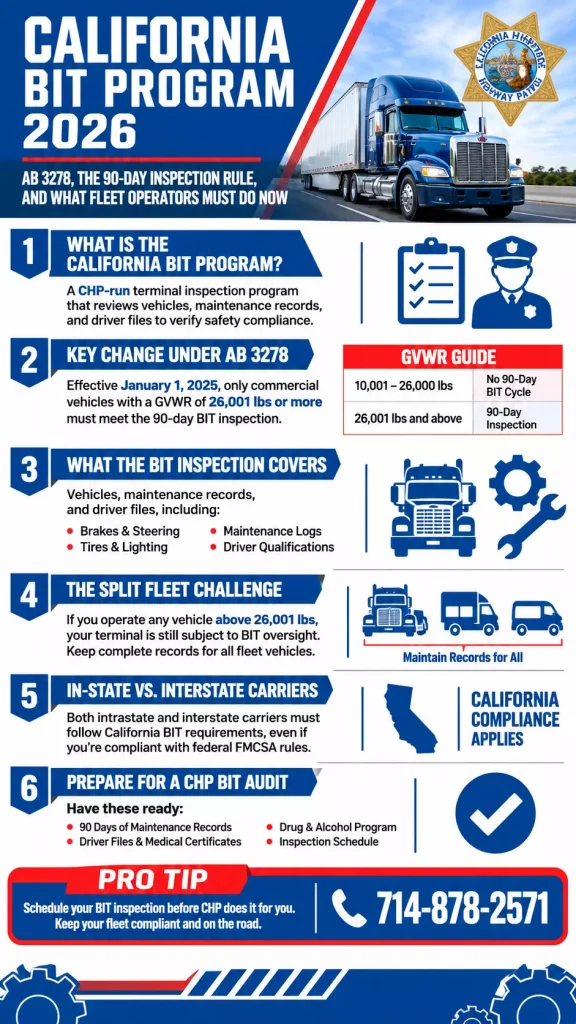
The California BIT Program is a California Highway Patrol (CHP) enforcement initiative that inspects motor carrier terminals, vehicle maintenance records, and driver files to verify safety compliance. Under AB 3278, effective January 1, 2025, the mandatory 90-day inspection requirement now applies only to commercial motor vehicles with a gross vehicle weight rating (GVWR) of 26,001 lbs or more, lifting the burden from lighter vehicles that were previously subject to the rule.
California has long held the most aggressive trucking safety standards in the country. For fleet operators running routes through Los Angeles, Orange County, or the Inland Empire, a failed BIT audit is not a paperwork inconvenience—it can trigger out-of-service orders, elevated safety ratings, and CHP scrutiny that follows a carrier for years.
Who this is for: This article is written for fleet managers, owner-operators, and safety directors running commercial vehicles in California who need to understand what AB 3278 changed and how to stay compliant in 2026.
Not for: Drivers looking for CDL licensing information or carriers operating exclusively outside California jurisdiction.
Key Takeaways
- The California BIT Program is a CHP-run terminal inspection program covering vehicles, maintenance records, and driver files, not just roadside checks.
- AB 3278, effective January 1, 2025, raised the mandatory 90-day BIT inspection threshold to vehicles with a GVWR of 26,001 lbs or more.
- Vehicles between 10,000 and 26,000 lbs are no longer subject to the 90-day BIT inspection requirement under the new rule.
- CHP selects terminals for BIT audits based on safety-performance scores, meaning your data trail matters before the inspector arrives.
- Split fleets (a mix of vehicles above and below the 26,001 lb threshold) create compliance complexity that many carriers underestimate.
- Fatal crashes involving large trucks rose 33% over the last decade (insurance industry analysis, 2022), which is the pressure behind California’s sustained enforcement posture.
What the California BIT Program Actually Covers
BIT stands for Basic Inspection of Terminals. The name is deceptively modest. When a CHP inspector walks into your terminal, they are not just checking tire tread. They are pulling a sample of your vehicles for roadside-style inspections, auditing your maintenance records for completeness and scheduling compliance, reviewing driver files including medical certificates and hours-of-service logs, and verifying your drug and alcohol testing records.
The CHP selects terminals for inspection based on safety-performance scores, which are calculated using out-of-service rates, violation histories, and crash data. If your fleet has had roadside inspection failures in the previous 12 months, your terminal is more likely to land on the inspection schedule. That is not a coincidence. It is an algorithmic selection process designed to concentrate enforcement where the risk is highest.
The California Trucking Association held a 2025 webinar titled “Sailing Through Your BIT” specifically because the program’s scope trips up even experienced carriers. What most operators do not realize is that a deficiency in driver records can produce the same negative outcome as a brake failure on a vehicle inspection. Both categories feed into your safety rating.
For further context on broader safety obligations, reviewing resources on california truck emissions compliance will help you understand how BIT intersects with other CHP and CARB enforcement programs.
Who Is Exempt from the 90-Day BIT Inspection After AB 3278
Before January 1, 2025, the 90-day BIT inspection Los Angeles County requirement caught a wide net. A rule change in 2016 extended the obligation to any commercial vehicle between 10,000 and 26,000 lbs GVWR. That meant delivery vans, light-duty service trucks, and smaller freight vehicles were all subject to the same quarterly inspection cadence as a 40-ton semi.
AB 3278 corrected that. As of its effective date, only CMVs with a GVWR of 26,001 lbs or more must meet the 90-day inspection schedule under the BIT framework. Lighter vehicles, those in the 10,000 to 26,000 lb range, are no longer subject to the mandatory quarterly cycle.
The trade-off is that this relief is narrower than it sounds. If you operate a mixed fleet, any single vehicle at or above 26,001 lbs keeps your terminal subject to BIT oversight. The exemption for lighter vehicles does not eliminate your terminal from the program. It only removes the mandatory 90-day cycle for that specific asset class.
| Vehicle GVWR | Pre-AB 3278 (Before Jan 1, 2025) | Post-AB 3278 (From Jan 1, 2025) |
|---|---|---|
| 10,001 to 26,000 lbs | 90-day BIT inspection required | No mandatory 90-day BIT cycle |
| 26,001 lbs and above | 90-day BIT inspection required | 90-day BIT inspection required |
| Trailers (regardless of weight) | Generally not subject to 90-day rule | Generally not subject to 90-day rule |
| Passenger-carrying vehicles | Separate rules may apply | Separate rules may apply |
For operators running vehicles that now fall below the threshold, the relief is real but do not abandon your maintenance documentation. CHP inspectors can still review records for any vehicle during a terminal audit, even if that vehicle is not on the mandatory 90-day cycle.
2026 BIT Inspection Requirements by Asset Type
The 90-day inspection obligation does not apply uniformly across every asset in your fleet. Here is where the program gets precise.
Power units at or above 26,001 lbs GVWR must receive a full BIT inspection every 90 days. The inspection covers brakes, steering, lighting, tires, coupling devices, exhaust, and suspension, among other items. The checklist mirrors the North American Standard Level I inspection with California-specific additions.
Trailers are a common source of confusion. California generally does not subject trailers to the 90-day BIT inspection mandate in the same way it covers power units. The catch is that trailers can still be pulled into a BIT vehicle inspection during a terminal audit. If a trailer has defective brakes or lighting, that violation counts against your terminal’s safety record even if the trailer was not on a mandatory inspection schedule.
Vehicles between 10,000 and 26,000 lbs are now outside the mandatory 90-day cycle post-AB 3278, but they remain subject to CHP enforcement during roadside stops and terminal audits.
For hazardous materials carriers and passenger-carrying vehicles, separate and often more stringent rules apply. These categories have additional federal and state overlays that BIT inspectors will verify independently.
Proper preventive scheduling is what keeps fleets off the out-of-service list. Reading up on the importance of semi truck fleet maintenance gives you a framework for building that schedule before an inspector sets the agenda for you.
The Split Fleet Problem That Catches Most Operators Off Guard
Here is a pattern that keeps recurring: a carrier runs 15 vehicles. Twelve are Class 8 tractors above 26,001 lbs. Three are medium-duty vehicles at around 20,000 lbs GVWR. After AB 3278, the operator assumes the lighter three are “out of the BIT program” and reduces documentation for them entirely.
That assumption is wrong, and it is the kind of mistake that elevates a routine audit into a formal safety rating review.
Your terminal is still subject to BIT oversight as long as you operate any CMV above the threshold. During an audit, inspectors can and do pull records for any vehicle in your fleet. If your medium-duty vehicles lack complete maintenance logs, that is a deficiency. It does not matter that those vehicles are no longer on a mandatory 90-day cycle.
The practical fix is to maintain consistent documentation standards across your entire fleet regardless of weight class. The 90-day inspection schedule may be legally optional for lighter vehicles now, but clean records protect you from audit findings across the board.
Maintenance surprises are expensive. Something as specific as semi truck radiator replacement cost illustrates how deferred maintenance on a single component can create costs far beyond a scheduled inspection. Catching a marginal cooling system during a 90-day check is cheaper than the alternative.
Interstate vs. Intrastate Carriers: How AB 3278 Applies to Each
This is the section most compliance guides leave incomplete.
Intrastate carriers, those operating solely within California, are fully subject to CHP’s BIT program and the 90-day inspection requirement for vehicles at or above 26,001 lbs GVWR. There is no federal preemption argument available here. California sets the standard, and CHP enforces it.
Interstate carriers, those crossing state lines, are subject to federal FMCSA regulations as their baseline. California still applies BIT requirements to interstate carriers operating in the state, but the intersection between federal and state rules creates a layer of complexity. An interstate carrier whose federal safety rating is “Satisfactory” can still receive a California-specific compliance action if a BIT audit uncovers deficiencies in California-required documentation.
The key point: federal compliance does not exempt you from California BIT obligations. FMCSA and CHP operate separate enforcement tracks. A carrier can be current on all FMCSA requirements and still fail a California BIT terminal inspection.
| Carrier Type | Federal FMCSA Obligation | California BIT Obligation | Key Risk |
|---|---|---|---|
| Intrastate only | Limited FMCSA exposure | Full BIT program applies | No federal safety rating to fall back on |
| Interstate (FMCSA-registered) | Full FMCSA compliance required | BIT applies during CA operations | Dual-track enforcement |
| Household goods movers | CPUC and FMCSA | BIT applies if GVWR threshold met | Multiple regulators simultaneously |
| Hazmat carriers | Additional federal overlays | Enhanced BIT scrutiny | Documentation burden is highest |
For carriers running Southern California routes with specific terrain considerations, runaway truck ramp southern california is worth reading alongside your safety training materials, since brake performance is a primary BIT inspection focus.
What a CHP BIT Audit Actually Looks Like on the Ground
Most carriers picture a BIT inspection as a vehicle walk-around. In practice, the documentation review is where most terminal audits either pass or fail.
An inspector typically requests 90 days of maintenance records for all vehicles subject to the BIT cycle, driver qualification files including medical certificates, drug and alcohol program records, and evidence of your inspection scheduling system. If you use paper logs, every entry must be legible, signed, and dated. If you use digital records, the system must produce a clear audit trail.
The vehicle inspection portion follows the standard CVSA inspection protocol. Brakes are the most common out-of-service finding nationally, and California is consistent with that pattern. Tire conditions and lighting deficiencies follow closely.
What usually trips operators up here is the mismatch between how they talk about their maintenance program and what the records actually show. A carrier might verbally confirm they inspect vehicles every 85 days. But if the records show a 97-day gap between two inspections, that is a violation regardless of intent.
For practical repair and documentation guidance, the diesel truck repair tips resource covers common maintenance items that appear on BIT inspection checklists.
You can also find additional resources and technical articles on the Precision Diesel website covering fleet compliance and mobile repair topics relevant to California operators.
Schedule Your BIT Inspection Before CHP Schedules It for You
California’s enforcement calendar does not send courtesy reminders. If your 90-day inspection window lapses or your records show gaps, the consequences show up in your safety rating, not in a warning letter. Precision Diesel provides mobile BIT inspections across Los Angeles County, Orange County, Riverside County, and surrounding Southern California areas, bringing the inspection to your terminal so your vehicles stay on the road and out of violation. Call Precision Diesel now at (714) 878-2571 to schedule your next BIT inspection or fleet maintenance visit before your compliance window closes.
Frequently Asked Questions
What is the California BIT Program?
The California BIT Program is a California Highway Patrol initiative that conducts terminal inspections of commercial motor carriers, reviewing vehicles, maintenance records, and driver files to verify safety compliance.
CHP selects motor carrier terminals for BIT audits based on safety-performance scores, which factor in prior roadside violations, out-of-service rates, and crash history. During a BIT inspection, a sample of vehicles receives a roadside-style mechanical check, while inspectors simultaneously audit driver qualification files, drug and alcohol program records, and your 90-day maintenance logs. A deficiency in any of these three categories can affect your terminal’s safety rating, which then influences how frequently CHP returns.
How did AB 3278 change the 90-day BIT inspection rule?
AB 3278, effective January 1, 2025, raised the GVWR threshold for the mandatory 90-day BIT inspection from vehicles as light as 10,001 lbs to only those at 26,001 lbs or above.
Before the change, a rule adopted in 2016 had extended the 90-day inspection requirement to all commercial motor vehicles between 10,000 and 26,000 lbs GVWR, pulling a large number of medium-duty fleet vehicles into the same quarterly compliance cycle as heavy Class 8 trucks. AB 3278 reversed that expansion. Vehicles below the 26,001 lb threshold no longer face the mandatory 90-day cycle, but carriers should understand that lighter vehicles are still subject to review during a terminal audit, so maintaining clean records for all fleet assets remains a sound practice.
Are trailers required to have a 90-day BIT inspection?
Trailers are generally not subject to the mandatory 90-day BIT inspection cycle in the same way power units are, but they can still be inspected during a terminal audit and deficiencies will count against your safety record.
The 90-day requirement under the California BIT Program targets commercial motor vehicles, which the regulation centers on power units meeting the GVWR threshold. Trailers do not carry their own GVWR-based inspection mandate under the same provision. The catch is practical: if an inspector conducting a terminal audit pulls a trailer and finds defective brakes, cracked lighting lenses, or a faulty coupling device, those violations feed into your terminal’s compliance record. Treating trailers as outside the BIT program entirely is a risk that experienced carriers avoid.
How long must I keep BIT inspection records?
California requires motor carriers to retain BIT inspection records, including maintenance records and driver files, for a minimum of 18 months.
The 18-month retention window is a floor, not a ceiling. Many carriers keep records for two years or longer to cover potential audit lookback periods and to support any administrative appeals if a CHP finding is contested. Driver qualification files, medical certificates, and drug and alcohol testing records each carry their own specific retention timelines under both California and federal FMCSA rules, and in some cases those timelines extend to three years or more. Keeping all documentation in a single, organized system, whether paper or digital, reduces the risk of a gap being identified during an audit.
What does the California BIT inspection checklist include?
The California BIT vehicle inspection checklist follows the North American Standard Level I protocol with California-specific additions, covering brakes, steering, tires, lighting, coupling devices, exhaust systems, and suspension components.
Brakes are consistently the leading out-of-service finding in California BIT vehicle inspections, followed by tire conditions and lighting deficiencies. Beyond the vehicle itself, the checklist extends to maintenance records confirming that each inspection was completed within the required 90-day window, that defects were documented and repaired, and that a qualified inspector signed off on the work. Driver files reviewed alongside the vehicle inspection include current medical certificates, hours-of-service logs, and evidence of enrollment in a compliant drug and alcohol testing program. Missing or unsigned entries in any of these categories can produce the same compliance finding as a mechanical defect.
The Bottom Line on the California BIT Program
The California BIT Program is not a one-time compliance checkbox. It is an ongoing performance measurement that follows your terminal, your vehicles, and your drivers across every quarter. AB 3278 brought meaningful relief for operators running lighter CMVs, but it did not reduce the documentation standard or the audit intensity for fleets operating heavy equipment. If anything, the regulatory clarity around the 26,001 lb threshold makes it harder to claim confusion as a defense when records are incomplete.
The operators who consistently pass BIT audits share one habit: they treat the 90-day inspection cycle as the minimum acceptable interval, not the target. They keep records that exceed what an inspector requires, and they fix defects before they appear on a CHP clipboard. If your current maintenance process leaves you scrambling to pull records before an audit, that is the gap worth closing first. Contact Precision Diesel at (714) 878-2571 to put a consistent mobile inspection and maintenance schedule in place across your Southern California fleet.
Research Sources
The data and claims in this article were drawn from the following sources, verified 2026.
- California Institute of Technology, Common Data Set 2023-2024, February 2025
- California Board of Registered Nursing, 2024-2025 Annual School Report
- California Climate Investments, 2024 Mid-Year Data Update
- California Department of Child Support Services, Comparative Data for Managing Program Performance, December 2024
- California Bureau for Private Postsecondary Education, 2024 Annual Report Document
- California College of Business, Science and Technology, 2024 Annual Report
