
What causes an Isuzu NPR to lose power? The most common reasons are a clogged diesel particulate filter (DPF), failing fuel injectors, a restricted air intake, or a boost leak in the turbocharger system. Each of these issues reduces the combustion efficiency your NPR’s engine needs to move a load.
That answer is a starting point, not a finish line. The cause hiding in your specific truck depends on mileage, maintenance history, and whether the truck threw a fault code before the power dropped. This article breaks down each root cause with enough specificity to hand to a mechanic or act on yourself by reviewing articles that cover similar diagnostic scenarios.
Who this is for: Owner-operators and fleet managers running Isuzu NPR medium-duty trucks in commercial service, especially those seeing sluggish acceleration, a check engine light, or limp mode activation. Getting reliable isuzu medium duty truck repair starts with pinpointing the exact system holding your rig back so you do not waste money swapping good parts.
Not for: Light-duty pickup owners or anyone looking for general diesel theory with no practical application to the NPR platform.
Key Takeaways
- A clogged DPF is the single most frequent reason an NPR loses power, especially on trucks with high idle time or short urban routes.
- Fuel system failures (injectors, fuel pump, fuel filter) starve the engine of the combustion energy it needs and produce noticeable power loss under load.
- Boost leaks and failed turbocharger components rob the engine of the air pressure required for efficient combustion.
- Limp mode is a protective response, not a malfunction itself. The underlying fault code is what you need to diagnose first.
- California operators face additional compliance pressure because DPF and EGR-related faults can trigger a Clean Truck Check failure, not just a power complaint.
- Mobile diagnostics from a qualified diesel mechanic can isolate the cause on-site, which matters most when your truck goes down mid-route.
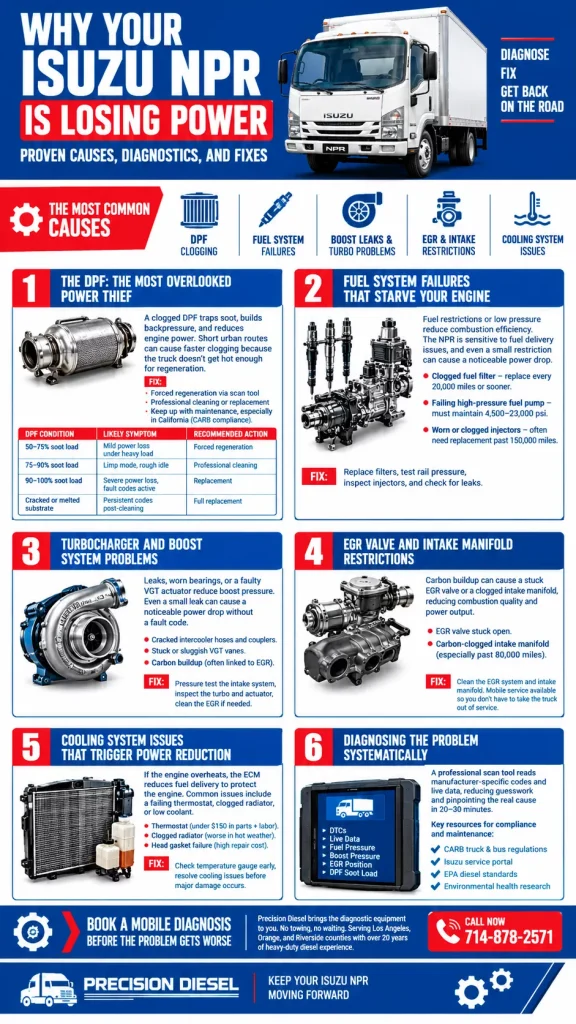
The DPF: The Most Overlooked Power Thief on the NPR Platform
The diesel particulate filter sits in the exhaust stream and traps soot produced during combustion. On the Isuzu NPR’s 4HK1 and 4JJ1 engines, the DPF is designed to self-clean through a process called regeneration. When regeneration fails or cannot complete, soot accumulates until backpressure builds to a level that suffocates the engine.
In practice, this shows up as a gradual loss of power that worsens under load. Drivers often notice it first on freeway on-ramps or when pulling a grade. The truck feels like it is pulling against resistance that was not there before.
What usually trips people up here is the assumption that regeneration is always happening. On NPR trucks running short urban delivery routes (think under 10 miles per trip), the exhaust never gets hot enough to trigger a passive regen. Soot accumulates faster than it burns off. Without scheduled forced regenerations, a DPF can reach 100 percent blockage in far fewer miles than the manufacturer’s regeneration interval suggests.
The fix involves either a forced regeneration using a scan tool or, in serious cases, professional DPF cleaning or replacement. For California operators, this ties directly into california truck emissions compliance requirements under the California Air Resources Board (CARB), which mandates functioning emissions equipment as a condition of operation.
The trade-off with DPF cleaning versus replacement: cleaning costs significantly less, often in the $300 to $600 range depending on the shop, but it does not restore a filter that has cracked internals from excessive heat. Replacement on the NPR platform runs considerably higher when dealing with semi truck radiator replacement cost and other major component work.
| DPF Condition | Likely Symptom | Recommended Action |
|---|---|---|
| 50 to 75% soot load | Mild power loss under heavy load | Forced regeneration via scan tool |
| 75 to 90% soot load | Limp mode activation, rough idle | Professional DPF cleaning |
| 90 to 100% soot load | Severe power loss, fault codes active | DPF replacement |
| Cracked or melted substrate | Persistent codes post-cleaning | Full replacement only |
Fuel System Failures That Starve Your Engine
After the DPF, the fuel system is the next most likely culprit. The NPR’s diesel engine is sensitive to fuel delivery issues, and any restriction or pressure drop between the tank and the injectors will produce a measurable power drop.
Clogged fuel filter: This is the easiest fix and often the most ignored. A partially clogged fuel filter restricts flow, which means the high-pressure fuel pump has to work harder to maintain rail pressure. Under load, the system simply cannot keep up. If your NPR has not had a fuel filter replacement in 20,000 miles or more, start here before anything else.
Failing high-pressure fuel pump: The common rail fuel system on the 4HK1 relies on rail pressure in the range of 4,500 to 23,000 psi depending on load. A weakening pump cannot sustain peak pressure, which means injectors receive less fuel than the engine control module (ECM) commands. The result is lean combustion and power loss that is most obvious at high RPM.
Worn or clogged injectors: Injectors on high-mileage NPR trucks accumulate carbon deposits that affect spray pattern and flow rate. An injector that is not atomizing fuel correctly will cause misfires, rough idle, and reduced power. Some shops perform injector cleaning as a first step, but in practice, injectors past 150,000 miles on a truck that has run lower-quality fuel often need replacement rather than cleaning.
For more practical context on fuel and other system diagnostics, the diesel truck repair tips resource covers common maintenance actions that prevent these failures before they strand your truck.
Turbocharger and Boost System Problems
The turbocharger on the NPR compresses intake air, which allows the engine to inject more fuel and produce more power per combustion cycle. Any reduction in boost pressure, whether from a leaking intercooler pipe, a worn turbo bearing, or a failing variable geometry actuator, translates directly into power loss.
Boost leaks are common on high-mileage NPR trucks. The silicone couplers that connect the intercooler piping crack with age and heat cycling. A crack as small as a few millimeters can dump enough compressed air to cause a noticeable power drop under full throttle. The frustrating part is that a small leak may not trigger a fault code, so the truck simply feels sluggish without any clear warning.
Variable geometry turbochargers (VGT), which the NPR uses, have a second failure mode: a stuck or sluggish vane actuator. When the vanes cannot move freely, the turbo cannot adjust boost across the RPM range. You get a truck that pulls adequately at highway speeds but feels gutless off the line. Carbon buildup on the vanes is the usual cause, and EGR cleaning is often part of the solution since the EGR system is a significant source of the soot entering the intake.
The catch with turbo diagnostics is that a boost leak test requires pressurizing the intake system with the engine off, which takes the right equipment. This is not a roadside diagnosis, and understanding runaway truck ramp southern california safety information demonstrates how power-related issues can compound into broader safety risks on grades and highways.
EGR Valve and Intake Manifold Restrictions
The exhaust gas recirculation (EGR) system routes a portion of exhaust gas back into the intake to reduce NOx emissions. Over time, soot and carbon deposits accumulate in the EGR valve, EGR cooler, and intake manifold. A partially stuck EGR valve that stays open when it should not will dilute the intake charge with exhaust gas, reducing combustion quality and output.
On the NPR’s 4HK1 engine, a carbon-clogged intake manifold is a known issue on trucks past 80,000 miles that have not had the EGR system serviced. The restriction mimics a boost leak in terms of symptoms: reduced power, hesitation under load, and sometimes black smoke.
EGR cleaning is part of Precision Diesel’s mobile service offerings, which matters because this type of service does not require a lift. A qualified diesel mechanic can clean the EGR system at your yard or fleet parking area without taking the truck out of service overnight.
Understanding the importance of semi truck fleet maintenance helps frame why EGR service should appear on a scheduled maintenance checklist rather than a reactive repair list. Waiting until the valve fails adds towing cost and downtime to what would otherwise be a $200 to $400 cleaning job.
Cooling System Issues That Trigger Power Reduction
Diesel engines protect themselves thermally. If the coolant temperature rises past the ECM’s safe threshold, the engine will pull fuel delivery to protect itself. The driver feels this as a sudden or gradual power reduction that correlates with the temperature gauge climbing.
Coolant system problems on the NPR include a failing thermostat, a clogged radiator, or low coolant from a slow leak. A clogged radiator is particularly problematic in Southern California’s summer temperatures, where ambient heat already stresses the cooling system. If you have been tracking your truck’s cooling costs, reviewing semi truck radiator replacement cost data gives you realistic cost benchmarks before you get a shop invoice.
The trade-off on cooling system repairs: a thermostat replacement is relatively inexpensive (under $150 in parts plus labor), but if the root cause is a cracked head gasket causing coolant loss, the repair scope and cost escalate significantly. Catching the symptom early, specifically when you first notice the temp gauge running higher than usual, is far cheaper than addressing a warped cylinder head.
| Cooling Issue | Power Effect | Temperature Gauge Reading |
|---|---|---|
| Failing thermostat (stuck closed) | Moderate to severe power reduction | Overtemperature alarm, rapid gauge rise |
| Clogged radiator | Gradual power reduction under load | Slow climb, worse in stop-and-go |
| Low coolant (slow leak) | Power reduction after extended driving | Climbs above normal operating range |
| Head gasket failure | Severe power loss, white exhaust smoke | Erratic temperature, coolant loss without visible puddle |
Diagnosing the Problem Systematically
The pattern that keeps appearing in real-world NPR diagnosis is this: technicians spend time replacing parts based on symptoms alone instead of reading the fault codes and live data first. The NPR’s ECM stores detailed diagnostic trouble codes (DTCs) that narrow the search considerably.
A professional scan tool (not a basic OBD reader) will read manufacturer-specific codes, show live fuel rail pressure, boost pressure, EGR position, and DPF soot load percentage. With that data, a competent mechanic can prioritize the diagnosis in 20 to 30 minutes rather than guessing across multiple systems. In professional isuzu medium duty truck repair, pulling live engine data saves hours of trial and error and gets your rig back on its route faster.
For fleet operators managing multiple NPR units, resources covering a range of medium-duty diagnostic topics help maintenance managers stay ahead of recurring issues across a fleet and understand when to invest in preventive care.
External resources worth reviewing include the CARB truck and bus regulation overview for emissions compliance context, the Isuzu Commercial Truck of America service portal for OEM maintenance schedules, and the EPA’s diesel emissions standards page for federal regulatory context that affects NPR compliance requirements. The NIH-affiliated environmental health literature also documents why diesel emissions equipment must remain fully functional, which helps explain why California’s enforcement posture is aggressive.
Book a Mobile Diagnosis Before the Problem Gets Worse
If your Isuzu NPR is losing power and you are running routes in Los Angeles County, Orange County, or Riverside County, Precision Diesel brings the diagnostic equipment to your location. No towing, no waiting for a shop appointment. We handle complete isuzu medium duty truck repair right at your yard or roadside so a sudden drop in power does not cost you an entire day of freight.
Precision Diesel’s mobile technicians carry the scan tools, EGR cleaning equipment, and DPF service capability to handle the most common power-loss causes on-site. With over 20 years of heavy-duty diesel experience serving Southern California fleets, they have seen every variation of this problem across the NPR platform.
Call (714) 878-2571 to schedule a mobile diagnostic visit. Your NPR stays on the road, and you get a clear answer about what is causing the power loss before authorizing any repair.
The Bottom Line on What Causes an Isuzu NPR to Lose Power
What causes an Isuzu NPR to lose power comes down to a short list: clogged DPF, fuel system restrictions, boost leaks, EGR carbon buildup, and thermal protection responses from a stressed cooling system. Any one of these can drop your NPR from full performance to limp mode, and more than one can be present at the same time on a high-mileage truck.
Start with a professional scan tool reading. That one step eliminates guesswork and tells you whether you are looking at an emissions system fault, a fuel delivery problem, or a turbo issue. Then call a mobile diesel mechanic who can come to you, read the data on-site, and give you a repair estimate before anything is disassembled.
Frequently Asked Questions
What are some common problems with ISUZU NPR trucks?
The most common NPR problems include DPF clogging, EGR valve carbon buildup, injector wear, and cooling system failures, especially on trucks used for urban delivery with frequent short trips.
These issues stem from the combination of a sophisticated emissions system and the duty cycles that medium-duty delivery trucks typically run. Regular DPF regeneration intervals and EGR cleaning are the most effective preventive measures. Ignoring either will lead to power loss and eventually limp mode.
Why is my truck losing power when I press the gas?
Pressing the gas and feeling no response usually points to a fuel delivery restriction, a boost leak, or a DPF that is too clogged to allow normal exhaust flow.
The ECM controls fueling based on sensor inputs, and if boost pressure, fuel rail pressure, or exhaust backpressure falls outside normal parameters, the ECM limits fuel delivery to protect the engine. A professional scan tool will show which sensor reading is out of range and guide the diagnosis from there.
How to get an Isuzu NPR out of limp mode?
Clearing the fault code that triggered limp mode is the only reliable way to exit it, and that requires addressing the underlying problem, not just resetting the ECM.
Some drivers clear codes with a basic reader and get temporary power restoration, but the truck will return to limp mode if the fault condition still exists. A forced DPF regeneration using a dealer-level scan tool resolves limp mode in many cases, but injector or turbo faults require the relevant repair before the ECM will allow full power again.
How many miles will an Isuzu NPR last?
A well-maintained Isuzu NPR can reach 250,000 to 300,000 miles, with some 4HK1-powered trucks reportedly exceeding that on fleets that followed strict oil change and DPF maintenance schedules.
The engine itself is mechanically durable, but the emissions system components, particularly the DPF and EGR valve, require consistent servicing to avoid failures that cascade into engine damage. Maintenance history is the single biggest predictor of longevity on these trucks.
What is the most reliable Isuzu engine?
The 4HK1-TC, a 5.2-liter turbocharged diesel used in the NPR and NQR, is widely regarded as the most reliable engine in Isuzu’s commercial truck lineup when properly maintained.
It has a long service record in North American fleets and benefits from strong parts availability through Isuzu Commercial Truck of America dealers. The trade-off is that the emissions hardware on post-2007 versions requires more active maintenance than the older pre-DPF engines, but the core engine architecture is proven and durable.
Schedule Your Mobile Diesel Diagnosis Across Southern California Today
Your Isuzu NPR does not have to sit in a shop bay waiting for a diagnostic slot that is days away. Precision Diesel deploys mobile diesel mechanics directly to your location across Los Angeles County, Orange County, Riverside County, and surrounding areas, so your truck gets diagnosed and repaired where it sits, whether that is your fleet yard, a job site, or a delivery stop.
With over 20 years of heavy-duty diesel experience and the scan tools, DPF service equipment, and EGR cleaning capability to handle the most common NPR power-loss causes on-site, Precision Diesel keeps your fleet moving instead of parked.
Call (714) 878-2571 right now to book a mobile diagnostic visit and get a clear answer about what is causing your NPR’s power loss before a single part is replaced.
