

Isuzu hot weather maintenance refers to the adjusted service intervals, fluid checks, and cooling system protocols that keep your truck running safely when temperatures climb. In Southern California, where summer heat regularly exceeds 100°F inland and high ambient temps persist year-round, skipping these steps puts your engine, DPF, and drivetrain at serious risk.
Key Takeaways
- Extreme heat accelerates coolant, oil, and transmission fluid degradation faster than standard intervals account for.
- Your cooling system is your first line of defense: inspect hoses, the radiator cap, and coolant concentration before every hot season.
- Diesel Particulate Filter (DPF) clogging happens faster when your engine runs hot and under heavy load, monitor regen cycles closely.
- Shortening oil change intervals during sustained high-heat operations protects your engine from premature wear.
- Mobile fleet maintenance services like Precision Diesel can service your Isuzu at your yard or job site, eliminating costly downtime.
- Fleet operators who document maintenance intervals are better positioned for DOT and FMCSA compliance inspections.
Why Southern California Creates Unique Heat Stress for Isuzu Trucks
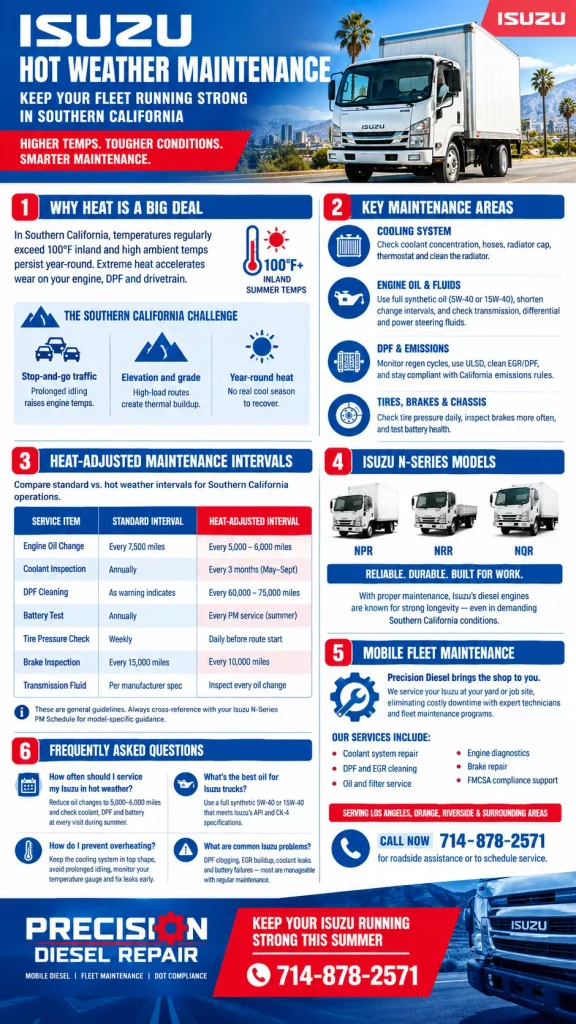
Southern California is not a single climate. Your truck might start a delivery route in coastal Long Beach at 72°F, then haul freight through Ontario or Riverside where the mercury hits 108°F before noon. This thermal variation alone stresses engine components in ways that standard factory maintenance schedules do not fully anticipate.
Isuzu’s N-Series trucks, including the popular NPR, NRR, and NQR models, use highly capable diesel engines that are well-regarded for reliability. According to a reliability overview published by MJ TruckNation, Isuzu trucks are known for strong longevity with proper maintenance adherence. The key phrase there is “proper maintenance”, and in a region like Southern California, proper means heat-adjusted, not just calendar-based.
Three specific factors make the Southern California environment particularly punishing:
- Stop-and-go traffic: Los Angeles County routes push engines into prolonged idling, where cooling airflow drops and engine temps rise without the benefit of highway speeds.
- Elevation and grade: Routes through the Inland Empire toward the Cajon Pass or through mountain corridors demand sustained high-load output, which generates serious thermal buildup.
- Year-round heat: Unlike northern states, Southern California trucks do not get a genuine “cool season” to recover. Heat stress accumulates over 12 months, not just a summer window.
Fleet managers who read the articles published by Precision Diesel regularly find practical insights on managing these exact regional conditions.
Cooling System Maintenance: Your Most Important Priority
If you take nothing else from this article, take this: your cooling system is the single most critical system to monitor during hot weather operations. A failed radiator, degraded coolant, or a cracked hose can take a running engine from normal temperature to catastrophic overheat in under 20 minutes.
Here is what your cooling system inspection should cover before and during hot-weather season:
- Coolant concentration: Isuzu recommends a 50/50 mix of antifreeze and distilled water, which provides a boil-over protection point around 265°F. In extreme heat, verify this ratio with a refractometer.
- Radiator cap condition: A cap that does not hold correct pressure (typically 13-16 PSI on Isuzu N-Series models) allows coolant to boil off prematurely.
- Hoses and clamps: Heat cycling causes rubber to harden and crack. Squeeze-test every coolant hose for brittleness.
- Radiator core: Debris, bugs, and road grime block airflow through the fins. A clogged radiator cannot shed heat efficiently.
- Thermostat function: A stuck-open thermostat causes slow warm-up; a stuck-closed one causes rapid overheat. Both should be tested.
If a radiator replacement does become necessary, understanding the semi truck radiator replacement cost ahead of time helps you budget properly and avoid being caught off-guard by a repair quote.
The Isuzu N-Series PM Schedule for 2026 published by Heavy Vehicle Inspection outlines the manufacturer-recommended preventive maintenance intervals, which serve as a solid baseline, though severe-duty conditions in Southern California typically warrant tightened intervals beyond those defaults.
Oil, Transmission Fluid, and Heat-Related Fluid Degradation
Engine oil does two jobs: it lubricates moving parts and carries heat away from critical surfaces. In extreme heat, conventional and even some synthetic-blend oils lose viscosity faster, meaning they become thinner and provide less of a protective film between metal surfaces. For Isuzu diesel engines operating in Southern California summers, this is a real operational risk.
Recommended fluid practices for hot weather:
- Switch to a full synthetic oil rated for high-temperature diesel applications. A 5W-40 or 15W-40 full synthetic provides better viscosity stability across the heat ranges your engine will see.
- Reduce oil change intervals during sustained hot-weather or heavy-load operations. If your schedule calls for every 7,500 miles under normal conditions, consider dropping to 5,000 to 6,000 miles during peak summer months.
- Check transmission fluid and differential fluid more frequently. These fluids also degrade faster under heat stress and are often overlooked in standard PM schedules.
- Inspect power steering fluid levels and condition. Extreme heat can cause seals to soften, leading to small leaks that go unnoticed until they become serious.
For operators managing a full fleet, staying current on these fluid checks at scale is where the importance of semi truck fleet maintenance becomes financially significant. Deferred maintenance on multiple units compounds quickly.
DPF and Emissions System Care in High-Heat Conditions
Modern Isuzu diesel trucks are equipped with Diesel Particulate Filters (DPF) as part of their emissions control systems. These systems work harder in high-heat, high-load conditions because the engine produces more soot under sustained stress. When the DPF clogs faster than active regen cycles can clear it, you face forced regeneration events, reduced power, and eventually costly manual cleaning or filter replacement.
Dealer anecdotal data cited by Heavy Vehicle Inspection (2026) suggests that trucks operating in severe-duty conditions without adjusted intervals are two to three times more likely to need a premature DPF service or turbocharger repair. This is consistent with what Southern California fleet operators experience on high-demand summer routes.
Practical DPF and emissions tips for hot weather:
- Monitor your dashboard DPF warning lights closely and allow active regen cycles to complete fully rather than interrupting them.
- Use ultra-low sulfur diesel (ULSD) from reputable fueling stations; contaminated or degraded fuel accelerates DPF clogging.
- Schedule EGR and DPF cleaning as part of your regular hot-weather service, not just when a warning light appears.
- Ensure your truck meets current standards for california truck emissions compliance, as CARB regulations continue to evolve in 2026.
Tires, Brakes, and Chassis Systems Under Summer Heat
Heat does not stop at the engine bay. Your tires, brakes, and chassis components are equally vulnerable to elevated temperatures, especially during heavy-load operations.
Tires: Heat causes air inside tires to expand. Check tire pressure every morning before routes begin, as pressures that were correct at dawn can be dangerously high by midday on a hot Southern California road. Under-inflation is dangerous; so is the pressure spike from over-inflated tires in heat.
Brakes: Brake fade occurs when brake components overheat during repeated heavy stops, a real concern on grades like those near the runaway truck ramp southern california locations in the region. Inspect brake lining thickness and drum or rotor condition more frequently during summer months.
Battery: Southern California’s heat accelerates battery fluid evaporation and plate corrosion inside the battery casing. Test your battery’s charge and cold cranking amps at each PM service during summer.
For a broader set of preventative steps, reviewing diesel truck repair tips from experienced Southern California mechanics gives you a practical checklist that goes beyond the owner’s manual.
A Comparison: Standard vs. Heat-Adjusted Maintenance Intervals
The table below outlines how standard Isuzu maintenance intervals compare to recommended adjustments for severe-duty hot weather operations in Southern California.
| Service Item | Standard Interval | Heat-Adjusted Interval |
|---|---|---|
| Engine Oil Change | Every 7,500 miles | Every 5,000-6,000 miles |
| Coolant Inspection | Annually | Every 3 months (May-Sept) |
| DPF Cleaning | As warning indicates | Every 60,000-75,000 miles |
| Battery Test | Annually | Every PM service (summer) |
| Tire Pressure Check | Weekly | Daily before route start |
| Brake Inspection | Every 15,000 miles | Every 10,000 miles |
| Transmission Fluid | Per manufacturer spec | Inspect every oil change |
These are general guidelines. Your specific Isuzu model, payload, and route profile will influence the right intervals for your operation. Always cross-reference with the Isuzu N-Series PM Schedule for model-specific guidance.
How Precision Diesel Supports Southern California Isuzu Fleets
Precision Diesel is a mobile diesel repair and fleet maintenance provider based in El Segundo, CA, serving Los Angeles County, Orange County, Riverside County, and surrounding areas. With over 20 years of experience, the team brings the shop to your yard, eliminating the need to pull trucks off route for scheduled maintenance.
Services relevant to Isuzu hot weather maintenance include coolant system repair, DPF and EGR cleaning, oil and filter service, engine diagnostics, brake repair, and FMCSA compliance support. For fleet operators running Isuzu NPR or NRR units across the Inland Empire or coastal LA routes, having a mobile mechanic who understands Southern California’s specific heat demands is a real operational advantage.
You can reach Precision Diesel at (714) 878-2571 for roadside assistance or to schedule preventive maintenance at your location. For fleet operators managing multiple Isuzu units, ask about fleet maintenance agreements that keep all your vehicles on a documented PM schedule.
According to Isuzu’s global sustainability reporting, the brand continues investing in powertrain efficiency and emissions technology, which means the service requirements on newer models will continue to evolve. Staying current with those updates through a knowledgeable service partner protects your warranty and your investment.
Frequently Asked Questions
How often should I service my Isuzu truck in hot weather?
In hot weather, you should service your Isuzu truck more frequently than standard intervals suggest.
During Southern California summers, consider reducing your oil change interval to every 5,000 to 6,000 miles instead of 7,500. Coolant, DPF condition, and battery health should be checked at every service visit during peak heat months rather than annually. Refer to the Isuzu N-Series PM Schedule for model-specific baseline intervals, then tighten them for your operating environment.
What’s the best oil for Isuzu trucks in Florida?
A full synthetic diesel engine oil rated 5W-40 or 15W-40 provides the best protection for Isuzu trucks operating in consistently hot climates like Florida.
Full synthetic oil maintains viscosity stability at high temperatures better than conventional or synthetic-blend alternatives. It also extends the protection window slightly between changes. Confirm the oil meets Isuzu’s API and CK-4 specifications as listed in your owner’s manual before selecting a brand.
How do I prevent my Isuzu truck from overheating?
Preventing overheating starts with regular cooling system maintenance, including coolant ratio checks, radiator cleaning, and thermostat testing.
Beyond the cooling system, avoid prolonged idling in direct sun when possible, monitor your temperature gauge closely on high-load runs, and address any minor coolant leaks immediately before they become engine-damaging events. Keeping the cab’s HVAC system and the engine’s cooling circuit both in good condition reduces the overall thermal load on your truck.
What are the common problems with Isuzu vehicles?
Common issues with Isuzu diesel trucks include DPF clogging, EGR valve buildup, coolant leaks, and battery failures accelerated by heat.
Many of these problems are manageable with consistent preventive maintenance. EGR and DPF issues tend to appear earlier in trucks running short urban routes where exhaust temperatures do not get hot enough to complete passive regeneration. Coolant leaks are often first noticed through a sweet smell from the engine bay or a rising temperature gauge.
What are common Isuzu maintenance needs?
Isuzu trucks regularly require oil and filter changes, DPF cleaning, EGR service, coolant flushes, brake inspections, and tire pressure management.
According to MJ TruckNation’s truck maintenance guide, sticking closely to these service categories preserves engine longevity and keeps operating costs predictable. For Southern California fleets, adding heat-specific checks to each service visit, such as battery load testing and radiator fin inspection, covers the additional wear that the regional climate introduces.
The Bottom Line on Isuzu Hot Weather Maintenance
Isuzu hot weather maintenance is not a once-a-year concern for Southern California fleet operators, it is a year-round discipline shaped by the region’s heat, traffic, and terrain. The trucks are built to last, but only when the service schedule matches the actual operating environment rather than a generic baseline.
Review your current PM intervals against the heat-adjusted recommendations in this article, and identify which systems, whether the cooling circuit, DPF, or battery, are most overdue for attention on your specific units. Then take action before a road breakdown forces the issue.
Contact Precision Diesel at (714) 878-2571 to schedule mobile service at your yard, or visit precisiondieselca.com to learn more about fleet maintenance programs designed for Southern California operators.
Keep Your Isuzu Running Strong This Summer With Precision Diesel
Southern California’s heat does not wait for a convenient time to expose neglected maintenance, and neither does a roadside breakdown on the 91 Freeway or a mountain grade in Riverside County. If your Isuzu fleet is operating on standard service intervals without any heat-adjusted modifications, you are carrying more risk than your operation can afford.
Precision Diesel brings certified mobile diesel mechanics directly to your yard, job site, or fleet location across Los Angeles County, Orange County, Riverside County, and surrounding Southern California areas. From coolant system repairs and DPF cleaning to full preventive maintenance programs and DOT compliance support, the team handles every service your Isuzu trucks need to survive the heat. Call Precision Diesel right now at (714) 878-2571 and schedule your heat-season fleet inspection before the next breakdown costs you a full day of revenue.
What Every Southern California Fleet Operator Should Do Next for Isuzu Hot Weather Maintenance
Isuzu hot weather maintenance is not a seasonal project you complete once and forget. In a region where ambient temperatures stay elevated year-round and route demands push engines hard every single day, consistent and heat-calibrated service is the difference between a fleet that runs profitably and one that bleeds money through breakdowns, emergency repairs, and lost delivery capacity.
Review the maintenance intervals across your Isuzu units right now, compare them against the heat-adjusted recommendations covered in this article, and identify the systems most at risk given your current service history. Whether your immediate concern is a cooling system that has not been inspected since last year or a DPF that is approaching its cleaning threshold, the right move is to address it proactively. Call Precision Diesel at (714) 878-2571 to schedule mobile service at your location anywhere in Los Angeles County, Orange County, or Riverside County, and keep every Isuzu in your fleet on the road where it belongs.
