

TL;DR
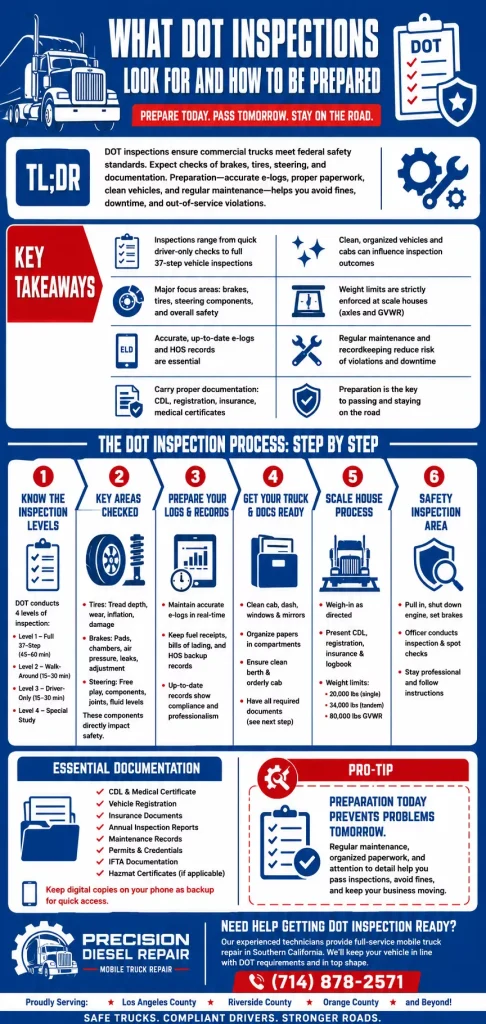
DOT inspections ensure commercial trucks meet federal safety standards and can include detailed checks of brakes, tires, steering, and documentation. Passing is largely about preparation: accurate e-logs, proper paperwork, and a clean, organized vehicle. Regular maintenance and readiness help avoid fines, downtime, and out-of-service violations.
Key Takeaways
- DOT inspections range from quick driver-only checks to full 37-step vehicle inspections
- Major focus areas include brakes, tires, steering components, and overall vehicle safety condition
- Accurate, up-to-date e-logs and HOS records are essential
- Drivers must carry proper documentation like CDL, registration, insurance, and medical certificates
- Vehicle cleanliness and organization can influence inspection outcomes
- Weight limits are strictly enforced at scale houses (axles and gross vehicle weight)
- Regular maintenance and recordkeeping reduce risk of violations and downtime
The key to a successful DOT inspection is preparation. Keep your e-logs up to date and accurate, making entries for all duty status changes in real-time. Supporting documents such as fuel receipts and bills of lading should be maintained, and HOS backup electronic records should be checked regularly. Vehicle cleanliness and organization are essential, including clean dashboards and instrument panels, with paperwork properly organized in the truck.
Understanding the Importance of DOT Inspections
As a truck driver or fleet operator, you understand how important DOT inspections are to keeping our roads safe. They ensure your truck complies with all federal safety standards and regulations—which Precision Diesel Repair takes extremely seriously. Consider the DOT inspection like a periodic health check of your truck.
Just like a doctor’s appointment will not be missed, staying on top of these inspections is good for business and safety. Failed inspection could be expensive, incurring fines and penalties, longer downtime, and affecting CSA scores, besides probable loss of business opportunities.
We know how stressful DOT inspections can be. So, we decided to put up a really detailed guide on what inspectors will look for, as well as some tips to help you get your truck ready, from the brake system all the way to tire condition, for that great passing grade. So, let’s walk through the major points that need your attention. Let’s dive into everything you need to know about acing your next DOT inspection.
Understanding DOT Inspections
A DOT inspection is a thorough examination of commercial motor vehicles to ensure compliance with the prescribed safety norms and standards. The Department of Transportation conducts various levels of inspection, from Level 1, which is a detailed full 37-step inspection, to Level 2 (Walk-Around), Level 3 (Driver-Only), and Level 4 (Special Study).
There are varying purposes for each type of inspection in the interest of road safety. A Level 1 inspection will generally take 45-60 minutes, while Level 2 and 3 inspections can be performed in 15-30 minutes. Your truck may be randomly selected for inspection at weigh stations, during a roadside stop, or as part of a scheduled compliance review.
At Precision Diesel Repair, we know these requirements inside and out. We help you keep your vehicle in line with DOT standards throughout the year, not just during inspections.
Key Areas of Focus During Inspections
DOT inspectors have definite areas they examine while conducting their inspections. For tire condition assessment, inspectors will check minimum tread depth of 4/32 inches on steering axles and 2/32 inches on all other tires, signs of irregular wear patterns, proper inflation levels, and look for any visible damage, cuts, or bulges, as well as matching tire sizes.
The brake system evaluation is another critical area. Inspectors examine brake pad thickness measurements, brake chamber push rod travel, airline condition and secure connections, air pressure readings, brake response time, absence of air leaks, and proper brake adjustment.
For steering component checks, inspectors will verify steering wheel free play (2 inches maximum on a 20-inch wheel), power steering fluid levels, steering gearbox mounting, tie rod condition, ball and socket joints, king pin wear, leaf spring integrity, and suspension system components.
These are the critical components that directly affect your vehicle’s safety. Failure in any of these inspection areas could result in an out-of-service order immediately. Regular maintenance checks at Precision Diesel can help determine possible troubles before they become inspection violations. Don’t forget to document all maintenance and repairs—inspectors appreciate well-documented maintenance. It demonstrates your commitment to both safety and compliance with the DOT.
Preparing for a DOT Inspection
A successful DOT inspection hinges on thorough preparation. Logbook compliance is essential, requiring drivers to maintain up-to-date and accurate e-logs with real-time entries for all duty status changes. Supporting documents like fuel receipts and bills of lading must be maintained, and HOS backup electronic records should be checked regularly.
Vehicle Cleanliness and Organization
Vehicle cleanliness and organization play a crucial role in inspection success. This includes maintaining a clean dashboard and instrument panels, organizing paperwork in assigned compartments, ensuring a clean sleeping berth, clear windshield and mirrors, and maintaining a neat and orderly driver’s area.
Driver Health Requirements
Drivers must maintain comprehensive health documentation, including a valid medical certificate, current commercial driver’s license, updated medical records, blood pressure documentation, and vision test results.
Essential Documentation
A complete documentation package should include vehicle registration, insurance documents, annual inspection reports, maintenance records, permits and credentials, IFTA documentation, and hazmat certificates where applicable.
Your truck’s appearance and organization reflect your professionalism and regard for safety. Many DOT inspectors believe that a clean, well-organized cab represents a driver’s attention to detail and attitude toward compliance with regulations. Maintaining digital copies of all necessary documents on your mobile phone as backup is advisable. This ensures access to required documentation even if physical copies are misplaced.
A systematic approach to the organization helps quickly present requested items during an inspection, demonstrating preparedness and professionalism. Regular self-assessments of health status and documentation help identify potential problems before they become issues during an inspection. Maintaining current medical certifications and keeping all health-related documents in an easily accessible file is crucial for inspection readiness.
What to Expect at the Scale House
When you pull into a scale house, there are certain procedures that you will have to go through to make sure everything runs smoothly. Here is what generally will occur:
Initial Weigh-In
Pull onto the scale when indicated, keeping your truck straight and centered. Wait for the green light before proceeding.
Documentation Check
You’ll need to have your CDL ready, your current registration in hand, your updated insurance documents available, and your logbook or e-log device ready for inspection.
Weight Regulations
Weight regulations are strictly enforced at scale houses. The single axle maximum is 20,000 lbs, the tandem axle maximum is 34,000 lbs, and the gross vehicle weight maximum is 80,000 lbs without permits.
Safety Inspection Area
When directed to the inspection zone, pull in carefully, turn off your engine, set your brakes, and stay in your truck until instructed otherwise. The scale house officers might perform spot checks of your load distribution and securement. They’ll verify your weights match your bill of lading and ensure compliance with bridge laws.
Remember, you have to be professional through these processes, as they can affect how well your truck gets inspected. Our mobile repair team here at Precision Diesel can help you get any issues with weight distribution fixed before you even get to the scales.
Weigh Station Inspection Insights
During a weigh station inspection, officers not only check your vehicle’s weight but also review your documentation and safety compliance to ensure you meet federal and state regulations. Passing a weigh station inspection smoothly requires proper preparation, just like any DOT inspection. Ensuring your load is correctly distributed, your logs are accurate, and your vehicle is in top condition can help avoid delays, fines, or even being taken out of service.
Chose Precision Diesel Repair
Being prepared for DOT inspections is a key part of success in the trucking industry. A well-maintained truck and organized documentation are not only going to help you pass inspections but also keep you safe on the road. You can save time, money, and stress with regular maintenance checks and staying updated with regulations during these essential evaluations.
Need help getting your truck DOT inspection ready? We’ve got your back. At Precision Diesel Repair, our experienced technicians provide full-service mobile truck repair in Southern California. We’ll keep your vehicle in line with all DOT requirements and in top shape.
Need to get your truck in tip-top shape for your next DOT inspection? Call us at (714) 878-2571 for professional mobile truck repair services in Los Angeles County, Riverside County, Orange County, and beyond.