

Maintaining a complete FMCSA compliance checklist is vital for commercial carriers seeking to reduce risk and pass safety audits. An FMCSA compliance checklist is a structured set of regulatory requirements that motor carriers, fleet managers, and truck drivers must satisfy to legally operate on U.S. roads and avoid federal enforcement action. Staying current on every item in this checklist is the single most effective way to protect your operating authority, your drivers, and your bottom line.
Key Takeaways
- Implementing a rigorous FMCSA compliance checklist helps fleet managers proactively address safety vulnerabilities, streamline recordkeeping, and maintain full operational authority.
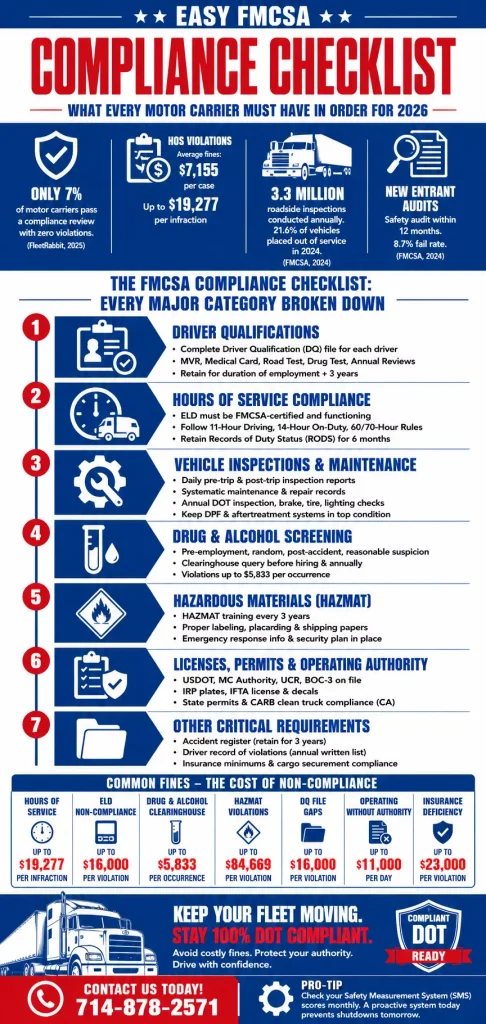
- Only 7% of motor carriers pass an FMCSA compliance review without a single violation, meaning the odds are heavily stacked against carriers who treat compliance as an afterthought (FleetRabbit, 2025).
- Hours of Service violations carry penalties averaging $7,155 per case and up to $19,277 per infraction, making HOS one of the most financially dangerous compliance gaps.
- FMCSA and state partners conduct roughly 3.3 million roadside inspections annually, with about 21.6% of vehicles placed out of service in 2024 (FMCSA Safety Research Forum, 2024).
- The Drug and Alcohol Clearinghouse is now one of the most enforcement-intensive areas of FMCSA oversight, with violations costing up to $5,833 per occurrence.
- New entrant carriers face a safety audit within 12 months of receiving operating authority, with an 8.7% fail rate that can trigger an immediate operations shutdown.
- California operators face additional state-level emission and compliance requirements on top of federal rules, including clean truck standards that can ground a vehicle on the spot.
What DOT and FMCSA Compliance Actually Means for Your Fleet
The Federal Motor Carrier Safety Administration (FMCSA) is the federal agency within the U.S. Department of Transportation (DOT) that sets and enforces safety standards for commercial motor vehicles (CMVs) operating in interstate commerce. DOT compliance is the broader umbrella; FMCSA compliance is the specific regulatory framework that applies to trucking operations, covering everything from driver qualifications to vehicle maintenance records. Implementing a rigorous FMCSA compliance checklist helps fleet managers proactively address safety vulnerabilities, streamline recordkeeping, and maintain full operational authority.
If your operation involves a vehicle with a gross vehicle weight rating (GVWR) over 10,001 lbs., transports 9 or more passengers for compensation, or hauls hazardous materials in federally defined quantities, you fall under FMCSA jurisdiction. Operating without meeting these standards is not a gray area. The agency issued over 62,000 violations across 865 different violation codes through mid-2025 alone (FreightWaves, January 2026). Fleet managers rely on an FMCSA compliance checklist to align daily operations with federal standards and prevent unexpected violations.
For operators in Southern California, compliance is compounded by state-level emission standards enforced by the California Air Resources Board (CARB). If you’ve ever failed a clean truck check, you already know how quickly a non-compliant vehicle can become a liability.
What a DOT Audit Looks Like and When You Can Expect One
A DOT audit, formally called a Compliance Review (CR), is an in-depth examination of your motor carrier records, systems, and safety performance. FMCSA and state partners conducted approximately 12,300 compliance reviews out of roughly 800,000 active motor carriers in 2024, representing just 1.5% of active carriers (FMCSA 2024 Safety Research Forum). That sounds like a low probability, but the triggers that bring an auditor to your door are more common than most fleet managers realize.
Common triggers for a compliance review include:
- A poor SafeStat or Safety Measurement System (SMS) score
- A fatal or serious-injury crash involving one of your vehicles
- A complaint filed by a driver, shipper, or competitor
- High out-of-service rates from roadside inspections
- Being flagged as a new entrant carrier within your first 18 months of operation
New entrant carriers face a safety audit within 12 months of receiving operating authority. According to the FMCSA 2024 Safety Research Forum, new entrant safety audits showed a 91.3% pass rate and an 8.7% fail rate as of 2023. Failing results in a “Failure to Comply” notice and can trigger an immediate revocation of operating authority if corrective action is not taken within 45 days.
Beyond compliance reviews, FMCSA also conducts focused audits targeting specific violation categories such as HAZMAT, safety fitness, and security. Each audit type has its own documentation requirements, which is why building your compliance system around a thorough FMCSA compliance checklist is not optional, it is essential infrastructure.
The FMCSA Compliance Checklist: Every Major Category Broken Down
Driver Qualifications: The Foundation You Cannot Skip
Every commercial driver must have a current and complete Driver Qualification (DQ) file on record. This file must be maintained for the duration of employment plus three years and must include:
- A completed FMCSA application for employment
- Motor Vehicle Record (MVR) from each state where the driver held a license in the past three years
- Medical Examiner’s Certificate (valid DOT physical, renewed every two years or as directed)
- Road test certificate or equivalent
- Annual review of the driver’s MVR
- Certificate of violations (annual)
- Pre-employment drug test results
Missing or expired documents in a DQ file are among the most common violations found during compliance reviews. For a comprehensive breakdown of what to include, you can review informational articles that provide additional guidance on compliance topics.
Hours of Service Compliance: Where the Biggest Fines Live
Hours of Service (HOS) regulations govern how many hours a commercial driver may operate within a given period. The penalty exposure here is severe. According to FleetRabbit (2025), HOS violations carry average fines of $7,155 per case, with individual infractions reaching $19,277. For a small fleet, a single audit could be financially devastating.
Your HOS compliance checklist should verify:
- ELD (Electronic Logging Device) is FMCSA-certified and functioning
- Drivers are taking required 30-minute breaks after 8 cumulative hours
- 11-hour driving limit and 14-hour on-duty window are being respected
- 60/70-hour weekly limits are tracked and enforced
- Records of Duty Status (RODS) are retained for six months
The ELD mandate applies to nearly all CMV drivers required to maintain a Record of Duty Status. Paper logs are only permitted in narrow exemption categories. If your electronic data log system goes down during a trip, your driver must be able to produce a written log and report the malfunction within 24 hours.
Vehicle Inspections and Maintenance: Keeping Your SMS Score Clean
Roughly 3.3 million roadside inspections are conducted annually, and in 2024, about 21.6% of vehicles inspected were placed out of service (FMCSA Safety Research Forum, 2024). That out-of-service rate directly impacts your SMS score, which FMCSA uses to prioritize carriers for future audits. Incorporating equipment audits into your FMCSA compliance checklist ensures proper documentation and prevents costly roadside failure.
Your vehicle maintenance checklist must include:
- Pre-trip and post-trip inspection reports filed daily
- Systematic maintenance schedule documented for each vehicle
- Repair records retained for one year after the repair date and six months after the vehicle leaves your fleet
- Annual DOT inspection certificate on file
- Brake, tire, lighting, and coupling system checks documented
For fleets operating in California, aftertreatment systems deserve special attention. Issues like semi truck dpf problems can cause an immediate out-of-service order at a roadside inspection, and a clogged or malfunctioning aftertreatment system diesel truck can also trigger a violation under California’s clean truck standards. Staying ahead of DPF maintenance is not just about emissions compliance, it is about keeping your vehicles on the road and out of the out-of-service column.
Drug and Alcohol Screening: The Clearinghouse Has Changed Everything
The FMCSA Drug and Alcohol Clearinghouse, launched in January 2020, fundamentally changed how drug and alcohol testing compliance is enforced. Employers must now query the Clearinghouse before hiring any new CDL driver and conduct annual queries for all current CDL drivers.
Key program requirements:
- Pre-employment drug test (urinalysis, DOT-compliant lab)
- Random testing program: minimum 50% of drivers for drugs, 10% for alcohol annually
- Post-accident testing within defined time windows (within 32 hours for drugs, 8 hours for alcohol)
- Reasonable suspicion testing documented by a trained supervisor
- Return-to-duty testing after any violation with a Substance Abuse Professional (SAP) evaluation
Clearinghouse violations now cost up to $5,833 per occurrence (FMCSA enforcement data, 2024-2025). An employer who hires a driver with an unresolved drug violation without conducting a full Clearinghouse query faces direct liability. The FMCSA Drug and Alcohol Clearinghouse is where all required queries must be conducted.
Hazardous Materials Regulations: The Most Complex Compliance Category
HAZMAT compliance sits at the intersection of FMCSA, the Pipeline and Hazardous Materials Safety Administration (PHMSA), and in some cases, the Environmental Protection Agency (EPA). It is also where compliance audits get most expensive, most quickly.
Your HAZMAT compliance requirements include:
- HAZMAT training for all employees who handle, transport, or prepare shipping documents for hazardous materials (recertification required every three years)
- Proper classification, labeling, marking, and placarding of all HAZMAT shipments
- Shipping papers completed accurately and accessible to the driver during transport
- Emergency response information in the cab
- Security plan for Tier I and Tier II shipments
If your operation carries any HAZMAT, your FMCSA compliance checklist needs a dedicated HAZMAT section reviewed against 49 CFR Parts 171-180. Incomplete HAZMAT documentation is one of the leading causes of unsatisfactory compliance review ratings. For authoritative HAZMAT shipping requirements, the PHMSA regulations page is the primary federal reference.
Licenses, Permits, and Operating Authority
Operating authority is the legal right to transport goods or passengers in interstate commerce. Every carrier must have:
- A valid USDOT number registered with FMCSA
- Operating authority (MC number) if you are a for-hire carrier
- Current Unified Carrier Registration (UCR) – renewed annually
- BOC-3 filing (process agent designation) on file
- International Registration Plan (IRP) apportionment plates if crossing state lines
- International Fuel Tax Agreement (IFTA) license and decals
- Applicable state-specific permits for oversize/overweight loads
California operators face an additional layer of state permit and registration requirements, including CARB compliance certifications. If your vehicles are subject to emission standards under the Advanced Clean Fleets rule, understanding what is the california diesel engine ban and its effects is critical context for your licensing and fleet planning decisions. California’s requirements extend well beyond federal minimums, and non-compliance can cost you your ability to operate in the state entirely.
For more background on what a clean truck check entails under California’s enforcement program, the clean truck check page explains the inspection process and what inspectors look for.
Other Requirements That Frequently Get Overlooked
- Accident register: Must be maintained for three years and include details of any accident involving a CMV.
- Driver record of violations: Each driver must provide a written list of violations annually. Blank or missing forms are still violations if the driver actually had none, the form must say “no violations” in writing.
- Insurance minimums: $750,000 for non-HAZMAT general freight; $1,000,000 to $5,000,000 for HAZMAT or passenger carriers.
- Cargo securement: Based on FMCSA’s cargo securement rules in 49 CFR Part 393, with specific requirements by cargo type.
The FMCSA Compliance Checklist reference from FleetRabbit includes a downloadable breakdown of these categories that fleet managers can cross-reference with their own internal records.
Common Fines and the Real Cost of Non-Compliance
The financial stakes of a failed compliance review are significant. According to FleetRabbit (2025), only 7% of motor carriers pass a compliance review without any violations, while 93% face fines averaging $7,155 per case.
| Violation Category | Maximum Penalty Per Violation |
|---|---|
| Hours of Service | Up to $19,277 per infraction |
| ELD Non-Compliance | Up to $16,000 per violation |
| Drug and Alcohol Clearinghouse | Up to $5,833 per occurrence |
| HAZMAT Violations | Up to $84,669 per violation |
| Driver Qualification File Gaps | Up to $16,000 per violation |
| Operating Without Authority | Up to $11,000 per day |
| Insurance Deficiency | Up to $23,000 per violation |
These are not hypothetical numbers. FMCSA’s enforcement posture has become more aggressive since the introduction of the Clearinghouse and the expansion of the SMS scoring model. Carriers who treat compliance as a one-time checkbox exercise rather than an ongoing system are the ones who show up in enforcement data. Utilizing an FMCSA compliance checklist minimizes financial liability by helping carriers identify recordkeeping errors before auditors do.
For additional implementation guidance on building a compliance-ready recordkeeping system, the DOT Compliance Checklist from OxMaint and the FMCSA compliance resource from Infinit-I are both practical references for fleet managers building internal programs.
Things to Know
- Your SMS score is publicly visible at FMCSA’s Safety Measurement System, meaning shippers and brokers can check it before awarding you freight.
- A single “Unsatisfactory” safety rating can result in FMCSA issuing an order prohibiting your operations within 45-60 days if not corrected or addressed by submitting a formal safety rating upgrade request.
- Checking your Safety Measurement System (SMS) scores at least once a month is highly recommended. The FMCSA updates these scores regularly (typically around the second week of the month) based on recent roadside inspection and crash data.
- The FMCSA provides a free, interactive tool called the Motor Carrier Safety Planner, which allows you to customize and save regulations, forms, and compliance guidance specific to your exact operations.
FAQ
What are FMCSA compliance requirements?
FMCSA compliance requirements are the federal safety regulations (FMCSRs) that govern commercial motor vehicles (CMVs) in interstate commerce. They establish mandatory minimum safety standards across multiple operational areas, including driver qualifications, Hours of Service (HOS) limits, drug and alcohol testing protocols, systematic vehicle maintenance, and hazardous materials transportation.
Is there a PDF version of the DOT compliance checklist available?
The FMCSA does not publish a single, universal “DOT compliance checklist” PDF because regulations vary based on the size and scope of your fleet. Instead, the agency offers an online “Compliance Questionnaire” and a robust Forms Library through their Motor Carrier Safety Planner. These official tools allow fleet managers to evaluate internal policies and print out templates tailored to their specific operational needs.
How do I check my DOT compliance?
You can review your company’s safety records and compliance standing through two primary FMCSA databases:
- The SAFER System: The Safety and Fitness Electronic Records system provides a free “Company Snapshot” containing your overall safety rating, crash data, and out-of-service summary.
- Safety Measurement System (SMS): By logging into the SMS portal with your USDOT number and PIN, you can view your detailed compliance scores across the seven BASIC (Behavior Analysis and Safety Improvement Categories) metrics.
Where can I find the FMCSA compliance Manual?
The official FMCSA compliance manual is titled the Motor Carrier Safety Planner. It is a free, interactive online guide maintained by the FMCSA to help operators understand and apply the Federal Motor Carrier Safety Regulations found in Title 49 of the U.S. Code of Federal Regulations. You can access it directly on the FMCSA’s official website.
The Bottom Line
Treating FMCSA compliance as an ongoing, systematic practice rather than a reactive scramble before a DOT audit is the only way to protect your business over the long haul. Whether you are actively managing Hours of Service limits, keeping up with Drug and Alcohol Clearinghouse queries, or ensuring your vehicles meet strict state-level clean truck standards, a proactive approach minimizes out-of-service disruptions and shields you from catastrophic fines.
By adopting a comprehensive DOT compliance checklist tailored to your fleet’s specific operations, you lock in your operating authority, protect your safety ratings, and keep your drivers on the road safely and legally. Don’t let a missed inspection ground your fleet, Contact Precision Diesel Today at 714-878-2571 to ensure your vehicles are road-ready and 100% DOT compliant.
