

Checking diesel engine oil quality comes down to evaluating color, texture, viscosity, and smell on a clean dipstick pull. Catching degraded or contaminated oil early can prevent catastrophic engine damage and save you thousands of dollars in repair costs.
Key Takeaways
- Dark black oil is not always bad, but milky, grayish, or gritty oil signals serious problems that need immediate attention.
- Diesel oil degrades faster than gasoline engine oil due to higher combustion pressures and soot load, so more frequent checks are essential.
- Coolant contamination is one of the most destructive conditions you can miss during a routine inspection.
- Viscosity changes, not just color, reveal whether your oil is still protecting critical engine components.
- Fleet operators in Southern California face unique challenges from stop-and-go traffic, heat, and high mileage that accelerate oil breakdown.
- A five-minute oil check at every fuel stop can extend engine life by tens of thousands of miles.
Why Diesel Engine Oil Degrades Faster Than You Think
Diesel engines operate under extreme conditions. The combustion pressures inside a diesel cylinder can exceed 2,000 psi, compared to roughly 800 psi in a gasoline engine. That pressure forces byproducts, including soot, sulfur compounds, and partially burned fuel, directly into the oil. According to the American Petroleum Institute, diesel engine oils must meet far stricter performance standards than conventional motor oils precisely because of this harsh environment.
What this means practically is that oil in a diesel engine becomes loaded with contaminants much faster. The oil’s additives, which include detergents, anti-wear agents, and dispersants, get depleted through use. Once those additives are spent, the base oil degrades quickly. For fleet operators running long hauls across Southern California freeways or urban delivery routes through Los Angeles, this degradation cycle is a constant operational concern.
The API’s engine oil categories for diesel are updated regularly as engine technology evolves. Knowing which specification your engine requires is the starting point for any meaningful oil quality check. Running the wrong viscosity grade or oil spec can accelerate wear even when the oil looks clean.
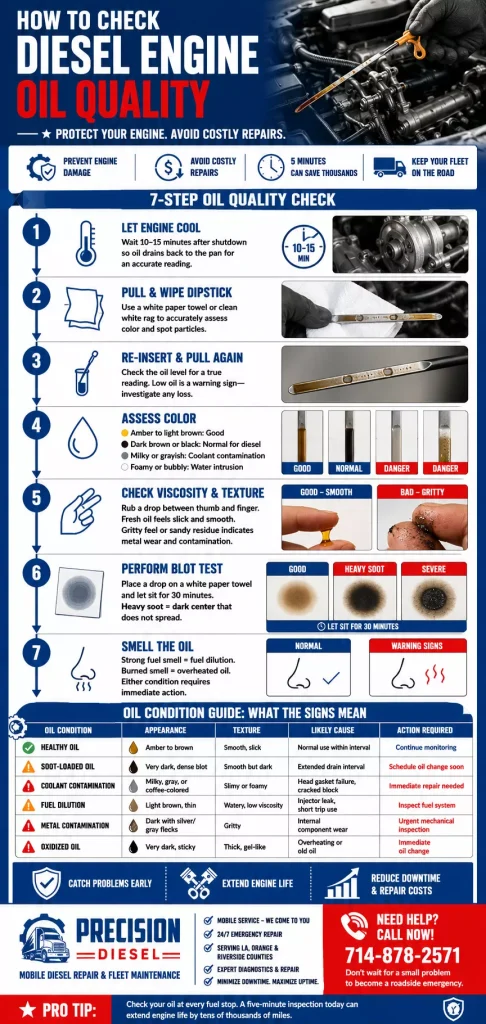
How to Check Diesel Engine Oil Quality Step by Step
Learning how to check diesel engine oil quality is a hands-on process. It takes about five minutes but requires attention to detail. Here is a reliable process to follow every time.
Step 1: Let the engine cool slightly Do not check oil immediately after shutting down a hot engine. Wait 10 to 15 minutes so oil drains back into the pan and gives you an accurate reading on the dipstick.
Step 2: Pull the dipstick and wipe it clean Use a white paper towel or a clean white rag. This is important. A white background lets you accurately assess color changes and spot particles.
Step 3: Re-insert and pull again for a true reading Check the oil level first. Low oil is itself a warning sign, as healthy engines should not be burning or leaking oil at an abnormal rate.
Step 4: Assess color
- Amber to light brown: Fresh or relatively new oil in good condition.
- Dark brown or black: Normal for diesel engines, which run darker than gasoline engines due to soot. Not automatically a cause for concern.
- Milky or grayish: Serious warning. This indicates coolant contamination, possibly from a blown head gasket or a cracked block.
- Foamy or bubbly: Water intrusion or coolant mixing with oil.
Step 5: Check viscosity and texture Rub a drop of oil between your thumb and index finger. Fresh oil feels slick and smooth. Degraded oil will feel gritty or may leave a dark, sandy residue. Grit suggests metal particles from internal wear.
Step 6: Perform a blot test Place a drop of oil on a white paper towel and let it spread for 30 minutes. A clean oil will spread with a relatively uniform light ring. Heavy soot loading will show a dark, dense center that does not spread. Excessive soot load means the oil’s dispersant additives are overwhelmed and oil change time is overdue.
Step 7: Smell the oil A strong fuel smell in the oil indicates fuel dilution, which reduces the oil’s lubrication ability. A burned smell suggests the oil is severely overheated. Either condition warrants immediate action.
Comparing Oil Conditions: What the Signs Mean
| Oil Condition | Appearance | Texture | Likely Cause | Action Required |
| Healthy oil | Amber to brown | Smooth, slick | Normal use within interval | Continue monitoring |
| Soot-loaded oil | Very dark, dense blot | Smooth but dark | Extended drain interval | Schedule oil change soon |
| Coolant contamination | Milky, gray, or coffee-colored | Slimy or foamy | Head gasket failure, cracked block | Immediate repair needed |
| Fuel dilution | Light brown, thin | Watery, low viscosity | Injector leak, short trip use | Inspect fuel system |
| Metal contamination | Dark with silver/gray flecks | Gritty | Internal component wear | Urgent mechanical inspection |
| Oxidized oil | Very dark, sticky | Thick, gel-like | Overheating or old oil | Immediate oil change |
This table gives you a quick reference during any field inspection. For fleet managers running multiple vehicles, keeping this framework consistent across your drivers can catch problems before they escalate into engine replacements costing $15,000 to $40,000 or more.
Oil Quality Checks for Specific Diesel Engines
Different diesel platforms have their own quirks when it comes to oil degradation. If you operate a Duramax-powered pickup or work truck in California, you may already know that these engines have specific oil consumption and contamination patterns. For a closer look at platform-specific diesel troubleshooting, the resource on duramax diesel trouble find the best mobile mechanic in southern california covers common failure points that often show up as oil quality problems first.
For semi trucks and Class 8 vehicles, the oil volume is much larger (20 to 50 quarts versus 6 to 10 in light trucks), but the same inspection principles apply. The semi truck repair guide california outlines maintenance intervals and service considerations that directly affect how often oil quality should be assessed on commercial vehicles operating in California.
Heavy-duty diesel engines from Cummins, Detroit Diesel, and Paccar often use oil analysis programs alongside visual inspections. Blackstone Laboratories, a well-known oil analysis lab in the United States, offers mail-in testing that measures viscosity, metal content, and additive depletion at a molecular level. For high-value engines, this lab analysis is worth doing every second or third oil change.
Oil Quality and Diesel Engine Health: The Bigger Picture
Understanding how to check diesel engine oil quality is not just about changing oil on time. It is about using oil condition as a diagnostic window into engine health. The National Institute for Automotive Service Excellence (ASE) emphasizes that skilled technicians use fluid analysis as a core diagnostic tool, not just a maintenance checkbox.
For fleet operators in Southern California, the combination of high ambient temperatures, stop-and-go urban traffic in LA and Orange County, and long interstate hauls creates a perfect storm for accelerated oil degradation. Operators who skip regular oil quality assessments often discover engine damage at the worst possible time, which is while the truck is loaded and on the road.
The resources available through Precision Diesel’s articles section cover a range of maintenance topics that complement routine oil inspections. Building a habit around these checks pairs well with professional fleet maintenance services.
Precision Diesel, which provides mobile diesel repair southern california across Los Angeles County, Orange County, and Riverside County, sees firsthand how neglected oil quality leads to injector failures, bearing damage, and complete engine seizures. Their mobile technicians carry diagnostic tools and can perform on-site oil analysis during scheduled fleet maintenance visits, which eliminates the need to bring vehicles into a shop.
Things to Know
- Diesel oil turning black quickly does not mean it is bad. Diesel engines are designed to put soot into the oil as a dispersant function. Black color alone is not a change trigger.
- The blot test (also called the patch test or RULER test in field diagnostics) is one of the most underused tools in fleet maintenance. It costs nothing and takes 30 minutes.
- Coolant-in-oil contamination can destroy bearings within hours if the vehicle continues to operate. It is the oil finding that demands the most urgent response.
- California’s high diesel use and emissions regulations under the California Air Resources Board create unique engine stress patterns, particularly for trucks with diesel particulate filters (DPFs), which can cause oil dilution from regeneration cycles.
- Mixing two different oil viscosity grades is not harmful in an emergency but should not become standard practice. Inconsistent viscosity affects film strength.
- The standard oil drain interval for heavy-duty diesels in the U.S. ranges from 15,000 to 50,000 miles depending on the engine, duty cycle, and oil specification. Always follow OEM guidelines.
Ready to Protect Your Diesel Engine Starting Today?
The single most actionable step you can take right now is to pull your dipstick at your next fuel stop and run through the seven-step check described above. If you identify any of the red flags outlined in the comparison table, do not delay getting a professional assessment.
Precision Diesel offers semi truck repair and preventative maintenance services across Southern California. Their mobile fleet maintenance teams come directly to your yard or job site, which means zero downtime from shop drop-offs. For emergency situations where your truck is already stranded, their heavy duty mobile truck repair in southern california service covers the region 24/7. Call them directly at (714) 878-2571 to request service.
Frequently Asked Questions
Q: How often should I check diesel engine oil quality between oil changes?
A visual oil check should be done at every fuel stop or at minimum every 1,000 miles for commercial diesel vehicles.
This is especially important during the first 5,000 miles after an oil change when contamination issues from component wear or coolant leaks are most likely to become apparent. For fleets running multiple shifts, daily pre-trip inspections should always include a dipstick check.
Q: Is black diesel engine oil always a sign that it needs to be changed?
No, black oil in a diesel engine is normal and does not automatically mean the oil has failed.
Diesel combustion produces soot, and the oil’s dispersants are designed to hold that soot in suspension and carry it to the filter. The blot test is a more reliable indicator than color alone. If the soot is so heavy that the blot barely spreads, an oil change is overdue.
Q: What does milky or gray diesel oil mean?
Milky or gray oil is almost always a sign of coolant mixing with engine oil, which is a serious mechanical problem.
This typically indicates a blown head gasket, a cracked cylinder head, or a failed EGR cooler. Operating the engine with coolant-contaminated oil will rapidly destroy rod and main bearings. The vehicle should be taken out of service immediately.
Q: Can diesel engines have oil diluted by fuel, and how do I detect it?
Yes, fuel dilution is a real risk in diesel engines, particularly those with high-pressure common rail injection systems that develop injector leaks.
The most noticeable sign is oil that smells strongly of diesel fuel and appears thinner than normal on the dipstick. The oil level may also appear higher than expected if significant fuel has entered the crankcase. A professional diagnosis of the injection system is needed to correct the root cause.
Q: What tools do professional diesel mechanics use to assess oil quality beyond a visual check?
Professional technicians use oil analysis kits, viscometers, and spectrographic lab testing to quantify contamination levels that visual inspections cannot detect.
These tests measure parts per million of metals like iron, copper, and chromium, which indicate specific component wear patterns. For high-mileage commercial fleets, scheduled oil analysis through labs like Blackstone Laboratories provides actionable data that prevents unplanned engine failures.
The Bottom Line on How to Check Diesel Engine Oil Quality
Knowing how to check diesel engine oil quality is a practical skill that pays for itself every time it catches a contamination problem before it becomes a catastrophic failure. The steps are simple, the tools are free, and the information you get from a clean dipstick and a blot test can guide maintenance decisions that protect a $150,000 engine asset.
For Southern California fleet operators and owner-operators who need professional support, Precision Diesel’s mobile service model eliminates the barriers that typically delay maintenance. Their team serves Los Angeles County, Orange County, Riverside County, and surrounding areas with full-service mobile diagnostics and repair. The next time your oil check raises a red flag, do not wait for the check engine light. Call (714) 878-2571 and get a qualified mobile diesel technician on-site before a small problem turns into a roadside emergency.